
India’s defense space ecosystem suffers from a fundamental structural deficit: the absence of an integrated force design and demand signalling apparatus. No amount of satellite procurement can fix this. While the October 2024 approval of the ₹26,968 crore (~$3.2B) SBS-III program for 52 military satellites and the September 2025 release of India’s first Joint Military Space Doctrine represent inflection points, they are procurement events layered atop an institutional architecture that lacks the analytical engine, standards framework, and predictable acquisition rhythm necessary to stay relevant in this era where “space is a war fighting domain”. India operates roughly 26 military/dual-use satellites against China’s 245+, with satellite revisit rates over the LAC of once every 36–48 hours versus China’s 7–8 daily passes. Closing this gap requires not just hardware but a fundamentally different institutional approach to generating, communicating, and executing defense space requirements.
While not comparable from a scale perspective, The US Space Force’s demand signalling framework is built on similar bulwarks of democracy, and even optimistic capitalism that India hopes to emulate. The Space Force (USSF) signalling rests on a deliberate institutional separation between analysis, requirements, and acquisition - a design principle India has not yet adopted. SWAC (Space Warfighting Analysis Center), activated in April 2021 at Peterson Space Force Base, conducts force design analysis using Model-Based Systems Engineering (MBSE) across capability areas including multi-domain sensing, spectrum warfare, and PNT. Its output is an authoritative force design guidance that flows to Space Systems Command (SSC) and the Space Development Agency (SDA) for execution. SWAC does not build or buy anything; it determines what the force needs and why.
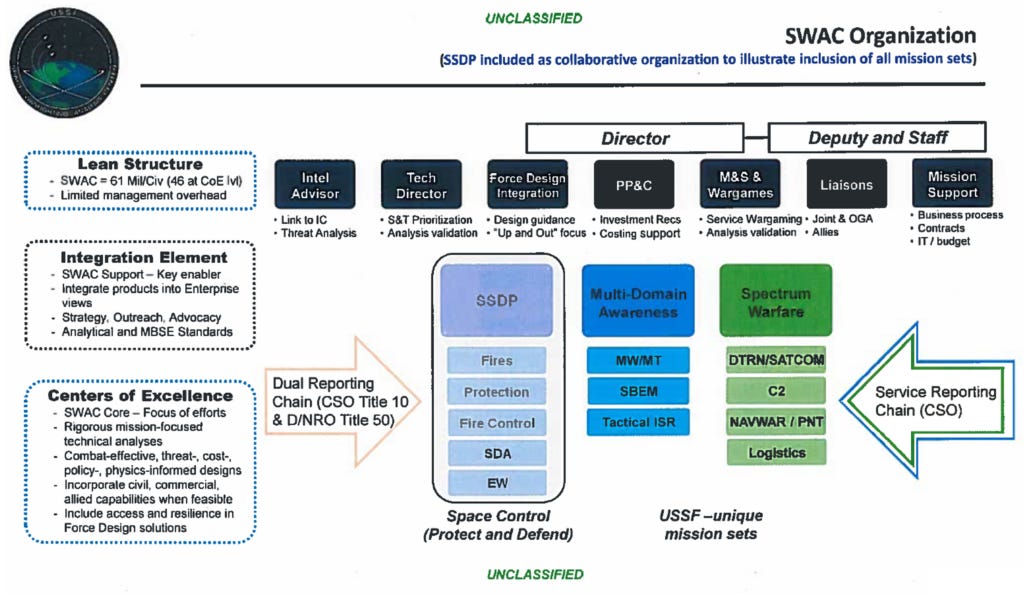
SDA translates this guidance into hardware through a predictable two-year tranche cycle that functions as the most powerful demand signal in the (global) space industry. Each tranche in SDA’s Proliferated Warfighter Space Architecture (PWSA) provides industry with multi-year visibility: Tranche 0 (28 satellites, on orbit), Tranche 1 (158 satellites, launching through 2027), Tranche 2 (~300+ satellites, contracts awarded), and Tranche 3 ($3.5B in tracking layer contracts awarded December 2025). SDA’s published five-year budget projections total $25.5 billion through FY2029, and its “trains leave on time” philosophy means technology not ready for one tranche can ride the next. Former SDA Deputy Director Brian Turner stated: “One of the things I always wished for when I was in industry was a schedule from the government that I can truly count on.”
Three enabling mechanisms make this system function beyond organizational structure. First, publicly available interface standards: the OCT (Optical Communications Terminal) standard at Version 4.0 and the NEBULA networking standard at Version 3.05 - allow companies to invest ahead of solicitations with confidence that their products will interoperate. Second, multiple contracting vehicles including Other Transaction Authority agreements, the HALO pool (19 non-traditional companies selected October 2024), and the STEC Broad Agency Announcement create continuous on-ramps for new entrants. Third, SpaceWERX ($457–470M annual budget, 1,470+ contracts since 2021) provides a direct SBIR-to-operational pipeline. Five companies have already transitioned from SBIR research directly into the HALO pool for PWSA integration.
Nestor Levin’s article detailed how the US Space Force's SWAC-SDA framework functions as industrial policy by using systems engineering, force design, and predictable demand signalling to transform military requirements into a catalytic force for the commercial space sector. Reading it raised an unavoidable question in my mind: can the Indian defense space ecosystem - built on fragmented agencies and episodic procurement - ever generate comparable industrial momentum?
India’s defense space ecosystem distributes authority across three organizations: the Indian Space Research Organisation (ISRO), the Defence Research and Development Organisation (DRDO), and the Defence Space Agency (DSA) - without a unifying analytical or architectural authority above them. ISRO builds satellites, DRDO develops specialized payloads and platform integrations, and DSA operates the end products, but no entity performs the force design analysis that would determine what a constellation should look like, how many satellites are needed, in what orbits, with what capabilities, and on what timeline for what effects.
The Defence Space Agency, operationalized in November 2019 in Bengaluru, remains a tri-service agency under the Integrated Defence Staff led by a two-star Air Vice Marshal - not a full command. It absorbed the Defence Imagery Processing and Analysis Centre (DIPAC) in Delhi and the Defence Satellite Control Centre (DSCC) in Bhopal, giving it operational control over military satellite imagery and operations. But DSA’s most critical institutional gap is structural: it has no representation on the Space Commission, India’s apex space decision-making body. The Commission added the National Security Advisor after 2020 reforms, but DSA and IDS remain excluded. This means the military’s space requirements compete for attention through indirect channels rather than having a direct voice in national space architecture decisions.
Requirements generation follows a fragmented, service-driven process. The Navy generated the requirement for GSAT-7, the Army for GSAT-7B (approved March 2023, ₹2,963 crore), and the Air Force for GSAT-7C (₹2,236 crore). Each satellite is procured individually through the Defence Acquisition Council rather than as part of an integrated constellation architecture. The SBS-III program breaks this pattern partially with its 52 satellites that span surveillance and communications across LEO, MEO, and GEO, supervised jointly by the National Security Council Secretariat and DSA - but it was approved as a single mega-project rather than through a repeatable, tranche-based acquisition rhythm.
The December 2024 Department of Military Affairs transition plan to strengthen DSA with increased manpower, ground infrastructure, and space assets acknowledged these limitations. While the plan and the September 2025 Joint Military Space Doctrine provide doctrinal framing, neither created a dedicated analytical center for space force design like SWAC. India has the doctrine without the analysis engine to operationalize it.
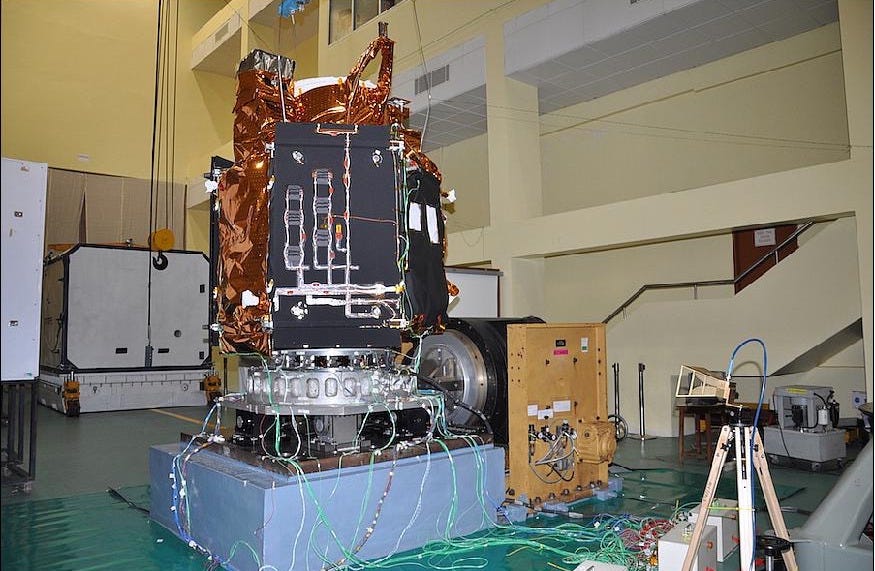
India’s defense space inventory reveals specific vulnerabilities that an integrated force design process would systematically address. The military communication satellite fleet: GSAT-7s for the Navy, Army and Air Force - provide service-specific communications but lacks the mesh networking and cross-domain data transport for joint and network-centric operations.
NavIC faces an existential reliability crisis. A July 2025 RTI disclosure revealed that five IRNSS satellites are completely defunct due to rubidium atomic clock failures (originally sourced from Israel), with only two satellites fully functional out of seven required for robust positioning. NVS-02, launched in January 2025 with indigenous atomic clocks, suffered an engine failure and is stranded in a sub-optimal orbit. This leaves India’s independent navigation system operating at or below minimum capability - a severe vulnerability given NavIC’s integration into precision-guided munitions including Astra missiles, Rudram anti-radiation missiles, and Nirbhay cruise missiles. By comparison, China’s BeiDou-3 operates 55 satellites with global coverage, and Pakistan has had access to BeiDou military-grade signals since 2018.
Space situational awareness through Project NETRA (sanctioned 2019, ₹400 crore initial outlay) has a stated goal of detecting objects as small as 10 cm in LEO within a 3,400 km range, using the MOTR radar at Sriharikota, optical telescopes at Ponmudi, Mount Abu, and Leh, and a phased-array radar under construction at Chandrapur, Assam. But even when realized, India cannot perform continuous 24-hour in-orbit tracking as of 2025. The US Space Surveillance Network tracks over 47,000 objects with a network of sensors and space-based assets. Digantara’s SCOT satellite and its planned 15-satellite constellation represent a private-sector augmentation, but the gap remains orders of magnitude.
The reconnaissance picture is similarly constrained. India’s Cartosat and RISAT series provide high-resolution optical (down to 25cm from Cartosat-3) and SAR imagery (35cm resolution from RISAT-2BR1), but the revisit rate over priority areas like the LAC is once every 36–48 hours. During Operation SINDOOR in May 2025, India had to supplement with commercial foreign imagery even after combining all civilian and military space assets. This validated the urgency of SBS-III but also exposed the absence of a pre-existing architecture designed for operational tempo.
India’s closest approximations to defense space demand signalling are Mission DefSpace (75 challenges launched October 2022 under iDEX) and the SBS-III procurement, which function as discrete programs rather than a continuous, standards-driven industrial engagement framework. Mission DefSpace issued challenges across five categories (launch, satellite, communication/payload, ground, and software systems) and has produced results: InspeCity won the first contract for micro-propulsion (May 2023) and Pixxel secured iDEX Prime contracts for multi-payload satellites from the Air Force. But these are individual project awards, not architecture-level demand signals.
The critical missing elements relative to the US model are structural:
No published defense space architecture or interface standards. India has no equivalent to SDA’s OCT or NEBULA standards that would allow companies to invest ahead of solicitations. The three-layered constellation plan (LEO/MEO/GEO) with encrypted links referenced in SBS-III reporting suggests architecture planning exists - but it remains classified, or worse - it is many things to many people. Without published standards, startups cannot design products for assured interoperability.
No predictable multi-year procurement rhythm. SDA’s two-year tranche cycle creates a cadence industry can plan around. India’s Technology Perspective and Capability Roadmap (TPCR) 2025, covers 15 years and mentions satellite hardening, AI-enabled tools, and quantum communications, but it is a capability wish list, not a procurement schedule. The Long-Term Integrated Perspective Plan has been described as “exercises in futility” by analysts due to poor correlation with fiscal realities. Average RFP-to-contract timelines remain around 120 weeks (~2.3 years), six times longer than MoD’s own rules (69 weeks) stipulate.
No SBIR/STTR equivalent with transition pathways. iDEX and ADITI grants (up to ₹25 crore) provide early-stage funding, and IN-SPACe’s ₹1,000 crore VC fund for space startups and the ₹500 crore Technology Adoption Fund create financial support. But there is no defined pipeline from prototype to operational deployment analogous to SpaceWERX’s SBIR → STRATFI → HALO pool pathway. Some analysts have noted that Indian startups get “trapped in repetitive trials, defensive loops, and wait-and-watch situations”.
The private sector is responding to the signal gap by seeking customers abroad. Pixxel secured a 5-year NRO contract and a NASA CSDA contract (that allows a pool of awardees to access up to $476M in awards). Digantara has split operations across India, Singapore, and the US, positioning itself to be eligible for US Space Command analytics contracts and selection for the Missile Defense Agency’s SHIELD vehicle. Indian space startups have raised $808M total (Tracxn, January 2026), but funding peaked at $130.2M in 2023 and declined 55% to $59.1M in 2024 - a pattern reflecting VC uncertainty about domestic defense procurement timelines.
India’s strategic context differs from the US in ways that should fundamentally shape its demand signalling model rather than merely replicate SWAC-SDA. Three asymmetries matter most.
First, the China capability gap demands a proliferated, resilient architecture prioritizing the IOR theater. China’s PLA Aerospace Force (reorganized April 2024 from the Strategic Support Force) controls 1,060+ satellites including 510+ ISR-capable platforms. China deployed satellite jammers along the LAC during the 2020 standoff and Pakistan received Chinese satellite intelligence during Operation SINDOOR. India’s response architecture must emphasize rapid reconstitution, distributed sensing, and theater-specific coverage of the IOR and northern borders rather than matching China satellite-for-satellite. The SBS-III program’s 31 private-sector-built satellites represent a step toward distributed manufacturing, but without a continuing tranche model, industrial capacity and will dissipate after this one-time procurement and deeper innovation will not take root.
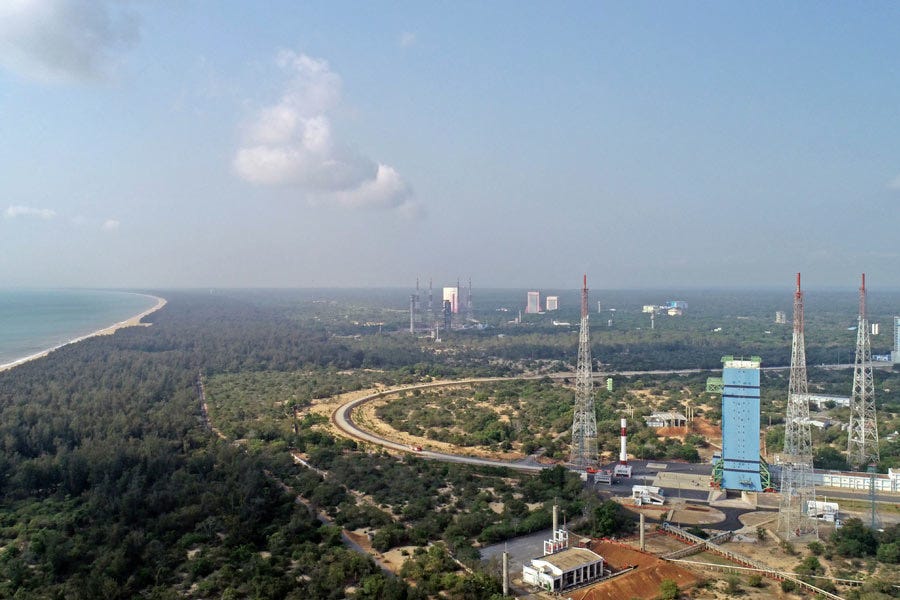
Second, India’s equatorial geography and IT workforce create exploitable asymmetric advantages. Sriharikota at 13.7°N provides substantial velocity gains for equatorial and GTO launches - yet India’s second spaceport at Kulasekarapattinam and potential sites in the Andaman and Nicobar Islands (6–14°N) remain underdeveloped. The HAL SSLV technology transfer (₹511 crore, June 2025) for rapid-assembly small satellite launches, Skyroot’s Vikram-I orbital vehicle (expected early 2026), and Agnikul’s 3D-printed engine Agnibaan could collectively deliver surge launch capacity if integrated into a responsive space architecture. Meanwhile, India’s software engineering talent pool - the same ecosystem that produces global IT services - is barely tapped for military space C2 software, AI-driven ISR analytics, and satellite network management. The IFC-IOR at Gurugram (76 linkages across 28 countries) already applies AI for maritime domain awareness; scaling this approach to space-based ISR would leverage India’s strongest comparative advantage.
Third, budget constraints require a fundamentally different cost model. India’s entire Department of Space budget for FY2025-26 was ₹13,416 crore ($1.57B) and is ₹13,705.63 crore for FY 2026–27, roughly one-third of SDA’s annual budget alone. The US Space Force operates on $29B annually; China spends an estimated $12-15B on military space. India cannot replicate the PWSA’s 300+ satellite transport layer. Instead, an Indian framework must maximize dual-use architectures, leverage commercial constellations for non-sensitive applications, and concentrate sovereign investment on irreducible military requirements: encrypted communications, precision navigation backup, and persistent ISR over specific theaters.
An effective Indian equivalent of the SWAC-SDA demand signalling model would require five institutional reforms, each achievable within existing political and budgetary constraints.
A. Establish a Defence Space Force Design Centre (DSFDC) within DSA. This would be India’s SWAC: a dedicated analytical unit performing constellation architecture analysis, threat-driven force design, and capability area assessments using modelling and simulation. It should be staffed with operations research analysts, systems engineers, and domain experts from all three services plus civilian scientists. Unlike DSA’s current operational focus, the DSFDC would be explicitly separated from satellite operations and procurement execution. Its output: architectural guidance documents specifying orbit regimes, payload requirements, constellation sizes, and interoperability standards to drive a standardized requirements process. The November 2024 Ex Antariksha Abhyas space wargame provides a foundation; efforts by some industry bodies and think tanks are also commendable - but this function needs to be institutionalized and made continuous rather than exercised annually.
B. Publish defense space interface standards and a rolling 5-year procurement plan. India should develop and openly publish standards for satellite bus interfaces, inter-satellite links, data formats, and ground segment connectivity - tuned to India’s architecture. The TPCR 2025 should be augmented with a specific space annex providing procurement timelines, capability increments, and budget projections on a rolling basis. This single action would do more for industrial base confidence than any grant program. Companies currently with satellite development capability (Pixxel, Azista Space and XDLINX among others), need architectural certainty more than subsidies.
C. Convert SBS-III from a one-time program into a spiral acquisition model. Rather than treating SBS-III’s 52 satellites as a finite project ending in 2029, India should adopt SDA’s tranche philosophy: define SBS-IV and SBS-V procurement tranches now, with specific capability increments and timeline commitments. Each tranche should maintain a ISRO-private split (or increase the private share) and use firm-fixed-price contracts to incentivize cost discipline. The “trains leave on time” principle would prevent India’s chronic procurement delays from cascading across the entire program. This investigation into the workings of the SDA should also be noted by planners to avoid the accumulation of assets without users when private industry sets the pace fueled by private capital.
D. Create a unified requirements process with DSA representation on the Space Commission. The current system where each service independently generates satellite requirements through the DAC produces stove-piped capabilities. Adding DSA and IDS to the Space Commission, or creating a parallel Defence Space Commission, would ensure military space requirements are considered alongside ISRO’s civil/commercial priorities. The requirements process should flow from DSFDC force design analysis through a joint validation process (analogous to SDA’s Warfighter Council, which meets every six months) to acquisition execution.
E. Establish a SpaceWERX-equivalent with explicit transition pathways from iDEX to operational procurement. India’s iDEX/Mission DefSpace/ADITI ecosystem provides seed and prototype funding but lacks defined transitions to scale. A dedicated Space Innovation Office under DSA should manage a pipeline from iDEX SPARK grants through prototype demonstration (using dedicated technology demonstration satellites, as SDA does with T1DES/T2DES) to production contracts. India’s 216+ space startups don’t need a larger funnel but a faster, more predictable conveyor belt from innovation to deployment.
India’s defense space ecosystem has three genuine strengths. The SBS-III program, despite being a one-time procurement, represents the largest single defense space investment in India’s history and the first to mandate significant private-sector manufacturing. The iDEX/Mission DefSpace pipeline has produced actual contracts, demonstrating that the startup ecosystem can deliver defense-relevant technology. And Operation SINDOOR, however costly the lessons, has created irreversible political consensus that space-based ISR is a national security imperative.
What’s missing is the institutional machinery that converts political will into sustained, predictable industrial activity. India has no force design analysis center, no published space architecture, no interface standards, no multi-year procurement rhythm, and no defined innovation-to-deployment pipeline. DSA remains undersized, under-ranked, and excluded from apex space governance. The civil-military boundary between ISRO and DSA creates coordination overhead that neither a civilian space policy (2023) nor a military doctrine (2025) bridges institutionally.
What’s uniquely applicable to India is the opportunity to leapfrog legacy architectures. A country building its military space constellation essentially from scratch (26 satellites scaling to 100+) can design for resilience, interoperability, and commercial integration from the outset rather than retrofitting decades-old systems. India’s concentration of software talent, its equatorial launch geography, and its network of IOR partnerships and the Quad should provide foundational assets that no amount of satellite procurement alone can substitute. The question is whether India will build the institutional architecture to exploit them systematically - or continue generating requirements satellite by satellite, doctrine by doctrine, crisis by crisis.
No posts
Comments
Nothing yet. Say the first thing.
Sign in to join the conversation.