
A lot is coming to a head at once, and most of it points the same way. The largest operator in Low Earth Orbit is consolidating from a constellation into an asset class. Starlink now flies roughly 10,000 active satellites, about two-thirds of everything operational, and in June its parent went public in the largest IPO in history. The busiest stretch of orbit now answers to a quarterly earnings call. The public goods that keep this neighborhood safe are being starved: the US civil space-traffic program has been touch-and-go on funding for two budget cycles, its FY2026 line proposed for elimination before Congress intervened. The governance layer is fragmenting too - the Outer Space Treaty consensus erodes without a successor while the US and the China-Russia bloc build rival rulebooks. And into that, India is scaling up: SBS-III’s military fleet, the EO-PPP commercial push, NavIC’s rebuild and the regulator, IN-SPACe, has already made an operator’s ability to meet Space Situational Awareness (SSA) obligations a condition for authorization. It is the right thing to do, but a mandate like this promises that a reliable, neutral source of SSA data exists to comply with. India doesn’t own one.
This article was triggered by a LinkedIn post by CelesTrak, the one-person non-profit, run by Dr. T.S. Kelso, that much of the world quietly relies on for free orbital data. They put out a warning that the US military's public element-set catalog was suffering yet another major outage: mean element age had drifted to 2.49 days (half the catalog older than 1.87 days), and 4,366 of 10,684 Starlink satellites had no match within 30 km of CelesTrak's higher-accuracy supplemental elements - a continuation of a degradation that had begun weeks earlier, on 2nd June 2026. That is the data layer most of the world flies on, stuttering in real time. So I went and read the documents that govern the new US system meant to be the safe replacement for it - the TraCSS Data and Information Policy and User Agreement and the TraCSS User Handbook v1.4.6, dated June 2026 as well as the longer record behind that one bad week.
TL;DR: None of it is reassuring.
The data CelesTrak serves are GPEs (General Perturbations Element sets, the modern name for the TLE): mean elements propagated with SGP4 and fit by the US to its Space Surveillance Network (SSN) observations. That outage is not an aberration but the visible tip of a pattern, and CelesTrak's GPE History Statistics shows it: mean element age, which should sit near a day, spikes repeatedly to two or three, and twice this year the "Lost GPEs" line has jumped above 20,000 - marking system-level interruptions in the catalog the civil world depends on. The exposed party is anyone screening collisions off the public catalog and emailed warnings rather than a private autonomy stack, which is to say most operators, and effectively all Indian ones today.
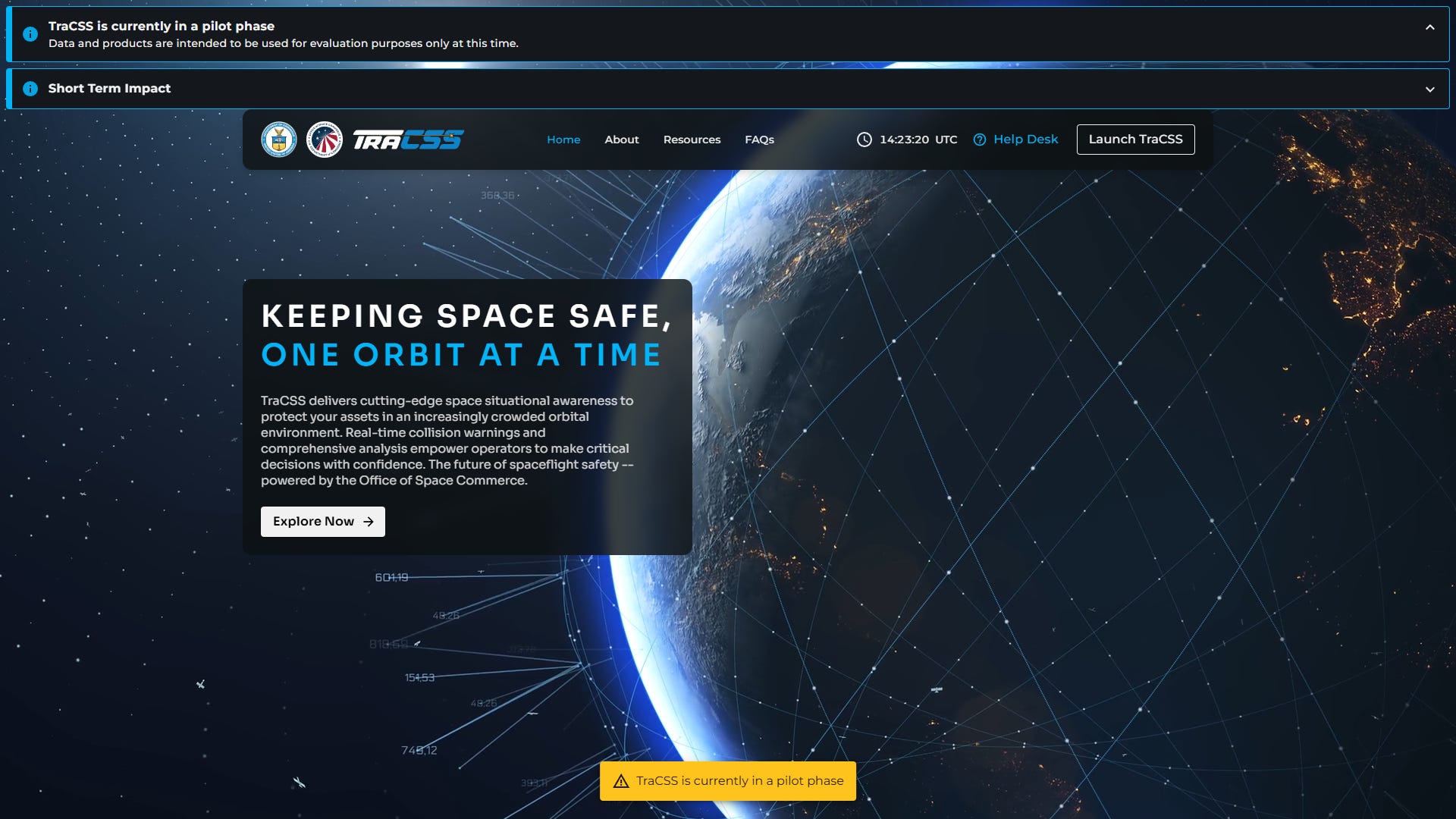
TraCSS, the Traffic Coordination System for Space, is the civil space-traffic service the US Office of Space Commerce (OSC) is standing up under Space Policy Directive-3, the 2018 Trump 1.0 era order that moved basic conjunction-assessment and safety-of-flight duties off the military and onto a civilian agency. On paper it is a real upgrade over the old space-track world: inheriting the Space Force's Mission Delta 2 astrodynamics, it screens conjunctions on special-perturbations (SP) ephemerides every four hours, runs on-demand checks in minutes, and publishes an open SP catalog and owner/operator ephemerides as CC0 data.
The limitation that matters is narrower, but is the one that should worry operators. That open SP catalog is released WITHOUT covariance, the uncertainty ellipsoid a definitive collision decision hinges on; a covariance reaches you only inside the conjunction messages TraCSS issues for your own registered spacecraft. It covers both objects, but only for a pairing the system has already flagged, never the whole catalogue you'd need to screen independently. And that narrows further exactly where it matters: when the conjuncting object is an analyst track, an uncatalogued object, or one the US has chosen to withhold, the covariance can come back too coarse to act on, or the conjunction may never be surfaced to you at all - the highest-fidelity layer stays behind the classification wall entirely. That gap is the entire commercial-SSA business model, what LeoLabs, Slingshot, Kayhan and SpaceX's Stargaze feed sell into. And per the June 2026 Handbook, TraCSS's own public open-data API (TODD) isn't even switched on yet.
And the wall is not drawn where you'd expect. In an open letter, Jim Shell - a former US Air Force Space Command scientist documents how an opaque classification regime - one even Space Force and Space Command leadership cannot reliably override - withholds object data that already sits in the US allies' public catalogs and that adversaries plainly track, and can even flag cleared US personnel if they declare it. The ceiling on what TraCSS can pass to a foreign user is set not by what is genuinely sensitive but by that classification regime, which a foreign state can neither audit nor reconstruct nor know if the feed is throttled. The gap is structural and unresolved: a product of design and dysfunction, not oversight.
None of this is hypothetical for India: the dependency is already operational. ISRO registers its satellites on space-track.org; IN-SPACe and ISTRAC workshops have directed Indian operators to do the same; and Indian assets already maneuver on conjunction messages emailed from a US military system. We are not deciding whether to rely on a non-sovereign feed; we have relied on one for years.
That habit is already law. India’s satellite-authorization proforma, Annexure-2 of the 2024 NGP, in force since May 2024 - makes a conjunction-assessment package a precondition to flying: show collision probability against catalogued objects below 0.001 or demonstrate avoidance capability, commit to regular conjunction assessment, share ephemeris with India’s Department Of Space (DOS), and certify compliance with UN debris-mitigation guidelines. One field in that form carries the whole argument: Item 18(a) asks for the “source of orbital elements of other Space Objects” - the catalog the operator runs its conjunction assessment against. For essentially every Indian operator, the honest answer is space-track.org. India has made naming a conjunction-assessment source a condition of authorization while producing no sovereign source for that field to point to!
This hard-codes dependence on a foreign service now being decommissioned in favor of TraCSS and offered, in its own User Agreement, “as-is,” “subject to the availability of appropriated funds,” and terminable “for any other reason, with no notice,” by a government whose legislature twice tried to de-fund it. The compliance obligation is real and the feed it runs on can be switched off without warning. The SSA-provider guidelines released since don’t soften this; they entrench it, explicitly exempting space-track, CelesTrak, EU SST, ESA DISCOS and ISON from authorization - so when an operator writes “space-track” into item 18(a), the regulation will wave it through. The borrowed baseline was codified first, the domestic provider-licensing scaffolding bolted on after, and still nothing sovereign sits between them. Read this paragraph again, if you don’t feel confused!
Why doesn’t India have its own baseline service? Project NETRA isn’t it: its radars and optical sites (Sriharikota, Ponmudi, Mount Abu, Leh, soon Chandrapur) are the start of a sensing capability for a slice of sky, not continuous catalog maintenance or a service an operator can comply against. IS4OM: ISRO’s System for Safe & Sustainable Operations Management, now framed as India’s TraCSS counterpart is the operational layer those sensors feed, but it screens ISRO’s own fleet on the same borrowed catalogue it would supposedly replace: this is dependency, not building a way out. Digantara and a thin field of peers are meant to be the domestic commercial layer, but progress is unconvincing, and the reason is telling: either no one in government owns the problem (ISRO guards the modalities of SSA; and the Defence Space Agency is too under-resourced for this mission), or it is unsolvable at their current scale. It is the same missing keystone behind India’s defense space gap, and Digantara’s own answer is the flight abroad I documented with Pixxel: operations split across India, Singapore and the US, chasing the demand signal where it exists. IN-SPACe has either over-estimated domestic readiness, or is quietly assuming TraCSS will be the baseline, which the US Office of Space Commerce is courting it to accept. Mandating compliance against a borrowed, terminable feed is not regulation; it is the outsourcing of regulatory sovereignty, with a domestic penalty attached.
Leaning harder on TraCSS doesn't fix India's real constraints. It doesn't touch the classification wall, and it carries a narrative cost India shouldn't bear: the US asks the world to be transparent and route coordination through its hub while its own regime withholds unclassified data and conducts operations it won't explain. That do-as-I-say posture is the one Shell's letter makes plain to everyone, adversaries included. Nor does it serve the mission that most justifies sovereign investment: characterizing China's co-orbital operations and proliferated LEO/GEO build-out, which a civil safety feed cannot touch by design.
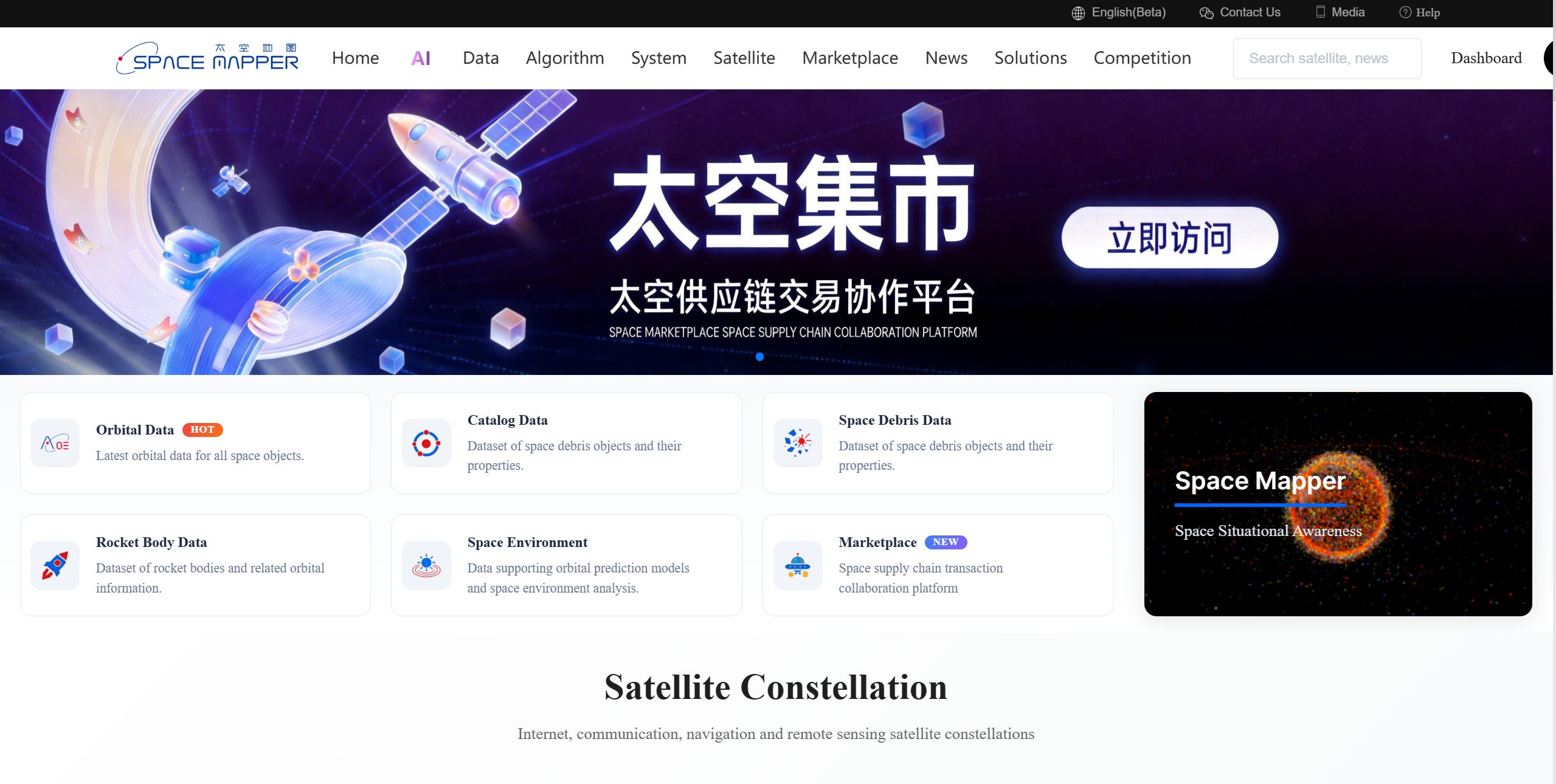
Meanwhile China is building the alternative and barely hiding it. An open-source extraction of its SpaceMapper catalog, identified by the US Air University as Beijing's equivalent of the Space Force's Unified Data Library, shows roughly 97% parity with the US public catalog and a stated goal of TLE localization by 2028. When the 3% gap closes, China can do what Washington never has, offering a free, no-strings-attached catalog to the Global South just as TraCSS wobbles on appropriations and space-track stutters. The Chinese catalog hides its own military objects too: no superpower offers a clean baseline, which is the entire argument for not renting your eyes from either.
For India-registered commercial operators: use TraCSS as augmentation through owner/operator accounts for civil, non-sensitive satellites, never as your safety net; go multi-source and keep the maneuver decision in-house; and press, through industry bodies (SIA-India, ISpA - I see you), for a domestic neutral broker so that “compliant” does not mean “dependent on a foreign agency.”
For the Indian government: do not mandate what you cannot provide. Sequence compulsory compliance in lockstep with a sovereign or neutral domestic means of meeting it, and resource that owner in layers. The civil safety baseline isn't missing on paper - IS4OM is nominally it - so the task is not to stand up a new SSA/STM cell but to turn the one that exists into a service operators can build on and answer for in the open, rather than an ISRO-internal function accountable to no one outside it. Above it, a commercial tier bought as a regulated service rather than exiled abroad, and a defense SDA layer with real authority for the threat mission. While at it, un-blur IN-SPACe, which cannot credibly regulate a mandatory market it also promotes and daresay supplies with its own SSA service.
And make the TraCSS National Government Account a deliberate decision, not a default. That option is no longer hypothetical: this month, in June 2026, OSC began onboarding “National Government Accounts,” with the UK and Australia first through the door, and such an account lets a government view safety information for every spacecraft affiliated with its country - India’s affiliated-fleet list, in effect, registered into a US-run system whose default data license is CC0 public-domain. The courtship is already at the door: OSC and ISTRAC co-hosted an India–US Joint SSA Workshop in Bengaluru on 22–23 June 2026, pairing TraCSS with IS4OM, and IN-SPACe ran an industry-outreach session on TraCSS for Indian commercial SSA providers. Engagement is sensible; enrolling the national fleet into a feed offered “as is” and terminable without notice is a sovereignty call that deserves an explicit yes or no - made with eyes open, not absorbed as a workshop deliverable. Also appreciate the asymmetric advantage in an alternate universe: a sovereign, geopolitics-free capability could make India the neutral SSA provider for the Global South, instead of a choice between an American hub and a Chinese one.
The first is close to alarm. I work in and around Indian commercial space operations, and the foundation we stand on is shaky in ways most outside this work do not see. The catalog stutters, the coordination protocols are strained relics (email, anyone?), the “authoritative” feed is neither fully authoritative nor reliably ours, and the regulatory regime now forces the whole system to rely on it.
The second is a conviction about transparency that cuts against how this domain is run. Space traffic does not respect classification: a debris cloud does not check the clearance of the satellite it shreds before it renders an orbit unusable for the victim, the object that hit it, and every uninvolved third party at that altitude. Hoarding orbital position data, by anyone, past a certain point stops being security and becomes a collective-action failure dressed up as caution - and that standard has to hold at home. India may well be the responsible actor it presents itself as: it runs conjunction assessment, flies collision-avoidance maneuvers, chairs the UN working group on the long-term sustainability of space. But there is no way to check. IS4OM’s annual Indian Space Situational Assessment Report arrives only as a release-day executive summary (haven’t been able to find the full reports yet). Responsible conduct you cannot audit is indistinguishable from a press release. And the same report quietly records the dependence this whole piece is about: to flag its maneuvers in 2024, IS4OM reviewed more than 53,000 conjunction alerts from US Space Command's CSpOC! Whatever the quality of India's conduct, trust cannot be asserted, only demonstrated, and figures based on sanitized foreign data that no one outside can check demonstrates nothing. Transparency is the precondition for being trusted.
The third is a concrete ask: I'd like to see operators, Indian operators first but anyone, put an "SSA Coordination" page on their websites. Identify your satellites (tag them to the published COSPAR ID), publish your ephemerides on your own terms, gate access if you must (an email, a UNOOSA or ITU registration number), list a point of contact another's ops team can reach at 2 AM, and flag unusual operations in advance, like a formation-flying pair or a proximity demo. None of this needs a treaty, an appropriation, or a superpower's permission. It is a bottom-up transparency norm operators can adopt immediately. Adopted widely, it builds the one thing no government feed gives today: direct, operator-to-operator visibility that no appropriation can de-fund and no classification desk can switch off. And it is the better data, not just the more sovereign. CelesTrak's SupGPEs, built from operators' own telemetry, measurably outperform the US catalog when both are checked against independent observation. So a collision-avoidance maneuver negotiated directly between two operators, each working from the other's actual ephemeris rather than an SSN-derived track, is the highest-fidelity version of that decision there is. It is not the whole answer: peer-to-peer coordination reaches only the parties who show up. Smaller constellations and single-satellite operators outside any sharing network, along with debris and uncatalogued or undeclared objects, are left to a sovereign sensor-and-catalog layer that still has to exist. But for the conjunctions it does reach, it beats what almost everyone is flying on today.
The catalog you fly on should be one you can see into, one you can fix, and one you can keep. The one India flies on is none of these, and India now requires its operators to depend on it anyway. We can do better than renting our eyes.
No posts
Comments
Nothing yet. Say the first thing.
Sign in to join the conversation.