

When the Fairfax Town Council convened a special meeting on March 6, 2024 to consider supporting a federal funding request for the Fairfax–San Anselmo Children’s Center (FSACC), one detail stood out in the official materials: Councilmember Stephanie Hellman’s name appeared on the federal funding packet as “Project Consultant.”
Hellman was absent from the vote.
But her absence did not erase the conflict created by her simultaneous role as a Fairfax elected official and a consultant for the very nonprofit seeking government support.
This article examines how the conflict arose, why it matters, and what California law says about public officials who appear on both sides of a governmental decision.
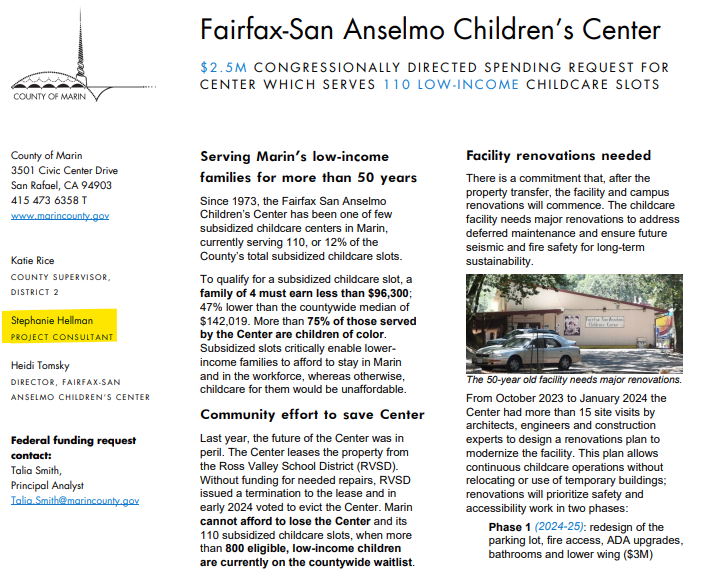
The County of Marin’s official one‑page fact sheet — attached to the Fairfax agenda — lists:
“Stephanie Hellman – Project Consultant”
Her name appears directly under County Supervisor Katie Rice and FSACC Director Heidi Tomsky.
This means:
Hellman was part of the official team preparing the federal funding request.
She was professionally involved in FSACC’s strategy to secure $2.5 million in federal appropriations.
Her consulting role was embedded in the materials the Fairfax Council was asked to endorse.
Even though she did not vote, her name was on the packet.
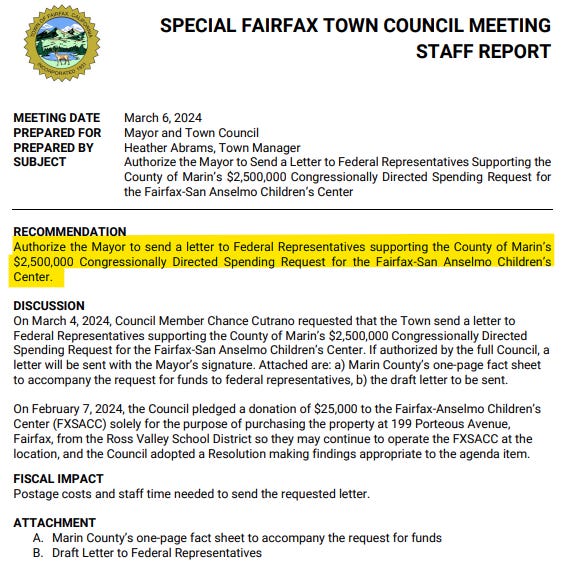
The staff report states:
“On March 4, 2024, Council Member Chance Cutrano requested that the Town send a letter…”
Town Manager Heather Abrams prepared the report, and the Mayor placed it on the agenda.
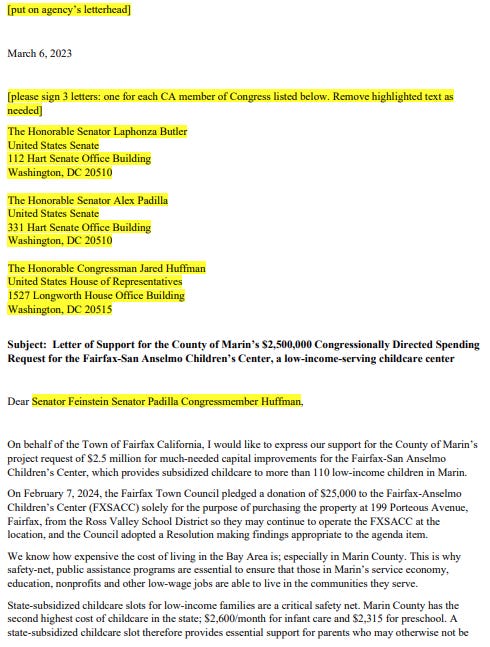
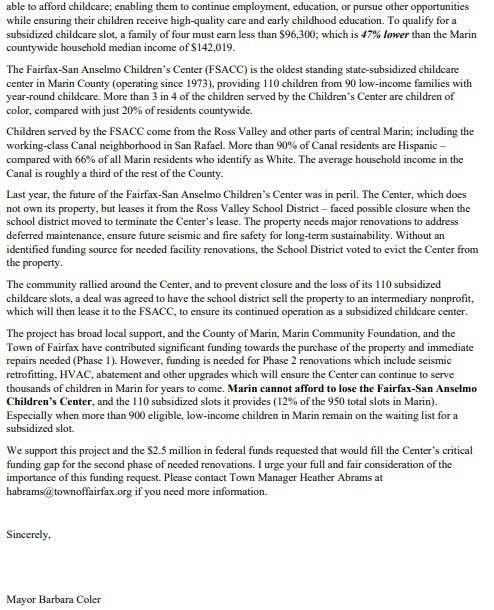
But the funding request packet itself — the attachments — came from:
Marin County
FSACC leadership
FSACC’s consulting team (including Hellman)
Thus, even though Cutrano formally requested the item, the materials presented to the Council were produced by a team that included Hellman.
Her professional involvement was already baked into the agenda item before the Council ever saw it.
A deeper look at Resource Renewal Institute’s financial disclosures reveals another layer of interconnected relationships that raise legitimate public‑interest questions. The 2021 independent audit confirms that Resource Renewal Institute (RRI) banked with Chase Bank, noting that both of RRI’s Paycheck Protection Program loans were “issued by Chase Bank” and later forgiven. This matters because former Fairfax Councilmember Chance Cutrano has served as RRI’s Director of Programs since 2018, placing him in a senior leadership role at an organization financially tied to Chase.
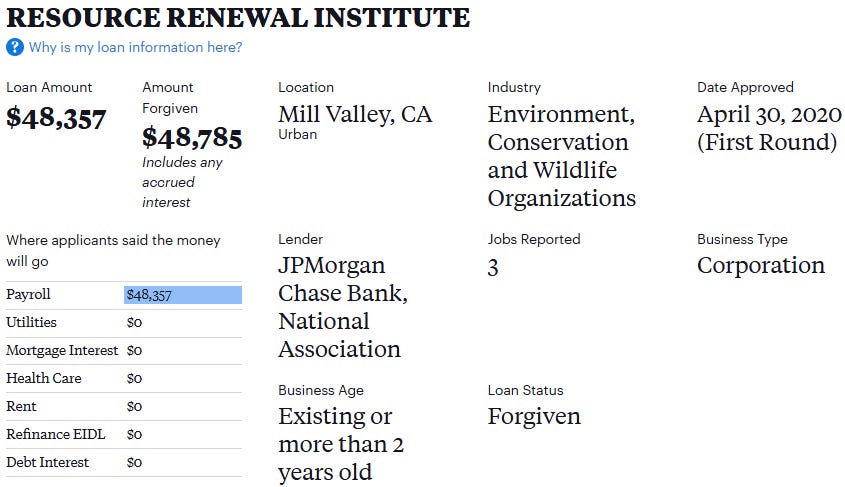
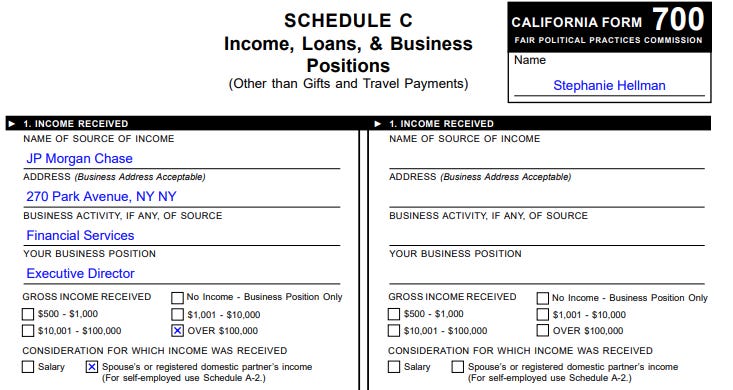
At the same time, Councilmember Stephanie Hellman’s spouse is the Executive Director of Financial Services at JPMorgan Chase, the parent company of Chase Bank. While there is no evidence of wrongdoing, the overlapping relationships — RRI banking with Chase, Cutrano’s leadership role at RRI, and Hellman’s spouse holding an executive position at Chase — create a constellation of connections that warrant public scrutiny when Fairfax officials participate in decisions involving RRI, its affiliates, or its interests.
Just one month earlier, the Fairfax Town Council pledged:
$25,000 to FSACC
“solely for the purpose of purchasing the property at 199 Porteous Avenue.”
If Hellman was consulting for FSACC at that time — and her Form 700 lists FSACC as a source of income — then she had a financial interest in a matter before her own Council.
This is a textbook conflict under California’s Political Reform Act.
Government Code §§ 87100–87103 prohibit a public official from:
making
participating in
or influencing
a governmental decision affecting a source of income.
Hellman’s Form 700 lists:
FAIRFAX SAN ANSELMO CHILDREN’S CENTER
as a source of income of $10,000 or more.
This triggers mandatory recusal from:
discussions
deliberations
advocacy
agenda involvement
influencing staff
influencing other councilmembers
participating in the project
appearing on project materials
Not just voting.
Under FPPC Regulation 18704, participation includes:
preparing documents
advising
advocating
providing information
influencing staff
influencing elected officials
being listed on project materials
being involved in the funding request
Hellman did all of these by appearing as a consultant on the federal funding packet.
Her absence from the vote does not cure the conflict.
The conflict is simple and stark:
FSACC was seeking federal funding.
Fairfax was being asked to support that request.
Hellman was a paid consultant for FSACC.
Her name appeared on the official funding packet.
She was an elected official with influence over staff and councilmembers.
She was absent for the vote — but present in the materials.
This is the definition of a dual‑role conflict.
Fairfax is a small town.
Conflicts of interest have outsized impacts.
When a councilmember:
consults for a nonprofit
appears on its federal funding request
and that request comes before her own Council
the public cannot be confident that decisions are being made impartially.
This is exactly the scenario the Political Reform Act was designed to prevent.
No posts
Comments
Nothing yet. Say the first thing.
Sign in to join the conversation.