
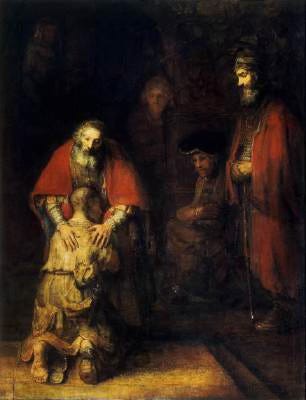
So he got up and went to his father. But while he was still a long way off, his father saw him and was filled with compassion for him; he ran to his son, threw his arms around him, and kissed him… ‘For this son of mine was dead and is alive again; he was lost and is found.’ So they began to celebrate.
Luke 15:20,24
The story of the Prodigal Son found in Luke’s gospel offers multiple perspectives from which we can draw. There is the Father’s perspective, who joyfully welcomes home his wayward son, and then there is the older brother, looking down on the whole scene in resentment. After years of self-destructive behavior, the younger son is welcomed home with open arms. Yet, the last time he saw his father, he demanded his inheritance early—an act that was essentially wishing death upon his father. Despite all this, upon the younger son’s return, the father runs out to meet him well before the son can step a foot in the door. In this reflection, I want to focus on an aspect of the father's radical acceptance that is freely given to both sons.
The father’s decision to run out to meet the younger son upends the historical and cultural norms of the time. Even today, the father’s reaction subverts our expectations. In many ways, the two sons’ reactions mirror the audience itself: the younger son struggles to reconcile his shame with the father’s forgiveness, while the oldest, so blinded by ego, cannot recognize his own radical acceptance in the father’s eyes. To the oldest son, the father says:
‘My son…you are always with me, and everything I have is yours.’
Luke 15:31
Jesus told this and many other parables after the Pharisees questioned his integrity for welcoming sinners and dining with them. For me, the truth declared in this parable was difficult to accept, as I was guilty of being the older brother. I allowed ego and self-righteousness to cast a veil over my eyes, blinding me to God’s grace. My ego told me that I earned my keep and deserved a fattened calf for myself. I couldn’t fully accept that I was already welcomed into the Father’s house, just as the other “prodigal sons” were. Nothing I did at that time in my life earned me the privilege of being there. A Franciscan priest, Richard Rohr, summarizes this tension masterfully in his book, The Universal Christ.
Faith at its essential core is accepting that you are accepted! We cannot deeply know ourselves without also knowing the One who made us, and we cannot fully accept ourselves without accepting God’s radical acceptance of every part of us.
If this quote stirs your insides, you are not alone—it did me as well. To embrace the gravity of this quote felt arrogant, egotistical, and selfish. Could I not believe God would accept me as I was, an imperfect human being—a wayward son? If faith begins with our brokenness, then whether we wander to a far-off country to squander our inheritance or stay home striving to earn our keep, we fail to see our identity in our creator. It’s as though we get stuck in Genesis 3, where Adam and Eve usurped God’s throne to make one of their own. We have forgotten that this brokenness is not how it was intended to be. In the beginning, humanity was created good—very good in fact. God chose humanity as worthy co-creators, for we are made in God’s image. Yet, when we refuse to see the truth behind the words, ‘You are always with me, and everything I have is yours,’ we fall into the same trap as both the younger and older son. It is here that we must grapple with our nakedness and shame.
He answered, “I heard you in the garden, and I was afraid because I was naked; so I hid.” And he said, “Who told you that you were naked?”
Genesis 3:10-11
Who told you that you are naked? To see ourselves as unworthy is to give into the same lies that convinced Eve to partake of the forbidden fruit. But when the Father runs out to greet us, we catch a glimpse of renewed creation—a New Eden to come.
Comments
Nothing yet. Say the first thing.
Sign in to join the conversation.