
“It takes something more than intelligence to act intelligently.” – Dostoyevsky
Being smart is one of the most elusive qualities a person can possess. Put ten strangers in an AA-style circle and ask them to define a series of human traits, and intelligence would probably be the one that kept them there until the early hours, long after they had reached some rough agreement on kindness, honesty, humour and everything else.
No single question could establish whether someone is smart, which is why professional intelligence tests rely on batteries of tasks measuring different abilities. And even then, an IQ score is not an all-encompassing account of how clever someone really is.
I always twitch when people call themselves smart and still have not entirely figured out why. Maybe I’ve always believed that certain qualities can only be conferred by other people and that claiming them for yourself somehow undermines the very premise on which they rest. But that is probably a topic for another time.
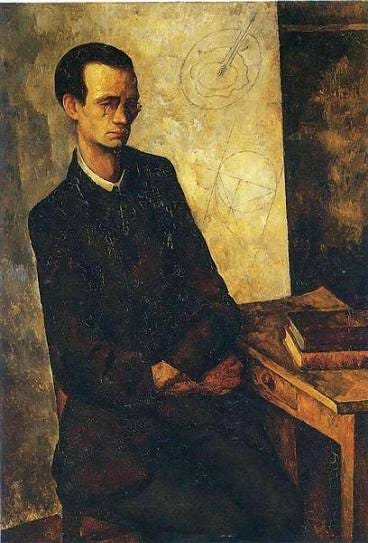
So what are we recognising when we call someone smart? The ability to understand things quickly? To know a great deal, speak fluently, make money, read people accurately, remember everything, solve math problems or make good decisions? Or, sometimes, simply their ability to agree with you in an articulate way?
There are a few topics I have carried with me everywhere since first becoming aware of them. The quality of being smart has been the subject of many of my musings, evaluations and even fears. In a strange way, intelligence is a little like beauty: it has a peak, or rather a series of them. Raw processing speed peaks around 18 or 19, while working memory and fluid reasoning tend to peak later, between the mid-twenties and early thirties. Of course, you can keep becoming better read, wiser and more incisive, and therefore differently intelligent. But unlike kindness, some of the faculties for which clever people are first praised do not deepen with age.
There have been a few times when someone has called me clever and somehow uncoupled a train of 38 mental carriages, each carrying evidence to the contrary: everything I do not know, every concept I have struggled to grasp (like infinity, fax machines and the concept of time), every brilliant argument that arrived in the shower a week after the fight, every time I failed to express myself eloquently, stuttered or contradicted myself.
Every person I have ever paid sustained attention to has undergone a forensic analysis in my head that they certainly never consented to. I have weighed their quick wit against their lack of scientific understanding, their uncanny ability to navigate a new city against their inability to read a room, their lack of instinct in one setting against their eerie knack for saying exactly the right thing in another. Then I have assigned them a score that is not remotely numerical and placed them somewhere on another abstract scale. In some people, one form of intelligence eclipses everything else, in others, a single blind spot seems to undermine the rest.
A century of trying to quantify cleverness
The modern measurement of intelligence began with an attempt to turn differences between minds into data. In the late nineteenth century, Francis Galton measured reaction times in the hope that mental superiority would reveal itself through faster perception. It did not, but his larger premise survived: cognitive differences could be measured. Binet soon redirected the field towards reasoning, abstraction and judgment, laying the foundations of the intelligence tests we recognise today.
Spearman then observed that people who performed well on one cognitive task tended to perform well on others, a pattern known as the positive manifold. From this he proposed g, or general intelligence: a broad mental capacity contributing to performance across many different tasks.
Later researchers argued that one general factor concealed too much variation. Cattell distinguished fluid intelligence, the ability to solve unfamiliar problems, from crystallised intelligence, the knowledge gained through education and experience.
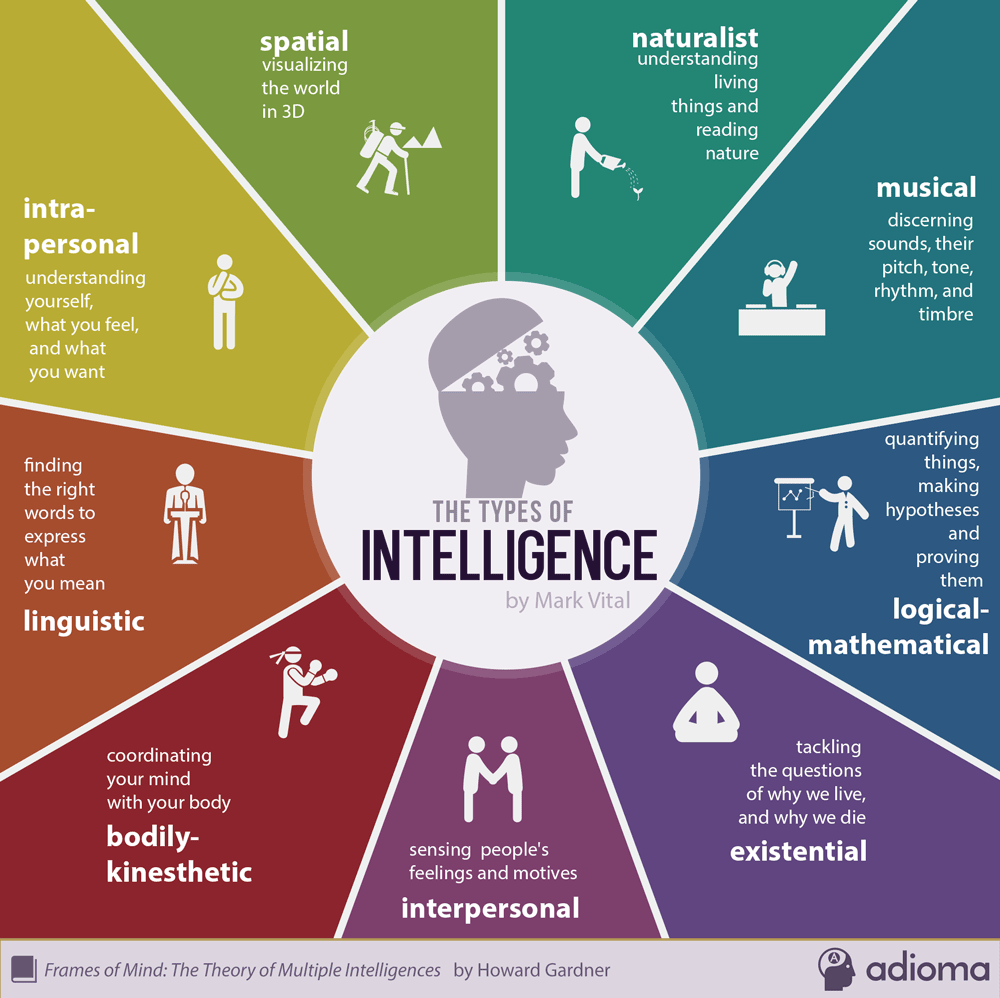
Other theorists widened the definition further. Gardner proposed multiple intelligences, including linguistic, musical, spatial, interpersonal and bodily-kinaesthetic ability. His theory became enormously influential in education and popular culture because it gave formal recognition to capacities conventional IQ tests had treated as peripheral, although evidence that they operate as independent intelligences remains limited. Sternberg distinguished analytical, creative and practical intelligence, while Salovey and Mayer developed emotional intelligence.
Where we stand today
Psychology has not ultimately chosen between one intelligence and many. The prevailing view is that intelligence contains both a general capacity and a range of more specific abilities.
The main framework used to describe this is the Cattell-Horn-Carroll model, usually shortened to CHC. In its most common hierarchical form, CHC places narrow skills such as memory span at the bottom, broader abilities such as fluid reasoning, processing speed and visual processing above them, and general intelligence, or g, at the top.
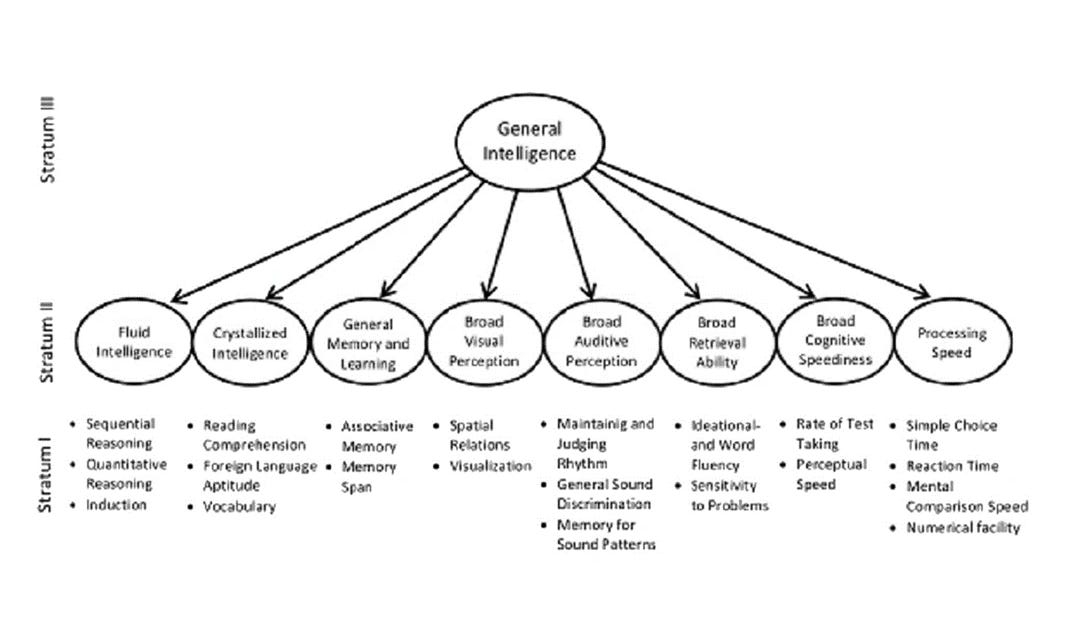
People can therefore arrive at similar levels of overall cognitive ability through very different combinations of strengths. Someone may excel verbally but perform less strongly in spatial reasoning. Another may think quickly yet have limited working memory.
Intelligence is best understood not as one single faculty or a collection of unrelated talents, but as a hierarchy of connected abilities. Narrow skills feed into broader capacities, which in turn tend to rise and fall together. My entirely unlicensed intelligence assessments were therefore not completely misguided – specific strengths and weaknesses do seem to combine to form a broader picture of cognitive ability.
What a score cannot tell us
But even if intelligence tests measure cognitive ability somewhat accurately, what does that ability amount to outside the testing room?

Some of the people I have placed highest on my abstract scale have also made decisions baffling enough to threaten their intelligence badge altogether. They can grasp difficult ideas and argue with precision, yet repeatedly misunderstand their own lives. Possessing intelligence and acting intelligently are evidently not the same thing.
Naval Ravikant has suggested that intelligence is ultimately tested by whether we get what we want out of life. It is perhaps a little too neat, since luck and circumstance do influence the course of our lives, but it points towards something no cognitive test can capture: whether a person can direct their abilities towards a life they actually meant to create.
A test can measure the power of a mind, but it cannot tell us whether it’s being steered well or in the right direction.
The limits of a powerful mind
We tend to assume that intelligence makes a person difficult to deceive, including by themselves. Surely a sharp mind should detect faulty logic, resist manipulation and notice when it has wandered into error.
One of the more humbling findings in psychology concerns the bias blind spot, our tendency to recognise cognitive biases readily in other people while remaining remarkably poor at detecting them in ourselves. Greater cognitive sophistication does not appear to eliminate this blind spot. In fact, in one study, people with higher cognitive ability showed a slightly greater tendency to believe that bias afflicted other minds more than their own.* Being good at thinking, it turns out, does not necessarily make you good at noticing the forces distorting your thinking.
What makes this more unsettling is that intelligence is not only an unreliable defence against error, but also one of its most effective accomplices. In The Intelligence Trap, David Robson argues that intelligence gives us greater cognitive power without guaranteeing that we will use it honestly. A clever mind can examine its assumptions, but it can also defend them, gathering better evidence, finding neater explanations and constructing a far more persuasive case for whatever pride, desire or identity already wants to believe. Expertise creates its own danger too. Being right repeatedly in one domain can make us forget that competence has borders. A smart brain can therefore become a better lawyer without becoming a better judge.
There is a perfect illustration of this in The Best Offer, one of the greatest films of all time and, from this sentence onwards, a spoiled one. Virgil Oldman makes a living distinguishing the authentic from the fraudulent. He sees details others overlook, recognises value beneath appearances and has organised his identity around being almost impossible to deceive. Yet the moment love becomes the object under examination, his expertise abandons him. He can authenticate a painting but not an emotion. The blind spot is created not by an absence of intelligence, but by his faith that intelligence acquired in one domain must travel intact into another.
The verdict on intelligence
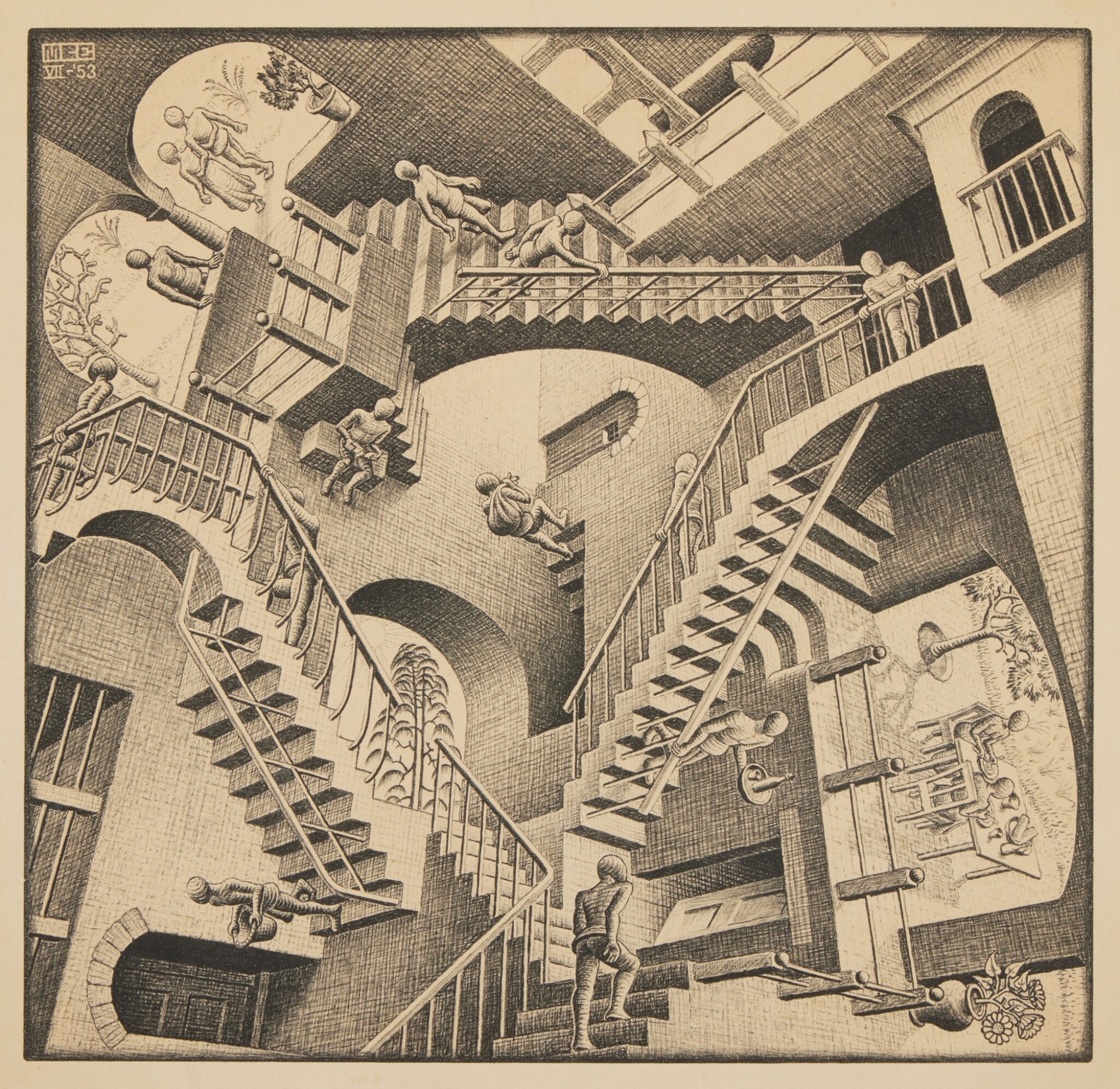
There are, of course, entire arguments this essay has left untouched: how much intelligence is inherited, how much of it can be developed, how accurately tests capture it across cultures and what happens to it as we age. Following every branch would have turned this into a 30-page document and possibly required the ten strangers from the opening to reconvene.
Intelligence, it seems, is neither one indivisible gift nor an endless collection of unrelated qualities. It is a recognisable whole assembled from many abilities, which is why one person can be verbally brilliant and spatially ordinary, emotionally perceptive and mathematically hopeless, sharp in one room and strangely blind in another.
Language functions as an effective mirror of that. You can be funny or hilarious, but there seem to be about 30 different ways to be smart. One friend may be incisive, sharp and bright. Another may be wise, cunning and witty. Both land on the same flattering adjective, though the equation behind it is entirely different. CHC describes that variation, but what it cannot tell us is whether the person possessing those abilities knows what to do with them.
So whether or not you are the kind of person who calls yourself smart, it may be worth asking where your intelligence has clarified reality and where it has merely furnished your preferred version of it. Where have you acted as the judge, and where have you been the lawyer building a better defence for the verdict your ego had already reached?
Intelligence remains elusive, made up of narrow skills and broader abilities, difficult to pin down and even harder to distill into a single verdict. In the end, perhaps Naval’s simple answer is truly the only one that matters: “The only real test of intelligence is if you get what you want out of life.”
For more on the ingenious ways the ego protects its preferred version of events, read my essay on the unreliable nature of memory.
subscribe to in plain sight to see your own life more clearly and live it more deliberately. free subscribers get the essays. paid subscribers get the deeper layer: reflections, prompts, and ways to turn insight into action.
enjoy 20% off forever with this special offer. 💌
* West, R. F., Meserve, R. J., & Stanovich, K. E. (2012). “Cognitive sophistication does not attenuate the bias blind spot.” Journal of Personality and Social Psychology,
No posts
Comments
Nothing yet. Say the first thing.
Sign in to join the conversation.