
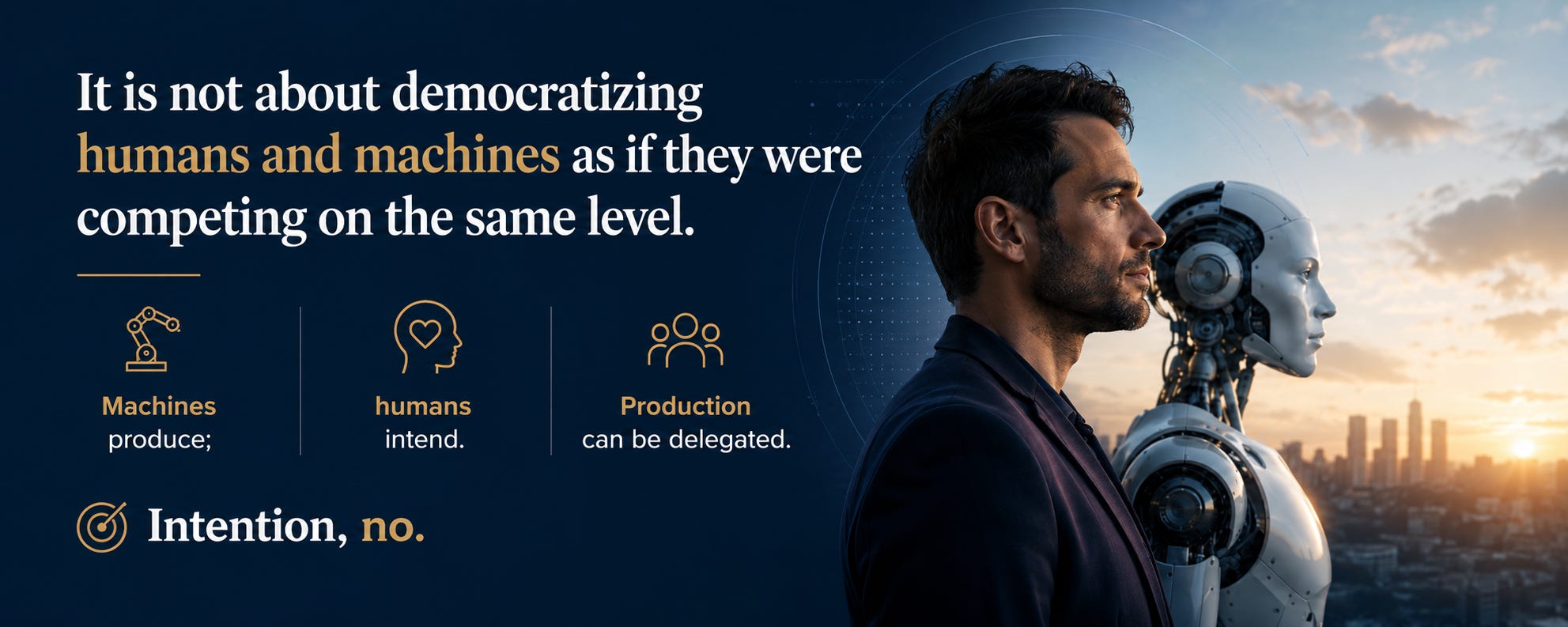
It is not about democratizing humans and machines as if they were competing on the same level. Machines produce; humans intend. Production can be delegated. Intention cannot.
Here is my humble opinion these days: I find myself reflecting every time I go to a store and see that machines have replaced supermarket cashiers, the people who serve coffee, the people at clothing store checkouts, and even those at gas stations.
They did not replace us with machines; they turned us into unpaid workers in the process. That is where the phrase “redistribution of labor” appears, and it was sold as autonomy.
Technological democratization makes little sense in an era where automation does not mean replacing what is human. It is worth analyzing that the problem is not automation itself, but the distinction between levels of responsibility.
The central issue is not whether machines should be treated as human equivalents. It is the current idea that all human tasks can be replaced by a machine. In parallel are the decisions of consumers who have accepted doing unpaid work because it was sold as autonomy.
They sell us more efficiently what machines do because they automate efficiency.
Organizations love automating efficiency, and what they actually do is redistribute operational workload. They measure how much extra work a human will tolerate before resisting. Automation should reduce product costs because it lowers infrastructure costs, but you rarely see that reflected in the bill.
There are people who are very clear that they will not pay to do certain things, even if they are few. Logically, complex tasks are not as marketable as microtasks. There are jobs that require real skill: you cannot tell a patient, “perform your own surgery,” because the value of the service is precisely that expertise.
There are jobs that remain human. In my case, perhaps many will agree, I would not dare put my head into a machine to cut my hair, no matter how efficient it may be, because I trust a human more to do it.
Now, an important nuance: whether it is convenient to delegate tasks to machines.
One paradox is that many restaurants are hiring humans again to wash dishes instead of using dishwashers because the electricity bill is more expensive from an energy standpoint. This is not a task they would ever sell to you as autonomy; the customer might resist. It is an uncomfortable task; precisely, you go to a restaurant so you do not have to do anything in the process.
But there are variations: there are already robots replacing waiters, as long as it is sold as innovation. Not every business model is fit to embrace innovation, or the type of consumer simply does not want it.
Furniture companies where you take home cheaper pieces made from machine-molded wooden parts and assemble them yourself have displaced the carpenters who used to make them for you with detail and care. This was not purely a technological leap; it was a well-sold business model that offered a cheaper product and made you part of the production process.
All that glitters is not gold. The “do-it-yourself” business they sell you has its downsides in terms of quality. For example, in customer experience, there is a reason why self-assembly furniture will never be as elegant, durable, or high-quality as what carpenters make, and likewise why coffee prepared by a machine will never equal the taste of that made by a professional barista.
The boundaries are not defined by technology; they are defined by how we act as humans. The key factor is the elasticity of our tolerance. The scope of modern automation does not seek to eliminate work, but to change who performs it and the quality of the result.
Today: Will machines take our jobs?
With every technological leap, the same ancestral fear is reactivated. First came industrial machines. Then computers. After that, the internet. Now artificial intelligence. History seems to repeat itself with an obsessive question: will they replace us?
The fear that AI will replace human jobs is no different from the fear provoked by earlier technological innovations such as mechanics. The answer, once again, lies in the redistribution of tasks. With AI, part of cognitive work is transferred to the user through prompting.
A good result depends on the prompt and must be well specified. This result empowers you when it multiplies your capabilities, but not when it turns you into an unpaid operator. You become an unpaid operator when a company uses AI to make you absorb work while capturing the savings and profits.
And I explain how it works: it is not that the designer’s work disappears; it is that you become the designer. It is not that AI displaces the artist or the musician; it is that you become a digital creator. The dynamic used to be: “I need a logo, and the designer interprets the needs and materializes them with creativity.” Now AI executes, but the cognitive direction comes from you.
Now we have become cognitive coordinators, but a cognitive coordinator does not replace an expert.
Theater of competition
The expert remains necessary where judgment is required. How do you know what AI has generated? How do you know whether the design or model is good? AI can generate something visually beautiful but conceptually weak. AI can produce large quantities of digital outputs, but it needs human judgment, selection, and coherence. To the end, the human remains the one who determines what is valid.
¡Gracias por leer O Substack de Adela! Suscríbete gratis para recibir nuevos posts y apoyar mi trabajo.
Comments
Nothing yet. Say the first thing.
Sign in to join the conversation.