
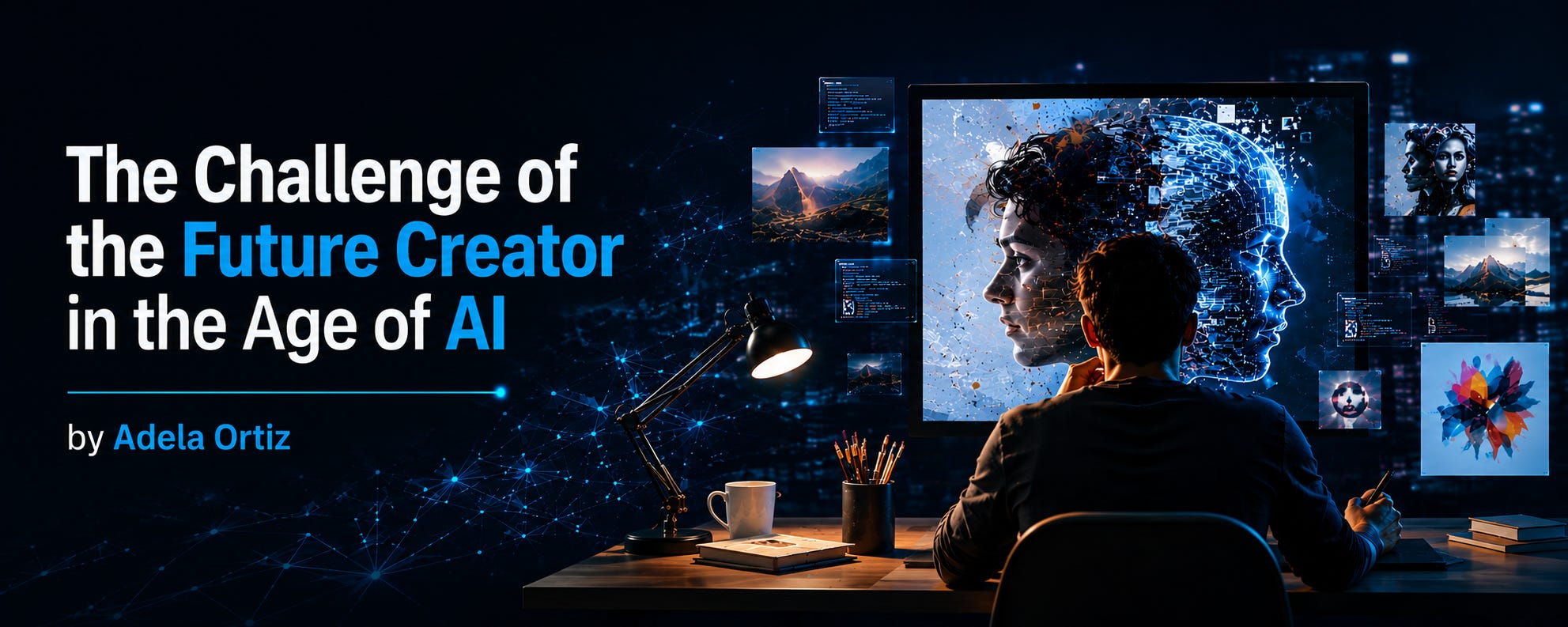
Currently, we do not face the same type of obstacles that marked previous generations. For centuries, creative limits were defined by the lack of automated tools. To write a book required years of discipline and knowledge on the subject; to produce a film, considerable resources and expensive editing tools; to design a visual campaign, personnel with specialized training. Artificial intelligence profoundly alters that reality.
But something extraordinary is happening.
For the first time, humanity shares the creative space with a non-biological intelligence. The historical barriers to creation are now decreasing very rapidly. The ability to generate images, text, music, video, prototypes, and complex concepts no longer depends exclusively on an acquired skill or academic experience. In appearance, this democratizes creativity.
The paradox of abundance
This is where hybrid creativity comes in has radically transformed the economy of creation. Today, that equation has changed. With generative artificial intelligence systems, a single person can produce in hours what previously required weeks or even months. The road to entry has been radically eased.
This, in every sense, seems like an unqualified win for creativity. More participation. More experimentation. But a fundamental paradox surfaces here: as scarcity is no longer an inherent facet of how art or content are created, the real scarce resource becomes human attention.
Still, a fascinating tension emerges here. In economics, when something becomes extremely abundant, its relative value tends to decrease. There is too much mass production and the consequence is negative because even valuable works can disappear in the noise.
In this friction may be AI’s ultimate challenge to humanity: asking something that had been taken for granted since time immemorial: what makes a creation fundamentally human? Creativity per se assumes envisioning, sensation, perceiving, and transforming lived experience into creations capable of moving, inspiring, or confronting.
There is a persistent myth: that of the solitary genius. But historically, creativity has always been collaborative. Every creation is a conversation whether with your inner self or with a machine.
What changes is not the existence of collaboration. What changed is that the interlocutor is not human, and fast. What changes is the speed and the criterion when producing content. AI may produce a thousand responses, human talent resides in recognizing which one deserves to exist. Distinguishing value amid excess, in an ocean of synthetic content.
One of the greatest challenges will be the saturation of synthetic content produced at industrial scale. Artificial intelligence changes the rules of the game. And deciding becomes more costly when there are too many options, to the point of making creative clarity difficult.
This produces a structural imbalance. More content does not mean more understanding, connection, or inspiration. In fact, the opposite may occur, content without criterion can impoverish the cultural experience. Therefore, creativity no longer competes solely on quality, but on visibility.
Authenticity as the new premium value
Authenticity becomes a competitive advantage, thus the genuine acquires greater value. Not because humans continue seeking emotional meaning and context. What today is organic growth, because the imperfectly human can be more memorable than the impeccably synthetic.
Visible effort regains cultural prestige. Not because technology is inferior. Because criterion, strategy, and conceptual originality are required.
Now another central figure emerges: the one who chooses with criterion. Even the consumer develops a new critical skill: learning to choose well.
Perhaps the future will not be a competition between human creativity and artificial intelligence.
Perhaps it will be the birth of a new form of hybrid imagination.
An imagination where human intuition and computational capacity mutually enhance each other.
An era in which the artist does not disappear, but evolves.
Comments
Nothing yet. Say the first thing.
Sign in to join the conversation.