
ADDISON TIMES MAJOR SPONSOR: STEPHENSON RIFE ATTORNEYS


Construction continues on the Indiana Department of Transportation improvement project at State Road 9 and Colescott Street. These photos, taken from Colescott Street near Harrison Street, show progress on the project, which includes widening the intersection radii and adding a dedicated left-turn lane for northbound State Road 9 traffic turning onto Colescott Street. | photos by JACK BOYCE

Shelby County officials have a simple goal as they prepare for a sweeping change in Indiana’s local income tax system: Don’t create winners and losers. Getting there may be considerably more complicated.
Representatives of municipalities, townships, schools, fire departments and the Shelby County Public Library gathered Wednesday for the county’s first Municipal Unit Strategic Task Force, or MUST, meeting, beginning a process intended to determine how local income tax revenue should be divided when a new state system takes effect.
County Council member Jeremy Ruble, who represents the council on the task force, said the objective is to find a structure that keeps local units financially whole while remaining responsible to taxpayers.
“We want to make sure that we all are prospering and do it in a manner in which is fiscally responsible for the citizens of the county,” Ruble said.
Reaching an agreement will require consensus. The task force includes a representative of the County Council and representatives of the county’s municipalities, and Ruble said any final proposal will require a unanimous vote.
The discussion stems from changes approved by the Indiana General Assembly that will replace the existing levy-based LIT distribution structure with a rate-driven system. The changes are expected to affect how cities, towns, townships, libraries, schools and fire and emergency medical services receive local income tax revenue.
Greg Guerrettaz of Financial Solutions Group, the county’s financial adviser, cautioned repeatedly Wednesday that some of the details could change again before the new system takes effect.
“The state doesn’t have the answer,” Guerrettaz said. “I don’t have the absolute answer, and I’m going to guarantee you one thing: It’s going to change.”
For that reason, Guerrettaz urged the group not to lock itself into specific tax rates during its initial discussions. Instead, Wednesday’s meeting focused largely on identifying needs and determining what “equitable” should mean when money is eventually divided.
“The issue as we go forward is no doubt the equity issue,” he said.
A two-page presentation distributed at the meeting framed the central question directly: Should revenue be allocated according to levy, population or some other measure?
The document compared Shelbyville with the remainder of Shelby County. Shelbyville accounts for about 45% of the county’s population, according to figures presented at the meeting, while the remainder of the county accounts for about 55%.
Estimated 2027 LIT distributions show a close split. Shelbyville is projected to receive about $11.6 million, or 43.17% of the countywide distribution, while Shelby County government is projected to receive approximately $11.8 million, or 43.95%. The remaining revenue is distributed among towns, townships, schools, the library and other units.
That relatively balanced top-line distribution masks much different circumstances among the smaller recipients.
“One rate fits all. NO!” reads one of the concerns listed in the Financial Solutions Group presentation.
Guerrettaz said that is where the challenge lies. A rate that works for one community may leave another short. He said he has seen financially distressed towns elsewhere ultimately turn to county government for help. The goal in Shelby County, he said, should instead be to protect those smaller units before that happens.
Shelbyville Central Schools Superintendent Dr. Matt Vance was the first local representative to speak during the public discussion.
“For the schools, the LIT is huge,” Dr. Vance said.
Shelbyville Central currently receives roughly a half-million dollars annually from LIT, and Dr. Vance said the potential loss comes while districts are already dealing with other financial pressures, including declining enrollment.
Dr. Vance said the district has made cuts and other financial adjustments but has fewer options for generating replacement revenue than some local government units.
Later in the meeting, County Council member Kyle Barlow urged the task force to consider the needs of all four Shelby County school districts as it develops recommendations.
“I think we need to fund our schools,” Barlow said, pointing to aging buildings, staffing concerns and other costs.
Southwestern Consolidated Schools Superintendent Dr. Jamie Wilkins echoed those concerns. Southwestern currently receives about $175,000 in LIT revenue, he said.
He noted that costs of goods and services continue to rise even as school revenue can fluctuate with enrollment and other state funding calculations.
For volunteer fire departments, the discussion was more than a number on a budget sheet.
Moral Township Trustee Lyle Lepper said additional LIT revenue received by volunteer departments has allowed his department to expand paid staffing at a time when demand for service has increased sharply.
“Our run load has doubled,” Lepper said.
He said the department receives about $6,700 each month through the additional LIT funding. After previously adding paid personnel, the additional revenue allowed the department to add three more firefighters, he said.
“We have two firemen every day at the fire station, sometimes three, and that’s with that LIT,” Lepper said. “That’s pretty important money for us.”
Fire and EMS funding will have its own component within the new LIT structure. Preliminary calculations discussed Wednesday suggested Shelby County may have enough capacity to preserve existing fire funding, although officials stressed that those calculations are preliminary.
Guerrettaz said the group’s objective is not to promise departments an exact rate today.
Shelbyville faces a different decision because its size allows it to establish its own rate rather than participate in the countywide municipal distribution.
Financial advisers indicated, however, that doing so would be considerably less favorable to the city under current projections.
Discussion at the meeting indicated Shelbyville could fall roughly $3.7 million short if it attempted to operate under its own 1.2% rate rather than participate in the countywide structure.
Tyler Lewis of Reedy Financial Group, who advises the city, said working with the county presents a “much more favorable” option for Shelbyville.
That makes cooperation important not only for the smaller towns and townships but also for the county’s largest municipality.
Ruble said the county itself appears likely to have enough room within the proposed structure to meet its needs. The more difficult question, he said, is whether individual units restricted by their own statutory caps will have enough room.
Guerrettaz agreed.
That includes townships, which face another unknown: some could be forced to merge under separate legislation approved by the General Assembly. Officials said the eventual LIT calculations will have to reflect whatever the county’s township structure looks like when the new tax system takes effect.
Edinburgh presents another complication. The town extends into Shelby, Johnson and Bartholomew counties, meaning officials must determine how a new distribution system treats municipalities crossing county lines.
Those questions were among several Wednesday for which officials acknowledged there is not yet a definitive answer. Despite nearly two hours of discussion, no one proposed a final LIT rate Wednesday.
Guerrettaz said attaching numbers to a recommendation now could prove counterproductive, particularly when lawmakers could alter the statutory caps before the system takes effect.
Instead, officials appeared to coalesce around broader concepts: preserve existing services, protect small communities, recognize the needs of schools and emergency services and, wherever possible, keep local units from losing revenue they currently receive.
A second MUST meeting is expected in mid-September. Guerrettaz said Financial Solutions Group plans to use financial information submitted by local entities to identify where the proposed state caps could create problems.
The group could then begin considering a draft containing conceptual recommendations rather than specific tax rates. If consensus cannot be reached at the second meeting, a third could follow.
Ruble said he wants officials to be able to identify the areas where the numbers do not work and determine whether revenue can be shifted or other agreements used to address those gaps.
That brings the discussion back to the word appearing throughout the meeting: equity.
The Financial Solutions Group presentation put the question this way: “What is equitable and how would you define it?” For Shelby County officials, the first answer appears increasingly clear. Start by trying to make everyone whole.
ADDISON TIMES MAJOR SPONSOR: FULL CANOPY REAL ESTATE

Joe E. Harlan, author of “You Can Go Anywhere in the World From Shelbyville, Indiana,” will hold a book signing today from 11 a.m. to 2 p.m. at the Boys & Girls Club of Shelbyville. Harlan will meet with community members and discuss the book, which chronicles his Shelbyville upbringing and the people, experiences and lessons that shaped his life and career. Free signed copies will be available to the first 100 attendees. An interview with Harlan will be published in tomorrow’s edition.
HOOSIER NEWS: Charleston, West Virginia-based HD Media LLC has agreed to acquire six Indiana newspapers. HD Media will assume ownership of Aim Media Midwest’s Indiana publishing operations Sept. 1. They include the Daily Reporter in Greenfield, The Republic in Columbus, Daily Journal in Franklin, The Tribune in Seymour, Brown County Democrat in Nashville and The Times-Post in Pendleton. HD Media will also acquire Aim’s 19 Ohio publishing operations. Terms of the sale were not disclosed. (IBJ)
INTERNATIONAL NEWS: A new study found that on average, just 2.2 percent of legislators across 97 democracies are working class, despite 69.9 percent of the people within those democracies hailing from said class. In the United States, only 1.1 percent of legislators who get elected have previously held a working-class job. (The Conversation/Numlock)
The Addison Times is pleased to offer free milestone announcements. Forms are available here: Engagement Announcement, Wedding Announcement and Anniversary Announcement.
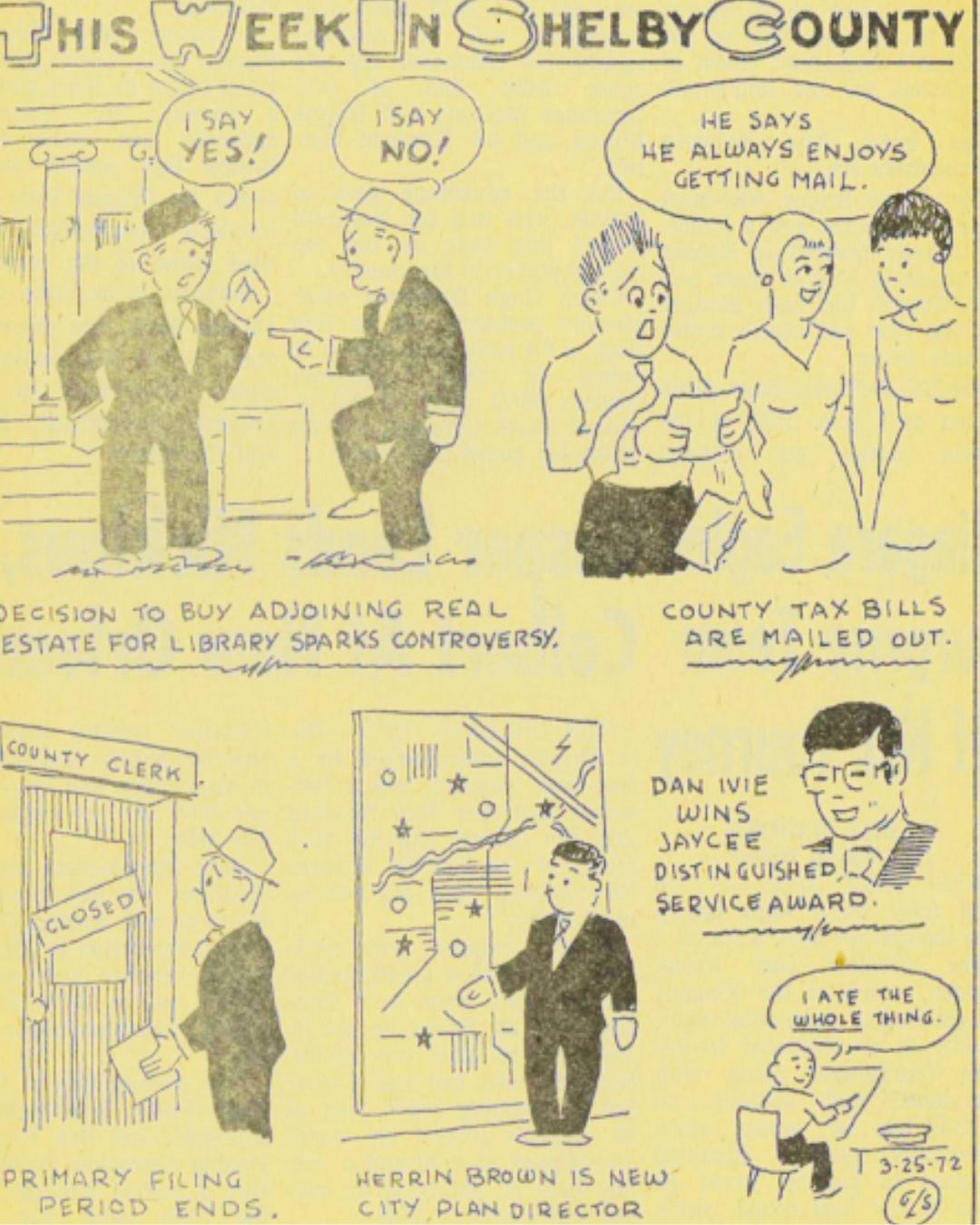
This Week in Shelby County, a cartoon feature illustrated by George L. Stubbs for 38 years, is reproduced with permission of the Shelby County Historical Society and the Stubbs family.
ADDISON TIMES MAJOR SPONSOR: MAJOR HEALTH PARTNERS

Local headlines reported on or around this date in Shelby County history. Selections are curated by The Addison Times from Shelby County Public Library Genealogy Department materials. | research by MYRON RAWLINGS
2016: Laura Guenin, public relations director for the Shelby County Public Library, shared organizational stats in a speech to the Rotary Club. There had been 168,796 patron visits to the library in 2015. There were 19,203 library card holders.
2006: The Marietta Volunteer Fire Department received a $228,175 grant from the U.S. Department of Homeland Security for equipment updates. The Marietta department was required to come up with a $12,009 match.
1996: The Shelbyville Common Council cut $60,657 from the city’s budget after Councilman Scott Furgeson questioned several miscellaneous funds.
1986: Beltman, sponsored by the State of Indiana, appeared in the Bears of Blue River Festival parade. Beltman, who had a black mask, red hood and cape and blue leotards, advocated wearing seatbelts.
About 100 citizens gathered in Sunset Park to object to recent increases in city sewage bills averaging $20 per household. Several residents spoke out and threatened to not pay their bills. The increases were due to renovations at the plant.
1976: Members of REACT, a local citizens band radio club, helped identify a suspect in a car theft case that resulted in a manhunt in rural Shelby County. The man, from Anderson, was arrested.
Sally O’Mara, secretary of Shelby Industrial Development, christened the 24,000 square-foot addition to the K-T Corporation building on Elston Drive by putting her signature into the concrete floor. O’Mara had started the tradition in 1962 by putting her signature into the floor of the first construction project funded by the local development firm. She had since put her initials somewhere in every building constructed with the help of Shelby Industrial Development.
1966: Spectators gathered to watch a demolition team blast down a 185-foot smokestack at the old KCL Corporation on West Washington Street. The building, constructed as the D.L. Conrey Furniture Factory before 1900, was completely razed to provide room for a parking lot.
Tina Carney and Robert Cortelyou received scholarships from the Shelby County Fair Association. Carney was attending DePauw University, and Cortelyou was enrolling at Purdue. The awards were presented by Riley Keaton, association president.
The 10-unit Wertz apartment building was completed across the street from the West Side Pilgrim Holiness Church, 523 Miller Ave.
1956: Shelbyville’s first toy and hobby store opened. Spurlin Toys and Hobbies, located in newly remodeled 211 S. Harrison St., was operated by Kathryn Spurlin.
1946: The Shelbyville Common Council dropped plans to extend State Street. Property owners in the vicinity of the State Street jog, which connected it with Quesada Street, had petitioned for the city to extend State Street northward one block, so that it would join Teal Street.
Paul Bernard Fisher, Robert Platt and Joe Showers, all of Shelbyville, and Ivan Solomon, Manilla, enrolled in flight training instruction in Shelbyville under the G.I. Bill. In other aviation news, the Sindlingers - Charles, Doris and Harold - purchased a new Fairchild plane.
1936: The last swim of the year was held at Porter Pool. A total of 15,557 people had paid admission during the season.
1926: A team of horses owned by J.H. Deitzer and Sons was saved from drowning in Blue River, north of the Franklin Street crossing, when a young man driving a wagon loaded with sugar corn dove into the water, swam out to the horses and cut them loose from a wagon they had been pulling. The wagon was pulled out later. Two young men who had loaded a wagon with trash, had driven the horses into the river, which was at a high level. The horses and wagon had been caught in the current and carried downstream to a gravel pit before they were rescued.
ADDISON TIMES MAJOR SPONSOR: Freeman Family Funeral Homes & Crematory

None today.
No posts
Comments
Nothing yet. Say the first thing.
Sign in to join the conversation.