
ADDISON TIMES MAJOR SPONSOR: STEPHENSON RIFE ATTORNEYS

The Shelbyville Common Council’s Ordinance Committee moved a revised truck ordinance toward the full council Wednesday while continuing work on regulations for massage therapy practices and beginning a review of the city’s two-decade-old stormwater standards.
Of the three issues, only the truck ordinance received a formal recommendation. The committee voted to send it to the Common Council for its Sept. 9 meeting, with officials still working on changes to the proposed truck-route map.
City officials have been revising Shelbyville’s truck ordinance in an effort to give police clearer authority to keep heavy trucks out of downtown and off streets that are not designed for them.
City Engineer Tyler Comstock said trucks have been traveling not only through the downtown area but along Tompkins, Washington, Miller and other streets, sometimes becoming stuck or damaging signs and other infrastructure.
The problem has been aggravated by the closure of the Interstate 74 ramp east of the city. Street Commissioner Shane Peters estimated that situation is responsible for about 70% of the current problem and said the ordinance should allow the city to establish temporary truck routes when similar situations arise.
“If Tyler and I decide that Vine Street to Walker Street is how you get through town before 44 is being closed, they need to use that route,” Peters said.
Comstock said the city has already asked trucks associated with POET to use Vine and Walker rather than traveling downtown or along narrower streets such as Mechanic and Pike. He said another challenge is that many out-of-town drivers are following directions from phones rather than GPS systems designed for commercial trucks.
“Cell phones don’t know that you’re in a full semi,” Comstock said.
He estimated nearly a dozen semis a day travel down Tompkins Street near his office and attempt turns they are not designed to make.
“We’re constantly seeing damage,” he said.
Committee Chair Linda Sanders said simply adding more signs is not the answer.
“We don’t want signs everywhere,” Sanders said. “We need to have this tight enough that it allows the police department, gives them teeth in order to write the tickets and have the judges enforce them.”
City Attorney Luke Jolly said the revised ordinance defines a truck as a vehicle weighing more than 16,000 pounds, using state standards, and requires covered vehicles traveling through Shelbyville to use designated truck routes.
Comstock said the city is confronting two different problems: weight, which can damage pavement, and the length of large trucks, which can make some city turns difficult or impossible without damaging signs and other property.
Local farmer Brandon Fix asked the committee to consider an exception for farm trucks.
Fix said traveling through downtown is often the safest and easiest option for local farmers, particularly when moving loaded semis. He said using Interstate 74 can be difficult and noted that his father, who is in his 70s, is uncomfortable driving farm trucks on the interstate.
Fix said a loaded farm semi can weigh 80,000 pounds. He proposed allowing trucks with farm plates to travel through downtown or creating a local permit that farmers could purchase and display on their trucks.
Peters expressed concern that making exceptions could undermine the effort to divert trucks.
“If you allow farm trucks through town, and I don’t have any issues with it, to be honest with you, everybody’s going to follow,” Peters said.
He said that after the first dump trucks began using the redesigned downtown area, the numbers quickly increased.
Peters and Comstock agreed to continue looking for a route that could accommodate local farm traffic. Vine Street remains one possibility. Peters said it was selected in part because it has less two-way traffic and is already scheduled for reconstruction.
Fix also suggested the city reconsider a former 42-foot vehicle-length standard, saying most farm trucks are shorter than 40 feet while many commercial trucks are longer.
The committee ultimately voted to recommend the ordinance to the full council while allowing the proposed route map to be amended before the Sept. 9 meeting.
In other business, the committee took no formal action on its proposed massage therapy ordinance, instead continuing a collaborative review with local licensed massage therapists and Michelle Roudebush of the Indiana chapter of the American Massage Therapy Association.
The city began considering the ordinance as a way to give local authorities more ability to respond to businesses operating under the appearance of massage therapy while potentially engaging in prostitution or human trafficking.
But after concerns that earlier drafts could place unnecessary requirements on legitimate massage therapists, Wednesday’s discussion increasingly centered on whether much of the proposed local regulation could simply rely upon standards already imposed through Indiana’s professional licensing system.
Therapists raised concerns about proposed requirements involving background checks, employment histories, clothing, restrooms and locker rooms, whether doors must remain unlocked during business hours and how permits would apply to existing practices.
Theresa Adams, a licensed massage therapist in Shelbyville, questioned language that appeared to prevent a practice from operating until a city permit had been issued. Jolly said the ordinance could include an exception for existing businesses.
Therapists also noted that the state already requires them to meet licensing requirements and undergo background checks.
Councilwoman Betsy Means Davis said the city should avoid duplicating that process.
“If you have state licensing, then you’ve been through all that, so you shouldn’t have to present it to the city,” she said.
Therapists also objected to requirements that could be impractical for sole practitioners, including separate restrooms or locker facilities and provisions that appeared to require doors to remain unlocked during business hours.
Roudebush said most local massage therapists are likely sole practitioners working from small offices rather than large spas. Sanders agreed that requiring an unlocked entrance could create a safety issue for a therapist working alone, and Jolly said the provisions could be rewritten.
A broader possible solution emerged later in the discussion: exempting legitimate sole practitioners who hold valid Indiana massage therapy licenses while focusing local enforcement on people practicing without them.
Roudebush pointed to proposed exemption language that could cover sole practitioners who comply with state requirements. She also offered to help police learn to use the state’s license lookup system and recognize warning signs of illegitimate operations.
The discussion highlighted the jurisdictional problem the city is trying to solve. Roudebush said practicing without a license is already illegal, but state-level enforcement can take time.
“You’re going to be filing a report with the attorney general’s office, and that sometimes takes upwards of months,” she said, while a business could potentially continue operating during the process.
Roudebush suggested the ordinance might ultimately be simplified to make operating without an Indiana massage therapy license a violation of Shelbyville’s ordinance, giving the city a local enforcement mechanism.
Committee member Dennis Harrold responded that such an approach might be “really all we need.”
Sanders emphasized that the committee is still working through the details and does not intend the ordinance to target legitimate practitioners.
“This is a starting point for us,” Sanders said. “This is something new, and an ordinance can always be amended and changed.”
She said Jolly will incorporate the latest suggestions into another draft before the committee considers the ordinance again.
The committee’s final discussion turned to an issue that has taken on added visibility following recent flooding: Shelbyville’s stormwater ordinance.
Comstock stressed, however, that the proposed update is not a reaction to the recent flooding.
“I don’t want people thinking maybe this is a knee-jerk reaction from what just happened,” he said. “We’ve actually been in discussions, looking into this for well over a year.”
Comstock described the city’s existing stormwater ordinance and design manual as outdated and said Shelbyville’s requirements have historically been among the more lenient standards he encountered during a decade working in private engineering.
The city is looking at adapting an ordinance being developed for Shelby County with assistance from Christopher B. Burke Engineering, an Indianapolis firm Comstock said is widely known for its stormwater work. Similar standards are used by communities throughout Indiana.
Comstock said adopting updated standards would address both stormwater quantity and quality.
New developments would be required to detain more water before releasing it into storm sewers and drainage systems, reducing the speed and volume at which runoff enters the system. The standards would also require measures intended to improve the quality of stormwater before it reaches detention ponds and other infrastructure.
“It’s more detention to hold that water back before it’s released into our storm sewers and ditches to prevent some of this flooding that we’re seeing,” Comstock said.
Sanders agreed that an update is overdue.
“A lot of things have changed,” she said. “Design standards have changed, and people — their concrete pads are getting much larger, and so we really need to beef this up.”
Comstock said the county’s draft could largely serve as a template, with references to county departments and procedures changed to fit Shelbyville.
He acknowledged that stricter standards will represent a change for developers. Recalling his own time designing projects in Shelbyville, Comstock said engineers appreciated the relatively light detention requirements.
But he called an update “long overdue.”
Comstock will continue adapting the proposal for the city before bringing it back to the Ordinance Committee. He said it will not be ready for the Sept. 9 council meeting because the committee will need to review the ordinance first.
If ultimately approved, the updated technical standards would be made available to developers and engineers through the city engineer’s office and website. Comstock said the city typically learns about projects months before construction and would introduce developers to the requirements during that process.
ADDISON TIMES MAJOR SPONSOR: FULL CANOPY REAL ESTATE

Joe E. Harlan, author of “You Can Go Anywhere in the World From Shelbyville, Indiana,” will hold a book signing from 11 a.m. to 2 p.m. Saturday, Aug. 22, at the Boys & Girls Club of Shelbyville. Harlan will meet with community members and discuss the book, which chronicles his Shelbyville upbringing and the people, experiences and lessons that shaped his life and career. Free signed copies will be available to the first 100 attendees.
HOOSIER NEWS: The Hoosier Lottery recorded nearly $1.7 billion in sales in fiscal year 2026 and expects to return almost $350 million to the state, up from $341 million the previous year. The surplus helps fund pensions for teachers, firefighters and police officers and offsets about half of Hoosiers’ motor vehicle excise tax costs, while the lottery paid roughly $1.1 billion in prizes during the year. Lottery officials also said they have submitted a proposal to Gov. Mike Braun’s office to allow online lottery sales, an idea lawmakers have considered but not approved in previous sessions. (IBJ)
NATIONAL NEWS: Membership brand Columbia House is shutting down after 71 years of operation, with the company behind the iconic “12 CDs for a penny” deal finally folding. Founded in 1955 as a direct-mail marketing program, it peaked at 16 million members in 1996, generating $1.4 billion in revenue. A recent attempt to pivot to Columbia House DVD Club in the wake of Napster and digital downloads generally wiping out its business did not take as hoped. Its legacy lives on; with Spotify paying $0.003 and $0.005 per stream on average, one penny for 12 albums is less an audacious entry offer and more the prevailing pricing strategy in music. (Media Play News/Numlock)
The Addison Times is pleased to offer free milestone announcements. Forms are available here: Engagement Announcement, Wedding Announcement and Anniversary Announcement.
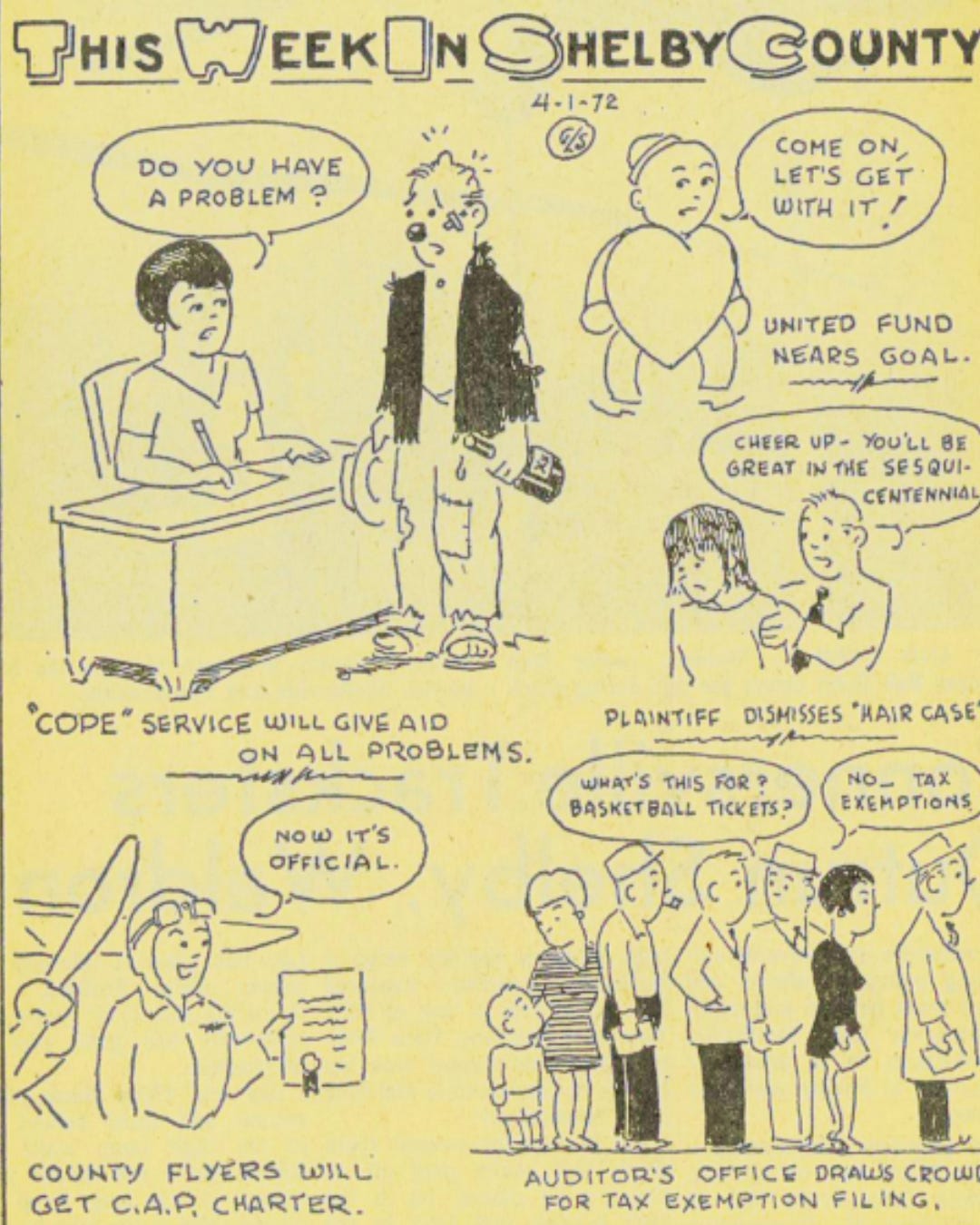
This Week in Shelby County, a cartoon feature illustrated by George L. Stubbs for 38 years, is reproduced with permission of the Shelby County Historical Society and the Stubbs family.
ADDISON TIMES MAJOR SPONSOR: MAJOR HEALTH PARTNERS

Local headlines reported on or around this date in Shelby County history. Selections are curated by The Addison Times from Shelby County Public Library Genealogy Department materials. | research by MYRON RAWLINGS
2016: Chief Deputy Sheriff Richard Allender announced he planned to retire in January 2017 after 50 years of service, 30 as a merit deputy and 20 years in the civil processing division. He had started in 1967 as one of only three deputies to help the Sheriff cover the county.
2006: A carport was installed at the animal shelter to help alleviate overcrowding. In July, 116 dogs and 115 cats had been relinquished to the shelter.
1996: Indianapolis Power & Light Co. workers from Shelby County cleaned up two miles of Frontage Road east of Fairland Road to the Michigan Road overpass. Those helping were Robin Harrell, Melanie Foltz, Mallory Burgess, Steve Plunkett, Greg Willard, Jerry Niccum, Lesa Adkins, Cathy McDaniel and John Burgess. They were joined by Dallas Phillips and Mike Gerrish from the county.
Shelbyville Common Council member Jeffrey Martin was named to the state Law Enforcement Training board by Gov. Evan Bayh.
1986: Tonya Brown, children’s librarian, and Nancy Graves, assistant director and reference librarian, started work at the Shelby County Public Library.
With The Garment Center closing, there were four vacant spots and a vacant building, once a gas station, available at Belaire Shopping Center. In response to criticism from locals about lax upkeep at the retail center, company officials said the sluggish economy and loss of large tenants made renovation impractical.
1976: Three local teams prepared to participate in the Great Bicycle Race at the Stair Fair. Those on the senior girls team, who won first place in the area contest, were Jenny Woollen, Kay Stadtmiller, Denise Zimmerman, Alyce Tower and Linda Tower. Jessica Shisler and Jan Spear coached the team. Members of the junior girls team were Susan Woollen, Kim Knecht, Rita Stadtmiller, Donna Drake and Toni Sexton. Kim Skinner and Dee Osborne were the alternates. Alyce Tower and Denise Zimmerman were their coaches. Kevin Laird, Brian Schilling, Keith Everhart, Scott Carson and Mike Burbrink were on the senior boys team. Brook Mount was the alternate, and Mark Hilton was the coach.
1966: Winners in the Shelby County Fair’s Baby Show were Dean Drake, Libby Russell, Garrett Nolley, Dale Dunham, Nathan Gearhart, Angela Bartlett, Kimberly McCracken, Randell McNeely and Michelle Baker. Johnny and Joe McNeely won the twins division.
Angela Leap, 15, showed the grand champion 4-H steer at the county fair.
1956: Wayne Hubler purchased the entire interest in Hubler’s Meat Market at 33 E. Washington St. Hubler and a brother had purchased the business from Buehler Brothers in 1949.
1946: The Shelby County Public Library reopened following several weeks of renovation.
1936: A “Back to School” dance was held at the Golden Glow ballroom from 9:30 p.m. to 1:30 a.m. A 15-piece band played. The event was sponsored by William Heppler and Wayne Cayton.
1926: The Sandwich Shop, on Second Street, across from the north entrance of Shelbyville High School, opened. It was owned by Raymond Murrell and Nathan Kaufman.
ADDISON TIMES MAJOR SPONSOR: Freeman Family Funeral Homes & Crematory


Jerry Litwack passed away peacefully in his sleep on July 7, 2026. He was born on April 15, 1931, in Maysville, Kentucky, to Isadore Litwack and Ida Groban Litwack. At age 6, his family moved to Cincinnati, Ohio, where he spent his formative years.
Jerry graduated from Walnut Hills High School in 1949 and remained good friends with many of his Sigma Delta Chi fraternity brothers there. He went on to The Ohio State University, where he met the love of his life, Louise Levenstein from Greensburg, Indiana, and they married in 1953. At OSU, he was a proud member of the ZBT fraternity and played on the varsity tennis team. He loved OSU and happily wore t-shirts, sweatshirts, pants, hats, and anything he could find with that logo. He loved being able to walk into a restaurant in any city and see someone else in OSU gear to shout out OH, and they would shout back IO.
In 1954, he was called up as a 2nd Lieutenant in the U.S. Air Force and trained at Scott Air Force Base in Illinois. He was then assigned to French Morocco as a Communications Officer. After two years in Morocco, Jerry and Louise moved to Cincinnati, where he worked for the family business, Litt Brothers. In 1956, they moved to Shelbyville, Indiana, where Jerry took over the Levenstein family scrapyard and wool business. He then purchased Shelby Dealer Supply Company in 1959, which he built into a very successful steel service center in the Midwest. He employed over 300 people and changed the name to Shelby Steel. He was known as a great and generous boss. By 1980, he was ready to retire and sold his company. During his first retirement, he became President of the Board of the Indianapolis Hebrew Congregation, President of the IHC Foundation, President of the Jewish Federation for three years, a member of the Executive Board of the American Israel Public Affairs Committee, Chairman of the Board of Goldman Union Camp, Vice President of the Anti-Defamation League for Indiana Ohio & Kentucky, served on the National Board of the United Jewish Appeal Joint Distribution Committee, Member of the Board of Jewish Family and Children’s Services, Dinner Chair for the City of Hope, and served on the National Planning and Campaign Cabinet for the United Jewish Appeal.
He then came out of retirement to start a new business called Action Steel, which he led from 1985 to 2000. He was a man on a mission to be a successful businessman and to do significant work to help lift up those in need. The positive impact of both his professional and community work has been felt by so many, and his irrepressible sense of humor has entertained everyone whom he met. He never met a stranger because he would always find a way to connect with everyone he said hello to.
He also stayed active by spending many hours of fun and frustration on the golf course. He made four holes-in-one on four different courses, and his best handicap was a seven. Jerry was very proud of his golf game and had a wonderful time playing all over the country with new and old friends.
Jerry lived an exceptionally full, happy life filled with family, good friends, lots of fun, great laughs, extensive travel, and big love. His wife of 66 years, Louise Litwack, passed away nearly seven years ago in 2019. He is survived by his children, Barry and Alla Litwack, Alix Litwack, Reid Litwack and Liz Lahr; grandchildren, Noah Bradtke-Litwack, Beth Neville, Isabella Litwack, Ian Amatetti, Lena Bradtke-Litwack, Abe Lahr, Ben Lahr, and Lucy Lahr; and great-grandchildren, Sophie, Henry, and Sloane.
Contributions in Jerry’s honor may be made to the Jerry Litwack Youth Program Fund at IHC or to Second Helpings in Indianapolis.
No posts
Comments
Nothing yet. Say the first thing.
Sign in to join the conversation.