
Ok, that was mildly clickbaity, but I couldn’t resist.
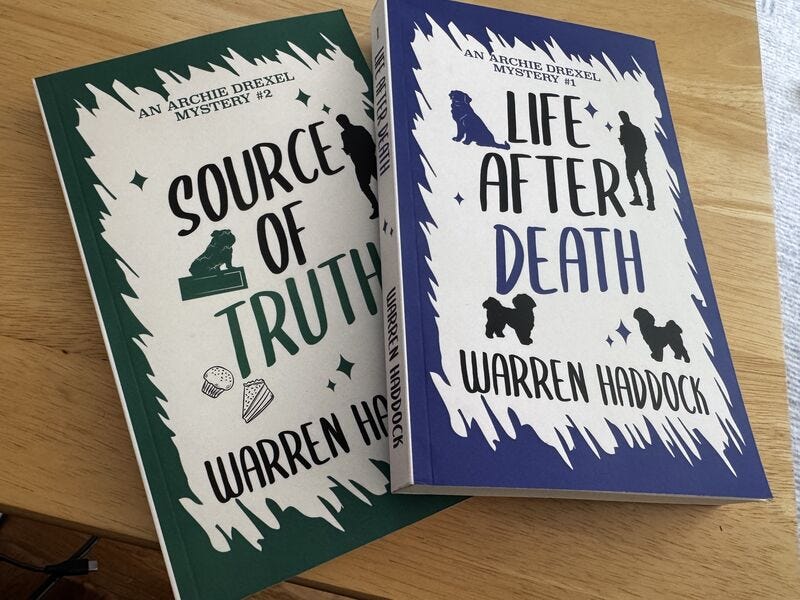
This story’s roots are in my coming across my friend, Timothy L. Johnson’s social post where he shared his nom de plume. He was describing a murder mystery series based in Des Moines, Iowa and I was intrigued enough to (accidentally) pick up the second book of the series. With both the first and second now in my “read” pile, I can comfortably say that I didn’t mess up the story line (much) by reading #2 first and am eager to read the third and fourth in the series due later this fall.
Although the links above are Amazon affiliate links, both books are also available for purchase at Beaverdale Books.
Tim and I were students at Central College in Pella studying Business Management and Computer Science respectively. Small college campuses create creative collisions, and we knew each other from such interactions in the computer labs. The connection continued as we both landed in the Des Moines area at Principal shortly after college, him programming, then product and project management and me as a programmer and network administrator. Pathways soon diverged and connections withered until I encountered his first set of books and writings in the late 2000s.
Our alma mater is rooted in the liberal arts and writing is encouraged and required across curricula. When we recently connected for this series, a story I was surprised to learn from him was about a writing assignment from my programming languages professor, one where he had to describe his calculations to compute the volume of a tetrahedron using a determinant matrix. The same professor also taught my programming languages class where, at the beginning of the semester, she creatively assigned our class a single (simple at its face) problem we were required to solve in the next ten weeks. The only constraint - we had to solve it in ten different languages, one learned each week. She honored and applied the ethos of the liberal arts widely even in computer science. While my liberal arts degree took me to the photography dark room to process film to fulfill the fine arts requirement, Tim found himself in art history classes studying, understanding, and verbalizing 20th century masters.
The late 90s progressed into the 2000s and career trajectory kept Tim engaged in project management roles in the metro area. He used and created systems to ease his and client workloads, learning from different industries along the way. He taught related courses at Drake University and UW Milwaukee, inadvertently collecting material for a future just around the corner.
Companies large and small were beginning to recognize the amorphous data exhaust from the systems they’d been building over computing’s past few decades. An industry, about to be born, would christen new titles such as data engineer, data analyst, and data officers. Those, like Tim, in the midst of these ‘data transformations’ were about to be inundated with new terms - master data management, data warehouse, data lake, data scrubbing and waterfalls (pun intended) of data initiatives.
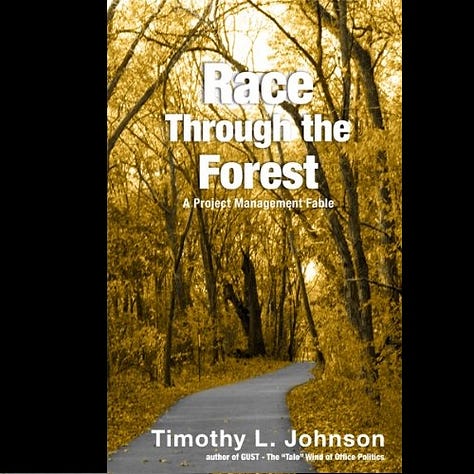
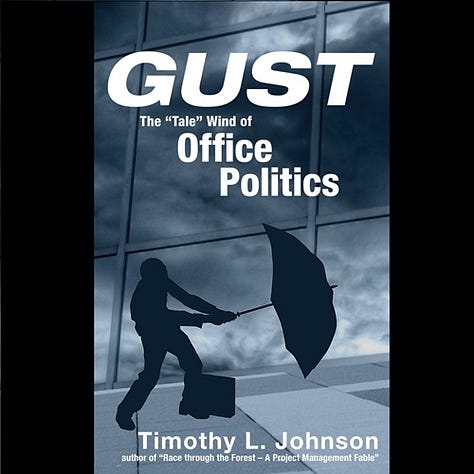
Tim found himself making sense of this deluge and began writing his process, systems, and technical thoughts into books. His first book, released in 2006 fictionalizes a project management scenario in Race through the Forest. It was followed the next year by Gust and three years later by SWAT. The three fables are fast reads that provide a peek into the world of corporate projects, politics, and systems thinking, especially for those who happily live simpler lives outside those worlds. I found myself mapping the book’s characters to friends and foes I’ve encountered through the years - the fables are real!
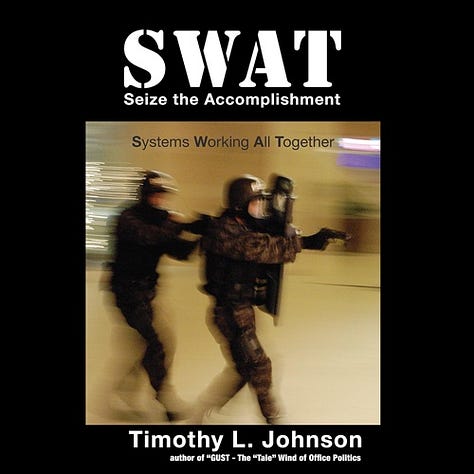
Tim was invited to join a SWAT team by a friend, a team commander in the city’s police force. He eagerly joined the group, learning techniques and observing activities including securing locations, assets, and property, deploying weapons when necessary. He asked and received permission to photograph the teams in action deploying tasers, flash bangs and much more.
He began observing the disparate personalities who surrounded him in these sessions. Recalling Stephen King’s On Writing, Tim realized these personalities were providing him ready characters for future stories. Although he had fictionalized characters in the first three books based upon real-life humans before, this set of personalities was new and different from the corporate environments. A notebook filled with potential characters was awaiting opportunity.
Tim’s first three books are dedicated to his wife and two daughters. One of his daughters, Lauren who was at that time an employee of Salisbury House invited him to host a murder mystery where the murder victims were the only actors in the know. Tim had a great time observing the willing guests playing along as participants. He knew he had to do it again.
Lauren agreed and encouraged dad.
Tim found many more personalities and characters amongst the guests and continued to document them for future mysteries.
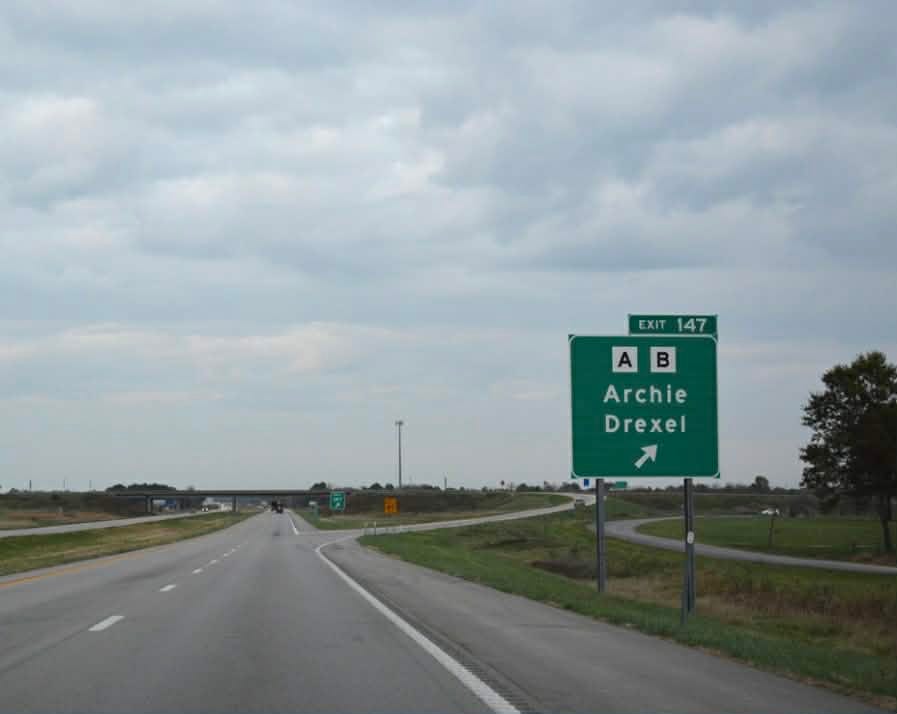
Two town names on a highway exit caught Tim’s attention during a family drive to visit the Crystal Bridges art museum in Bentonville. The town names Drexel and Archie off the Interstate between Des Moines and Bentonville planted themselves in Tim’s mind as a cool first and last name of a character. His family in the car agreed and Archie Drexel was born.
The book series begins with Archie’s life upended by his wife’s passing, his two daughters beginning their adult lives anew, a new neighbor, a murder in the neighborhood and the ensuing investigation. I won’t share much more about the plot or outcome, but it became evident from the beginning that this book would explore a subplot of male friendships. Characters from SWAT, the murder mystery at Salisbury House, and Tim’s own life perform lead and cameo roles throughout.
Those familiar with Des Moines will find mental detours as they read this series. The first book’s characters drive through the western suburbs toward the south side. The second book’s murder is set squarely in the city’s pride and joy - the downtown farmer’s market. I was, in both cases, imagining the drives myself, inadvertently giving names to streets where the characters turn, the investigative location of a parking garage, and even the coffee shop.
Archie is a data consultant whose professional life is mired in a data transformation project. Unlike someone fully fictionalizing this part of the story, Warren Haddock (Johnson’s pen name), obviously speaks from experience. His descriptions of the data engineering workload, client expectation, finger pointing, and desired outcomes are surprisingly accurate for a novel. Similarly, the process of elimination to reach the murder suspect (innocent until proven guilty?) are almost ministerial in approach. No cliffhangers or big twists - rather a simple yet effective conclusion.
The books carry the subplot focused on the three main male characters. Although there is a cast of female characters, the primary characters are experiencing life as new bachelors late in life. Capable and confident, they find compatriots in each other and develop a friendship bond necessary in solving the murder mystery. And it is through this bond they inadvertently fill a void in each other’s lives.
I think this surprising element makes the series worth more than a fictional tale. Male friendships, formed later in life, are surprisingly few in number and almost never referenced in fiction or non-fiction. The subtle subplot alone makes the books remarkable, and I whole-heartedly recommend them for your reading pleasure.
Creative individuals live and work across the state, in rural communities, suburbia and urban centers. They are writers, poets, singers, musicians, photographers, YouTubers, authors, speakers, podcasters and so much more. The Internet has given them the world as a potential market, and many are creating their own versions of the Silk Road. The Okoboji Writers and Songwriters Retreat is one such venue where creatives assemble to share, expand, and hone their craft.
Most are independent, individual, and creative in their special spaces - be it a comfortable nook, an intimate stage, a pottery studio or even a car on the open road. They may not be building IPO-ready businesses yet are creating a life and livelihood unique to their need, passion, and initiative.
No posts
Comments
Nothing yet. Say the first thing.
Sign in to join the conversation.