
Introduction to computer programming has presented students with an anxiety inducing blank screen with a flashing cursor for nearly six decades. The flashing cursor remains a mainstay despite rapid change in underlying languages and AI’s recent (supposed) takeover of computer programming. Another mainstay is the deceptively simple one-line program which connects the lone programmer to all of humanity:
Print “Hello World”
I’d like to continue exploring Iowa’s technologists in this article with someone who has spent nearly three decades exploring such blank canvases. Although I’ve known her longer as a member of my family and shared some of these experiences as a colleague, partner, friend, and confidant, I hope to share a part of her creative process as a technologist that few know beyond the Business Record profile in their 2023 Photo Issue.
The subject of this story is Erin Rollenhagen, CEO and founder of People Friendly Tech (previously Entrepreneurial Technologies), author of books Soul Uprising and Love at First Launch, an insightful and informative LinkedIn series, The Revolutionaries Notebook, and incredible paintings bursting with emotion, color and inspiration.
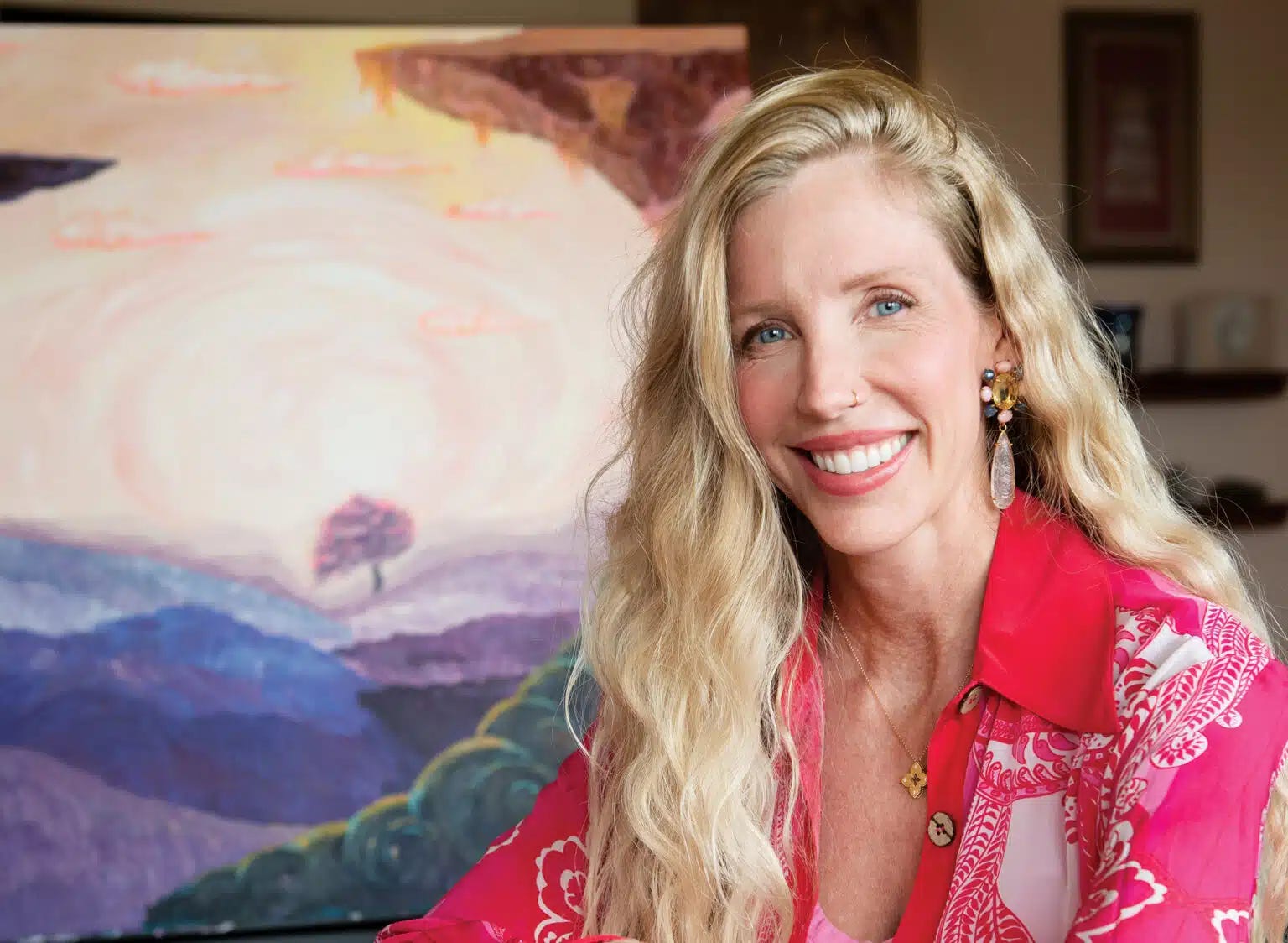
Let’s first visit the origin story.
Erin secured a summer internship at the end of her freshman year and began administrative work in a technology company. The company of fortyish people was quite self-reliant with limited administrative work to occupy her day. A learner by passion and entrepreneurial at heart (both mom and dad are creative entrepreneurs), she picked up a book on the Java programming language from the company library and began exploring a different kind of language. The prosaic book must’ve had a profound impact because she returned to the University of Iowa with a switch to now study MIS.

Graduation brought her full circle to a career in software development at the same company. As is customary for small software teams, she became a part of a team who captured user input about their desired systems, designed the user-interfaces, programmed the underlying logic, presented to the sponsors, trained the end-users, and managed the product post-deployment. This 360-degree view of the user experience inspired the latent entrepreneur to forge a new future for herself in 2007, just as the world was about to encounter a global financial crisis.
There is never a right time to start a new business except perhaps at the onset of an economic crisis. Incidence of entrepreneurship rises as big businesses falter and the motivated decide to bet upon themselves. Erin found herself in an executive suite, a euphemism for a 10x10 shared office amongst a sea of other independents running their businesses. She’d identified a need for billing and management software for small(er) independent law firms and contracted with her first customer.
She blogged to share the handful of mistakes made in the infancy of her business and their impact on how she evolved the young company. These insights, captured first in the blog and later in her first book, Soul Uprising, published in 2017 paint a candid picture full of vulnerability and discipline.
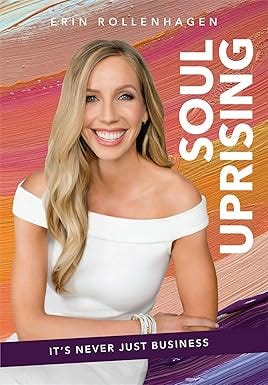
Through her own experiences creating and running Entrepreneurial Technologies, her book illustrates authentic leadership and resilience necessary to create the purpose-driven business. Personal anecdotes further make the business book part-memoir, part-instruction. I read the book nearly a decade ago, but my Kindle remembers what I found inspiring then. Those highlights remain true today as then in an entirely different life:
Feedback is good for sticking to the status quo. If you want to break new ground, you’re going to have to go against the grain
I got a harsh reality check one day when a colleague told me that my business wasn’t really making money unless we could pay me a fair salary and still have a profit on top of that.
A lot transpired since the publication of that first book. Entrepreneurial Technologies grew organically, engaging in customer relationships that honored the company’s ethos and a shared passion for success. Personal and professional challenges were consistent with growth of any business, but the company endured through the meaningful and trusting relationships with its customers and employees.
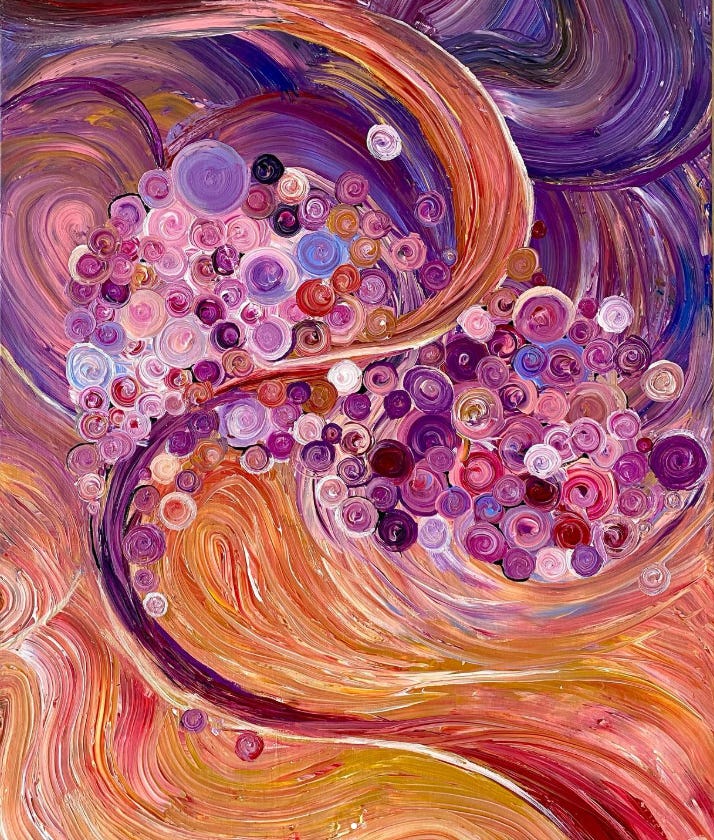
Although I had seen Erin’s artistic sparks at family gatherings through sketches and paintings before, she began sharing some of her larger canvases online. As she told Nicole Grundmeier of the Business Record in 20231, she was not only embracing the process of creating something beautiful rather than obsessing on a pre-ordained end-result. She was living the paradox of creativity where one must create something ‘ugly’ in order to create something wonderful.
Painting is a metaphor for technology because to be a true master of the craft, you have to spend a great deal of time just learning the parameters of the medium. What does it do well? What pushes its limits? What tricks does it have? Learning to express the fullest potential of the medium is the true art. It’s also true that the most successful paintings, like successful user interfaces, start with a plan for what I want the audience to focus on. Then the choices made about proportion, colors and shapes all follow that plan.
-Erin’s interview with Nicole Grundmeier, Business Record Photo Issue, June 2023
If you have followed this Creative Technologists series, you know I have a soft spot for polymaths who don’t just write code but also descend into its layers. As November 2022 brought consumer-grade AI to the masses, Erin began interrogating the technology from her customers’ point of view. Rather than just consume popular content regurgitated by consultants ad nauseum, she deployed a playbook of the past - study the science, inspect those who lean upon her for advice, prepare her perspective, and broadly share the learnings.
The lifelong learner enrolled in Wharton School of Business’ certificate program in Decision Making. As the world was hallucinating AI’s potential, she chose to condition herself and gain competence in the field, not just to satisfy her curiosity but also to imagine the innumerable ways in which those who trust her, employees and customers, could benefit from the newly acquired knowledge.
She knew there existed a segment of business who didn’t just want to do the work, they wanted to change the future through the work they did. Rather than a bland designation of product owners or customers, she chose to call such individuals and teams revolutionaries. And she began documenting this journey on LinkedIn as The Revolutionaries Notebook.
A particularly meaningful sentiment from the first post in the notebook is below.
What are the moments when the emotion kicks up a notch? Where’s the pain? Where’s the hope? Where’s the fear? You can almost always hear the pitch change in someone’s voice when they are talking, the moment when it flips from an analytical discussion to something they feel deeply. Pay attention to that moment - that’s where the opportunity lies. That’s the thing to prioritize.
The connections to hope and fear are powerful and embedded within each mammal’s amygdala. If we have evolved to instantly react to these emotions in matters of life and death, why ignore them in the software we write, experiences we design, stories we share, or photographs we capture? Erin’s paintings captured that for the walls in her home and her (then, to be) husband’s comedy club. Patrons of Teehee’s Comedy club were greeted with grand paintings with brushstrokes intrinsically connected to the improv on stage.
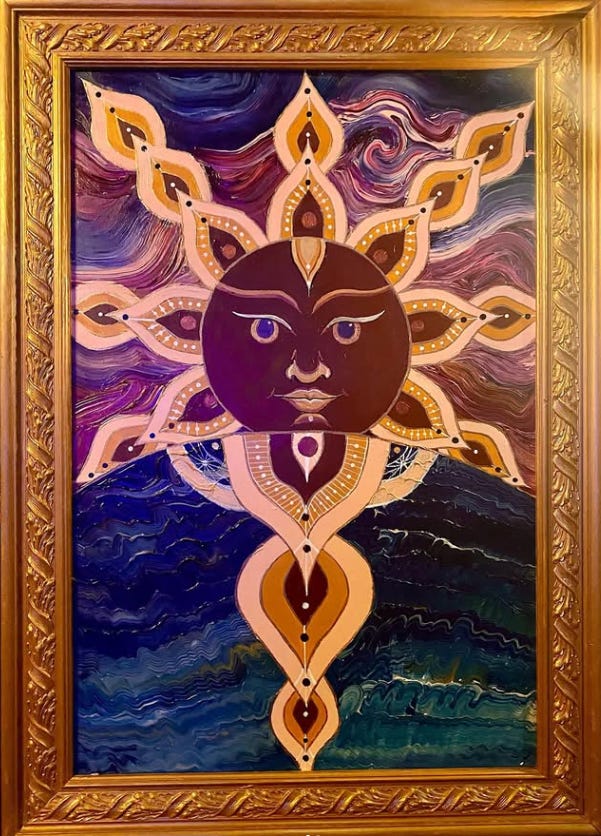
That’s another part about revolutionaries - they don’t exist in vacuums. A close friend and colleague with deep expertise in information and network security found her comedic voice and identity in that comedy club. I wonder if Antoinette was subconsciously inspired by the brushstrokes of her tech contemporary. I was reintroduced to poetry in the very room by the (then) CEO of Business Publications when her poetry was read aloud by professional stage actors at a Script-tease (not misspelled) event. I wonder if the actors found new inflections for Suzanna’s words in the art surrounding them.
Her paintings often feature bold colors and layered textures in contrast to the flat, minimalist "Material Design" that dominates our screens. Programmers laugh at ‘it’s a feature, not a bug’ in response to unexpected software outcomes. Sometimes, however, such unexpected features, the stray keystrokes and brushstrokes birth new textures and experiences in her art.
In a recent entry within The Revolutionaries Notebook titled “Why Great Colors Can Still Make Ugly Software”, she encourages revolutionaries to adapt their brand palettes to shift the user experience. She encourages leveraging the power of color to add balance to a page or a mobile screen, testing the alternative ‘dark mode’ to free the user from the lightness of white. The complete article is a lesson in balance, creative energy, inspiration and immersion. I like it so much that I’ll link it again below 😊
Why Great Colors Can Still Make Ugly Software | LinkedIn

Erin’s work continues to evolve in various media. She is an oft-sought guest on panels and keynotes, sharing her experiences and wisdom with audiences large and small. Her latest book was released just about a month ago. The book picks up from Soul Uprising and incorporates the revolutionaries from her LinkedIn series, delving deeper into the hopes, fears, emotions and actions necessary to build a great product. Although software runs through the book’s veins, the principles apply to building anything great with passion, purpose and people.
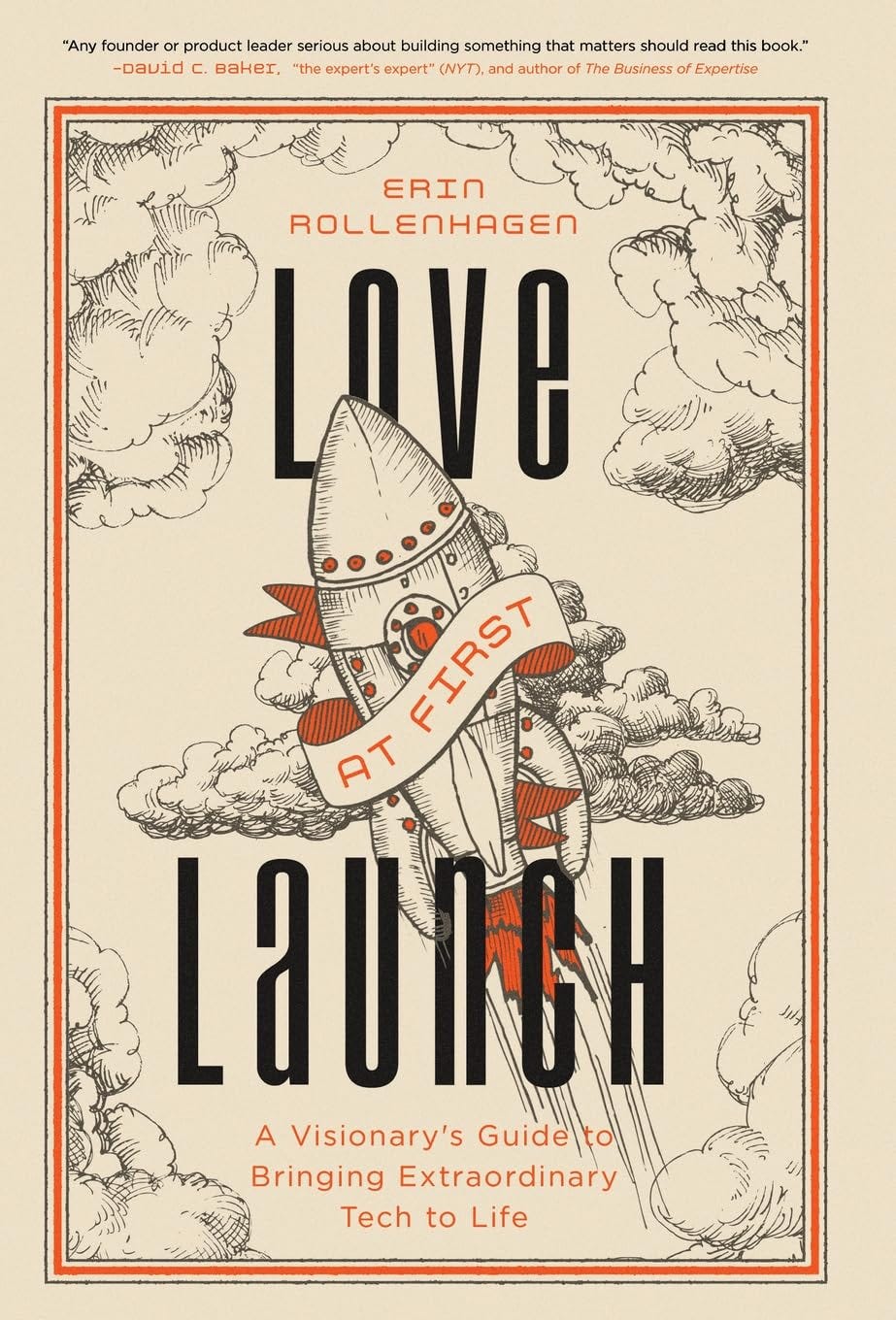
There are two vivid examples that make the book’s lessons memorable. The metaphor of red and green shirts instructs how a delicate dance between those who see the forest and have a vision to conquer it and those who identify with each tree in the forest and devise the plan to win them individually. Both are necessary and neither expendable, yet inadequate attention to the needs of the two can lead to perilous outcomes. The second vivid example is of visionaries everyone needs on their team including Journey Guides, Dragon Slayers, and the Simplifiers. My mind drove me to their analogs from Star Wars - Yoda, Luke and Obi-Wan respectively.
I believe the book is a wonderful parable worthy of an easy read before embarking on a product journey; I devoured it in a single day. The link here is to Amazon but the book may be available at your local book nook as well.
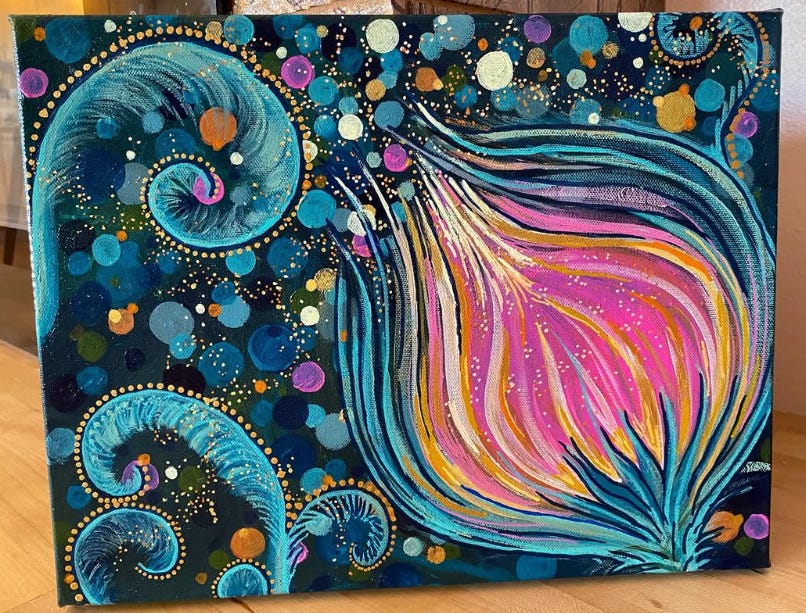
I’ll leave you with a piece Erin shared at the onset of Spring last year. The piece is titled “Pollination” and the acrylic on canvas was her inspiration to welcome spring on her own schedule, on March 1st (and not on spring equinox). If you want to check the validity of her decision, go search ‘meteorological spring’.
Creative individuals live and work across the state, in rural communities, suburbia and urban centers. They are writers, poets, singers, musicians, photographers, YouTubers, authors, speakers, podcasters and so much more. The Internet has given them the world as a potential market, and many are creating their own versions of the Silk Road. The Okoboji Writers and Songwriters Retreat is one such venue where creatives assemble to share, expand, and hone their craft.
Most are independent, individual, and creative in their special spaces - be it a comfortable nook, an intimate stage, a pottery studio or even a car on the open road. They may not be building IPO-ready businesses yet are creating a life and livelihood unique to their need, passion, and initiative.
No posts
Comments
Nothing yet. Say the first thing.
Sign in to join the conversation.