
The assignment from my writing group is to pay attention to liveness and this morning I notice the trees are talking. I am standing in the open doorway looking out at the back yard, not going out because it is raining, just greeting everything, and the way the branches of the maple are swaying seems suddenly, undeniably, like speech.
The online yoga teacher says breath is spirit, and if breath is spirit then surely wind is spirit, and here it is made visible: the wind allowing the tree to speak, not my language but something adjacent to my language, not my English language but maybe my other language — I feel suddenly and delightfully looked at.
I go inside. The place where I sit in the mornings, first to drink coffee and then to write, is in front of a window that looks out at this same tree. Its branches are still moving, but in here I am a viewer of the conversation, like the window is a movie screen. I wonder whether we can learn to communicate through the glass.
I’ve developed a complicated routine where I move my desk multiple times a day. I feel very strongly about looking out the window. I don’t like facing into the room. The first thing I do is light a candle. They are small meditation candles, designed to burn for twenty minutes, and they work near perfectly. I light the candle to do something adjacent to meditation which is really drinking coffee while staring out at the back yard, and sometimes writing things down in my journal. I can’t bear to have a table between me and the window while this is happening. If the window is a television screen the table is a wall. So the desk starts out to the side.
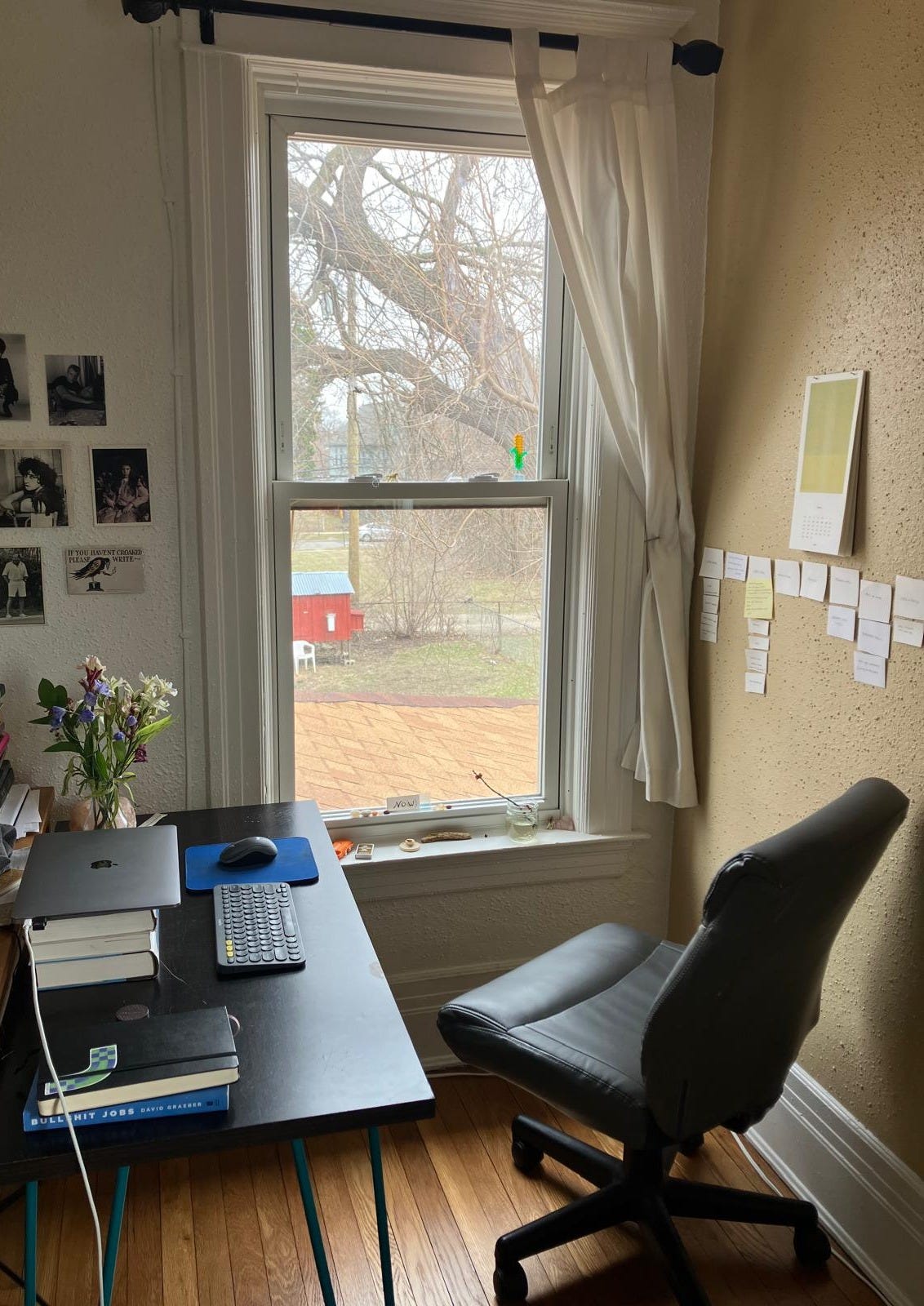
Once the 20 minutes is up and I begin working, it seems like it would be fine to turn to the side in order to work at my desk. It is not. The room, even when clean, feels visually chaotic; I have to look out the window. So I move my desk. Luckily it is not heavy. Here it is now, as I am writing to you:
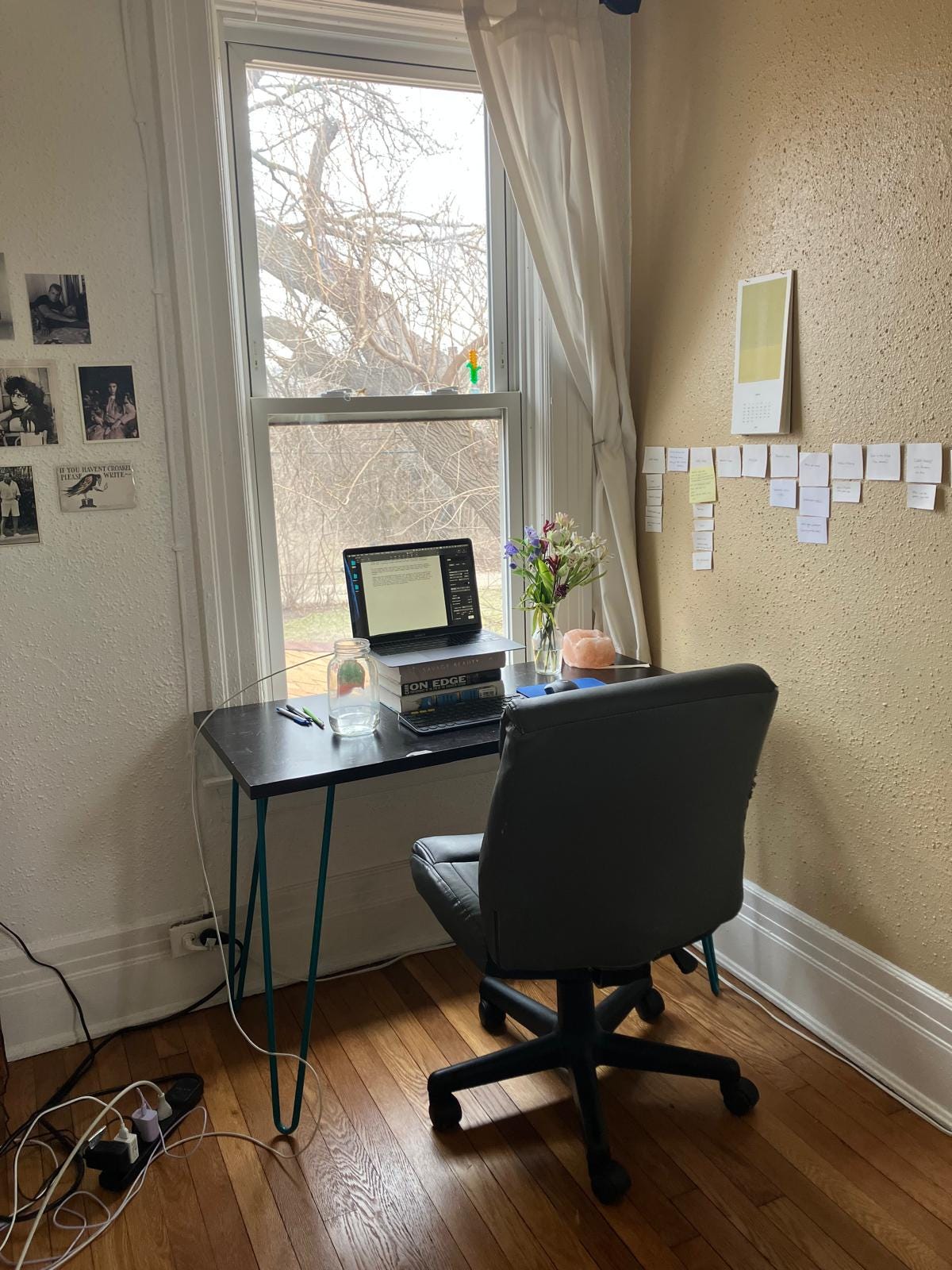
This is my report from the job site.
It is great here today. It is not always great, but today it is great, and many days, actually, it is great.
I got unemployment — for any regular readers who were wondering — I wasn’t sure if I would, since when you get fired it all depends on what you say and what your employer says and if they match up. But I did, and that too is great. It feels like a miracle, actually, that this social service exists, like finding one high-speed-rail route that runs the exact commute I need though an otherwise train-less suburban landscape. I feel almost embarrassed by my luck. Oh, says my brother, when I tell him, so you’re just gonna live off the government for a while, huh? In case you can’t tell from this comment, my brother works a job that pays him richly for his labor, perhaps too richly, even by his own account. I don’t bother with a speech about how art is not a business, how using taxpayer dollars on art is a necessary counterpoint to private patronage. I make a funny joke that if six months of unemployment insurance is what we have left of the NEA, I’ll take it. It doesn’t really land. Yes, I finally say, I’m going to live off the government. Isn’t that great?
It’s not that I haven’t had some qualms about unemployment insurance myself. When I got it briefly during Covid, I remember researching to make sure there wasn’t a numeric cap, a specific and limited number of people who could receive it, in which case I felt it shouldn’t be me. (There isn’t a cap.) And this time, I found myself researching where exactly the money comes from, not because I feel guilty about it exactly, but maybe to have an answer for people like my brother about whether my weekly payment has come from their pocket. Turns out it’s a fund all employers are required to pay into, a kind of business tax. Individual taxpayers do not contribute to unemployment insurance.
This is my report from the job site, where this week my tasks range from the abstract (look for liveness)
to the esoteric (read about the Greeks pulling their visions down from the heavens with white oxen)
to the concrete yet fictional (does the play end with a card game or should there be a final scene among the beans?)
to the promotional (how do I make a flier on adobe express dammit)
to the relational (send me pages, I’ll send you the flier, can we have coffee?)
to the educational (Lyanna talked during check-in today about dreading sex ed… can we work this into the play?)
to the applicational (can I cut and paste for this or am I gonna have to write a whole new artist statement?)
The job, here at my desk, is to toggle between the above tasks. Like any job, sometimes the meaning drains out and the tasks become an endless line of check boxes, just rearranging different words on different pages until you can close the computer. But more often, if I wait patiently, the task opens to me, and the color floods back.
I thought I should issue a report from the job site to let you know how things are going, because last month I told you how scared I was. I’m still scared I guess; I can’t look my calendar in the eye without getting panicky that I’m not using the time well enough. But this is a general life problem, not a writing-specific one, and it turns out whatever difficult things your mind does, it will do them MORE LOUDLY the more you are alone and making decisions about your own time. At the moment, I’ve accepted it as a reasonable downside to an otherwise excellent job.
**
My favorite book I read last year was Bullshit Jobs by David Graeber. When people saw me reading it, they tended to assume I considered my own job (bartending) a bullshit job, and that I was looking (in this book) for an escape path. Neither were true; by both my and Graeber’s assessment bartending isn’t a bullshit job. Rather, I was drawn to the book because it opens up a space to consider, and to trouble the notion of, jobs themselves.
Graeber debunks, over and over, the belief that there is a correlation between the amount someone is paid for a job and its societal value. (In fact he implies that if there is any correlation to be found, it is often an inverse correlation.) He speaks of the spiritual cost to spending your life doing work you feel is meaningless, especially when the rewards of status and money you receive mean you have to keep that meaningless feeling to yourself. Graeber interviews people who choose to keep these jobs despite their spiritual violence (his words) because they need the financial security. He talks to people who give up that security for more meaningful work. And he talks to people who drop out of “professional” life to do lower-paid jobs (like bartending) whose purposes are not lofty but also not obscure so that, when they clock out, they can turn their minds to other things.
This isn’t to say all high-paid jobs are meaningless, or that most jobs aren’t a more complex blend of bullshit and not-bullshit. The core argument is that we live in a society where making a living and making meaning are two sides of a venn diagram; some people find a way to work in the overlap, but for many, that sliver is too constricting. This is a plain truth in the arts sector, but what a relief to hear it spoken about as a broader societal truth. It really cured something in me.
Similarly, it has cured something in me to get paid $446 per week to work on exactly the things I want to work on. No matter that it’s accidental, that according to the record I’m getting the $446 for being insufficient at another job rather than sufficient at this one. The experience is working in me regardless. It’s bringing into focus what I want to accomplish, allowing me to physically rearrange the room of my life, and I’m hopeful some of that furniture can stay in place when I go back to work.
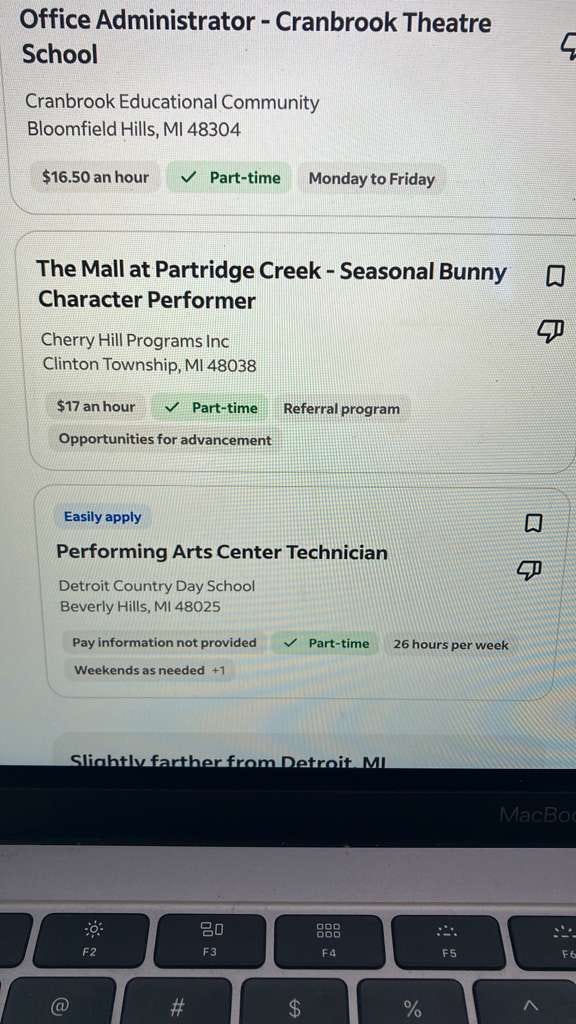
Because I will, of course, need to find a new job a few months from now. And this is okay too: jobs bring an influx of people and ideas and energy, even if they do steal time. To continue getting unemployment, you have to report at least one job application per week (a very reasonable standard!), so I keep my Indeed tab open. Recently saved jobs include: creative writing teacher (remote), learning center tutor at a community college, adjunct professor of humanities (unclear what classes and if they’re actually hiring), admissions reader for a nursing program, server at a country club, and administrative assistant at a funeral home. (I went down a funeral home rabbit hole; that’s a whole other conversation.)
While I’d love to find something I’m truly excited about, I don’t waste time thinking there’s some platonic ideal of a job out there waiting for me. (What about that creative writing instructor job?! you say. I haven’t had the interview yet, but I suspect that job is 3-5 hours per week.) I think part of the trick of jobs is riding the pendulum swing — knowing when you need a change without assuming the change is a permanent solution.
**
One thing Graeber doesn’t really address is the friction that comes with choosing a service industry or otherwise low-wage job when you have, or seem to have, other options. I mean this both in terms of representing yourself to people in your life and in terms of relationships with coworkers. I’m noticing how this gets more dramatic as I get older. Lots of people with education, class mobility and even money are working wage jobs in their 20s; less so in their 40s. The older I get the more my coworkers seem confused or even suspicious of my choices. Am I cosplaying some working class life?
Even by writing to you here about my unemployment and job search, I worry that I am telegraphing some starving artist narrative, or allowing you to land on that assumption because it is so familiar. The truth is, I probably wouldn’t still be pursuing this career path were it not for a series of privileges, particularly ones that have come into view in the last 5-10 years. My partner comes from a family with more money than mine, which has created, in recent years, a substantial sense of security. Similarly, my brother’s professional ascension to overpaid coder, as much as I snark about it, has given me the relief of knowing that if my parents had a large and unexpected emergency, he would be able to help them.
Maybe where Graeber’s analysis leaves off is actually mine to fill in: the way being an artist is almost always a paradoxical mix of class experiences. It’s an outline shaped by a personal level of risk tolerance combined with how many safety nets you can or cannot see spread out below you. I think there is something useful in holding this mixture up for people to see — letting it trouble notions of success, of work, of privilege, and what priorities a person might organize their life around.
So this is my report from the job site, where today’s Indeed search using the term “theater” returns the job Mall Bunny (but there are opportunities for advancement! to head bunny, perhaps?) and the tree outside my window is waiting patiently for me to return my attention to her. If I get a few more pages written about the old people who play cards, the day will be a success. Either way, dinnertime will come and I will close my computer and clock in again tomorrow. I am riding this high-speed rail through a depraved landscape. Another report will follow.
No posts
Comments
Nothing yet. Say the first thing.
Sign in to join the conversation.