
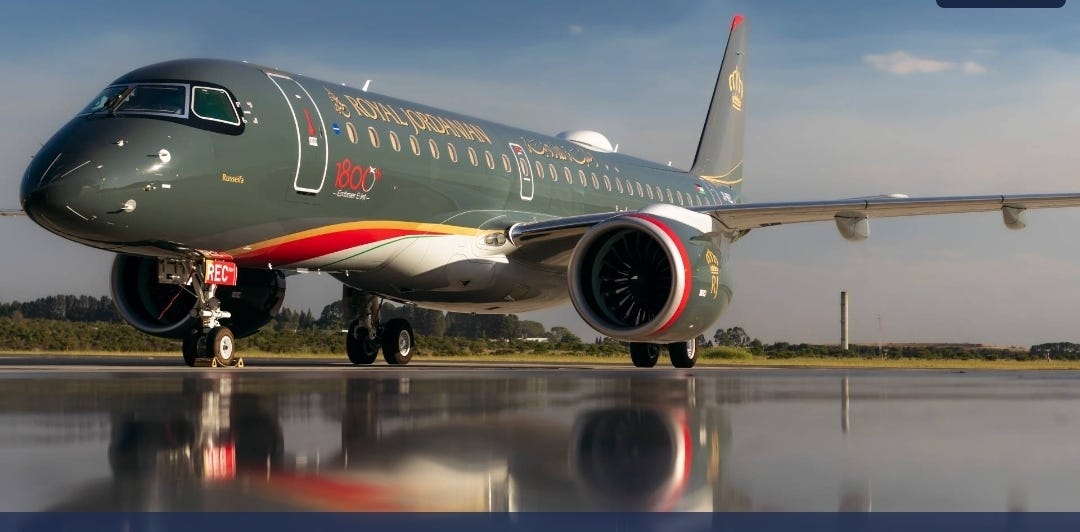
For more than a decade, Yemen's skies have symbolized the country's political divisions. Every aircraft landing at or departing from Sanaa has represented far more than civilian transportation—it has reflected the struggle for legitimacy, sovereignty and regional influence. Jordan's initiative to establish regular commercial flights between Amman and Sanaa therefore carries significance well beyond aviation. It is a humanitarian proposal with potentially far-reaching political consequences.

The initiative has received swift endorsement from Saudi Arabia and Yemen's internationally recognized government, both of which describe it as a practical measure to ease civilian suffering. Yet its success ultimately depends on the response of Ansar Allah—the Houthi movement that has controlled Sanaa and much of northern Yemen since 2014.
The proposal arrives at one of the most delicate moments in Yemen's recent history. After several years of relative calm following the 2022 UN-mediated truce, tensions have risen sharply. Airstrikes on Sanaa International Airport, missile attacks on Saudi Arabia, and renewed regional confrontation have exposed how fragile the ceasefire has become.
Against this backdrop, Saudi Arabia's support for regular civilian flights reflects a notable evolution in its Yemen strategy. Having spent years pursuing primarily military objectives, Riyadh increasingly appears focused on containing conflict while reducing humanitarian pressures. By welcoming Jordan's initiative, Saudi Arabia is attempting to separate humanitarian access from military confrontation.
The internationally recognized Yemeni government has likewise embraced the proposal, arguing that regular flights through internationally accepted procedures demonstrate that humanitarian relief can coexist with state sovereignty. Officials contend that previous efforts to operate Sanaa Airport legally through Yemenia Airways were repeatedly obstructed by the Houthis.
The central question now is whether Ansar Allah views this initiative as an opportunity—or as another arena for political contestation.

That question has become even more significant following the latest televised address by Ansar Allah leader Abdul-Malik al-Houthi. Rather than emphasizing compromise, al-Houthi framed recent developments as part of a wider regional struggle involving Saudi Arabia, the United States and Israel. He warned that any renewed Saudi military escalation would be met with reciprocal attacks against Saudi airports, ports and oil infrastructure, declaring a strategy of "airports for airports and ports for ports." He also portrayed the movement's regional alignment with Iran as a strategic success rather than a liability.
His speech illustrates the dual nature of the current moment. Militarily, Ansar Allah seeks to project deterrence and resilience. Politically, however, it governs millions of Yemenis whose daily needs cannot be met through military rhetoric alone.
This is where Jordan's initiative assumes strategic importance.
The proposed air link does not alter the military balance in Yemen. It does not recognize Houthi sovereignty, nor does it weaken the internationally recognized government's legal position. Instead, it offers something much more practical: restoring a degree of normal life to civilians trapped by war.
For ordinary Yemenis living in Houthi-controlled areas, the impact could be transformative.
Patients requiring specialized treatment abroad would once again have a predictable route to hospitals.
University students could travel to pursue education without navigating dangerous land routes.
Families divided by years of conflict could reunite more easily.
Business people could reconnect with regional markets, while humanitarian organizations would gain more reliable access to affected communities.
These may appear modest achievements, yet after years of isolation they represent profound improvements in everyday life.
The significance extends beyond Yemen itself.
Jordan has positioned itself as a trusted intermediary capable of facilitating humanitarian engagement without becoming a direct participant in Yemen's political conflict. Saudi Arabia's endorsement further indicates that regional diplomacy is increasingly prioritizing stability over escalation.
Nevertheless, formidable obstacles remain.
Security concerns continue to threaten civilian aviation. Recent exchanges between Saudi Arabia and the Houthis—including attacks on airports—demonstrate how quickly military developments can disrupt humanitarian progress. Technical issues involving airport management, passenger security, insurance and international aviation standards must also be resolved before regular flights become sustainable.

Equally important is the political symbolism.
If Ansar Allah accepts the initiative without obstruction, it could signal a willingness to distinguish humanitarian needs from broader geopolitical disputes. If it rejects or impedes the proposal, millions of civilians would once again bear the consequences of political deadlock.
History shows that confidence-building measures often precede successful peace negotiations. Restoring civilian transportation has frequently provided divided societies with opportunities to rebuild trust before comprehensive political settlements become possible.
Yemen remains deeply fragmented. The country continues to face economic collapse, institutional division and one of the world's gravest humanitarian crises. No single aviation agreement can resolve these structural problems.
Yet humanitarian diplomacy often succeeds where political negotiations fail.
Jordan's proposed flights between Amman and Sanaa offer more than a transportation corridor. They represent a test of whether competing actors can place civilian welfare above military calculations, even if only in one limited sphere.
Ultimately, the future of this initiative will not be measured by the number of aircraft that depart Amman each week. It will be measured by whether sick children reach hospitals, students reach classrooms, families embrace again, and Yemenis begin to recover freedoms lost during years of war.
In a conflict defined by blockades, missiles and competing claims to legitimacy, reopening the skies may prove to be one of the few decisions capable of delivering immediate, measurable hope. Whether that hope evolves into broader peace will depend not on speeches alone, but on the willingness of all parties—including Ansar Allah—to allow humanitarian necessity to prevail over political confrontation.
Mohamed Mohamoud Adde is an academic and a geopolitical analyst
No posts
Comments
Nothing yet. Say the first thing.
Sign in to join the conversation.