
By now, you’ve surely seen the memes: everyone’s becoming Chinese. In what feels like an episode of sleep paralysis, I woke up one day in January in the cultural upside-down. Here, the people who once pulled their eyelids to the side and yelled “ching chong” when I walked past them, the same ones who shoved our elders to the ground and spat in their faces during COVID, can now be found Chinamaxxing. They’re wearing Tang jackets, drinking hot water, and celebrating the year of the Fire Horse. I want to hold a mirror up to their hypocrisy, to the privilege of trying on cultures as a seasoning for the beige-ness of one’s own, but that would make me a hypocrite. I can’t front. I’m trying to do the same thing.
I, too, am in a very Chinese time in my life. The most Chinese I’ve been since I gained consciousness, probably. In the same way that the fish doesn’t recognize the water, being Chinese wasn’t part of my identity when I lived in China. It was only brought to my attention after I’d left, by those who saw me from the outside. In North America, it became a mark on my back—a trait I didn’t want to be defined by, but was nevertheless made to be the most important thing about me. “Chiny,” my classmates called me in grade school. “Chink,” strangers would say on the street. When we became Canadian citizens and in doing so, relinquished our Chinese passports, the naive child who chose to go by Tracy instead of Tian thought it might be the end of it.
The calls came from inside the house, too. My attachment to Chineseness was pushed away by relatives who made fun of my diminished ability to speak and understand Mandarin, parents who rejected the core units of who I was shaping up to be, and my own desperate attempts to assimilate into these new worlds. I became fluent in their languages, consumed their cultures, cooked their food, giving up any mental real estate occupied by the Chinese part of myself. These camouflage tactics didn’t work too well. The mark remained: too Chinese to blend in, too foreign to go back to where I came from. Decades of my life were spent here, floating in the muddied waters of the in-between.
I can’t say with certainty when I started wanting to be Chinese again, but I know that meeting Eva had something to do with it. She’s the chef behind Yan Dining Room, a tasting menu concept held in a private dining room in Hong Shing. Before Yan, Eva was at Momofuku Kojin and Avling, which is where I first tasted her food. Through this food, we became friends. And through this food, I found a version of Chineseness that I felt at home in.
In its own words, Yan’s tasting menu serves “Neo-Chinese cuisine, blending traditional Chinese culinary techniques with fresh, local, and seasonal ingredients.” It’s a culinary point of view that bows with reverence to heritage while orienting itself towards the future—a future where Chinese food is not condemned to its static forms in the name of preserving authenticity, but allowed to shapeshift.
Yan’s dishes reflect the time and place that they were created in, instead of adhering to the customs of a place that no longer exists. It’s diasporic cooking, a regional Chinese cuisine delineated not by borders but by cultural identity, planted by those who’ve brought a piece of their hearts and sown it in their new lands. This is the version of Chineseness that I pledge my allegiance to.
The menu changes as ingredients come in and out of season. Eva’s background—Hawaiian-Samoan-Singaporean-Chinese—often surfaces in these dishes, buoyed by memory. How her mother made dumplings. The traditions she inherited from her father. Not everyone wants their food to be seasoned with personal history, but I relish it: it is through these stories that I glimpse an alternate reality, the self that I could have become if things had turned out differently.
January’s menu was inspired by a smattering of dishes traditionally consumed in the ramp-up to Lunar New Year. It showcased the flavours of Chaoshan alongside the techniques of Hunan, the sea of China’s coastal cuisines and the ferments of the north, all interpreted through the language of local ingredients. It also exemplifies what I’ve come to understand as Eva’s approach: elemental, autobiographical, and transmutable. Ingredients become conceptual and cultural building blocks that, when swapped out and substituted, evoke the uncanny sensation of a familiarity you’re meeting for the first time.
A sampling:
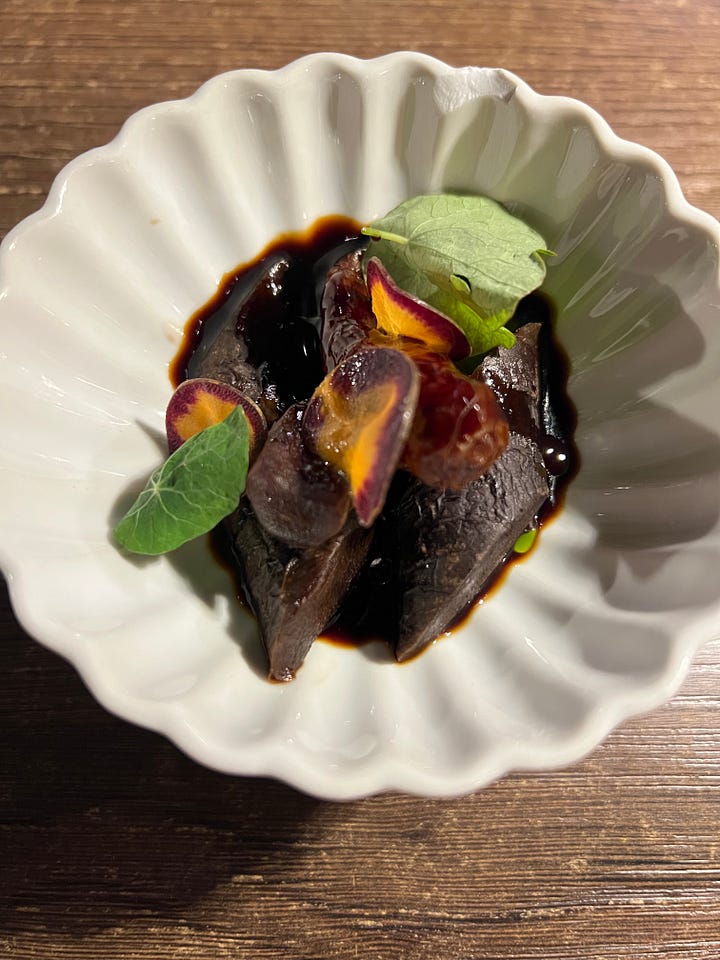
Hongshao (red braised) carrots instead of pork belly, carried by the depth of caramel, soy, and red yeast rice, made round in the mouth with a brown butter reduction—
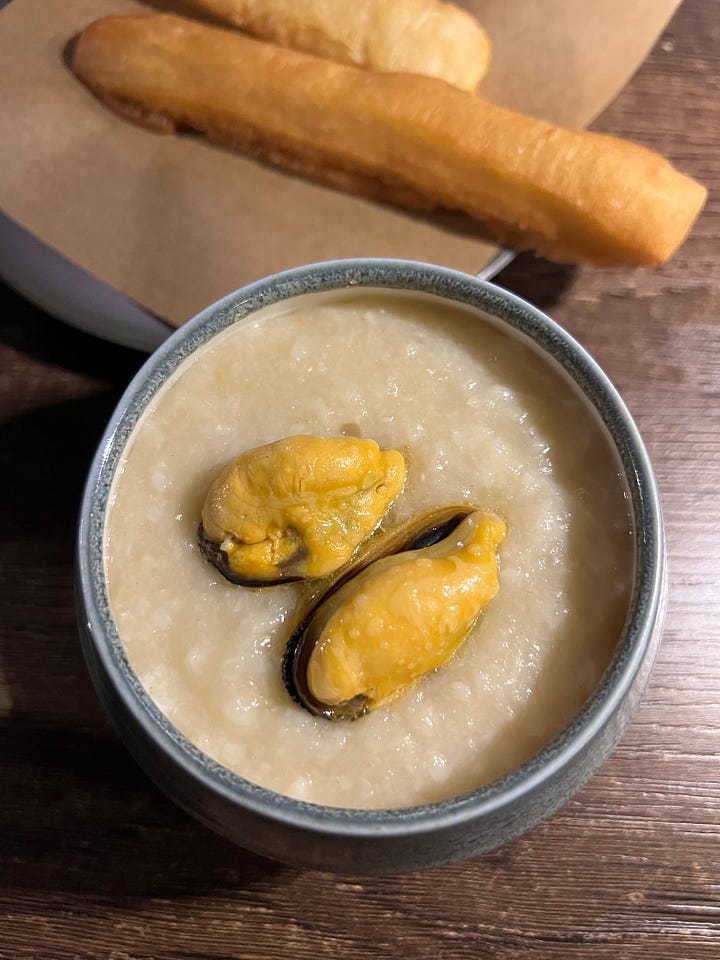
Scallop congee topped with honey mussels, concealing in its simplicity flavours as profound as the sea of their provenance—
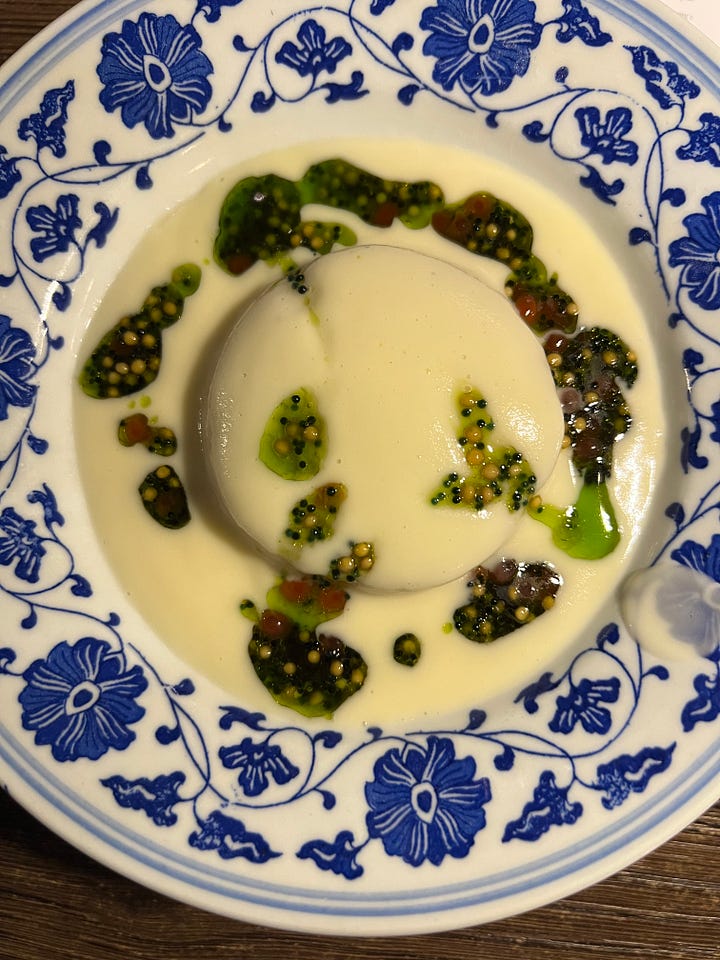
Braised daikon farced with shrimp and blanketed by an emulsion of its own flavours, layers of seafood harmonies punctuated by a dilly-mustard interlude—
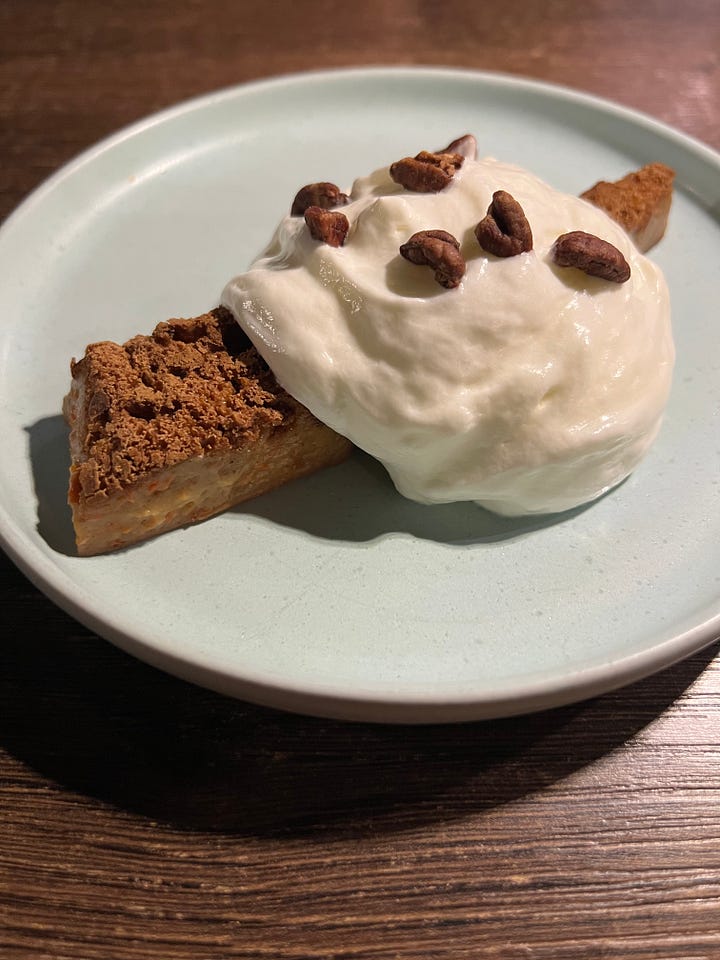
And for a playful twist on a dim sum classic, Lo Bak Go (which translates to turnip but also carrot cake) reimagined as dessert—bouncy niangao instead of cake, fluffy imperial yogurt instead of cream cheese icing, and hickory nuts in place of the traditional walnuts.
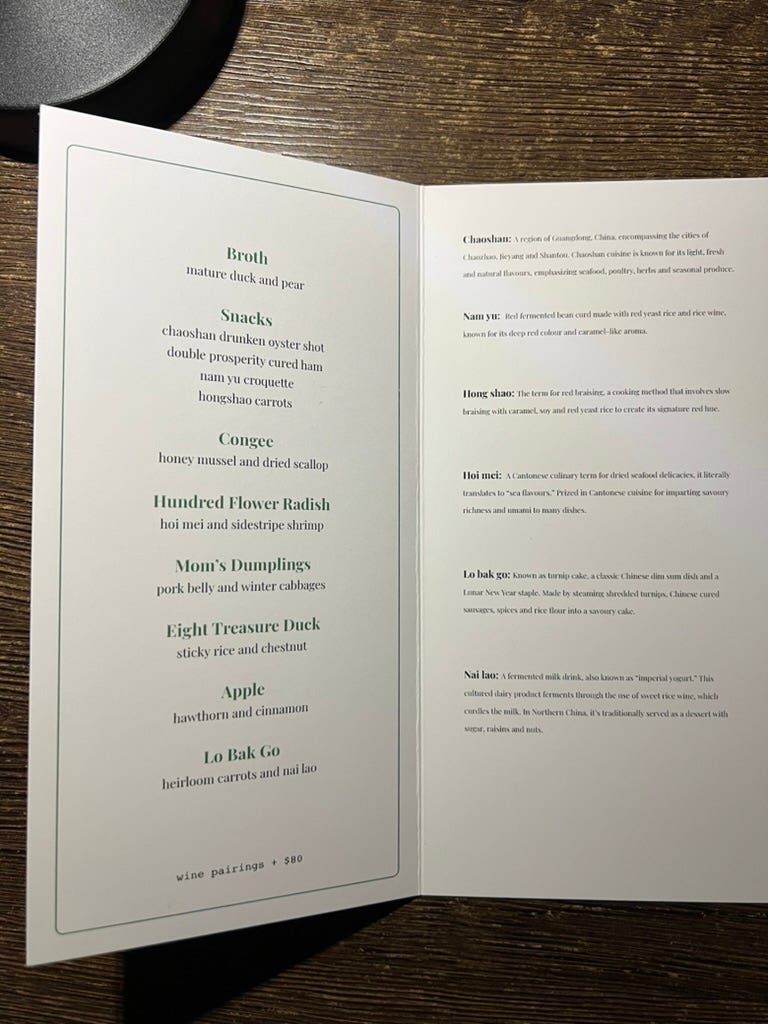
In these dishes I taste my lived experience: evidently Chinese, and equal parts something else. Both from there, and here. A Chineseness that does not depend on geographic ties or language fluency, but a love for the rich culture that underpins our identity—and the agency to build on that foundation using the materials available to us. This is how a culture evolves, how it’s kept alive. It’s how I’m keeping that part of myself alive, too.
That night, I pored over Yan’s menu with avid interest, like someone coming to a map for the first time. Once, I used to be ashamed of how little I knew. Now, I know that shame is not a great teacher. To a degree, I empathize with the Chinamaxxers: how could I fault anyone for consuming Chineseness, when I am a student in the same school? I, too, am guilty of eating the other, of attempting to absorb a culture through its food. It just happens to be my own.
Yan Dining Room
195 Dundas St W
Toronto
No posts
Comments
Nothing yet. Say the first thing.
Sign in to join the conversation.