
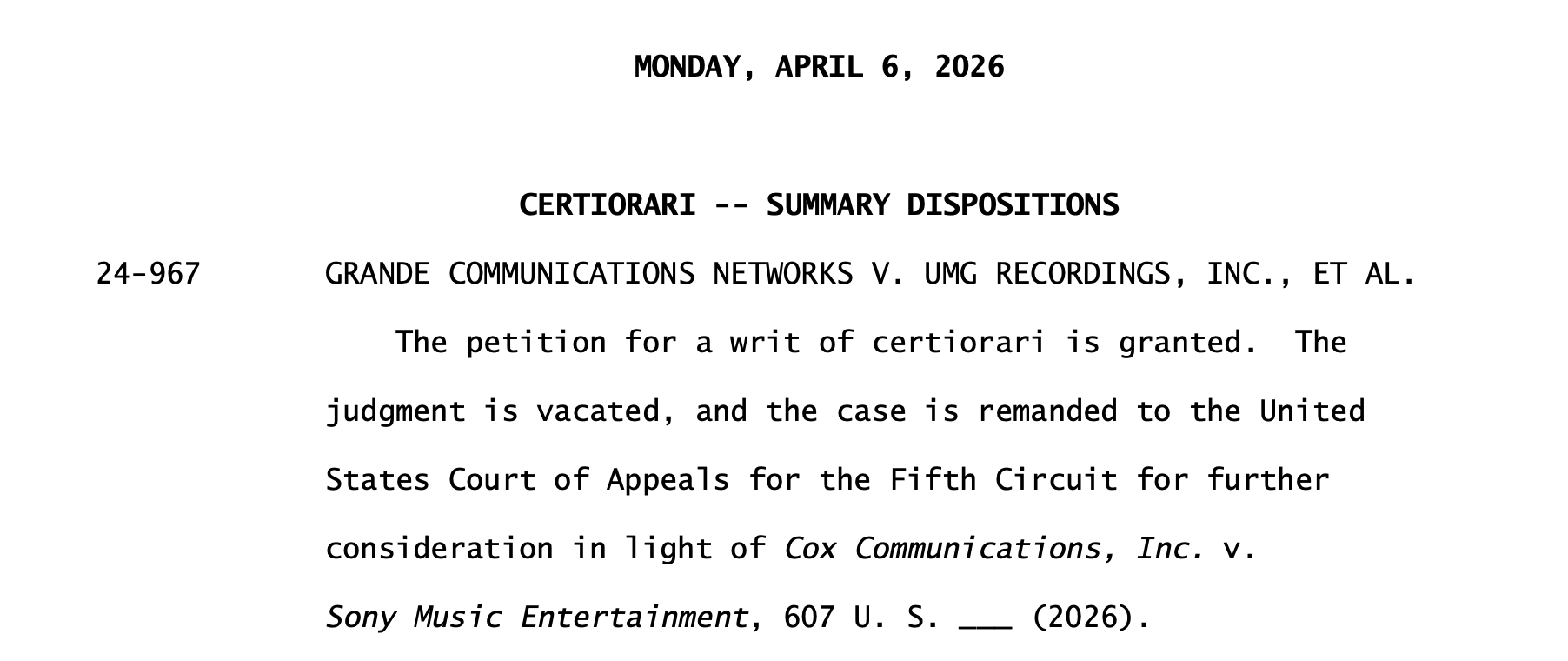
Welcome back to 14th & Colorado! Today’s post will cover the alphabet soup of summary dispositions (“grant vacate and remand” and “dismissal as improvidently granted”), as well as a revisit the value of concurrences.
May 15 was a big day at the Texas Supreme Court for concurrences. In Noyes v. State, involving the Second Amendment, Justices Sullivan and Hawkins wrote separate concurrences. Justice Sullivan’s concurrence was a tour through English and American history, as the U.S. Supreme Court’s Bruen test demands, assessing whether permanent disarmament of a party without a finding of dangerous passes constitutional muster following the U.S. Supreme Court’s decision in Rahimi. To quote Justice Sullivan “spoiler alert”—it doesn’t (based on his preliminary review). Justice Hawkins’s concurrence raised an interesting procedural issue at the Court—how the Court handles a petition when an intervening decision of the Texas Supreme Court or U.S. Supreme Court materially informs or changes the outcome, but the lower court didn’t have the opportunity to consider it. Enter the GVR—grant, vacate, and remand.
As readers of this Substack know, the Texas Supreme Court has moved a bit closer to the way the U.S. Supreme Court operates with the 2026 amendments to the Rules of Appellate Procedure. The biggest change in the last thirty years (since moving from writs of error to petitions for review) is the move to grants before briefing. The Court has also expressed (in its summary of procedures) a potential interest in more error correction through per curiam decisions. That process could entail relying on the court of appeals briefs, along with the petition/response/reply and issuing a per curiam. Other things cropped up even before the rule changes, as well. For example, in 2024 the Court provided some much-needed clarity and refinement to the standard for granting temporary relief, a.k.a. a stay pending appeal/mandamus. The standard espoused in In re State moved Texas courts to something more akin to the federal courts’ NKen factors—likelihood of success on the merits is the primary consideration. The Court, as well as several intermediate courts of appeals, have also adopted the practice of granting administrative stays.
The latest suggestion from Justice Hawkins is that the Court embrace GVRs. As he notes, the U.S. Supreme Court issues many of these “summary dispositions” in a term. The Texas Supreme Court, by contrast, has issued relatively few. In his view, doing more of this could lead to greater efficiency for the Court and litigants
Justice Hawkins noted approximately a dozen true GVR’s in the Court’s history, with most of them in the early 2000s. He also noted that many per curiam decisions had the effect of a GVR. So what’s the difference?
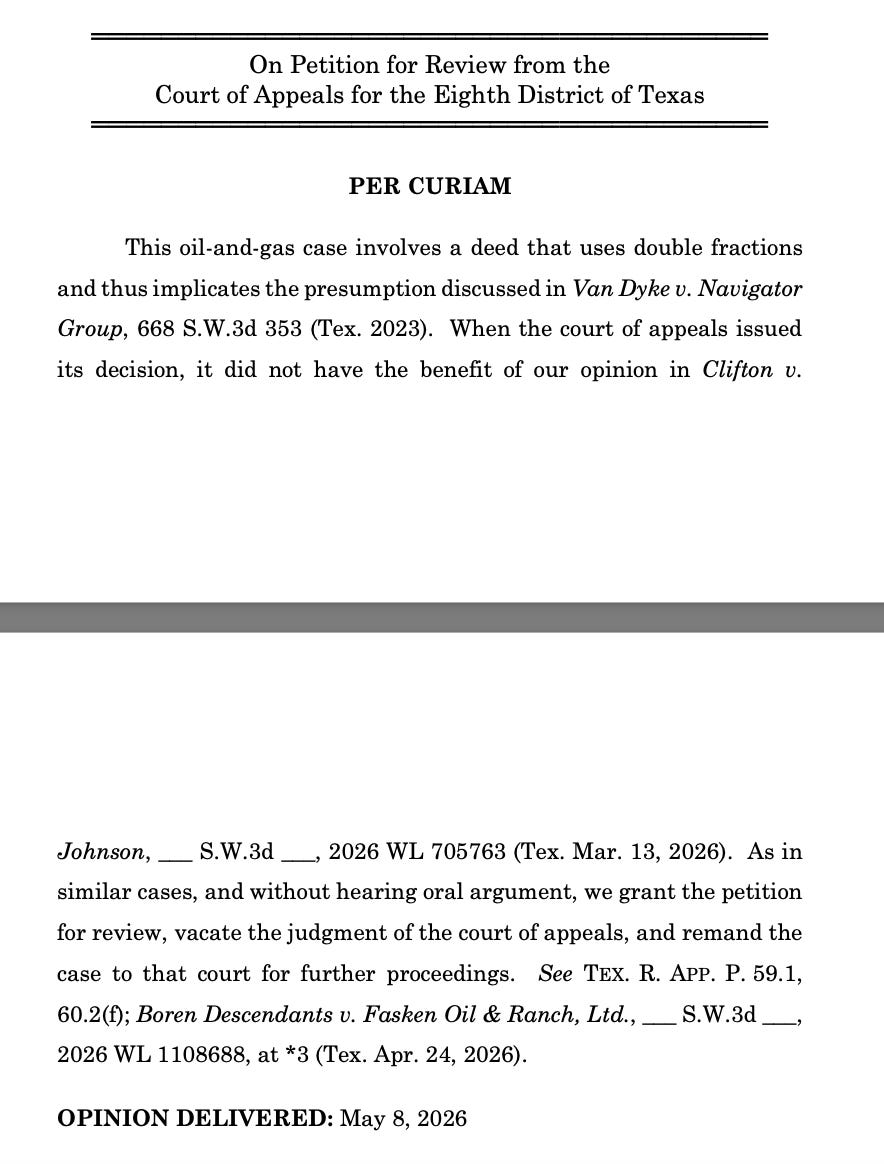
GVRs are based only on the petition-stage filings. Justice Hawkins noted the Court’s most recent GVR, issued just a week earlier on May 8, in Karli. That case was one of the many “multiple fraction” oil and gas cases the Court has encountered since its decision in Van Dyke v. Navigator Group. The Court’s decision earlier this term in Clifton v. Johnson may have some impact on multiple fraction cases (though it is still unclear how much). So the Court GVR’d the case for further consideration in light of Clifton. In contrast, per curiam decisions that function like GVRs are typically issued after full merits-stage briefing. Just a few weeks earlier, the Court “PC’d” Boren Descendants v. Fasken Oil in light of its decision in Clifton. That case had been through full briefing and was clearly being held for Clifton.
Some of this phenomenon (and divergence from SCOTUS) is a byproduct of the Texas Supreme Court’s three-decade briefing-before-grants system. Several cases may have received merits brief requests with similar issues before a decision was made to grant one of the cases. Indeed, the timing was such in Boren Descdants—briefing was requested in June 2025. Argument was not granted in Clifton until September 2025. Had the new system been in place, Boren Descendants may have been eligible for a true GVR instead of a PC—Clifton might have been granted much earlier. It, at least to some extent, is the luck of timing of the petition that Karli got a GVR instead.
I anticipate that things will be different now. With grants-before-briefing, the Court will need to make its decision based on the petition package. So we should see fewer PCs that act as GVR’s. But the Court may have to be even more circumspect about which case to grant. It will not have the luxury of development through merits briefing to evaluate the vehicle and quality of advocacy in a case. So, if one petition is ahead of the other, but the Court isn’t sold that it’s the right vehicle, cases could sit longer while the Justices decide which is the better vehicle. Otherwise, another SCOTUS phenomenon may appear: the Court may dismiss a case as improvidently granted (DIG).
Perhaps the most interesting thing—and something I’ll come back to at the end of this post—is Justice Hawkins’s invitation to parties to alert the Court in the petition to a case’s fitness for GVR. As I’ve written before, concurrences have significant value. The justices often telegraph their interests. The Court’s new summary of procedures suggests it may engage in error correction without briefing, in some instances. Indeed, some petitioners have noted that their case is a candidate for a per curiam opinion. Justice Hawkins now invites petitioners similarly flagging candidates for a GVR.
One thing Justice Hawkins doesn’t discuss is the Court’s unusual process of posting a per curiam (even if a “true” GVR) and putting it on the Friday orders like any other opinion (as pictured below). True, there is little skin off anyone’s back to write a paragraph, as the Court did in Karli v. Wilson. But the U.S. Supreme Court handles these on the orders list (as seen at the very top of this post), rather than in a separate opinion (though, unlike at SCOTX, the SCOTUS orders list is a PDF). The few line order states that the petition is granted, the judgment is vacated, and the case is remanded to the relevant court in light of the decision leading to the GVR. Perhaps we’ll see the Texas Supreme Court make this shift, as well.
Occasionally, the U.S. Supreme Court will “dismiss as improvidently granted.” Put simply, this means the Justices have concluded it was a mistake to agree to hear the case. There are any number of reasons this could happen. SCOTUSBlog provides three situations resulting in a DIG:
First, the court will dismiss a case when the justices discover a procedural problem. They might take a case to decide an important constitutional or statutory question but then discover technical problems as they look more deeply. For example, they might see that the parties do not have proper standing (that is, a legal right to sue); that the issue was not raised or decided by a lower court (which means it cannot be brought up on appeal); that the lower court ruling was not a final judgment and so not fully appealable; that the case is narrower and more fact-specific than it appeared in earlier reviews; or that the case is moot (that is, no longer a live controversy).
Second, the court may dismiss a case when the justices feel that the issue being argued is not exactly the same issue that was first raised in the petition that the court agreed to review. This may, on occasion, be referred to as a “bait and switch,” a practice that is apparently of increasing concern to the justices. For example, [in March 2025] during an oral argument in a habeas corpus case, Rivers v. Guerrero, a frustrated Justice Samuel Alito observed to the lawyer representing the prisoner whose petition for review the court had granted, “Well, we’ve had a mini-epidemic of cert petitions that have convinced us to take a case because there’s supposedly a conflict [between the appeals courts] on a certain issue, and then once cert is granted, the argument that is advanced by the petitioners, [is] quite a bit different from what we were sold at the petition stage. Is this another outbreak of the same disease?”
Third, the justices may occasionally dismiss a case because they could not reach agreement on how to decide the issue. This category may be the most difficult of the three to diagnose because the justices will likely give no inkling that deadlock is the reason for dismissing a case.
At the U.S. Supreme Court, there are typically a couple of DIGs every term. Indeed, the Court dismissed a case just the other day. In contrast, the Texas Supreme Court rarely DIGs cases, and it hasn’t done so in many terms.1
In some cases, the Texas Supreme Court concluded—after more thorough review—that it did not have jurisdiction to hear the case. Under a former version of the Texas Government Code, the Supreme Court’s jurisdiction was limited on interlocutory appeal, which sometimes led to a DIG. For example, in County of Dallas v. Sempe, 262 S.W.3d 315 (Tex. 2008), the Court noted that its “jurisdiction to consider an interlocutory appeal of an order denying a plea to the jurisdiction is limited by statute to cases in which the justices of the court of appeals ‘disagree on a question of law material to the decision’ or in which the court of appeals’ opinion conflicts with a prior decision of this Court or of another Texas court of appeals.” Because no dissenting opinion was filed in the court of appeals, the only basis for jurisdiction would have been a conflict between the courts of appeals. But “after reviewing the parties’ briefs and the relevant authorities, we do not find that a conflict exists....”
In other cases, post-grant events made the case a bad vehicle. For example, in Kallam v. Boyd, 232 S.W.3d 774 (2007), the plaintiff, who sued healthcare providers for failing to diagnose her cancer, died before oral argument. The Court noted that “Boyd’s death does not affect the court of appeals’ judgment or the continuation of this appeal. But because of the change in the posture of the case, we decline to address the important constitutional issue that is presented.” But the Court believed “prudence dictates awaiting a case in which this important issue has been fully litigated below ‘so that we will have the benefit of developed arguments on both sides and lower court opinions squarely addressing the question.’”
One consequence of grants before briefing is a potential increase in number of DIGs—if any of the issues SCOTUSBlog describes above happens, the Texas Supreme Court will find itself in the same situation as the U.S. Supreme Court. So, just as we see more GVRs under the new petition system, we may also see more DIGs of cases that the Court realizes were not the best vehicle for deciding the issues presented.
Speaking of SCOTUS and concurrences—Sarah Isgur tweeted about noted-SCOTUS advocate Lisa Blatt’s view of concurrences.

Sarah Isgur@whignewtons
There's a whole chapter in my book about the unfortunate rise of concurrences, aka "The Fan Fiction of Supreme Court Jurisprudence." When I asked Lisa Blatt whether concurrences were muddying the waters: “I don’t read the concurrences. Who cares?”

Dilan Esper @dilanesper
Thesis statement: Supreme Court commentators highly overrate dissents and concurrences, which are some of the least important parts of the Court's work product. They do so for several reasons, all bad: (1) ideology, (2) contrarianism, (3) boredom, (4) rebelliousness.
4:27 PM · May 17, 2026 · 107K Views
22 Replies · 12 Reposts · 284 Likes
I take Sarah’s point that there is a tendency among judges across the country, particularly at the U.S. Supreme Court, to use concurrences as an intellectual exercise that isn’t always useful to the parties or future litigants. But concurrences and dissents have a lot to offer, particularly at the Texas Supreme Court.
It may be that repeat litigators at the U.S. Supreme Court, like Blatt and Paul Clement, have a sense of what the justices want in future cases without reading concurrences. Certainly, I think my time at the Texas Supreme Court gave me a feel for things the justices are interested in that aren’t always public. But there’s a lot of valuable insight into the Court in concurrences over the last 5-6 years. There seems to be a greater tendency to forecast interest in procedural innovation, invitation to bring substantive arguments and cases before the Court, and other information that advocates wouldn’t otherwise know (particularly those who haven’t worked with these justices recently). So, I say…ignore Isgur…read the concurrences.
Until next time….
Thanks for reading 14th & Colorado! This post is public so feel free to share it.
See Zachry Const. Corp. v. Tex. A & M Univ., 298 S.W.3d 617 (Tex. 2009); County of Dallas v. Sempe, 262 S.W.3d 315 (Tex. 2008); Allstate Ins. Co. v. Fleming, 248 S.W.3d 166 (Tex. 2007); Gage Van Horn & Assoc., Inc. v. Tatom, 87 S.W.3d 536 (Tex. 2002); Collins v. Ison-Newsome, 73 S.W.3d 178 (Tex. 2001).
No posts
Comments
Nothing yet. Say the first thing.
Sign in to join the conversation.