
Welcome back to 14th & Colorado! Today’s post covers cases from the Texas Supreme Court and the Business Court.
It was a big family law day at the Court. So the cases are tragic across the board. Before diving into one of them, I want to start off with a positive—congratulations to my good friend Cody Vaughn for his win at the Texas Supreme Court. Cody took on a pro bono family law case after the Court requested briefs on the merits. Despite previous appointed counsel arguing in their petition for review that there were no non-frivolous grounds for appealing a Mother’s parental termination, the Court’s careful evaluation suggested that might not be the case. And Cody successfully convinced the Court to reverse and render.
As Justice Young noted in a statement respecting the denial of review, “[e]very case in which the government invokes the Texas judiciary’s authority to terminate a parent–child relationship represents a tragedy for the family involved.” But one case on the orders list this week was particularly heartbreaking. Justice Young’s concurrence in the denial of In re A.B. is a particularly stark reminder to always thoroughly review your filings before submitting, particularly if you used a template from earlier in the case or another case. A proofreading error could cost your client significantly. In A.B., counsel’s failure to proofread, and failure to respond to the Supreme Court’s order seeking clarification, may have cost a Mother her child.
In 25-0474, In the Interest of A.B., Mother petitioned the Court to review the termination of parental rights. The petition argued that “Mother’s due process rights were violated due to ineffective assistance of court appointed trial counsel and the ineffectiveness of trial counsel prejudiced Mother.” According to the petition, trial counsel did not initially appear for the termination trial. The trial court called Mother’s trial counsel, who apparently said that she would not be “coming in” and was not prepared to proceed. Ultimately, counsel appeared, but she was “not ready and had not intended to appear at trial, . . . no witness had been subpoenaed on behalf of AC, no evidence had been prepared for presentation on behalf of AC and no trial preparation at all had occurred by trial counsel or with AC herself.” The petition therefore argued that harm should be presumed.
But, right after making this argument, the following page appeared in the petition:
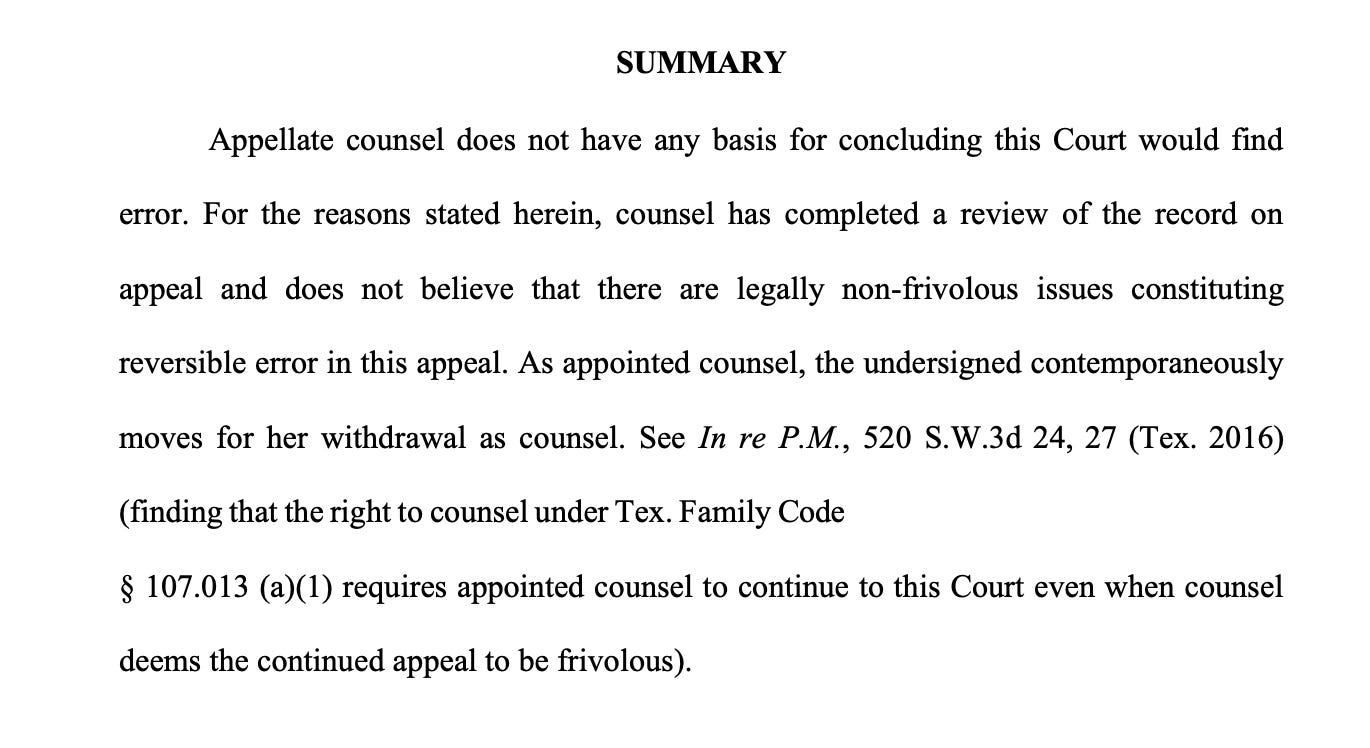
As Justice Young’s concurrence in the denial notes, this sounds a bit like language for an Anders brief.
Briefly, for those unfamiliar with the parental termination process, Texas law requires the trial court appoint counsel for indigent parents in parental termination proceedings. See Tex. Fam. Code §107.013(a)

The Texas Supreme Court has concluded that the right to counsel continues through the exhaustion of appeals under Family Code section 107.016(2)(B), which includes filing of a petition for review. See In re P.M., 520 S.W.3d 24, 27 (Tex. 2016) (per curiam). Once appointed by the trial court, counsel is permitted to withdraw only for good cause and on appropriate terms and conditions. Id. The process for withdrawing is drawn from the U.S. Supreme Court’s decision in Anders v. California, 386 U.S. 738 (1967).
The Texas Supreme Court has explained the withdrawal process as follows:
In Anders, 386 U.S. at 744–45, the United States Supreme Court created a procedure that appointed counsel in criminal cases must follow when seeking to withdraw from an appeal that counsel believes is frivolous. Before requesting permission to withdraw, counsel must “master the trial record, thoroughly research the law, and exercise judgment in identifying the arguments that may be advanced on appeal.” McCoy v. Court of Appeals, 486 U.S. 429, 438 (1988); see also Anders, 386 U.S. at 744–45. If, after a conscientious review of the record, counsel concludes that the case is wholly frivolous, he or she may so advise the court of appeals and request permission to withdraw. Anders, 386 U.S. at 744, 87 S.Ct. 1396. “That request must, however, be accompanied by a brief referring to anything in the record that might arguably support the appeal.” Id. A copy of the Anders brief must also be furnished to the indigent client, and the court must allot the client time to raise any points that he or she chooses. Id. After counsel files the Anders brief, the appellate court conducts a full examination of all proceedings to decide whether the case is wholly frivolous. Id. If the court concludes that the case is frivolous, it may grant counsel’s motion to withdraw. However, if the court finds any of the legal issues arguable on their merits, and therefore not wholly frivolous, it must either deny counsel’s request to withdraw or appoint substitute counsel.
In re D.A.S., 973 S.W.2d 296, 297 (Tex. 1998)
The Anders process has been imported into the parental termination context in Texas.
Counsel in A.B. filed no motion to withdraw. And he had just spent several pages arguing that prejudice should be assumed. Indeed, counsel closed with the following prayer:
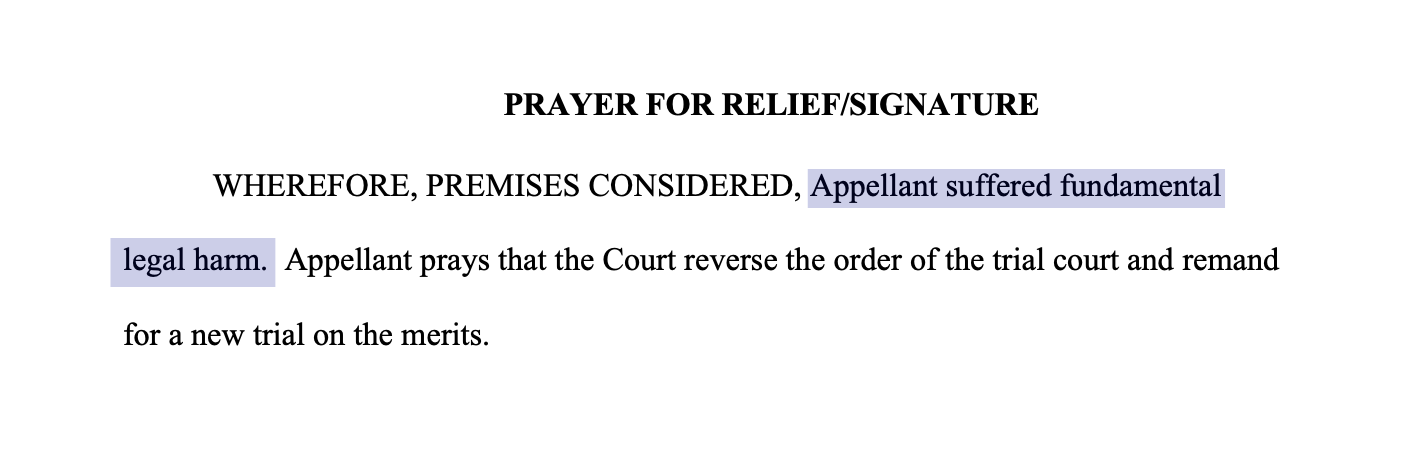
(emphasis added)
The State seized on the Anders-like language. This was its first argument in response:
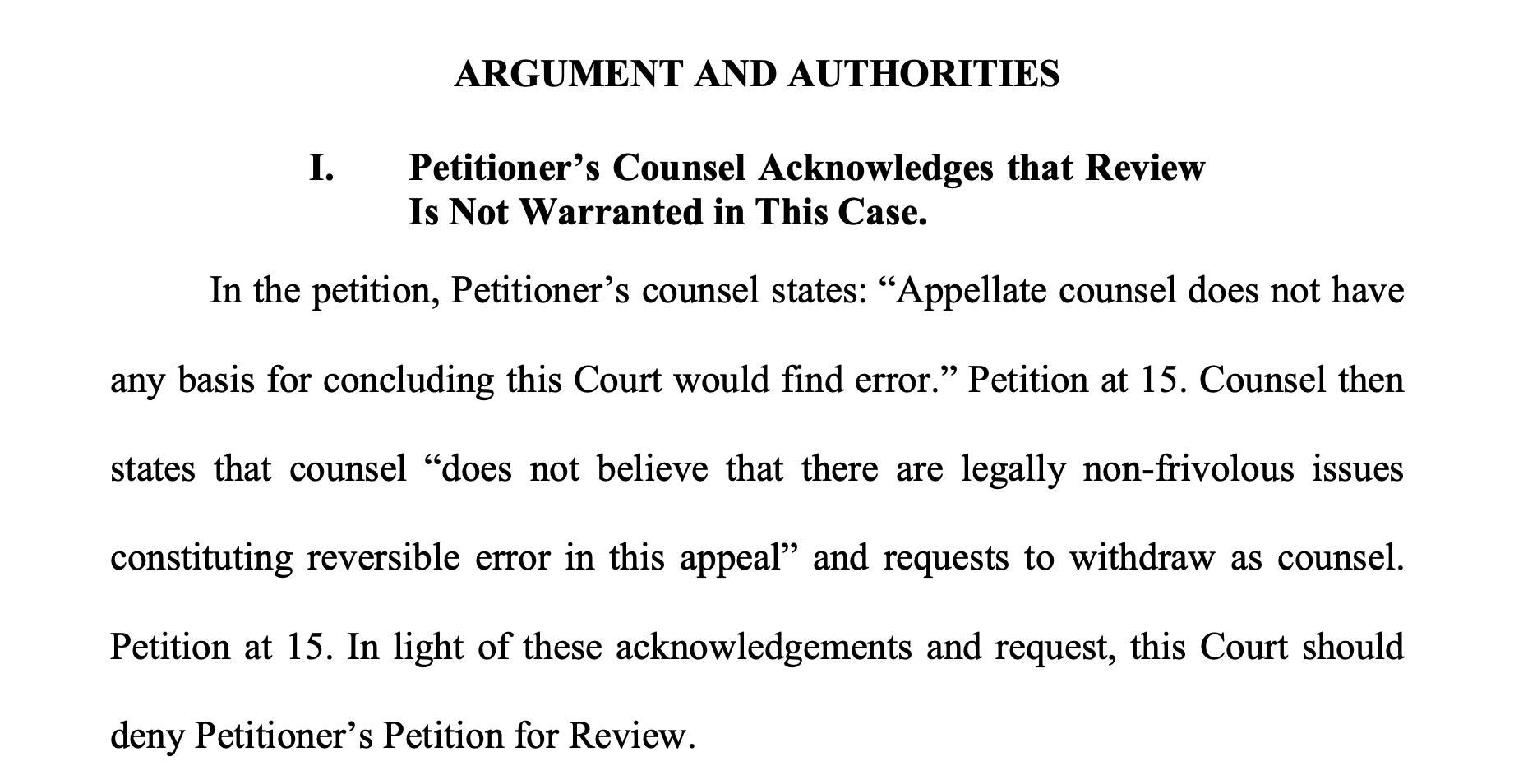
Reasonably confused by the situation, including the fact that the Anders-like language asked for “her” withdrawal from the case (counsel was male), the Supreme Court issued an order asking counsel to clarify whether he intends to proceed under Anders and seek withdrawal.
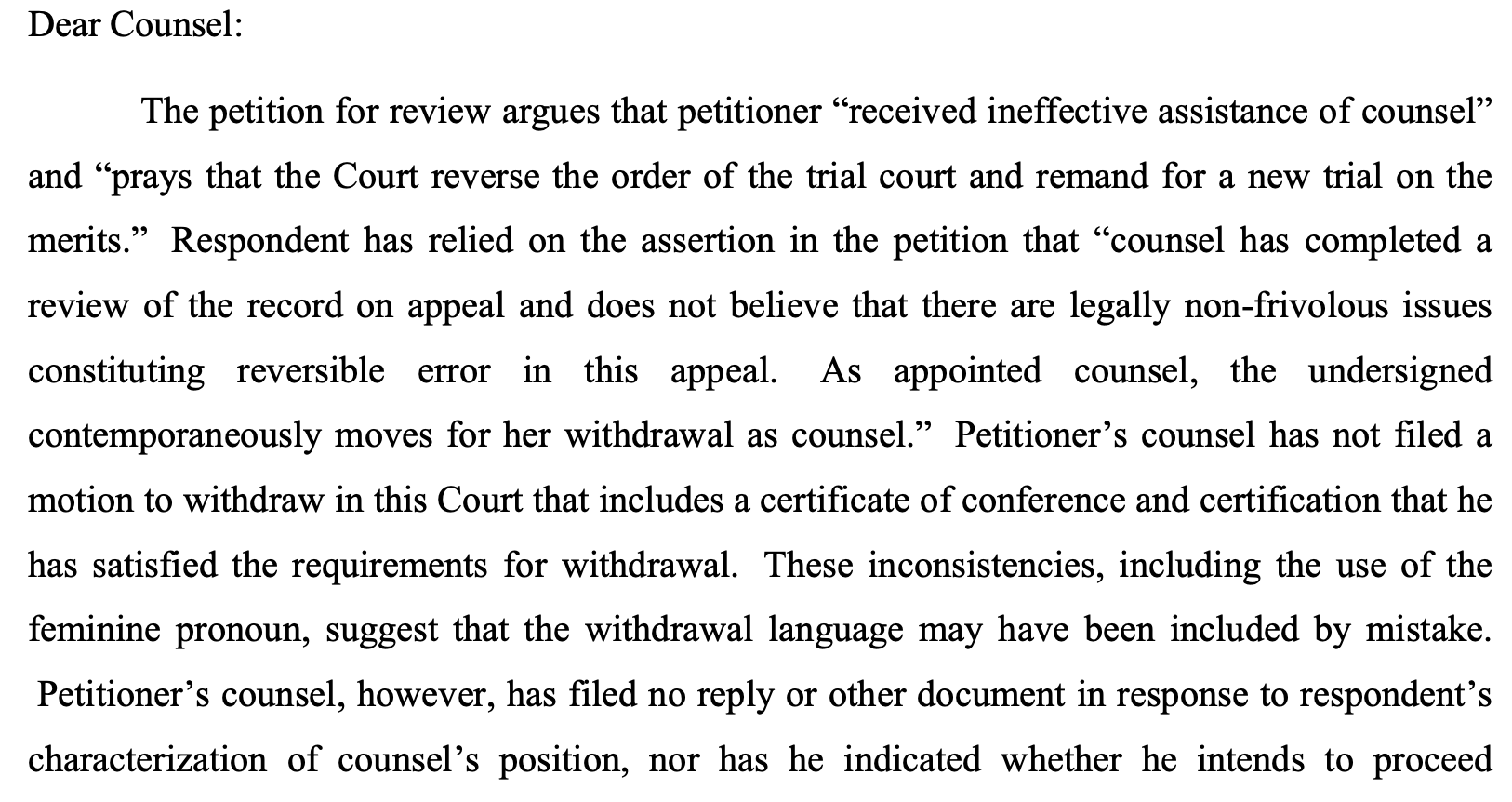
But counsel for Mother never responded to the order and never filed a reply brief that could have clarified the situation.
Justice Young wrote a scathing concurrence about counsel’s deficient performance. He characterized the inconsistency as follows:
The Anders boilerplate is so strikingly out of sync with the rest of the petition that I suspect it was inserted by accident. Perhaps the petition was created by opening a different case’s previously filed petition, saving it as a new document, renaming it, adding some new context, and then failing to delete all the prior document’s text. The likelihood of something along these lines having happened is heightened by the use of the feminine pronoun (“moves for her withdrawal as counsel”) when the attorney who signed the petition in this case is a man.
Justice Young then noted that counsel never responded to the Court’s order: “a Texas lawyer who has invoked the jurisdiction of the Supreme Court of Texas has ignored the Court’s direct order.” And the consequences are stark: “The Court today denies Mother’s petition for review, so her appeal fails and her parental rights are lost. The family is dead. Mother and her child are now strangers to each other in the eyes of the law.” (emphasis added).
That is a sobering thought. If trial counsel was as deficient as the petition suggests, perhaps the Court would have taken further interest in the petition and the family would not be . . . dead. Justice Young ended with this sobering (and haunting) remark:
If the result of today’s decision is erroneous—if it is an injustice that Mother’s attorney could have prevented by something as basic as proofreading the petition, actually reviewing the opposing party’s response, or simply responding to our order—then this case should haunt counsel’s conscience far more than professional discipline ever could.
It isn’t lost on me that readers of this blog are probably the type that hardly need the reminder to proofread their petitions and briefs. And it probably haunts those of us who least need the reminder. But the opinion was a good reminder and worth sharing. How many of us have used a template from something we’ve previously written because it has all of the styles embedded? Even in the same case. This case is an abundantly clear reminder of just how important proofreading is.
The Supreme Court is, without a doubt, unable to right every wrong. Nor should it be the Court’s burden to do so. But, as the Court has described it, “[t]ermination of parental rights, the total and irrevocable dissolution of the parent-child relationship, constitutes the ‘death penalty’ of civil cases.” In re K.M.L., 443 S.W.3d 101, 121 (Tex. 2014) (Lehrmann, J., concurring). This situation strikes me as an opportunity for appointment of an amicus. As I’ve written before, the Court’s process for appointing counsel is slightly different than at the U.S. Supreme Court’s. Instead of appointing someone directly (which allows the Circuit Justice to appoint a former clerk looking for a big break), the Court refers the case to the Pro Bono Committee to facilitate the selection and appointment of counsel. But, regardless of the system used for appointing someone to dig into the merits, if a Justice has questions and appointed counsel is unwilling or unable to comply with an order of the Court to clarify, perhaps the Court could ask competent counsel to assess and file a response.
Perhaps the Court’s own dive into the record confirmed that appointment of an amicus was unnecessary. After all, Justices Young, Sullivan, and Hawkins concurred in the denial, rather than simply filing a statement respecting denial. So they did not oppose or even respond neutrally to the decision to allow the family to die. It just strikes me as especially tragic that, as Justice Young notes, a parent may have been saddled with two ineffective attorneys.
Generative AI is . . . generating . . . a glut of interesting legal issues. Over the last few months, parties’ interaction with generative AI platforms has raised serious questions and litigation about attorney-client privilege and work-product doctrine. The courts are all over the map (literally and figuratively) about whether using generative AI waives work product protection or attorney-client privilege. I wanted to flag a minute entry in the Texas Business Court’s Houston Division, which looks to be the first decision on the issue in Texas.
In Tate Group Automotive, LLC v. Legacy Automotive Capital,1 which involves the purchase of an automobile dealership, one of the parties had “conversations” with ChatGPT that were withheld during discovery based on a claim of attorney work product protection. The defendants argued that attorney work product protection does not extend to a non-lawyer’s “chats” with AI. In the alternative, the use of AI waived any potentially applicable privilege.
The defendants cited a recent Southern District of New York decision, United States v. Heppner. “In connection with Heppner’s arrest . . . agents with the Federal Bureau of Investigation executed a search warrant at Heppner’s home . . . . Heppner’s counsel later represented to the Government that among the seized materials were approximately thirty-one documents that memorialize communications that Heppner had with the generative AI platform ‘Claude’ . . . .” Heppner tried to claim privilege because he input information learned from counsel, had created the documents for the purpose of speaking with counsel to obtain legal advice, and had shared the contents of the documents with counsel. But counsel did not direct Heppner to conduct these exchanges with Claude.
Judge Rakoff held that a criminal defendant’s communications with a publicly available generative AI platform are not protected by attorney-client privilege or work product privilege. With respect to attorney-client privilege, the court concluded that no attorney-client relationship exists between Claude and the defendant because (1) the platform was not a lawyer, (2) the platform further trained on user inputs and stated in its privacy policy that it could share the information with third parties, including the government, and (3) Heppner did not communicate with Claude for the purpose of obtaining legal advice. The court admitted the third point was the closest because Heppner had alleged that he used Claude for the express purpose of talking to counsel. But, again, he did not do so at the direction of counsel.
That last point proved fatal to the alternative argument that the documents were shielded by work-product privilege, which the court concluded only shielded documents produced by or at the direction of counsel.
On the same day SDNY issued its decision, the Eastern District of Michigan released its decision in Warner v. Gilbarco, Inc. In Warner the court concluded that, under the civil rules, materials prepared by a party (particularly a pro se party acting as her own representative) are generally shielded as work product. The party seeking to compel discovery argued that the privilege is waived because the material was put into third-party generative AI. The district rejected that argument. Waiver of work product requires disclosure to an adversary or “in a way likely to get in an adversary’s hand.” ChatGPT (and other generative AI programs) are tools, not persons, even if they may have administrators somewhere in the background. Thus, no waiver occurred.
Texas state civil rules are more like the federal civil rules than the federal criminal rules, as Judge Dorfman noted.2 The court therefore agreed with the Eastern District of Michigan’s decision that “work product protections are typically waived by disclosure to an adversary, or in circumstances that substantially increase the likelihood that an adversary will obtain the materials.” Texas Rule of Civil Procedure 192.5(a)(1) protects “material prepared or mental impressions developed in anticipation of litigation or for trial by or for a party.” Thus, some of the withheld documents were protected under work-product privilege.
Thanks for reading 14th & Colorado! This post is public so feel free to share it.
Note: I previously represented the Tate Group in earlier proceedings in this case. My involvement in the case ended long before the proceedings described in this post.
The federal rules applicable to civil cases are different, as well. As the District of Colorado court noted in Morgan v. V2X, Inc. (D. Colo. Mar. 30, 2026), Rule 26(b)(3) protected a plaintiff’s mental impressions and litigation preparation materials because the civil rule protects the work product of a party, not merely counsel.
No posts
Comments
Nothing yet. Say the first thing.
Sign in to join the conversation.