
Welcome back to 14th & Colorado!
Before diving into the substance of today’s post, I wanted to flag a new feature coming to the site—Argument Alerts. Several fellow appellate lawyers have lamented the end of the Supreme Court’s emails summarizing the upcoming arguments and identifying arguing counsel.
For years, the Court’s first and only Staff Attorney for Public Information, Osler McCarthy, wrote the summaries. Osler retired in 2021, and the chambers took over responsibility for providing grant and opinion summaries for the website and the Supreme Court Update Paper. For reasons that likely relate to staffing changes over the last year, the grant and opinion summaries have been spottier. And the emails previewing arguments have stopped. Information—very short snippets about the cases—is still available on the Court’s calendar. But it still takes a bit of work to get to. And you’d have to click through to the docket to check the argument acknowledgment forms. So I’ve decided to add “Argument Alerts” to the site, which will send subscribers a brief snippet (for the November arguments, the very brief snippet the Court provides) about the upcoming arguments and who will be arguing. I hope this adds a measure of convenience for everyone.
(And maybe it’ll be a good reason for the unaware to subscribe and get the more substantive analysis and tips I post.)
Thanks for reading 14th & Colorado! Subscribe for free to receive new posts and support my work.
Now on to the substance of today’s post.
General personal jurisdiction after Mallory
Last year, I previewed State v. Yelp. The substance of the case is about whether Yelp violated the Texas Deceptive Trade Practices Act after the U.S. Supreme Court’s Dobbs decision. This appeal focused on whether Texas courts have personal jurisdiction over Yelp. We now have a unanimous opinion from the Fifteenth Court concluding there is no general jurisdiction over Yelp, but there is specific jurisdiction.
A bit of review
In the wake of the U.S. Supreme Court’s decision in Dobbs, Yelp added a consumer warning to the listings for crisis pregnancy centers across the country. The notice said, “This is a Crisis Pregnancy Center. Crisis Pregnancy Centers typically provide limited medical services and may not have licensed medical professionals onsite.” According to the state, the notice painted with an unfairly broad brush—“many crisis pregnancy centers targeted by Yelp do offer a range of medical services provided by licensed medical professionals.” And the message did not convey what Yelp intended— i.e., these centers do not provide abortions. Yelp refused to remove the notices for months. Eventually, 24 attorneys general sent a demand letter to Yelp. It amended its consumer notice: “This is a Crisis Pregnancy Center. Crisis Pregnancy Centers do not offer abortions or referrals to abortion providers.” Texas does not object to the new notice.
The State sued Yelp in Bastrop County district court, alleging that the original notice violated the Texas Deceptive Trade Practices Act. The State claims that Yelp mislead consumers about the availability of medical services at crisis pregnancy centers. Yelp filed a special appearance challenging the court’s jurisdiction to hear the case. Yelp argued that it is not subject to general personal jurisdiction in Texas because the company is headquartered in and has its principal place of business in California. And Yelp argued that the company was not subject to specific jurisdiction because it did not purposefully avail itself of the Texas market and the State’s allegations do not arise out of or relate to Yelp’s “very limited Texas contacts.”
The State’s response to Yelp’s special appearance (this will become key in a minute) argued that Yelp voluntarily agreed to subject itself to general jurisdiction in Texas when Yelp registered to do business in the state under Chapter 9 of the Business Organizations Code. The State relied on the U.S. Supreme Court’s decision in Mallory v. Norfolk Southern Railway Co., which it contends supports consent by registration. Yelp made several arguments in response. First, Chapter 9 of the Business Organizations Code does not contain an express consent to general jurisdiction like the Pennsylvania law at issue in Mallory. Second, Yelp failed to plead sufficient facts in its petition to support the exercise of general jurisdiction.
The Bastrop County district court dismissed the suit with prejudice, finding Yelp neither consented to general jurisdiction nor did this suit arise out of any contacts with Texas for specific jurisdiction. While the appeal was pending in the Fifteenth Court, Yelp was fighting on a second front—the U.S. Court of Appeals for the Ninth Circuit.
A battle on two fronts
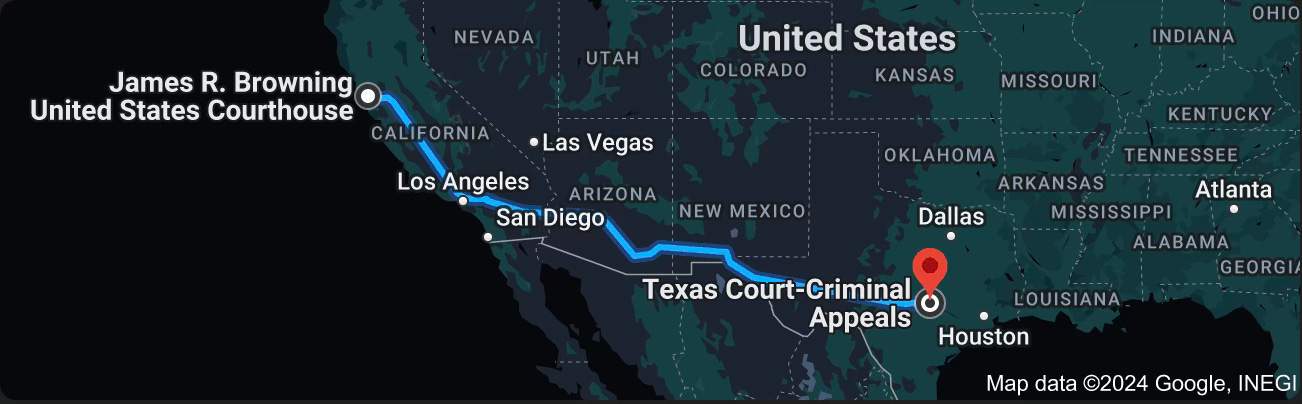
A day before Paxton sued Yelp in Texas court, the company sued him in the Northern District of California under 42 U.S.C. § 1983, alleging First Amendment retaliation. Yelp moved for a preliminary injunction in the federal litigation to enjoin Paxton from further action, while Paxton sought to dismiss the federal case under Younger abstention, which forbids federal courts from interfering with pending state judicial proceedings.
The parties generally agreed that the requirements for Younger abstention were met. But Yelp alleged that abstention was not warranted because the bad faith exception to Younger applied. That is, the State’s attorneys allegedly acknowledged at a hearing that the disclaimer was “literally true,” and Yelp accused Paxton of retaliation because he filed the suit one day after the company sued in California to protect its First Amendment rights. Yelp also accused Paxton of filing the suit to “score points with his base of voters” after he survived an impeachment vote.
Judge Trina Thompson (N.D. Cal.) succinctly laid out a brief background on Younger abstention and its application in her order in the case:
In most cases, if a federal court has jurisdiction, its obligation to hear and decide a case is “virtually unflagging.” Sprint Commc’ns, Inc. v. Jacobs, 571 U.S. 69, 77 (2013) (quoting Colorado River Water Conservation Dist. v. United States, 424 U.S. 800, 817 (1976)). But Younger abstention carves out an exception to this general rule, requiring federal courts to “decline to exercise jurisdiction over the underlying claims for reasons of comity.” Washington v. Los Angeles Cnty. Sheriff’s Dep’t, 833 F.3d 1048, 1058 (9th Cir. 2016) (citations omitted).
Younger abstention applies in only three “exceptional” categories of cases: (1) “parallel, pending state criminal proceeding[s],” (2) “state civil proceedings that are akin to criminal prosecutions,” and (3) state civil proceedings that “implicate a State’s interest in enforcing the orders and judgments of its courts.” Sprint, 517 U.S. at 70 (internal citations omitted).
“In civil cases, therefore, Younger abstention is appropriate only when the state proceedings: (1) are ongoing, (2) are quasi-criminal enforcement actions or involve a state’s interest in enforcing the orders and judgments of its courts, (3) implicate an important state interest, and (4) allow litigants to raise federal challenges.” ReadyLink Healthcare, Inc. v. State Comp. Ins. Fund, 754 F.3d 754, 759 (9th Cir. 2014) (citing Sprint, 571 U.S. at 80–81). If these elements are met, the court then considers “whether the federal action would have the practical effect of enjoining the state proceedings and whether an exception to Younger applies.” Id. (internal citations omitted).
The district court dismissed the federal case based on Younger abstention.
In December 2024, both the U.S. Court of Appeals for the Ninth Circuit and the Fifteenth Court of Appeals heard oral argument in these two cases. We now have opinions from both courts.
The Ninth Circuit’s decision
Earlier this year, the Ninth Circuit held that Younger’s narrow bad faith exception did not apply. The court relied, at least in part, on the Second Circuit’s framing that “it is only when the state proceeding is brought with no legitimate purpose that the state interest in correcting its own mistakes dissipates’ and the ‘bad faith’ exception to Younger applies.” Yelp did not sufficiently establish that Texas’s civil enforcement action was brought without a reasonable expectation of obtaining a valid judgment or was facially meritless. Whether the first notice Yelp posted was “misleading” was open to interpretation. And it was not clear or obvious that applying the DTPA to Yelp’s first notice would violate its First Amendment rights. Yelp also failed to show that Paxton’s enforcement action was motivated by a desire to harass Yelp or was pursued in retaliation for Yelp’s support of abortion rights. Thus, the Ninth Circuit affirmed the district court’s dismissal under Younger. The case in Texas could proceed.
Now on to the part that most of you probably care more about—the Texas personal jurisdiction piece!
The Fifteenth Court’s Decision
In a unanimous opinion, the Fifteenth Court (rightly) did not reach the merits of the State’s general jurisdiction argument. In Texas, allegations in support of personal jurisdiction must be in the plaintiff’s pleading. The Court noted that the State did not reference the Chapter 9 registration or Mallory in their live pleading. Indeed, the first time the State raised the general jurisdiction argument was in response to Yelp’s special appearance. The Court noted that the State did attach evidence to that filing. But the pleading sets the bounds under the burden-shifting framework for establishing and contesting personal jurisdiction in Texas. The pleadings may not be dispositive when the defendant contests those pleadings with evidence, but the “additional evidence merely supports or undermines the allegations in the pleadings.” That is, “[b]ecause the plaintiff defines the scope and nature of the lawsuit, the defendant’s corresponding burden to negate jurisdiction is tied to the allegations in the plaintiff’s pleading.” So, evidence may be attached or included in response to a special appearance, but it must be consistent with the allegations in the pleading, rather than additive.
Now, I think that looking for those magic words is the wrong standard. The fact that the State didn’t include “Chapter 9” or “Mallory” should not change the outcome, if the State had pleaded sufficient facts to would fit those laws. The State likely only needed to plead that there is general jurisdiction because Yelp is registered to do business in Texas to properly put the issue before the courts. But the State’s petition in the trial court makes no mention of Yelp’s registration or general jurisdiction. Instead, the State focused on Yelp’s specific contacts with Texas—contacts supporting specific jurisdiction.
Ultimately, the Fifteenth Court reversed the trial court’s dismissal finding that there is specific personal jurisdiction over Yelp for these claims.
Mallory in other Texas courts
We’ll have to wait for another day for the statewide appellate court, tasked with hearing appeals from the new Business Courts, to decide whether registration to do business in Texas under Chapter 9 constitutes consent to general jurisdiction. But, as I laid out in my earlier post on the case, I don’t think so. The U.S. Supreme Court’s decision in Mallory simply clarified that a state requiring a company to consent to general jurisdiction did not violate due process. Indeed, the Court had already answered the question in Pennsylvania Fire, but some confusion has ensued over the last century. But Mallory never addressed what language in a state’s business registration statute afforded general jurisdiction or whether general jurisdiction could be exercised in the absence of a clear statement of consent.
The Pennsylvania statute at issue in Mallory contained a clear consent requirement. To register to do business in Pennsylvania in §5301(a)(2)(i), registration as a foreign business entity is “sufficient ... to enable the tribunals of this Commonwealth to exercise general personal jurisdiction over” such a corporation. Yelp notes, as the parties did in Mallory, that this is unique among the states. Texas’s statute contains no such express consent. The State attempted to imply such consent from a statement that registration as a foreign business made a company “subject to the same duties, restrictions, penalties, and liabilities” as a domestic Texas corporation.
Several Texas appellate courts previously rejected the argument that registration to do business in Texas constitutes consent to general jurisdiction.
In Certain Underwriters at Lloyd’s, London v. Henry Vogt Machine Co., Inc., the Fourteenth Court of Appeals rejected an argument that chapter 9.202 is a consent provision. The Court addressed the issue in a somewhat practical analysis, concluding
[i]f having the same rights and privileges as a domestic entity meant that all foreign filing entities consented to the exercise of personal jurisdiction over them by Texas courts in any case filed in Texas, then all foreign entities that have done any business in Texas, no matter how small the amount, would be deemed to have consented to the exercise of personal jurisdiction over them by Texas courts in any case filed in Texas, even as to cases not based on the entities’ Texas business contacts and no matter how limited their Texas contacts.
Thus, “under its unambiguous language, chapter 9 does not provide that foreign entities consent to the exercise of personal jurisdiction over them by Texas courts in any suit filed in Texas as a condition of doing business in Texas or as a consequence of having registered to do business in Texas under chapter 9.”
In Repairify, Inc. v. Opus IVS, Inc., the Dallas Court of Appeals rejected a similar argument. Indeed, the Court could not have put it any better. It recognized that the key question in Mallory was “whether consent jurisdiction for non-resident corporate defendants comports with Due Process. . . . Mallory never sought to instruct how to read a state’s statutes or whether to intuit from them that they meant a registering business consented to general jurisdiction in the absence of a clear statement of that consent.” Thus, Mallory “has no effect on this court’s interpretation of the Texas non-resident corporation registration scheme and we decline the invitation to reinterpret settled Texas law.” Because “unlike Pennsylvania law in Mallory, none of Texas’s business registration statutes—and nothing in Texas’s long-arm scheme—includes any language specifically directing that complying with them would subject a business to personal jurisdiction in Texas.”
These opinions are not binding on the Fifteenth Court, or any appellate court other than their own. We may yet see this argument, in substance, make it to the Fifteenth Court in another case. I’ll keep an eye out and keep you updated if or when we do.
Key takeaways
This case has good lessons for lawyers filing lawsuits in Texas. Keep in mind the Court’s admonishment that the pleadings set the bounds for determining personal jurisdiction. Anything in a response to a special appearance will be limited to information consistent with those pleadings. Thus, it’s important to be clear and complete in your pleadings. The information need not necessarily all be in the section labeled “jurisdiction.” Though that certainly won’t hurt. And explicitly spelling out your legal bases for jurisdiction, e.g., citing any statutes or cases, also cannot hurt. But any facts necessary to support jurisdiction should certainly be thoroughly developed in the factual discussion with the point being you’re making being clear. And if you’re arguing a special appearance, keep in mind the good lawyering here from Yelp’s counsel—look for shortcomings in the plaintiff’s pleadings/allegations.
Look for several few more posts in the coming days this week. The courts have provided good fodder in the last few days.
Until next time…
Thanks for reading 14th & Colorado! This post is public so feel free to share it.
Comments
Nothing yet. Say the first thing.
Sign in to join the conversation.