
As my toddler says after every absence, no matter how brief, “I’m back!” The Court held its long conference at the end of August. In an unusual twist, the Court seems to have released that conference’s orders a week later, rather than the same Friday. The September 5 orders list brought a number new grants, including one that could clarify the Supreme Court’s 2023 decision in Van Dyke v. Navigator Group.
I’ll be taking a look at some of the upcoming cases a bit later. But in today’s post, I want to dive into a topic inspired by this week’s arguments and a couple of panels at last week’s Advanced Appellate Practice CLE: appointment of amicus to defend the judgment below.
The Supreme Court’s new term kicks off with oral arguments this week, and in the last case on Tuesday, my good friend Cody Vaughn will argue his first case at the Texas Supreme Court on behalf of a pro bono client. The process that got him there is a little different than it is at the U.S. Supreme Court.
Appointed Amici at the U.S. Supreme Court
In a previous post, I wrote about the differences in amicus practice in the federal and Texas courts. Amicus briefs, typically are filed in support of a particular party to the case, though they are occasionally filed “in support of neither party,” share the same name with the appointed amici, but they are markedly different. Amicus briefs are commissioned by non-parties looking to have SCOTUS hear their points of view. But there is a different kind of amicus, which many readers of this Substack are likely aware of, and which come closer to the spirit of helping the Court—lawyers appointed to defend the decision below when the party who won chooses not to.1 The “defense-of-the-judgment” amici are often appointed at the U.S. Supreme Court when the Department of Justice chooses not to defend the decision below, often following a change in administration where the party in power has flipped. This practice happens about once per term at the Court.2
For example, in 2025, the Supreme Court appointed former Assistant to the Solicitor General (in contrast to Texas’s “Assistant Solicitors General”) Michael Huston to argue Parrish v. United States.3 Former-Solicitor General Elizabeth Prelogar filed the United States’ brief in opposition in November 2024. Of course, the administration changed parties in 2025. And the United States changed positions to support the Petitioner. The Court appointed Huston just weeks after President Trump’s inauguration to argue in defense of the judgment below. That is, he and others like him are not appointed to represent the party, they are appointed only to defend the judgment below.
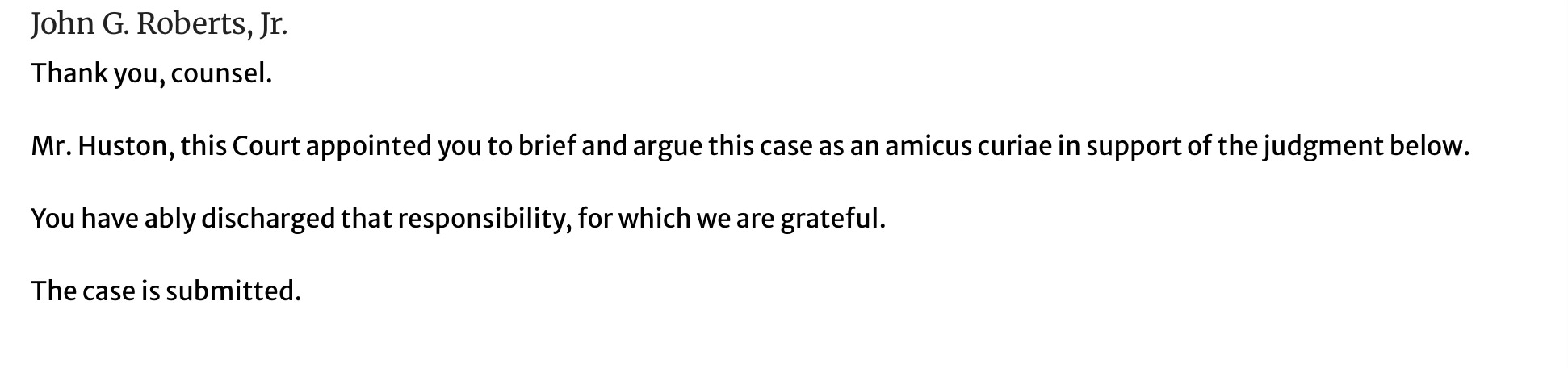
While Huston had argued at the Court many times during his tenure at the SG’s office, Stephen Hammer, a panelist at last week’s Advanced Appellate CLE (which included former-Fifth Circuit Judge Gregg Costa4 and Advisory Opinions host Sarah Isgur on practice before the U.S. Supreme Court), like many other amici was appointed to present his first argument before the Court. Indeed, this process has given the first argument to several names you’ll certainly recognize: Justice Evan Young was appointed to argue Sester v. United States, and Texas Solicitor General Will Peterson got his first SCOTUS argument when he was appointed in Reyes Mata v. Lynch. At the end of the argument, Chief Justice Roberts typically notes (as pictured above) that the advocate was appointed to brief and argue the case as an amicus, that they have ably discharged that responsibility, and expresses the Court’s gratitude.
The appointment process for these Supreme Court “defense” amici highlights the professionalization (and small circle of Supreme Court advocates) that has emerged at the Court. Whether you think this process is a good one may depend on whether you’re inside that circle. It certainly reinforces the limited universe of SCOTUS advocates. Isgur suggested on last week’s panel that this may not be a bad thing. She suggested that advocates who don’t speak “Supreme Court-ese,” a kind of language unto itself, don’t tend to fare as well before the Court. And that may well be right—there is plenty of inside baseball at the U.S. Supreme Court, the Texas Supreme Court, and indeed at all Courts of Appeal.
Professor Kate Shaw’s article notes that while these SCOTUS amicus appointments fall into several categories, a significant number of these advocates are former clerks of the “circuit Justice” from which the case arose.5 The Court will often appoint a former clerk of the Justice assigned to the particular circuit when it calls for an amicus. For example, Justice Young’s appointment came in a case out of the Fifth Circuit. His former boss, Justice Scalia, was the circuit Justice at the time of his appointment. Stephen Hammer’s appointment came in Riley v. Bondi, a case out of the Fourth Circuit. His former boss Chief Justice Roberts is the circuit Justice.
Others are appointed for their expertise in a particular area. In 2011, Judge Stephanos Bibas, then a professor of Criminal Law at the University of Pennsylvania, was appointed to argue Tapia v. United States, which involved a question of district court sentencing authority.
However they’re appointed, these amicus appointments have raised interesting questions for academics, particularly whether this practice violates Article III’s case and controversy requirement. If the parties are no longer at odds, is there really a an adversarial proceeding over which the Supreme Court has jurisdiction? As Professor Henry Monaghan put it, “[i]f the litigants have no actual interest in defending the judgment, or have abandoned positions taken below, what conception of judicial authority authorizes the Court to intervene?” The Texas Supreme Court has largely avoided this case or controversy issue.
Appointed Counsel at the Texas Supreme Court
The process for obtaining counsel to assist the Court is markedly different at the Texas Supreme Court. First, I cannot think of a time in recent memory where the Texas AG has confessed error, but the Court has insisted the case move forward with an amicus. Perhaps that is because for the last 26 years the AG’s office has been held by the same party. Second, when the Court believes that it would benefit from the assistance of counsel, typically when a party is proceeding pro se, the Court refers the case to the Pro Bono Committee to facilitate the selection and appointment of counsel. The Court does not select the amicus attorney. Thus, while Vaughn is a first-time advocate at the Court and a former law clerk to Justice Young, he was not selected by his former boss to argue, as Justice Young was when he was selected to serve as amicus at SCOTUS. The process, much like the Texas Supreme Court bar in general, does not necessarily favor former clerks the way it does at the U.S. Supreme Court.6
Instead, the Pro Bono Committee Program Liaison emails members of the bar who have signed up to be on the Committee’s list, and lawyers volunteer for the appointment. In only two cases that I am aware of has the Court appointed an amicus to defend the judgment below, rather than represent the party: In the 24-25 Term, the Court appointed Marshall Bowen in Stary v. Ethridge, and in the 23-24 Term, the Court appointed David Campbell in Texas Windstorm Insurance Association v. Pruski.
In Stary, the Court appointed Bowen as an amicus because the respondent did not file a response in accordance with the Court’s requests. The Court referred “the matter to the State Bar of Texas Appellate Section’s Pro Bono Committee to locate a volunteer lawyer to serve as an Amicus Attorney for the purpose of defending the court of appeals’ judgment.” That is, the Court officially appointed Bowen as amicus to defend the judgment, but the Court did not select him. Rather, he volunteered after receiving the Pro Bono Committee’s solicitation.
In Pruski, the Court appointed Campbell after Pruski, appearing as a pro se respondent, informed the Pro Bono Committee that he did not qualify for pro bono representation. The Court issued the following order:
The Court previously referred this matter to the State Bar of Texas Appellate Section’s Pro Bono Committee and was notified that Respondent indicated he does not meet the Program’s eligibility requirements. The Court has now set this case for oral argument on February 21, 2024, and is supplementing its referral to request that the Pro Bono Committee attempt to locate a volunteer lawyer to serve as an Amicus Attorney for the purpose of defending the court of appeals’ judgment. The attorney’s duties would consist of submitting supplemental briefing if the attorney deems it appropriate and participating in oral argument.
Campbell ultimately shared argument time with Pruski.
In other cases, however, the Pro Bono Committee’s appointed attorney represents the party, rather than merely defending the judgment below. For example, Vaughn is appointed to represent the mother in this week’s argument in In the Interest of H.S., B.S., and M.S., children.
The other significant difference stems from the way the Texas Supreme Court handles cases: an appointed attorney may go through the briefing process, and the petition may be denied. In contrast, an amicus at the U.S. Supreme Court is only appointed if the case is granted. So one of the significant carrots of appointment for first-time advocates at SCOTX—an argument before the Court—isn’t guaranteed.
With the Court considering changes to its process to grant cases before briefing, could we see a different procedure for appointing attorneys to argue either as amici or on behalf of a party? Two of the current Justices clerked for the U.S. Supreme Court. And one of those two was appointed as an amicus. So anything is possible. With the different circumstances giving rise to the need for an appointment, however, it may feel a bit different for the Court to simply tell a party to the litigation that a specific person will represent them.
I look forward to this week’s arguments. You can watch them on the Court’s YouTube. Good luck to Cody. And I look forward to bringing you more updates on interesting cases and issues, practice tips, and more. Stay tuned.
Thanks for reading 14th & Colorado! This post is public so feel free to share it.
There are other amicus appointed by the Court, for example when a party simply does not respond. In one case amicus, now-Judge Barrington Parker, Jr., was invited to argue for suppression of a confession as insufficiently attenuated from an unlawful search, after the criminal defendant in the case failed to respond to numerous communications from the Clerk’s office. The federal appellate courts similarly will appoint an amicus when the prevailing party abandons the position it took below or confesses error.
October Term 2024 appears to have been an extraordinary term. Five cases were argued by Court-appointed amici. In addition to Huston and Hammer, Michael McGinley, a partner at Dechert and a former clerk to Justice Alito, defended a ruling by the Fifth Circuit in Hewitt v. United States. It was also his first argument at the Supreme Court. Christopher Michel, a partner at Quinn Emanuel and a former law clerk to Chief Justice John Roberts, argued his 11th case at the Court in Glossip v. Oklahoma when he defended the Oklahoma Court of Criminal Appeals judgment that left the conviction and death sentence of Richard Glossip in place, even after the state’s AG confessed error and agreed they should be set aside. Christopher Mills argued Martin v. United States, his first argument at the Court, as well.
Huston argued Parrish against Jones Day’s Amanda Rice, who got her first argument before the Court in Lange v. California (and was my legal writing instructor at the University of Michigan), a case out of the Ninth Circuit. Rice’s former boss Justice Kagan is the circuit Justice for that court.
Judge Costa was recently appointed as amicus to defend the merits of a law the Texas Attorney General decided it would not defend. Judge Mark Pittman of the Northern District of Texas followed in Judge Dale Ho’s footsteps. Costa’s brief is due to be filed this week. Just a few months earlier Judge Ho (not the one most are used to hearing about in the Fifth Circuit) appointed arch-conservative and former-SG Paul Clement to help determine whether the government should be allowed to drop the case against NYC Mayor Eric Adams without prejudice. The administration sought to do so after Adams seemed to play ball cracking down illegal immigration. Commentators worried that allowing the DOJ to dismiss the prosecution without prejudice would allow the President to use the threat of prosecution as a sword of Damacles to ensure Adams’ compliance. Clement ultimately agreed: “A dismissal without prejudice creates a palpable sense that the prosecution outlined in the indictment and approved by a grand jury could be renewed, a prospect that hangs like the proverbial Sword of Damocles over the accused. Such an ongoing prospect of re-indictment is particularly problematic when it comes to the sensitive task of prosecuting public officials.”
Supreme Court Justices are assigned particular circuits. These assignments represent the primary responsibility for emergency requests for cases originating from the respective circuits (for example, an application to block an execution or to allow it to go forward), as well as more mundane matters, such as requests to extend filing deadlines. The Justices can, and often do, refer emergency requests to the full court.
Whether the Texas Supreme Court’s more egalitarian approach or the appointment of former clerks produces a better result is subject to debate. Like Isgur suggested in her panel remarks, perhaps a better outcome is achieved for the parties and the system if the appointed lawyer speaks SCOTX-ese and has an insider’s understanding of the Court. But it may also be worth more to the legal system to spread the experience around to benefit those who do not yet have, but are keenly interested in, experience with the Court.
No posts
Comments
Nothing yet. Say the first thing.
Sign in to join the conversation.