
I first met Sean McGowan some years ago in the Bay Area video studio at Acoustic Guitar magazine, where he was filming a review of a Collings OM built in collaboration with Julian Lage. Before the cameras were fully set, he sat with the instrument for a few minutes, just long enough to get his bearings, and the room shifted in that subtle way it sometimes does when a player settles in. The guitar was already familiar to me—clear, balanced, impeccably made—but in his hands it seemed to open up, the lines taking on more heft, the sound traveling further than expected.
I’ve since worked with McGowan in a number of contexts—lessons and features for the magazine and its Patreon page, transcriptions for his publications, and, more recently, editing and engraving his book The Holistic Guitarist: A Complete Guide to Musical Well-Being, a project that stands a little apart in the guitar world in the way it treats playing as something inseparable from the physical and mental habits that support it.
In the course of that work, I’ve gotten a clearer sense of how his music fits together. The extended techniques that can look on paper like tricky feats of coordination tend to come across in practice as straightforward musical choices—ways of getting at a sound or a line that wouldn’t be available otherwise, and that don’t call attention to themselves once they’re in place.
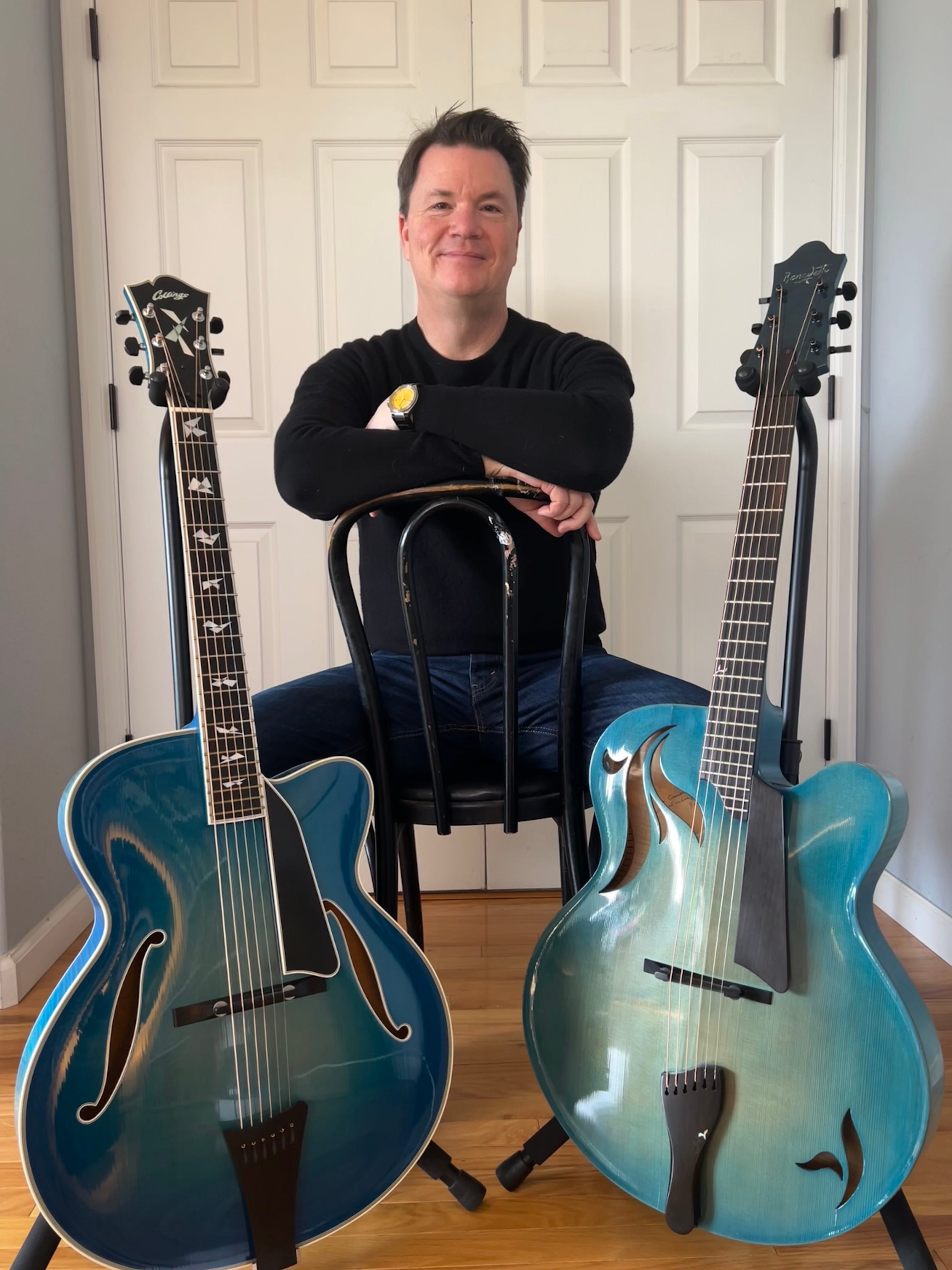
Based in Colorado, McGowan works across performing, teaching, and recording, and that mix of experiences feeds directly into his latest album, All Blues, available now on Bandcamp or for preorder in a deluxe vinyl edition. The project grew out of extended access to a group of instruments from the Blue Guitar Collection—large, cerulean-finished archtops commissioned mostly in the 1990s by collector Scott Chinery, each built by a different luthier within a shared set of parameters. Given more than a few minutes with them—time to actually live with the instruments rather than sample them—McGowan set about figuring out what each one had to say.
Recorded under controlled conditions—same player, same room, same microphones—the album ends up documenting those differences in a direct way. The shifts in feel and response from one guitar to the next are easy to hear, and they shape the music accordingly, whether in solo settings or in the duo and trio pieces that round out the program. I spoke with McGowan about that process—what surprised him once the novelty wore off, how the guitars influenced his choices, and what it means to spend real time with instruments that most players only encounter in photographs or in passing.
You’ve recently spent time with a number of guitars from the Blue Guitar Collection, and I’m curious what surprised you once you got past the idea of them and started living with them day to day.
Yeah, that’s a great question. Just for a brief backdrop, I became aware of them peripherally through a very dear friend of mine, Brad Nickerson, who’s one of the original Chinery collection luthiers. I remember him working on getting that commission back in the ’90s, so it’s always kind of been there.
Then I had the opportunity a few years back, when the Archtop Foundation purchased the collection and started bringing them to shows—that was really cool. That was my first opportunity to play them, but it was more like playing them for a couple of minutes in a noisy room at a guitar show, or something like that. I even did a couple of performances at shows on a few of the guitars—I played a gig with Paul Asbell on the Benedetto—but even after having the opportunity to perform with them, it wasn’t the same as, like you say, living with them.
That’s when I started really appreciating them on a very deep level—the craftsmanship, the unbelievable attention to detail, and also being able to see the stylistic differences and choices between all of these master luthiers. If you have a minute by yourself, or hours by yourself, or days, to look at these guitars side by side—to look at the tailpiece, the way the bridge is designed and structured, all of these little details—it feels like you’re just going deeper and deeper into the mind and the heart and soul of the builder, which I think is a wonderful thing to observe.
And then sonically, I think that also really surprised me. Part of the fun of doing this record was that the equation was the same player, same engineer, same microphones—same everything—except for the guitars. The more I listened to the recordings through the mixing process and then mastering, the more I was really able to discern these subtle—and now, to me, not so subtle—differences in the sound between these guitars. They all have their own personalities, visually and sonically.
Comments
Nothing yet. Say the first thing.
Sign in to join the conversation.