
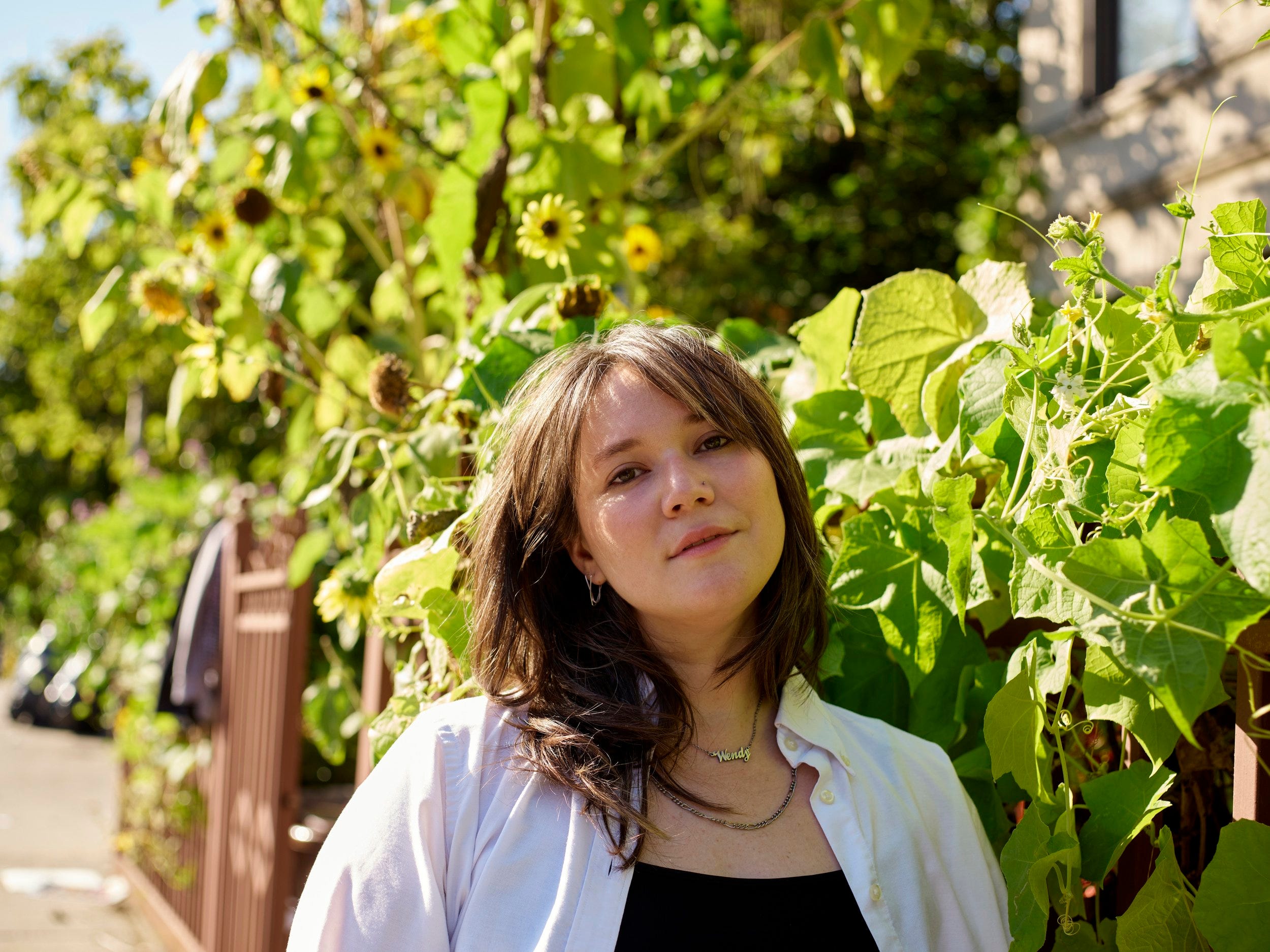
When I first interviewed Wendy Eisenberg in 2019, they were emerging as one of the most distinctive voices in a younger generation of guitarists shaped by free improvisation and nonstandard musical thinking. We spoke for Acoustic Guitar magazine around the release of Its Shape Is Your Touch, a solo acoustic album built from spontaneous compositions and exploratory approaches to harmony, gesture, and texture. Eisenberg talked about improvisation less as a style than as a way of engaging critically and personally with sound—setting up problems on the guitar and teasing them out in real time, whether through unusual chord voicings or the emotional associations contained within something as simple as an open C chord.
In the years since, Eisenberg’s music has continued to expand in all directions. They’ve moved fluidly between free improvisation, art-rock, noise music, jazz, and folk-informed songwriting, often within the span of a single year or even a single project. Albums like Auto and Viewfinder pushed further into collaborative and large-ensemble territory, while other releases explored banjo music, intimate song forms, and increasingly personal writing. Along the way, Eisenberg has become not just a prolific recording artist and collaborator but one of the most compelling musical thinkers working around the guitar today.
Eisenberg’s recent self-titled album feels different, though not necessarily like a break from the earlier work. Written during a period of major personal change following their move from Western Massachusetts to Brooklyn, the album channels many of the same exploratory instincts into songs that feel unusually direct, emotionally open, and deeply rooted in the history of the guitar itself. The record draws inspiration from figures like Gillian Welch, Willie Nelson, and Judee Sill, as well as more idiosyncratic songwriters like Richard Dawson and Joanna Newsom, while still carrying the sensibility of someone shaped by years of improvisation.
When we spoke recently, our conversation ranged from songwriting to the enduring influence of Ran Blake, the emotional resonance of certain guitars, and why a taped-on car bumper and an encounter with a Tacoma acoustic guitar on a trip to Staten Island ended up becoming important parts of this particular record. This interview has been edited and condensed for clarity.
When we last talked, a lot of your thinking centered on improvisation as a way of understanding music in real time. I’m curious about how improvisation shows up in your latest work, which is of course more singer-songwriter oriented.
The journey that that took me to this record or something is kind of paralleling something deep in my life, where before I even improvised at all, I was trying to write songs. So it feels kind of like a strange return to form, to be presenting something so extremely song-forward. Like, let’s not be too weird with the song itself, but show how weird song form itself can be.
There’s one narrative of my life in music that would be easier to trace, which is when you were 12 years old you wrote songs, and then you got into things that were improvisational because you loved it, but it was all kind of in service of some aesthetic or spiritual impulse within a song, which is the spark of recognition.
And I think for many years in my 20s—and now I don’t know why I’m saying my 20s like I’m 100 years old or something—but every bit of free improvised work that I really love takes on the character of a song. I file it in my brain in the same place the best songs live. And it’s because there’s something that’s recognizing me, or that I’m recognizing, that I had previously not known or not admitted to myself. Songs just seem to be the places where that kind of psychoanalytic space is contained.
So the actual material practice of it, beyond this weird philosophy, is that every time I sit down to write a song, it’s based on some kind of improvisation, and it’s segmenting the improvisation until I can enlarge it into the thing it’s reminding me of. A lot of the songs on this record would have been momentary occurrences in a longer-form improvisation—or they were when I was writing them. But there’s just something that made me want to come back. You can’t really write a new song without improvising a little bit, I think. Or at least not a good one.
What does that look like in practice?
Improvisation is just the practice of living for me. Whenever I sit and practice guitar, I’ll be trying to touch up on things that are more programmatic or already existing or something. But usually they’re on a very simple level—an interval, a chord voicing, something like that. And then if I’m improvising with whatever structure that is, something will happen and I’m like, well, there needs to be further development here. That’s where the song comes out of.
So it’s not like a long trance where I’m improvising and then all of a sudden I’m like, “Aha.” It’s more like I’m solving some other musical problem through improvising, and then I’m like, well actually this is speaking to a feeling on a much more emotional level. So let’s just hang out with the feeling that the improvisation or the practice brought forth.
We both came out of the Contemporary Improvisation program at New England Conservatory, and I’m wondering how that experience continues to shape your music in all forms.
It’s amazing you’re asking that because just this morning I finally read Ted Reichman’s piece about being influenced by Anthony Braxton and being taken into his orbit. He was kind of writing about the strange place those teachers occupied. Like, the future of the universe depends on whether or not you play accordion with me. There was this openness of approach where songs were taken just as seriously as more strictly improvisational, Derek Bailey-ish, Tony Oxley-ish places. They just took creative music seriously.
My undergraduate program [at the Eastman School of Music] was incredible and rigorous, but they didn’t really take these newer and far less potentially lucrative forms seriously. So when I think about the shifts I’ve been able to make in my career—from improviser to songwriter to whatever, sometimes within the span of a week—that paradigm wouldn’t have felt as supported anywhere else.
And also you just see people from the program all the time. There’s definitely an NEC mafia in New York that I’m kind of tangential to. But really, on a practical level, the openness of approach from people like Anthony Coleman and especially Joe Morris—who as far as I know doesn’t really write songs—made my life conceivable to me. And that’s paid off pretty handily. So I’m very indebted.
Comments
Nothing yet. Say the first thing.
Sign in to join the conversation.