
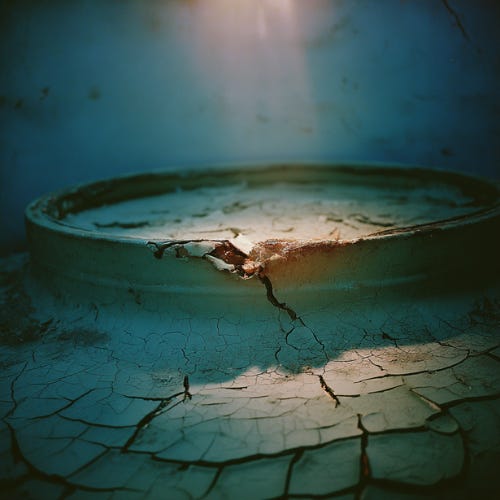
Sixth grade. Mr. Jury’s art class.
I wasn’t there because I was particularly “artistic.”
I was there because my dad knew the teacher and my schedule had a hole in it.
I sat near the door.
Back to the wall, as usual.
Perched to leave the second the bell rang.
In front of me: a large blank paper.
On the table: big bottles of paint with crusts of dried color around the tops.
You had to poke holes through the crust to get anything out.
Sharp, chalky smell.
Through the half-wall window: the school drop-off circle. Minivans. Ordinary.
Up until then, art class had been arts and crafts.
Follow instructions.
Q-tip pointillism.
Marshmallow men.
Fun, but there was always a right way to do it.
This time, nobody told me what to make.
So I started playing.
And this is the first place I ever felt the difference.
If you’re new here: I write about coherence — how to connect the many yous so you can act as one.
Last week: certainty vs. coherence.
This week: optimization vs. origination.
The Emergence
Blue first. Sloshed on the paper.
Mixed with a little white. Then black. Blue-grey. Sloshed that on top.
It started to look like a cold sky.
Then water.
A horizon line.
Grey. Cold. Arctic, maybe.
More white — frozen.
More blue-grey to break it up.
Icebergs.
But lifeless.
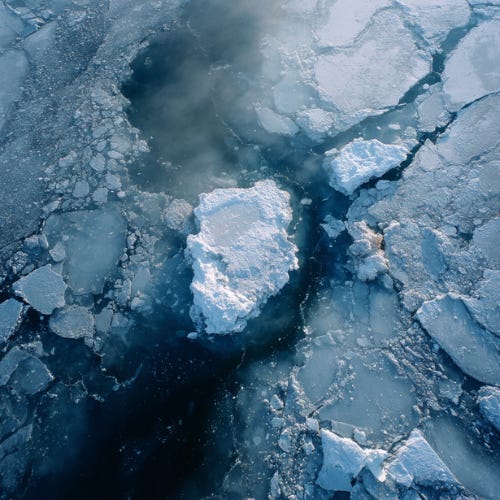
I grabbed brown and made a few aggressive strokes right in the center of the water — like the shape of a bowling pin.
And something shifted.
I wasn’t making it anymore.
I was watching it happen.
A seal. Rising out of the water into the scene on its own.
Whoa. That actually looks like a seal.
Black for eyes. Ripples for movement.
The thing was alive.
I don’t know how long it lasted.
Two minutes? Twenty?
But I remember what disappeared:
The drop-off circle outside the window — gone.
The other kids near the kiln — gone.
Just the paint. The cold water. And this creature showing up.
Then I broke the trance.
I looked at what I’d made.
Felt proud.
And then I did what ambitious people always do:
I tried to repeat it.
I decided to add more animals in the background — on the icebergs.
But something was different now.
I was back in the room. Back in my head.
Instead of following the paint, I was reaching for a picture — what does a seal look like? — and trying to copy it onto the paper.
The results were fine. You could tell what they were, mostly.
But the quality was different.
Flat. Stiff.
They didn’t look like arctic animals resting on ice.
They looked like circus sea lions — poised on a platform, waiting for a ball on their nose.
I’d tried to add life.
And made something lifeless.
The first seal had emerged.
The sea lions were manufactured.
I was eleven. I didn’t have language for what happened.
But I could feel exactly where it shifted.
Two Modes
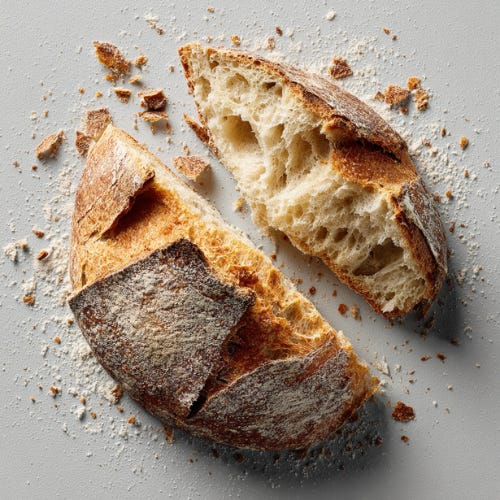
When I painted the seal, I was in contact with the material:
the shapes
the colors
the thing forming right in front of me
I wasn’t trying to make it look like anything.
I wasn’t referencing an image in my head.
I was following what was appearing.
The room disappeared.
I disappeared.
Just paint finding a form.
When I painted the sea lions, I came back.
Up into my head.
Pulled up an idea of what a seal “should” look like, and tried to copy it onto the paper.
Same kid. Same paint. Same table.
Two completely different operations.
Origination: staying with what’s emerging.
Optimization: matching what’s in front of you to a picture you already have.
Optimization is useful.
It’s how you get better.
It’s how you refine.
But it has a hidden cost:
The better you get at repeating, the harder it gets to stay open.
You don’t just get faster.
You get narrower.
And eventually, your life starts to look like the sea lions:
competent, recognizable…
and strangely lifeless
The Strange Part
Here’s what I couldn’t have told you at eleven, but can feel clearly now.
The sea lions felt more like mine.
I was conscious of making them.
I could see “Adam painting.”
I knew what I was going for.
I could take credit — because there was a clear “I” doing it.
But the seal?
I couldn’t take credit for the seal. Not really.
Because the “I” wasn’t running things when it showed up.
Something else was.
Something that needed me to get out of the way.
That’s the paradox:
The thing that feels most like “yours” —
the managed, directed, intentional effort —
often produces the deadest work
And the thing you can’t quite claim —
the thing that happened while you weren’t watching yourself —
is the one that’s actually alive.
The Pattern
This isn’t just art.
It’s everywhere.
The career you built because it was the logical next step —
and now you can’t leave because you’ve become too good at it.
The relationship where you know exactly what to say to keep the peace —
but you haven’t said what’s actually true in years.
Parenting, when the efficient version of you manages bedtime like a project —
and the present version of you, the one who’d sit on the floor and listen, doesn’t get a turn.
Someone asks what do you want? and your first move is to calculate rather than feel.
This is drift in disguise.
Not laziness.
Not failure.
Just a system that learned to succeed by compartmentalizing.
The optimizer takes the wheel.
The part that stays in contact — with the body, the moment, what’s actually forming — goes quiet.
Not because it’s broken.
Because it hasn’t been invited.
The Dojo
This happens to me when I cook.
I never follow recipes. I follow my tastes. Stay in contact with what’s in the pan.
Sometimes something comes together that my wife and kids love. Something I didn’t plan.
Enjoy it now. Because I’m not sure I could make it again.
That’s what origination feels like from the inside. You can’t reverse-engineer it. Because it didn’t come from engineering.
The cognitive scientist Francisco Varela pointed to something that helps explain why.
He described a moment he called suspension — a pause where your habitual response doesn’t fire. Your usual pattern of reaching for what you already know goes quiet. And in that pause, something else becomes available. Fresher perception. A response that isn’t pre-loaded.
Suspension doesn’t happen between the two modes.
It’s what makes origination possible in the first place.
The seal was born inside that pause — before my habits had a chance to take over.
The sea lions came after the pause collapsed and the familiar mind rushed back in.
So the practice isn’t a question to answer.
It’s a moment to catch.
Next time you’re in the middle of something —
a conversation, a decision, a paragraph, a meal —
notice the instant you leave contact.
The instant you go from being with the thing
to managing the thing.
From inside the painting
to above it.
You’ll feel it in your body before your mind names it:
a small tightening
a shift from belly to head
the room gets a little flatter
That’s the threshold.
Don’t fix it.
Don’t force yourself back into some “better state.”
Just notice it.
Because the noticing is the crack.
And origination lives in the crack.
The Painting
My dad was our “picture person” growing up. Art history minor in college.
He hung that sixth-grade painting in his office.
It stayed there for twenty years.
Each time I saw it, I saw the same thing.
The sea lions — competent, recognizable, clearly made by someone.
I could see the effort. Trace the intention. That was Adam.
And the seal — alive, emergent, surprising even to the kid who painted it.
But no artist attached.
For most of those years, I identified with the sea lions.
Not because they were better —
because at least I could see who made them.
The seal was harder to claim.
Because the version of me that painted it wasn’t really “me” at all.
It was what showed up when “me” stepped aside.
And that unsettled me for a long time.
Because if your best work comes from a place you can’t control or schedule or summon on command…who are you when you stop managing?
I think that’s what origination actually asks.
Not what’s my next move?
But: what happens when I stop being the one who decides?
My parents have moved since then. I texted today to ask if the painting still exists.
I don’t know yet.
But I know what it showed me.
Two ways of making anything — side by side, in the same frame.
A seal that arrived because a kid disappeared into the paint.
And a row of sea lions that proved how quickly he could come back.
See like you’re many. Act like you’re one.
With you in this,
Adam
P.S. Where are you still painting sea lions? Not failing — just manufacturing from memory, when something else is trying to emerge. Reply or comment below.
LAST WEEK:
Comments
Nothing yet. Say the first thing.
Sign in to join the conversation.