

The 2025 DORA report recently dropped. DORA is of course famous for their annual State of DevOps reports, which look at industry wide trends and performance around the core DevOps concepts described in the Accelerate: The Science of Lean Software and DevOps book, one of the core reference texts of modern software leadership. But this year’s report carried a new title, the State of AI-assisted Software Development, which seems like an appropriate recognition of the depth of the AI transformation taking place in the software industry.
The 2025 report covers lots of new ground and considers a range of new topics. Much of the coverage, including a new look at AI success factors, hints at the idea that we are seeing the early maturation of AI in software engineering. It’s still clearly early days, but you can feel in the report that we are starting to grow out of the “wild west” phase of AI adoption.
This maturation hinted at by the DORA report stands in interesting contrast to the growing volume of pessimistic chatter that we are entering a “trough of disillusionment” phase in AI adoption.
This idea of a “trough of disillusionment” phase in new technology adoption comes from the Gartner Hype Cycle, a well known model for tracking the perceived value of new technologies from initial innovation, through early days of inflated expectations (which we’ve certainly seen plenty of around AI!), then a “trough of disillusionment” that hits as the practical limitations of the technology are experienced, and then a longer term phase of enlightenment and productivity where the technology finds its real stride and value. It really does seem to be a pattern most innovations follow, although at different rates.
The chart below shows the 2025 hype cycle for AI technologies (Source: Gartner):
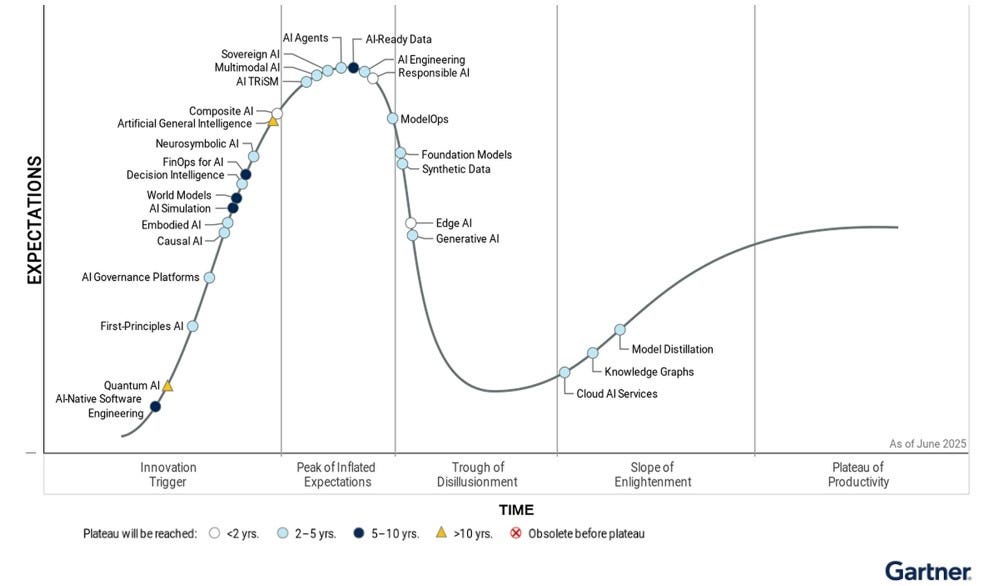
Buzz has been growing around the idea that AI is starting to hit the trough of disillusionment in some areas (e.g., we see this depicted for topics like Foundation Models and Generative AI in the Gartner plot). This chatter seemed to gain momentum this summer around the release of GPT-5, which was perceived by many as disappointing, at least in relation to the outsized expectations of rapid advancement that were established by prior major model releases.
Beyond AI sentiment in general, there’s also evidence that we’ve been entering a trough of disillusionment specifically in the area of AI-assisted software development (not shown in th Gartner view, but based on many other data points). For example, the annual Stack Overflow developer survey released this summer showed a 12% decline in developer sentiment around AI tools compared to 2024 (from 72% favorable to 60% favorable). Developers cite incorrect code suggestions and time spent debugging AI-generated defects as top frustrations.
For anyone who has been actively working on or with teams trying to adopt AI, this probably comes as no surprise. We’ve been hearing the early concerns from engineers, especially the most senior engineers, for the past couple of years. Now with AI adoption happening at scale and with a meaningful amount of burn-in time, there’s real and mounting evidence that the concerns and frustrations are real.
The trough of disillusionment can be a dreaded phase for advocates of a given technology. After all, this is where the initially over-inflated expectations about a technology are recalibrated against reality. Your favorite technical innovation can come out the other side looking very different in terms of reach and impact! Consider blockchain, which reached peak hype in the mid to late 2010s. Arguably with the maturation and wide adoption of cryptocurrency, blockchain technologies have reached the other side of the trough. But we no longer hear much about the grander predictions about blockchains completely reimagining the nature of many distributed applications to fully decentralized models (i.e., “web 3”). Blockchain is on the plateau of productivity, but perhaps not where some of its biggest champions hoped it would level out.
AI enthusiasts may choose to deny or ignore the trough, but in reality the trough is an opportunity to filter out some of the noise of more far-fetched aspirations, focus on the most promising use cases, and advance to the “slope of enlightenment” where we actually drive towards delivering real and measurable outcomes and value.
The DORA report gives us clear evidence that we are entering this phase of maturation, and also gives some solid guidance on how to navigate it successfully. This year’s report is particularly interesting in that it marks the first real “follow up” report with broad coverage of AI adoption. The 2024 State of DevOps report pivoted hard to look at AI adoption trends, but in many ways these represented an initial snapshot (AI was covered in the 2023 report, but it was not a main topic like in 2024).
In the 2025 report, we now get to see how the story is evolving – what do the trend lines look like, and what does that tell us?
In terms of basics, unsurprisingly AI is now very widely adopted, with 90% of the study respondents indicating that they use AI at work, up 14% from last year. And the median reported daily usage time was 2 hours, which is a pretty significant chunk of the workday!
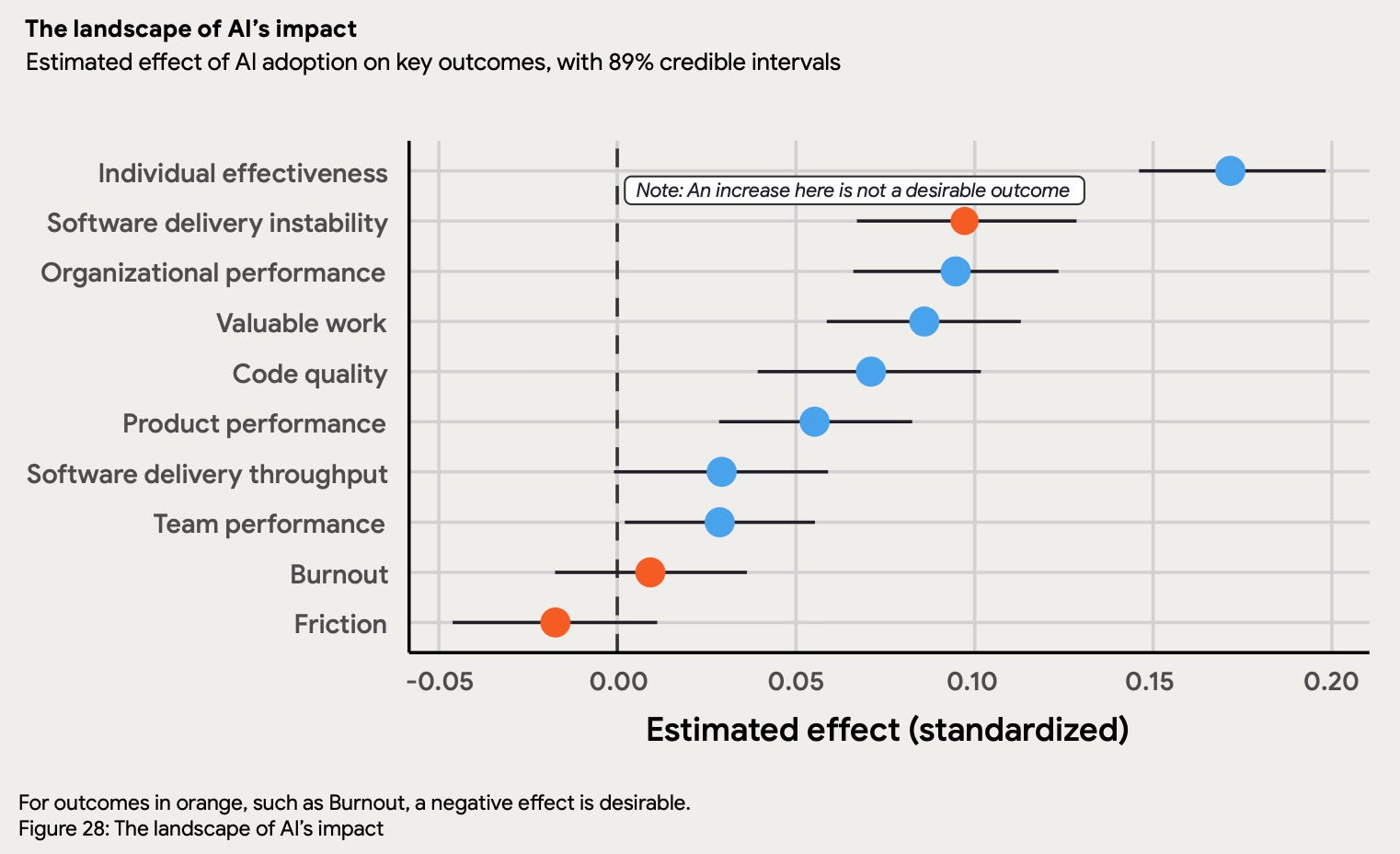
And as depicted in the impact chart below, use of AI continues to be associated with positive software delivery benefits including higher individual effectiveness, better code quality, and improved team and organizational performance. And in a change from last year’s DORA findings, this year’s survey showed a positive impact on software delivery throughput, which echoes findings from other studies such as the recent joint study between OpenAI and Jellyfish.
(Source: DORA)
Not all of the impact findings were positive though. Similar to last year, the study finds that increased use of AI leads to increased software delivery instability (e.g., rework and failed deployments). And AI seems to have no impact on areas such as burnout and friction, where intuitively we might expect it to help.
But overall, this year’s results show improvements in the reported impact experienced, indicating that organizations are adapting and improving. Of course, the impact of AI is not just a function of deploying the technology, but also how teams learn to use it. And based on the clear improvements in impact measures, it’s clear that organizations are not standing still, but rather are evolving their practices and approaches to drive greater AI impact.
Specifically related to this question of how organizations adopt AI, this year’s DORA study investigated the enabling investments that seem to improve the impact that AI can have. Based on looking at a variety of factors and correlating these with AI impact measures, DORA identified a new model of AI Capabilities that organizations should focus on to unlock greater impact from AI.
Based on the analysis, the following factors stood out as the most important:
Clear and Communicated AI Stance [medium impact] - Setting clear expectations about the usage of AI at work helps to improve developer trust, reduce concerns about irrational expectations as well as concerns about compliance and data privacy, and generally serves to de-mystify the use of AI in the software development process.
Healthy Data Ecosystem [high impact] and AI Accessible Data [high impact] - Having data and documentation that is high quality, clear, and accessible to AI models strongly correlates with better reliability and subsequent trust in what the AI tools can produce.
Strong Version Control Processes (including rollback) [high impact] - Strong version control and rollback capabilities create a psychological safety net for experimentation, which helps lower the barrier to AI adoption, and increases trust.
Working in Small Batches [medium impact] - Teams that focus on smaller commits are better able to course correct quickly, which is especially beneficial when working with AI generated code.
User Centric Focus [small impact] - User centricity, including a focus on user experience, creates beneficial clarity in goals and design that enhance the quality and reliability of what AI can produce.
Quality Internal Platforms [high impact] - Internal platforms, defined as shared systems and code artifacts, standardize best practices, reducing the room for bad design and increasing the quality of AI output.
Platform Engineering, in particular, is covered as a particularly important best practice. 90% of organizations report use of internal platform constructs, broadly defined, and 76% of respondents report having a dedicated platform engineering team in their organization. Platform teams capture best practices, making them easy for feature teams to re-use, and tend to drive strong impact on outcomes such as reliability, security, strong infrastructure management, etc. These benefits accrue to human developers, but in the case of AI coding tools, the extra structure and context that platforms provide is even more valuable.
In fact, this idea that best practices that support human developers also tend to drive success with AI is a core theme, and perhaps the most profound finding, of the 2025 DORA report.
The idea that AI is like a mirror that reflects and amplifies your organization’s true strengths and challenges makes intuitive sense. This is a conversation I feel like I’ve had many times over with fellow engineering leaders. After all, LLMs thrive on context to generate good output, which isn’t really different from human engineers. Better documentation, re-usable code artifacts that codify organizational best practices, shared systems for common engineering needs like infrastructure management, CI/CD, observability, etc. – these types of investments make life easier for human engineers, allowing them to create better artifacts with less effort and fewer wrong turns. And the same holds true for AI. All of that context allows AI to create better output with greater reliability.
At the same time, it also makes intuitive sense that AI runs the risk of amplifying dysfunctions. For example, if an organization lacks adequate processes for managing and ensuring quality, then generating a ton more code with AI is only going to exacerbate the pile of quality issues. More output is only desirable if it’s the right output. Similarly, if we’re not able to manage the end-to-end flow of work through the organization, AI can exacerbate bottlenecks, which in turn can place new stresses on human members of the team. For example, it’s a clear best practice to ensure human review on all AI generated code, but this can easily swamp our best reviewers if we don’t put focus on improving the review experience. For example, we should consider augmenting human review with AI code review agents to reduce the per-review effort.
The notion of AI as a mirror of our organizational strengths and weaknesses has been emerging for many engineering leaders, but this year’s DORA report brings a ton of clarity to this concept on the basis of solid research results, as well as concrete suggestions for how to put it into action. Some of the areas it suggests focusing on include:
Efficient code reviews and handoffs
Integration and deployment pipelines
Data infrastructure
Security and privacy protocols
Change management and cultural alignment
And it suggests that organizations look beyond AI for coding tasks, and consider how AI can enhance the end-to-end SDLC, for example in areas such as:
AI-native delivery pipelines (e.g., AI automated testing)
AI-native data systems
AI-native security (e.g., AI security tools)
AI-native collaboration models (e.g., swarming)
Beyond these recommendations, the report provides extra depth on new areas of analysis including Platform Engineering and Team Profiles.
One of the standout results from this year’s report was around the impact of high quality platform support. The report uses an intentionally broad definition of engineering platforms: “A platform is a set of capabilities that is shared across multiple applications or services.” And it surveyed for a variety of platform attributes to understand the relationship between these and engineering outcomes. Platform quality attributes include things like helping to build reliable applications, helping to build secure applications, helping to follow required processes, and abstracting the complexity of underlying infrastructure.
Unsurprisingly, the report found that quality platforms are a force multiplier, improving organizational performance and productivity. I know that in my personal experience, a strong focus on platform capabilities is a huge part of creating a strong engineering culture.
And as suggested by the AI mirror concept, DORA also found a strong relationship between quality platforms and AI impact. This makes sense since platforms create better context and guard rails, the exact types of constructs that help AI produce better and more trustworthy output. But it’s also a delightful result in that it addresses some of the concerns about AI hurting software engineering as a profession. Here we have solid evidence that the very same investments that drive quality developer experience are the ones that are also among the best unlocks for achieving better productivity with AI!
The AI mirror is broader than any one aspect such as platform engineering. As a multiplier on our capacity, you can argue that the main point of this year’s DORA report is that AI places extra stress on our overall engineering strategy, across the board.
Of course, charting an effective overall engineering strategy is a broad and deep topic with many facets. Engineering organizations are highly complex systems. But underlying any good strategy is a solid grasp of your organizational strengths and weaknesses. One of the more interesting parts of this year’s DORA report is a new model for thinking about this.
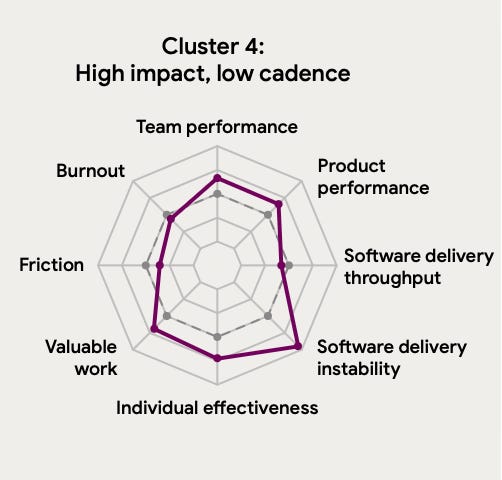
The new analysis looked at organizations using the existing DORA metrics around delivery throughput and instability, and considered additional survey questions looking at assessments of team and product performance, as well as individual performance measures including individual effectiveness, valuable work, friction, and burnout. DORA clustered organizations along these dimensions and identified seven distinct organizational profiles.
(Source: DORA)
For example, the above chart depicts the “high impact, low cadence” profile. The full set of clusters includes the following profiles:
Foundational Challenges (10% of orgs) - Teams stuck in survival mode, with significant challenges in process and environment
Legacy Bottleneck (11% of orgs) - Teams constrained by unstable legacy systems, which undermine their performance
Constrained by Process (17% of orgs) - Teams with stable systems but inefficient processes that encumber process and lead to burnout
High Impact, Low Cadence (7% of orgs) - Strong product performance but slow throughput due to delivery instability
Stable and Methodical (15% of orgs) - High quality work delivered with stability but at a methodical pace
Pragmatic Performers (20% of orgs) - Balanced speed and stability but not yet at maximum achievable performance
Harmonious High Achiever (20% of orgs) - Stable, low-friction environment where the team delivers high-quality work sustainably
While these clusters are not directly prescriptive, they provide a backdrop that illustrates the high level challenges of the team, and are suggestive of where to focus. The insight of the DORA analysis is that AI, in and of itself, is not the “solution” to improving your performance. Rather, without additional system level considerations, AI is likely to make you even more deeply indicative of your organizational profile. A healthy view across engineering environment considerations is more necessary than ever.
Looking broadly at this year’s DORA report, we find a wide range of evidence that the industry is, on average, driving towards greater impact from AI on the basis of organizational improvement, including many tried and true engineering strategies such as platform engineering. And it’s not just the stats that tell us this story. The emerging understanding of AI best practices, such as the DORA AI Capabilities Model, illustrate concretely how the maturation of systems thinking around AI-assisted software development is unfolding.
Returning to the hype cycle, this all begs the question, are we really in the trough of disillusionment, or does this feel more like the slope of enlightenment? In reality, I think it’s rarely clear cut (i.e., “the future is already here; it’s just not evenly distributed”). In reality, it’s more like a probability function, with leaders further along towards enlightenment, and laggards a bit behind. And this effect is magnified by the startling pace of change around AI. Tools, models, and best practices have been moving at a breakneck pace, compressing the time in various phases of adoption. The pace of change is creating what feels like a “red shifted” environment, where some orgs are still in the early stages of adoption, while others have iterated significantly.
If you’re in an organization that isn’t on the bleeding edge, it can feel concerning to be behind in a fast moving space. The volume of progress you need to catch up on can feel daunting. But if there’s a silver lining, it means there’s more progress on best practices to work from. The 2025 DORA report certainly contributes to that effect.
Now, you might be wondering, what about the traditional DORA metrics? Do they matter any more? Of course, in keeping with the theme of the AI Mirror, of course the fundamentals matter more than ever. In fact, in recent iterations of the DORA report, the original metrics have now been further contextualized into the DORA Core Model that clarifies why the core DORA metrics around software delivery matter in the larger engineering context. As was always the case, measuring the DORA metrics, and other key indicators of engineering productivity and performance is a starting point, not an end game. Metrics clarify what’s working and what needs improvement.
The AI Impact results from the 2025 DORA report and many other studies show us that AI is having a positive and growing impact on software engineering. The AI Mirror tells us that this transformation is not at odds with, but aligned with creating a great engineering environment with strong developer experience. Where we land on the “plateau of productivity” remains to be fully seen. But indications are increasingly positive.
—
Join me and DORA Lead Author, Nathen Harvey, for a deep dive into the 2025 report on October 30. Register here. If you’re reading this before the end of October 2025, I’d like to invite you to join me for a webinar on October 30th with DORA Lead Nathen Harvey and members of the Jellyfish team. We’ll review the key findings of the 2025 DORA report with Nathen, especially around AI adoption and impact. And we plan to have an interactive conversation about how to put the ideas from DORA into practice in real world engineering management settings, especially around AI transformation. I expect it’s going to be a lively and valuable conversation, and I hope you can join us for it! Details and registration here.
No posts
Comments
Nothing yet. Say the first thing.
Sign in to join the conversation.