
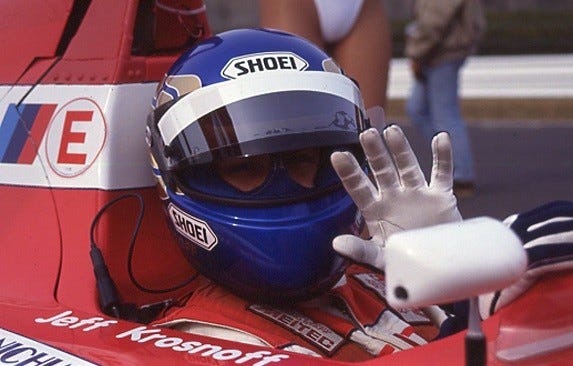
Thirty years ago today a horrific crash in the closing laps of the Toronto Indy Car race claimed the lives of series rookie Jeff Krosnoff and marshal Gary Arvin.
For those close to Krosnoff there were obvious parallels with the death of Roland Ratzenberger at Imola a couple of years earlier. Both men had raced extensively in Japan, honing their talents while hoping to find a way back to the racing mainstream.
Both had finally been able to make the next step up, in Roland’s case to F1, and for Jeff, to Indy Car. And having achieved their dreams both were soon robbed of the chance to show how good they really were.
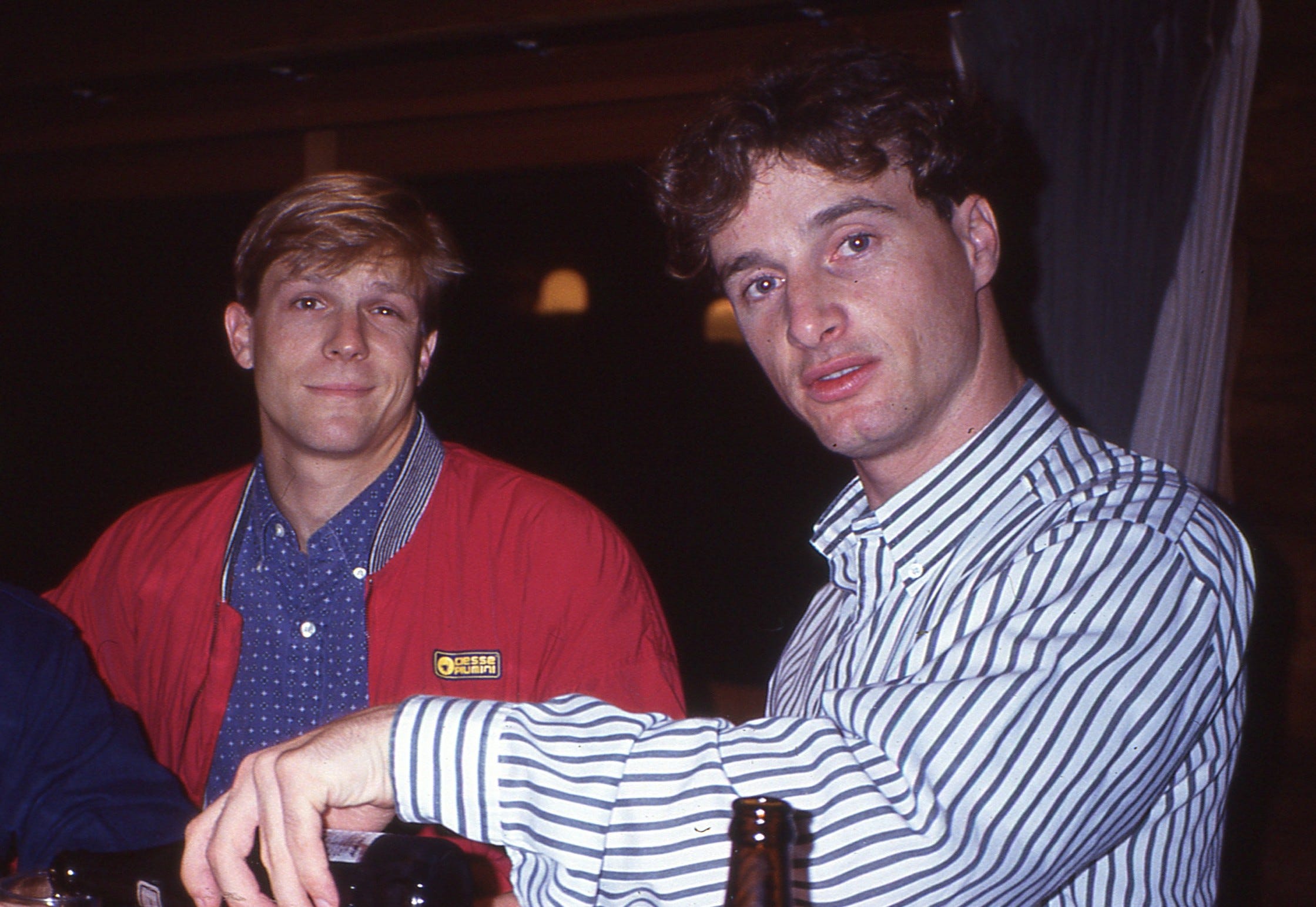
“It was kind of sad,” says Eddie Irvine, a Le Mans team mate to both drivers. “It was the same as Ratzy. No sooner had Jeff made it to where he really wanted to get to than he got killed. And they were probably two of the most driven guys to get to where they wanted to get to.”
He may have been a rookie in Indy Car in 1996, but he had raced in the Japanese F3000 series for seven years, going wheel to wheel with several drivers who would have long and successful F1 careers, and he had very nearly won Le Mans. He was a class act.
“He had a very competitive instinct,” says Johnny Herbert. “He was always trustworthy, whenever you were side by side. He had a brain in him, and you would know that you could trust each other. But the main thing was the fun factor outside the racing arena – you could talk to him, and not just about understeer and oversteer.”
“He was a hard-working guy, he worked a lot on his racing,” recalls Mika Salo. “He wasn’t like the rest of us, having fun and partying on the side. He was just concentrating on his job. He was probably too intelligent for that group of us in Japan! It’s hard to say how good he was, because he was not in a good team, and he never had a chance to show what he could do.”
I got to know Jeff well when I was living in Japan and covering the local scene in 1992-’93. We travelled around to races together on bullet trains or in hire cars, often sharing hotel rooms. In April 1994 I got a taste of Jeff’s home life, staying with him and wife Tracy in LA when I went to the Long Beach GP. Along with Roland he was one of the best friends I ever had in motor racing.
Among the tight knit community of imported drivers, he was universally popular. Jeff was a fun guy to be around. He had an off-the-wall sense of humour, and if Jeff was your mate, you’d regularly receive silly faxes. My old Tandy word processor carried a sticker he placed bearing the legend “Sphincter says what?,” a favourite catchphrase.
He once asked Roland to record him a Terminator-style “I’ll be back” phone message in his deep Austrian accent. At a fogbound Fuji F3000 meeting Jeff roused a bored crowd by firing rockets into the stands. Then there was the time fellow prankster Johnny Herbert dropped his trousers in the Tokyo hotel lift. Jeff stamped on them before the owner could pull them up, a struggle ensued, and the lift arrived in reception...
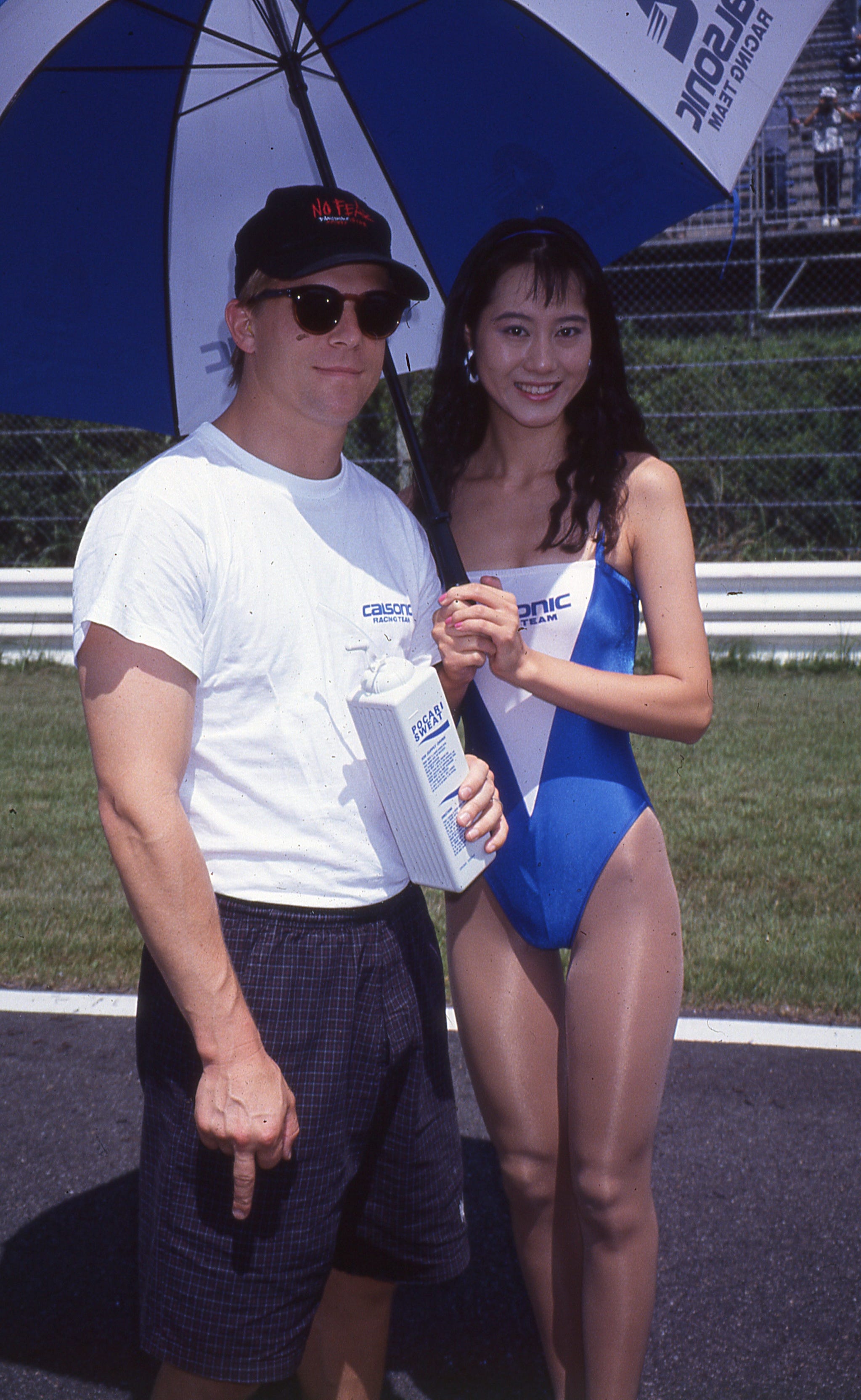
Jeff was incredibly fit and never had a hangover, because as far as I know, he didn’t touch alcohol. He got his buzz from being with his friends and simply enjoying the job he loved. He took delight in wearing silly T-shirts and reversed baseball caps, and generally went for the surfer dude look. In the car, he usually wore a blue boot on one foot and a red one on the other. This, he said, represented the “duality of man.”
Apart from being unusual, that was a reminder that he was a pretty smart guy, having studied psychology at UCLA. Off the track, his talents ranged from accomplished rock drumming to making painstakingly detailed models of the cars he raced. On a more serious note, he was selected by the drivers as their safety representative in Japan, and was frustrated when little seemed to come out of his work.
He was also one of the few drivers to make a serious effort to learn the Japanese language, which allowed him to appreciate the culture a little more, and form a closer bond with many of the people who worked with him.
Born in Oklahoma in 1964, Jeffrey John Krosnoff grew up in California. Early visits to the Long Beach GP with his plastic surgeon father installed a passion for F1 in the youngster, and after a Jim Russell course he competed in the school series in 1983, winning seven races and a rookie award named after Gilles Villeneuve.
Over the next few seasons he raced in Formula Mazda while finding time to complete his degree. By 1987 he was in Formula Atlantic, and then he moved into the SCCA’s very competitive Racetruck Challenge series. It was through winning races in a works Nissan pick-up that an extraordinary opportunity arrived.
A Japanese sponsor was looking for a young American to race in its home country, and Jeff was invited over for a test. He thought he was going to try an F3 car, but when he arrived, it was an F3000 Lola.
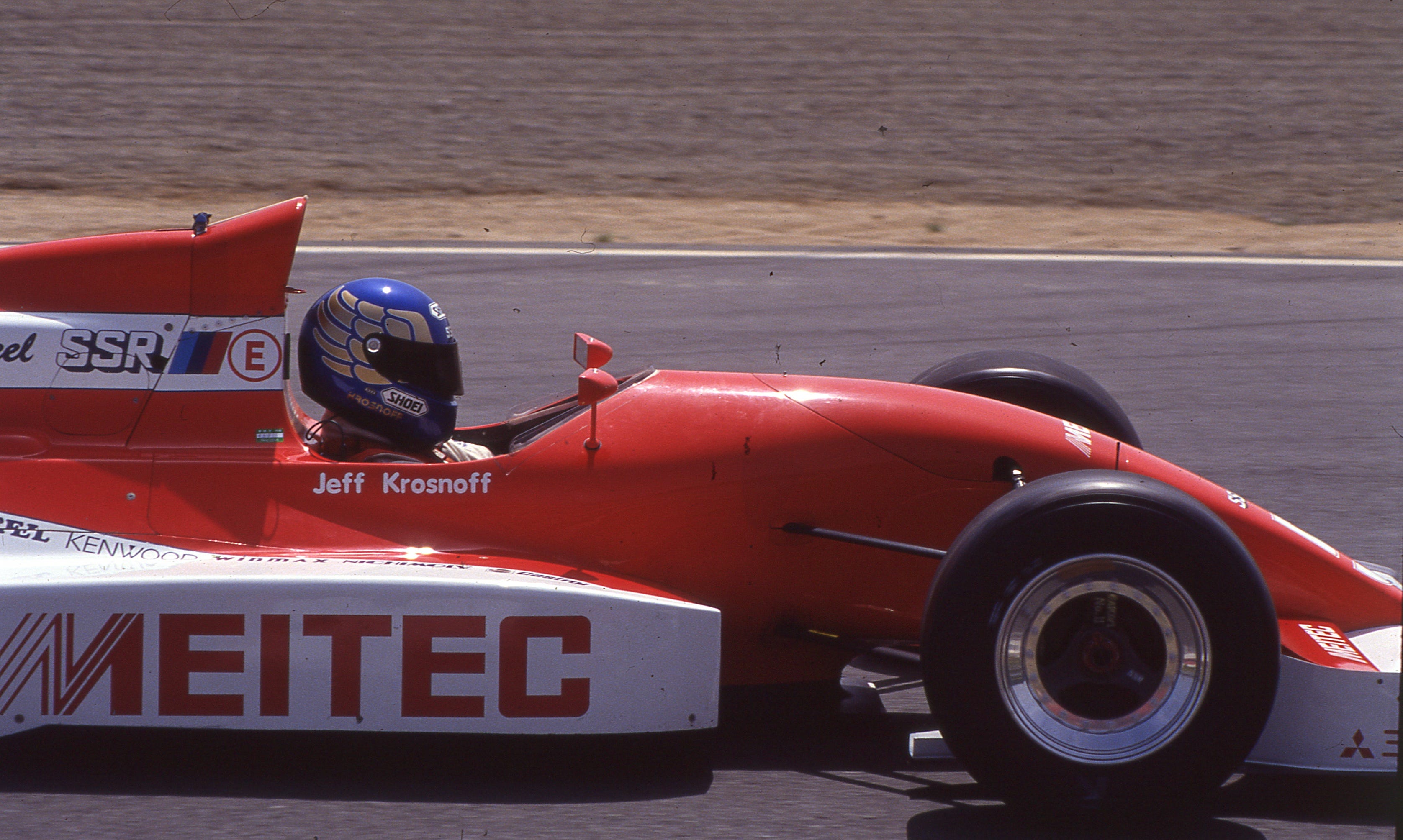
He got the job, and thus his Japanese adventure began in 1989. He was up against veteran local heroes who had raced for two decades, and visiting Europeans who had enjoyed extensive FIA F3000 careers – several of whom had also raced or tested F1 cars. He proved to be fast learner, and over the next few years he gained the respect of his colleagues on and off the track, although he never actually won an F3000 race.
“When I arrived in Japan he was the first person to come over and introduce himself,” says Irvine. “He was just a super friendly, really outgoing guy.”
“Japan was a big university for us, it was the campus,” says Jacques Villeneuve, who raced in F3 in 1992. “It was a special time, with Ratzenberger, Tom Kristensen, Irvine... We were all a group, and I was probably the youngest one there, and I had all these big brothers looking after me. And Jeff was one of them. He was a great guy, always fun to be around. He was very open.”
In 1991 a sponsor signed a deal with Tom Walkinshaw to run a Jaguar XJR11 in the Japanese sportscar series for Jeff and his close pal Mauro Martini. The turbocharged machine was not competitive, but the arrangement included a Le Mans V12 entry, with David Leslie in the third seat. Jeff set the fastest race lap of any of the 12 TWR works drivers before the green car’s retirement, and later he impressed when he drove Ross Brawn’s iconic XJR14 in the Japanese season finale at Sugo.
A second outing at Le Mans in 1994 nearly resulted in victory. Jeff was due to share the SARD team’s Toyota with Martini and team regular Ratzenberger, but after the Imola tragedy, Irvine stepped in to fill Roland’s seat. The trio were on course for the Japanese marque’s first win at the Sarthe when the gear linkage failed with 90 minutes to go. Somehow Jeff managed to get the car going again, and they finished a frustrated second.
Everybody wanted to win for Roland, so it was heart breaking for all concerned, including myself, as I was writing press releases for the team that weekend. And even more frustrating in retrospect, for a Le Mans win on his resume would have helped immeasurably to earn Jeff a place in motor sport history.
“He was quick and he didn’t make any mistakes,” Eddie recalls. “That’s what you need at Le Mans. He was a real team player.”
By 1995 Jeff was treading water in F3000, and rivals like Irvine, Salo and Heinz-Harald Frentzen had graduated to F1. He accepted that he had little chance to follow them, having aroused zero interest when he tried to talk to visiting team bosses at previous Japanese GPs.
Indy Car appeared to be equally as out of reach, but suddenly his efforts began to pay dividends. That winter he tested for the Ganassi and Arciero-Wells teams, impressing the latter sufficiently to land a drive for 1996. At 31 he was finally coming home, and to a team based in California.
I was at the Australian GP in Adelaide in November 1995 when I heard the news. That day I told Irvine, Frentzen and Salo of Jeff’s new deal, and they were all delighted for him. Later, Eddie and I rang Jeff’s number in California, and we left a suitably rude congratulatory message on his machine. Jeff had always joked that Irvine was “a mega.” We reckoned that he now deserved that title too.
He had spent seven years in Japan. He had been as happy as anyone to see old pals find success in F1. Now it was his turn to move on, demonstrate what he’d learned while logging up those thousands of miles at Fuji and Suzuka.
The drawback to his new arrangement was that car owner Cal Wells had agreed a deal to run the brand new Toyota engine in Jeff’s Reynard, and the only benchmark was the works AAR Eagle-Toyota of Juan Fangio. It was always going to be a challenging season given that the engine was at the start of its development curve.
“Jeff acquitted himself very well,” recalls Arciero-Wells engineer and former McLaren designer Gordon Coppuck. “He gave us confidence that he would develop rather quicker than the engine! His feedback was very good. All that we were really able to do was compare his performance with Fangio’s.”
Inevitably Jeff qualified towards the back of the field, and four engine-related retirements in the first six races showed how what a challenge he faced.
“He was learning oval racing as well, so it was a big chunk of responsibility for that stage of his career,” says Coppuck. “I was very impressed with his ability to communicate and not lose his rag with some of the disappointments. He had the team around him, everyone was behind him, and understood that he was in a difficult position. He encouraged everyone to be as committed as he was to making the project work.”
By the 11th race of the season in Toronto things were starting to come together. Jeff qualified 20th of 28 – his best result thus far – a place ahead of series veteran Stefan Johansson.
“We sat in the same car around the parade lap before the start of that race,” says Johansson. “Just bullshitting and joking and laughing, like mates. He was a really funny guy. He was doing a very good job. His car wasn’t great, and they had the Toyota engine, which wasn’t super competitive.”
In the race Jeff ran strongly in the midfield pack, and after a late restart he found himself behind Johansson and Emerson Fittipaldi. At the end of the long back straight Jeff attempted to pass just as Stefan himself jinked to the right.
“I tried to outbrake Emerson, and I dove on the inside of him,” Stefan recalls. “Jeff had already made his move, but you’re focussed on the guy in front. There wasn’t enough room for all the cars in the end when we got to the braking area.”
There was heavy contact, and Krosnoff’s car spiralled into the debris fencing on the right, striking a tree that was just behind it, and then a lamp post that stood between the concrete wall and the fence. The terrible double impact split the engine from the chassis, before the wreckage spilled back onto the track. Despite the best efforts of the Indy Car rescue team, Jeff stood no chance. Sadly Gary Arvin, a 44-year-old marshal from Calgary who was struck by the Reynard, also lost his life.
“What I remember is the engine from his car landed right in front of me,” says Johansson. “Had it landed a few feet further back it would have been on top of me. It was one of the lowest points of my career. It was just bad circumstances that made it happen. It’s a painful thing, so I’ve tried to erase it from my memory as much as I can. It was very difficult at the time. You have a defence mechanism, you go into a little bubble.”
I was at the British GP that weekend, and a few hours after the race ended, and with Eddie Jordan’s band playing in the paddock, the Toronto event was being shown in various motorhomes. I watched the start, but there was work to do. Later a Japanese journalist told me there had been a crash, and that it was a bad one. Later we found out just how serious it was. This time I had the most awful news to pass to Eddie, Mika and Heinz-Harald.
What could Jeff have achieved had he had more time to develop as an Indy Car driver?
“It’s really difficult to answer that,” says Coppuck. “Because he never had the equipment to show his potential. The results were definitely not a reflection on Jeff.”
“He was a great person, a great human being, a cool guy, and super well respected by everybody,” says Johansson. “And a tough competitor, fast but fair, just like a real racing driver could be. He was just on the cusp, the next year was going to be his breakout year, I think. He would have been very strong.”
Jeff’s personal motto was “Stay Hungry.” On that Toronto weekend he made a comment in a team press release that neatly summed up his philosophy: “I’ve said many times this season that in racing you should be doing one of two things, winning or improving. If you’re doing that, then you’re doing your job.”
No posts
Comments
Nothing yet. Say the first thing.
Sign in to join the conversation.