
If you’re checking out potassium on the periodic table, and why wouldn’t you it’s quite the looker, you’ll notice it sits on the leftmost column of said table. Yep we’re back in volatile territory.
With just one electron in its outer shell, that it is desperate to get rid of, potassium takes the form of a soft silvery lump that you could cut with a butter knife. Drop it in water, however, and soft it ain’t. It skitters across the surface, ignites the hydrogen it releases, and bursts apart in a shower of lilac flame.
You might remember we said something similar for its fellow left-columner sodium. Well potassium is even more exuberant because, being one row further down, its outer electron is further from the central nucleus and therefore held even more weakly.
Humphry Davy, yep the H-dog again, isolated potassium on 6 October 1807. Mere days later he nailed sodium. He was on one of the great runs in the history of science. In a little over a year he isolated, discovered or named 7 elements, and added chlorine just two years later. Seriously, Humph, no need to be greedy!
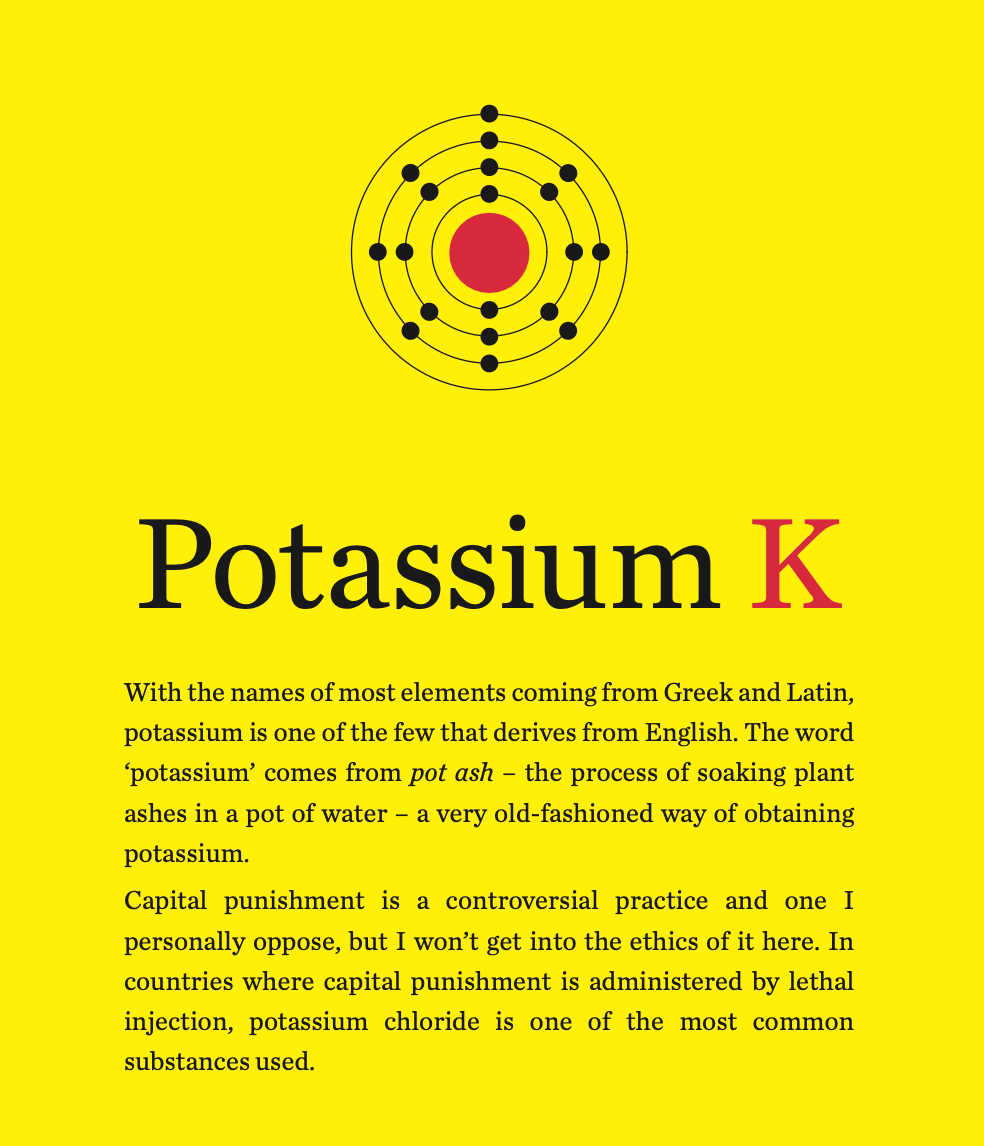
He named it potassium in English, from potash, literally the ashes left in a pot. But the European scientific community was calling it kalium, from the Arabic al-qali. This is where we get the chemistry term “alkali”, the opposite of acid. Kalium gives us the K that is potassium’s slightly confusing chemical symbol. Well confusing until now. Thanks Elemental!
Your body runs on potassium all the time. Potassium ions, K⁺, are the other half of an electrochemical see-saw that lets your nerves fire and your heart beat. Sodium floods in to trigger the signal and potassium floods out to reset it. That rhythm, orchestrated by those two left column buddies, governs the hundred thousand or so heartbeats you have every day. Not to mention the billions of neuron firings evey second.
Potassium-40, a naturally occurring radioactive isotope, is one of the reasons your body, right now, is mildly radioactive. The same K-40 has been converting to argon-40 inside the planet’s rocks for billions of years. This helps geologists date ancient formations. Argon of course was the star of last week’s show.
Outside the body, most mined potassium goes into fertiliser. It’s the K in NPK — the three nutrients every crop needs. As a result, potash is treated as a strategic resource by farming nations worldwide.
A soft, explosive metal that quietly keeps your heart beating and feeds the world. Potassium you are kick-ass-ium.
Next week, our final Elemental for a while, will round out the mini-periodic table with calcium. See you then.
No posts
Comments
Nothing yet. Say the first thing.
Sign in to join the conversation.