
In 1894, after two years of painstaking work, physics phenom Lord Rayleigh, confirmed a very small measurement. Very small, but very important. You see, the nitrogen he extracted from air was very slightly heavier than the nitrogen he made from chemical reactions in the lab.
Many physicists of the day would probably have dismissed this as instrument error. I mean what’s a skerrick of nitrogen between friends yeah? Not the R-Dog.
Relentless Rayleigh teamed up with chemistry gun William Ramsay, and found that roughly one per cent of the air was something else entirely.
Something that was part of every breath every human had ever drawn. But had until then lay, undetected, because it simply refused to do anything.
They named it argon, from the Greek argos — lazy, idle. A curious element that seemed so content with its own company it had flown entirely under the radar.
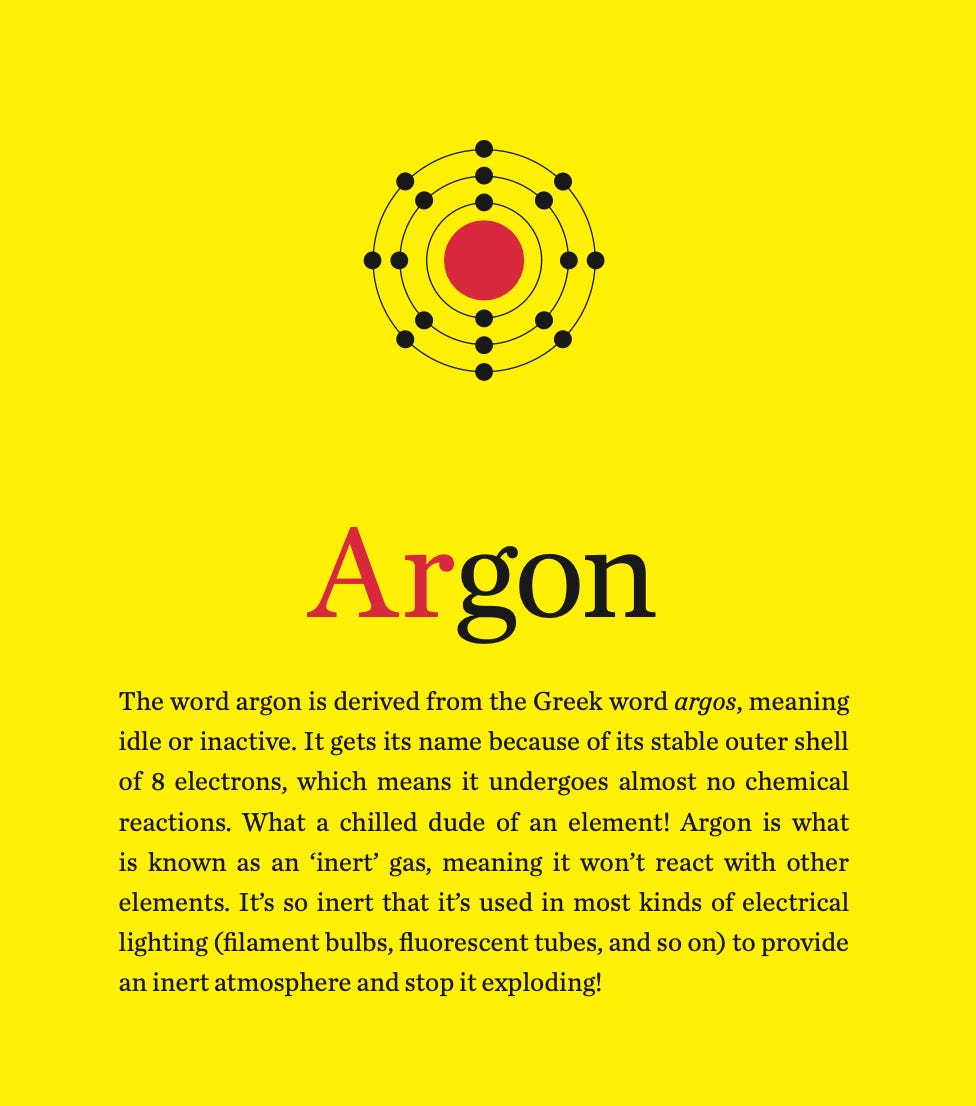
This ‘laziness’ is built in to the very structure of the element. Argon is a noble gas — a term borrowed from noble metals like gold and platinum, which similarly refuse to react with much. Its outer electron shell is perfectly full, with no gaps to fill and no electrons to spare. So, under normal conditions, argon won’t react with anything.
This passivity is enormously useful. Think of argon as a beautiful bystander. You will find it pumped in as a protective blanket in welding. It fills old incandescent bulbs to slow tungsten filament burn-out. Need something to sit between double-glazed panes and provide extra insulation — argon is your guy.
Heck, it even floods into opened wine bottles to displace oxygen and stop oxidation. For that alone, argon, I thank you.
As I mentioned for Neon, those classic purple-blue “neon” signs are mostly argon with a dab of mercury vapour. But as any songwriter will tell you, “I was drawn to the big city and its argon-with-a-dab-of-mercury-vapour lights” just doesn’t trip off the tongue.
Even where it comes from is low-key. Next week we meet potassium. Well one of its unstable varieties is potassium-40. And when you have a chunk of p-40, in a process taking billions of years, some of it decays into argon. Some of that is trapped inside the planet’s rocks and slowly leaks into the air.
It is from there that roughly one molecule in every hundred you inhale is argon. It passes straight back out, unchanged. Chillax.
Last week we took a quiz at chlorine.
Next week, potassium.
No posts
Comments
Nothing yet. Say the first thing.
Sign in to join the conversation.