
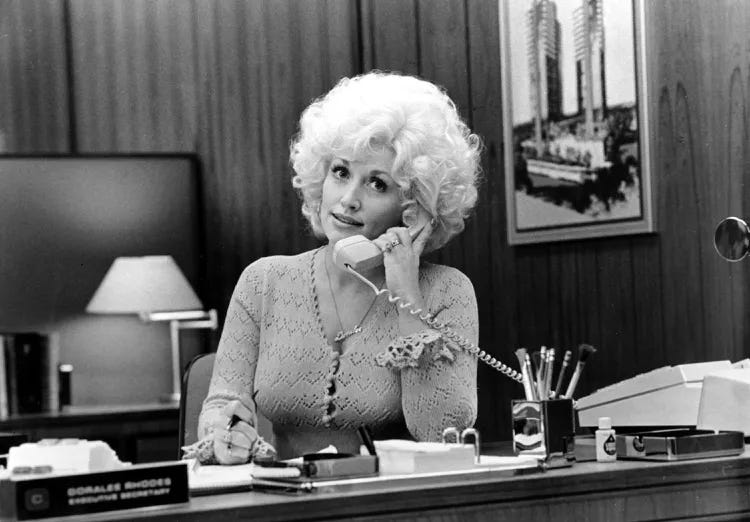
When I heard that Dolly Parton had died, I inevitably thought about the line of hers that has been sitting at the top of this newsletter for almost five years. It comes, of course, from “9 to 5,” when Dolly tumbles out of bed, stumbles to the kitchen, pours herself a cup of ambition, and heads off to a job where she is underpaid, underestimated, and largely powerless. It is an extremely cheerful song about a fairly bleak set of circumstances.
I clearly liked the phrase a cup of ambition enough to name the whole newsletter after it. But, looking back, I think I was trying to figure out what ambition meant to me at a point when many of the things I had previously associated with being ambitious no longer felt particularly appealing.
It was 2021. We were emerging from the worst of COVID, my kids were six and three, and I was exhausted. Some of that exhaustion was familiar to anyone who had small children during those years. My days were still governed by lunches and laundry and childcare logistics and illnesses and the relentless physical needs of young children. I loved being their mother, and I also felt completely consumed by the work of mothering them. There wasn’t a lot of mental space left over for wondering who I was or what I wanted, although I was doing quite a lot of wondering anyway.
I was also burned out professionally. I had spent years in academia, collecting degrees and titles and taking on increasingly complicated roles. For a long time, I had found that work deeply meaningful. But I had also spent enough time trying to change large, resistant systems to understand how much of yourself you could pour into making something better and how little it might move in response. I was tired of pushing.
The problem was that I had always thought of myself as ambitious. And if I didn’t want the next title or the bigger institutional role—if, in fact, I wanted to leave the institution altogether—I wasn’t entirely sure what that said about me.
Starting a coaching business was something I had been contemplating for a while, but actually doing it felt both exciting and vaguely preposterous. I had spent my entire career inside institutions. Institutions came with salaries and health insurance and recognizable titles and other people who could explain what you did for a living. Going out on my own meant giving up many of the external markers I had used to reassure myself that I was succeeding.
It also meant believing that the expertise I had spent years developing still counted when it wasn’t attached to a university or a title. Dolly once said, “You’ll never do a whole lot unless you’re brave enough to try.” I don’t know that I would have described myself as brave at the time. I worried I wouldn’t get enough clients. I worried people would think coaching was unserious. I worried that leaving academia meant I had somehow failed at academia. I worried that I was walking away from the very things that proved I was good at what I did.
Motherhood made all of this more complicated. I was still working through my own discomfort with being an ambitious mother, even if I wouldn’t necessarily have described it that way at the time. I had absorbed the idea that professional ambition and good motherhood existed in some kind of zero-sum relationship—that wanting more for myself necessarily meant giving less to my children. I didn’t really believe that intellectually, but believing it emotionally was another story.
So I started writing. Partly, I wanted a place to think through the questions I was encountering in my coaching work: why smart, capable people get stuck; how work becomes tangled up with identity; what happens when the thing you thought you wanted stops fitting. Partly, I wanted to write about motherhood and ambition because I was living inside that tension myself. And, frankly, I wanted people to know how I thought. A newsletter seemed like the most authentic and least sales-y way I could imagine to advertise my coaching services.
I called it A Cup of Ambition. Nearly five years later, I have been surprised by how differently I understand the name.
My children are older now. They still need me, sometimes intensely, but they no longer require so much of me physically. I’m not perpetually wiping something, cutting someone’s food, finding a missing shoe, or calculating exactly how many minutes I have before somebody needs to be picked up. I have more mental space than I did then, and I don’t think I appreciated how little I had until some of it came back.
I’ve changed professionally, too. The business I was afraid might not work became a real business. More importantly, I am no longer the young upstart in the room, quietly wondering whether everyone else knows something I don’t. I know what I’m good at. I know what I know, and I have become much more comfortable knowing what I don’t. There is a confidence that comes with experience that is difficult to manufacture when you’re younger, no matter how many credentials you accumulate.
And I think that confidence has changed my ambition. When I was younger, ambition had a certain anxious quality to it. I wanted to do good work, certainly, but I also wanted evidence that I was doing good work. The degree, the title, the promotion, the invitation, the next opportunity: each provided some external confirmation that I was moving forward and that other people could see it.
I still like accomplishing things. I still want to do excellent work. I still like recognition. I have not transcended achievement, and I don’t particularly aspire to. But I no longer experience ambition as an endless need to demonstrate that I am an ambitious person.
One of the things I misunderstood five years ago was that leaving an impressive-sounding career wasn’t necessarily a retreat from ambition. Starting my own business wasn’t one either. I was trying to answer a different question: where do you put your ambition when the conventional containers for it stop working?
Sometimes you put it into building something of your own. Sometimes you put it into becoming exceptionally good at work that doesn’t come with another promotion attached. Sometimes you put it into writing something because you have something to say, even when no one has asked you to say it. And sometimes you put some of it somewhere other than work.
There is another Dolly line I’ve been thinking about since she died: “Don’t get so busy making a living that you forget to make a life.”
In my 30s, I would have heard those as competing instructions. There was work, where ambition lived, and there was life, which had to be protected from work. The challenge was to figure out the correct balance between them, as though somewhere there existed a perfect allocation of hours that would allow me to be sufficiently ambitious without shortchanging my children or myself. I don’t believe in that division anymore.
Making a life requires ambition, too. It takes a certain amount of nerve to decide that you want work to occupy a different amount of space than the culture around you says it should. It takes confidence to turn down something impressive because you don’t actually want it, or to pursue something that matters to you even when its value won’t be obvious on a resume. It takes ambition to imagine a life expansive enough to contain meaningful work and motherhood and partnership and friendship and travel and reading books in the middle of the afternoon and occasionally wasting time without turning the wasted time into an exercise in personal development.
This is one of the things I find interesting about Dolly when I look back at her life. She was spectacularly ambitious. She wrote and performed and built businesses and made enormous amounts of money and gave enormous amounts of it away. But she never seemed especially interested in performing “seriousness” in order to prove that her ambition counted. She could be funny and feminine and self-deprecating and covered in rhinestones while also being extremely serious about her work and extraordinarily good at it. Her ambition seemed expansive enough to accommodate the rest of who she was.
I suspect that’s closer to what I want now.
I don’t want less. In some ways, I want more than I did five years ago. I want more interesting work and more time to think. I want to write things that feel worth writing and work with people I genuinely want to work with. I want to keep getting better at what I do. I also want to greet my kids when they get off the school bus. I want long trips and books I read soley for enjoyment. I want enough space in my life to notice when something that once fit no longer does, and enough confidence to change it when that happens.
Five years ago, I think I chose A Cup of Ambition because I was trying, at least in part, to convince myself that I still had some. I was leaving the career I had spent years building, starting something I had no idea would work, and raising two very small children. I couldn’t quite tell whether I was making a brave choice or quietly opting out. I don’t wonder about that anymore.
What surprises me is that I feel more ambitious now, not less—maybe even the most ambitious I’ve ever felt. But the ambition feels different. There is less fear attached to it, less urgency to prove that I am moving forward, and much less interest in pursuing something simply because it would look impressive from the outside. I still want to build and accomplish and be taken seriously. I am simply more particular about what deserves my ambition.
Maybe that’s why Dolly’s line means something different to me now than it did when I borrowed it five years ago. A cup of ambition isn’t necessarily fuel for the climb. It is energy, and attention, and desire—and we get to decide where to pour it.

No posts
Comments
Nothing yet. Say the first thing.
Sign in to join the conversation.