
A Note Before We Begin
If you work in a professional role whether in law, finance, consulting, technology, management, then your identity and your career are probably more intertwined than you realise. Most people only discover how deeply when one of them changes. AI is about to change the career dimension for a very large number of people, very quickly. This essay is about what happens to the person inside the professional when the professional role disappears. Read it now, while you have the luxury of thinking about it before it becomes urgent.
The Fear Is Real, And It’s Being Spoken Out Loud
“Some areas, again, I think just like totally, totally gone.”
These are the words of Sam Altman, CEO of OpenAI, speaking to the Federal Reserve on July 22, 2025. He was addressing the most powerful bankers in America, the people whose job it is to understand systemic risk, and he was telling them, plainly, that entire categories of work are already obsolete.
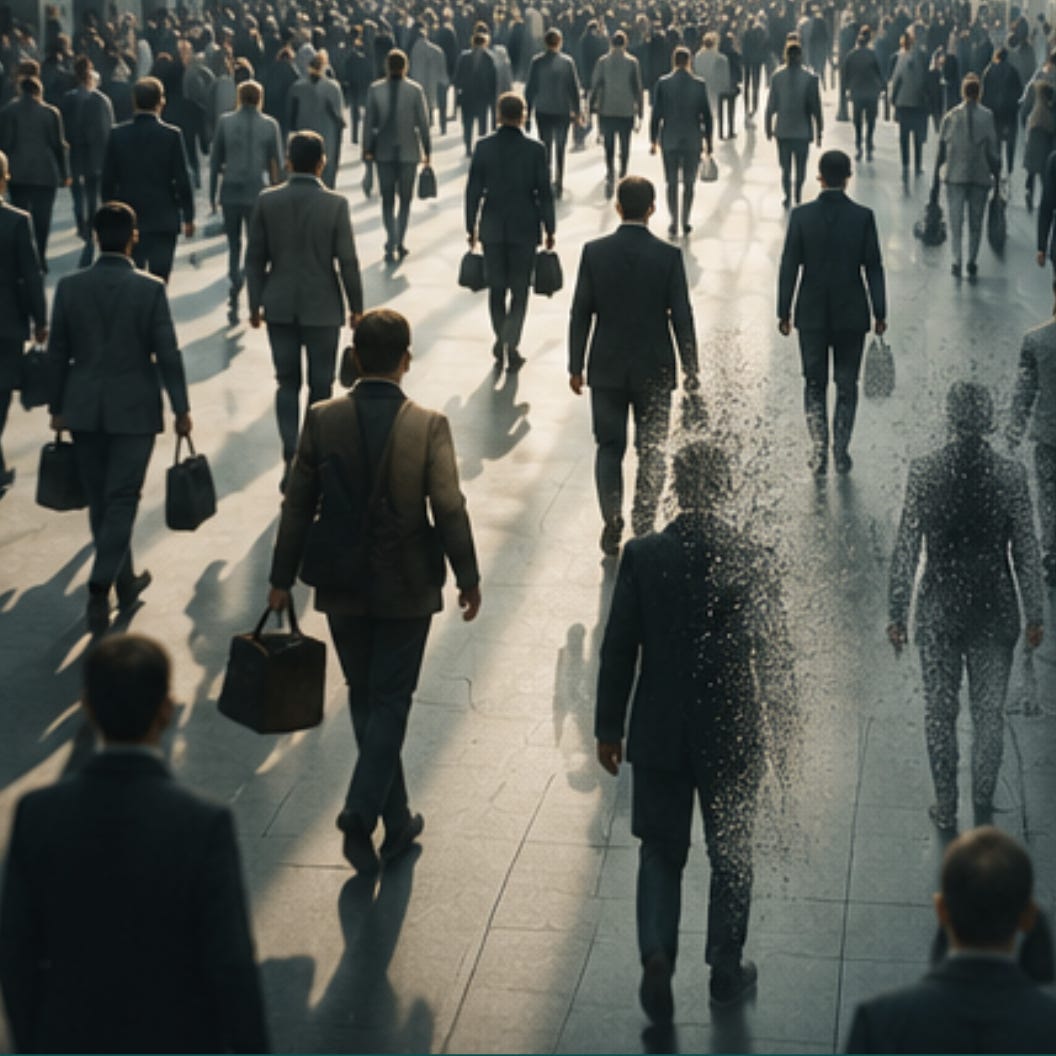
This is a conversation happening at the highest levels of the technology industry, and most people are not paying close enough attention to it. These are public statements, podcast appearances, congressional testimonies, made by the most powerful and influential figures in artificial intelligence, in their own words, without ambiguity.
Altman, arguably the most influential person in AI today, went further than that single sentence. His stated ambition has been to build artificial general intelligence that matches the capability of what he calls a “median human that you could hire as a co-worker.” The language is striking. A coworker, one that never sleeps, never asks for a raise, and scales infinitely.
Mark Zuckerberg was equally direct. Speaking on the Joe Rogan podcast in early 2025, the Meta CEO said that AI would “effectively be a sort of midlevel engineer that you have at your company that can write code” and that eventually, all the code in Meta’s apps would be “built by AI engineers instead of people engineers.” He was talking about people earning mid-six-figure salaries. People who did everything right, studied hard, got the degree, landed the prestigious role.
Then there is Elon Musk, who at the UK AI Safety Summit declared that “there will come a point where no job is needed, you can have a job if you want a job.” At VivaTech in Paris, he went further, asking the question that cuts to the heart of everything: “If the computer and robots can do everything better than you, does your life have meaning?” It is a remarkable thing for the man accelerating that future to ask. He posed it as philosophy. It deserves to be treated as a warning.
Perhaps most sobering of all is Dario Amodei, CEO of Anthropic, one of the world’s leading AI companies. Amodei is sounding an alarm. He believes AI could eliminate half of all entry-level white-collar jobs within five years, pushing unemployment to between ten and twenty percent. He has called it a potential “white-collar bloodbath.” And he said something that should stop every leader, every policymaker, every professional in their tracks: “Most of them are unaware that this is about to happen. We, as the producers of this technology, have a duty and an obligation to be honest about what is coming.”
Read that again. The people building this technology are telling us, plainly, that the world of work as we know it is about to change in ways most people are unprepared for.
The question, the one I do not think we are asking seriously enough, is what happens to the rest of us when it does.
The Shift Is Already Happening, Look Around You
Here is what is easy to miss when we focus entirely on the technology itself: ordinary people are already responding to the disruption. Quietly, instinctively, without a coordinating manifesto, a significant portion of the population has begun to hedge against a future they sense but cannot fully articulate.
Look at cryptocurrency. Despite its volatility, despite the scandals and the scepticism, adoption has continued to grow. By 2025, an estimated 560 million people globally held some form of cryptocurrency. For a growing number of people, this represents something deeper than speculation, a deliberate step outside the traditional financial system, a bet that the institutions which have governed money for centuries may not be the institutions that govern it in the future. Trust in central banks, in fiat currency, in governmental economic management has eroded. Crypto, for all its imperfections, is a symptom of that erosion as much as it is a technology.
Look at the solopreneur economy. Social media has fundamentally changed what it means to build a livelihood. Millions of people now generate income independently, through newsletters, podcasts, YouTube channels, coaching, consulting, content creation, digital products, operating as one-person businesses that would have been structurally impossible twenty years ago. The platforms provide distribution. The audience provides revenue. The corporation, the employer, the traditional career ladder, optional. This is a structural shift in how economic value is created and captured, and it is accelerating.
Look at what some have dismissively called the “trad” movement, people investing in smallholdings and farms, growing their own produce, making their own food from scratch, learning traditional crafts, raising animals, stepping deliberately away from mass consumption. Strip away the cultural politics that sometimes surrounds it, and what sits underneath is something more interesting: a reassertion of self-sufficiency in the face of systems that feel unreliable. People are hedging. They are reducing their dependency on supply chains, on employers, on institutions they no longer fully trust.
Look at the bartering communities quietly growing online and offline, people exchanging skills, services and goods outside traditional monetary frameworks. Look at the explosion of local food markets, community-supported agriculture, and peer-to-peer exchange platforms. Look at the rise of the digital nomad, structuring life around personal freedom rather than organisational loyalty.
None of these trends, taken alone, represents a revolution. Taken together they describe something significant: a quiet, distributed withdrawal of faith in the centralised structures that have defined economic life for the past century. People are already reimagining how they live and work. They are doing it without permission and without waiting to be asked.
What is striking, from an economic perspective, is that this is happening before the full force of AI disruption has even arrived. The institutional trust deficit driving these trends has been building for decades, through the 2008 financial crisis, through the pandemic, through rising inequality, through the sense that the social contract between capital and labour has been quietly rewritten in favour of capital. AI is widening a fracture that already existed.
The question is whether the systems we have, political, social, economic, are capable of responding quickly enough. And history, as we are about to see, gives us reason for both genuine hope and serious concern.
We Have Been Here Before, But Never Quite Like This
The optimists, and there are serious, credible economists among them, will point to history, and they are right to do so.
Every major technological revolution has provoked the same fear. The Luddites smashed the looms because they believed mechanisation would destroy their livelihoods. It destroyed their specific livelihoods. But it also, over decades, created an industrial economy that employed far more people than the cottage industries it replaced, at higher wages, with higher living standards. The same pattern repeated with electrification. With the automobile. With the personal computer. With the internet. Each time, the initial displacement was real and painful. Each time, the long-run outcome was more employment and greater overall prosperity.
Morgan Stanley’s research, published as recently as 2026, concluded that past innovation waves “consistently displaced some jobs, but ultimately increased productivity, created new roles and expanded overall employment over time.” The historical record supports this. It is a serious argument, made by serious people, and it deserves to be taken seriously.
But here is where the historical analogy begins to strain, and where the optimists are, in my view, not being fully honest about two variables that together make this transition categorically different from anything that came before.
The first is pace.
When the personal computer arrived, it took twelve years from its mass-market launch for forty percent of American adults to be using it. The internet took four years to reach the same milestone. Generative AI took less than two. Researchers at the National Bureau of Economic Research confirmed that overall AI adoption has been faster than either the PC or the internet. Epoch AI, reviewing the evidence in 2025, concluded that AI diffusion has been “faster than for almost all technologies in history.”
This matters enormously, because the mechanism by which technology transitions have historically been survivable is time. Time for workers to retrain. Time for new industries to emerge and absorb displaced labour. Time for education systems to adapt. Time for policymakers to design support structures. Time for societies to psychologically and culturally adjust to a new conception of work. Previous technological revolutions, including electrification and computerisation, took decades to diffuse through economies. Generative AI has spread at a pace enabled by its low cost of adoption, ease of deployment, and applicability across virtually every sector simultaneously. The adjustment window that societies previously relied upon is compressing in real time.
The second variable is autonomy, and this one is even less discussed.
Every previous technology that disrupted work remained, at its core, a tool. It amplified human capability but was structurally dependent on human direction. A spreadsheet does not decide what to calculate. A search engine does not decide what to look for. An industrial loom does not decide what to weave. Even the most sophisticated software of the pre-AI era required a human to initiate every meaningful action. The human was always in the loop, not as a formality or a regulatory requirement, but as a structural necessity. The technology was inert without us.
AI agents are different in kind, not just degree. They can be given an objective and left to determine how to achieve it, researching, deciding, executing, iterating, without human input at each step. That autonomy is what makes the displacement dynamic unlike anything in economic history. It is not that AI does things faster than humans. It is that AI does things without humans. The oversight that every previous technology required as a feature of its basic operation has, for the first time, become optional.
These two variables, pace and autonomy, are also connected. The reason AI is spreading faster than any previous technology is partly because it requires so little human scaffolding to deploy. You do not need to retrain a workforce to operate it. You do not need specialists to supervise every output. The very autonomy of the technology is what enables its extraordinary speed of adoption. And that combination, moving faster than any previous disruption, while requiring less human involvement than any previous technology, is what makes the question of societal adaptation so urgent and so genuinely uncharted.
The optimists may well be right in the long run. New roles will likely emerge. Productivity will almost certainly rise. The economy will adapt. But the question that does not get asked enough is: what happens to the people caught in the transition? What happens in the gap between the old world and the new one, a gap that this time may close far faster, and far more completely, than any society has previously had to manage?
We do not need to speculate about the answer. We have already lived it.
The Warning We Already Had, And Ignored
In the 1980s, the British government decided that the coal industry was no longer economically viable. Mines closed. Steel plants shuttered. The industrial heartlands of South Wales, Yorkshire, the North East of England, communities that had organised their entire existence around these industries for generations, were told to adapt.
Some did. Many did not. And the consequences were far more than economic.
Research published by the Centre for Economic Policy Research found that deindustrialisation in the UK created effects that “durably affect living standards” and are “carried across multiple generations.” Children who grew up in communities where industries had collapsed carried health and economic scars into adulthood, scars that were resolved neither by time nor by access to better opportunities elsewhere. The damage reached bodies, families, and life expectancy itself.
The Economics Observatory documented that unemployment and suicide rates tracked each other throughout the twentieth century, with the worst health outcomes concentrated in former industrial areas, the coalfields, the steel towns, the places that globalisation left behind. These were the “deaths of despair” that economists Anne Case and Angus Deaton later documented so devastatingly in the United States, the rust belt communities of Detroit, Cleveland, Pittsburgh, where the closure of factories hollowed out the social and psychological infrastructure of entire communities.
When a steelworker in Motherwell or a miner in Merthyr Tydfil lost his job, he lost the thing around which his identity, his social relationships, his daily structure and his sense of purpose had been organised. One researcher captured this with a quote from a Scottish steelworker coming to terms with his redundancy: “How do you tell fifty-year-old steelworkers to sell tartan scarves to Americans?” The question is economic on the surface. Underneath, it is existential.
This is the precedent that the current AI conversation almost entirely ignores. The debate is dominated by macro-level projections, net job creation, GDP growth, productivity gains. These are averages. And averages conceal the human reality of transition, which is that it falls unevenly, it falls hard, and when it falls on communities that have built their entire identity around a particular form of work, the damage extends far beyond what any economic statistic can capture.
The difference this time is one of scale and speed. Deindustrialisation hit particular regions, particular occupational categories, particular social classes. What AI is being predicted to do, by the people building it, is cut across the entire white-collar economy simultaneously. The junior lawyer. The mid-level engineer. The entry-level analyst. The customer service professional. These are the backbone of the professional middle class in every major economy in the world.
We already know what happens to communities when their defining form of work disappears. We have the data. We lived through it. The urgent question is what we intend to do differently this time. So far, the honest answer is: very little.
The Problem Nobody Is Talking About
The dominant frame for the AI and work debate is economic. Will there be enough jobs? Will incomes hold up? Will the safety net be sufficient? These are legitimate questions. But they are the wrong first questions, or at least, they are incomplete in a way that will cause us to badly misdiagnose what is actually happening.
The problem beneath the economic problem, one that rarely makes it into mainstream debate, is the problem of meaning.
Human beings do not work only for money. This is one of the most robust findings in the social sciences. Research published in Frontiers in Psychology found that in modern life, work has become “one of the key domains from which people derive meaningfulness”, shaping identity, purpose, social connection and psychological wellbeing. Studies consistently show that the loss of a job correlates with loss of purpose, and that loss of purpose correlates with declining mental and physical health. Meaningful work, the research tells us, buffers the impact of stress and anchors people’s sense of worth and contribution.
This is why early retirement, despite its material comfort, so often produces outcomes that surprise people. Research on abrupt retirement shows increased rates of depression, physical decline and cognitive deterioration. The absence of money does not cause this. The absence of structure, identity, social connection and the sense of being needed does. Utility, the feeling that you are contributing something that matters, turns out to be as fundamental to human wellbeing as shelter or nutrition.
Elon Musk, of all people, put his finger on this when he asked at VivaTech: “If the computer and robots can do everything better than you, does your life have meaning?” He asked it as a philosophical curiosity. It is the central practical question of the AI transition. And the fact that the people driving that transition are asking it without appearing to feel any particular responsibility for answering it should concern us deeply.
The conversation we are not having, in boardrooms, in parliaments, or in the mainstream media, is this: if the primary vehicle through which modern human beings derive meaning, identity and purpose is professional work, and if that vehicle is about to be fundamentally disrupted, then we face a psychological and civilisational transition, not merely an economic one.
Wealth concentration makes this harder. The data is unambiguous. The richest one percent of the global population now owns forty-five percent of all global wealth. In 2024 alone, billionaire wealth grew by two trillion dollars, the equivalent of five point seven billion dollars every single day, while the number of people living below the World Bank poverty line has barely shifted since 1990. Since the 1990s, the wealth of billionaires has grown at approximately eight percent annually, nearly twice the rate of the bottom half of the population. The concentration is accelerating.
This matters for the AI transition because the productivity gains from AI will overwhelmingly flow to the owners of the technology and the capital behind it. The workers whose labour is displaced will not automatically share in the prosperity that displacement creates. This is exactly what happened during every previous technological transition, and there is no structural mechanism in place to ensure a different outcome this time.
The question of meaning and the question of inequality are connected. When work disappears, the people who fare best are those with financial cushioning, social capital, education and a sense of identity that extends beyond their professional role. The people who fare worst are those for whom work was the organising principle of their entire existence. In a world of accelerating wealth concentration, the former group is shrinking and the latter is growing.
The Twist: It Is Not Who You Think
There is a comfortable assumption built into most discussions of AI and employment, and I think it is wrong.
The assumption is that the people who will struggle are the low-skilled, the poorly educated, the technologically resistant, workers in routine, manual or administrative roles who lack the sophistication to adapt. The implication is that knowledge workers, professionals, the highly educated and highly compensated are relatively safe.
But listen again to what the AI executives are actually saying. Altman is targeting the “median human”, the average, competent, capable professional. Zuckerberg is targeting mid-level software engineers earning mid-six-figure salaries. Amodei is predicting a “white-collar bloodbath” in law, finance, technology and consulting. These are the centre of the professional economy, not the margins.
Early data from 2025 and 2026 is bearing this out. Tech entry-level hiring dropped between thirty and fifty percent in 2025. Wall Street banks began cutting approximately two hundred thousand roles, concentrated in entry-level analyst positions, the roles that the most academically successful young people in the world competed fiercely to obtain. They are disappearing because AI can now perform the core functions those roles existed to serve.
But I want to push this further than the data alone takes us, because there is a deeper vulnerability that the statistics do not capture.
The people most at risk in this transition may be those who are most successful, but whose success has come at the cost of everything else. The senior partner who has worked eighty-hour weeks for thirty years and whose identity is so completely fused with their professional status that they have no idea who they are without it. The specialist consultant whose entire self-worth is predicated on being the smartest person in the room on a particular subject, a subject AI is rapidly mastering. The academic whose authority rests on being the keeper of knowledge in a world where knowledge is becoming instantaneously accessible to everyone.
These are people who, by every external measure, are flourishing. They have the income, the status, the credentials, the professional recognition. But they have built those things on a foundation that is shifting, and they may be the least psychologically equipped to deal with that shift, precisely because their success has never required them to ask who they are beyond what they produce.
I have seen this pattern in organisations. When AI enters as a genuine replacement for certain functions, it is often the people at the top of those functions who struggle most to adapt. The junior employee, less invested in the hierarchy, less defined by their specific role, frequently finds it easier to reorient. The senior person, whose professional identity has been constructed over decades around a particular way of working and a particular form of expertise, frequently cannot.
Adapting to AI is a psychological task before it is a technical one. It is about the willingness and the capacity to reconstruct your sense of purpose around something other than your current professional identity. That is a task many very successful people have never had to undertake.
What We Have Forgotten About a Full Life
Let me be direct about what I think the most likely outcome of the AI transition actually is, because I do not believe the dystopia, and I want to say that clearly.
Altman and Musk will not get everything they predict. The centralised structures that govern our economies will not collapse. The historical record on technology and employment, however imperfect an analogy, gives genuine grounds for optimism that new forms of work will emerge, that productivity gains will, eventually, unevenly, imperfectly, translate into broader prosperity.
What I do believe is this: the nature of work is going to change more profoundly and more rapidly than most people, most organisations and most governments are currently prepared for. The turbulence of that transition will be real, unequal, and some people who are flourishing today will not navigate it well, not because they lack intelligence or capability, but because they have never been asked the question that this moment is about to force on everyone.
Who are you, if not what you do?
Before we can answer that question well, we need to recover something that industrialisation caused us to forget. For most of human history, before the factory, before the office, before the nine-to-five defined the architecture of daily life, work was one part of a full human existence, not the defining feature of it. People worked, yes. But they also raised children with genuine presence and attention. They told stories. They maintained communities. They practised crafts. They cultivated land. They developed deep relationships across generations. They engaged in the life of their neighbourhoods and their civic institutions.
Industrialisation did not just change how people worked. It changed how people understood the purpose of a life. It elevated productivity as the supreme measure of human worth. It created the cultural and psychological conditions in which a person’s value, to themselves, to others, to society, became almost entirely indexed to their economic output. We absorbed this so thoroughly that we now struggle to imagine what a good life looks like without professional achievement at its centre.
If AI genuinely does what its architects predict, if it absorbs the mundane, the administrative, the repetitive, the routine, then it creates, for the first time in two centuries, the structural possibility of recovering a richer and older understanding of what a life is for. Less work, but different work. More purposeful engagement with the things that make us human: relationships, creativity, care, learning, contribution to something beyond our own professional advancement.
Jensen Huang, the Nvidia CEO who has been more measured than most in his public statements, put it simply: “Everybody’s jobs will be different. A lot of the things that we do mundanely or arduously or very difficultly are going to be done very simply.” The mundane done simply. The arduous done easily. What does that free us to do?
Perhaps we work less and spend the recovered time raising our children with the presence that our current working lives make impossible. Perhaps we invest in learning not for credentials but for the joy of understanding. Perhaps we recover the art of storytelling, of community, of genuine friendship, things we have deprioritised in the relentless pursuit of professional advancement.
The people who will navigate this transition best will not necessarily be the most technically proficient. They will be the ones with a sense of self that extends beyond their professional output. The ones with the self-awareness to ask who they are beyond their job title, and the courage to build an answer.
Start Figuring It Out
The turbulence ahead is real. The transition will be neither smooth nor fair. Some industries will be devastated before new ones emerge. Some communities will bear costs that never fully resolve. The inequality that already distorts our economies will, without deliberate intervention, be amplified by AI-driven productivity gains. And governments, most of which are still struggling to regulate social media, are nowhere near prepared for what is coming next.
But the destination, if we are intentional about it and ask the right questions now rather than after the disruption has arrived, does not have to be the dystopia that the most alarming voices are describing.
The most important shift required is psychological. It is the willingness, individually and collectively, to loosen the grip that professional identity has on our sense of self. To understand that a person’s worth is not equivalent to their output. To begin building, now, the relationships, the communities, the interests, the inner lives that will sustain us through a transition that is coming whether we are ready or not.
Elon Musk asked the right question, even if he asked it without taking responsibility for the answer. So let me ask it again, more directly, to you:
Who are you, if not what you do?
If you have a ready answer, if you know, genuinely and concretely, who you are beyond your professional role, you are better prepared for what is coming than most.
If you do not, you might want to start figuring that out. Not because the future is certain to be dark. But because the future belongs to people who know themselves well enough to adapt to whatever it brings.
And that has always been true. AI is simply making it urgent.
No posts
Comments
Nothing yet. Say the first thing.
Sign in to join the conversation.