
A Note Before We Begin
Most people are asking whether AI will replace them entirely but the more useful question and the one this essay answers is which parts of your role AI will take and which parts it will make more valuable. Understanding that distinction is the difference between being displaced by the transition and being strengthened by it. Read this if you want a clear framework for thinking about your own role, your own judgment and where your value actually lives in an AI-integrated workplace.
For many professionals, the rapid advancement of generative artificial intelligence feels less like a technological milestone and more like a looming existential displacement. We are haunted by a singular, persistent fear: that the machine is not merely a tool, but a successor, a digital entity poised to render human labour obsolete.
However, this anxiety stems from a fundamental misunderstanding of the nature of work. To navigate the coming era, we must shift our perspective from “job replacement” to the infinite landscape of human problem-solving. As long as the world presents new challenges, the need for human ingenuity remains secure. In the modern landscape of automation, one principle stands firm, in the words of Dr. Maria Del Rio-Chanona (UCL) in our recent webinar: “So long as we have problems, we will have jobs.” Problems are an inexhaustible resource, and our role is evolving to meet them in more sophisticated ways.
AI Is Coming for Your Chores, Not Your Career
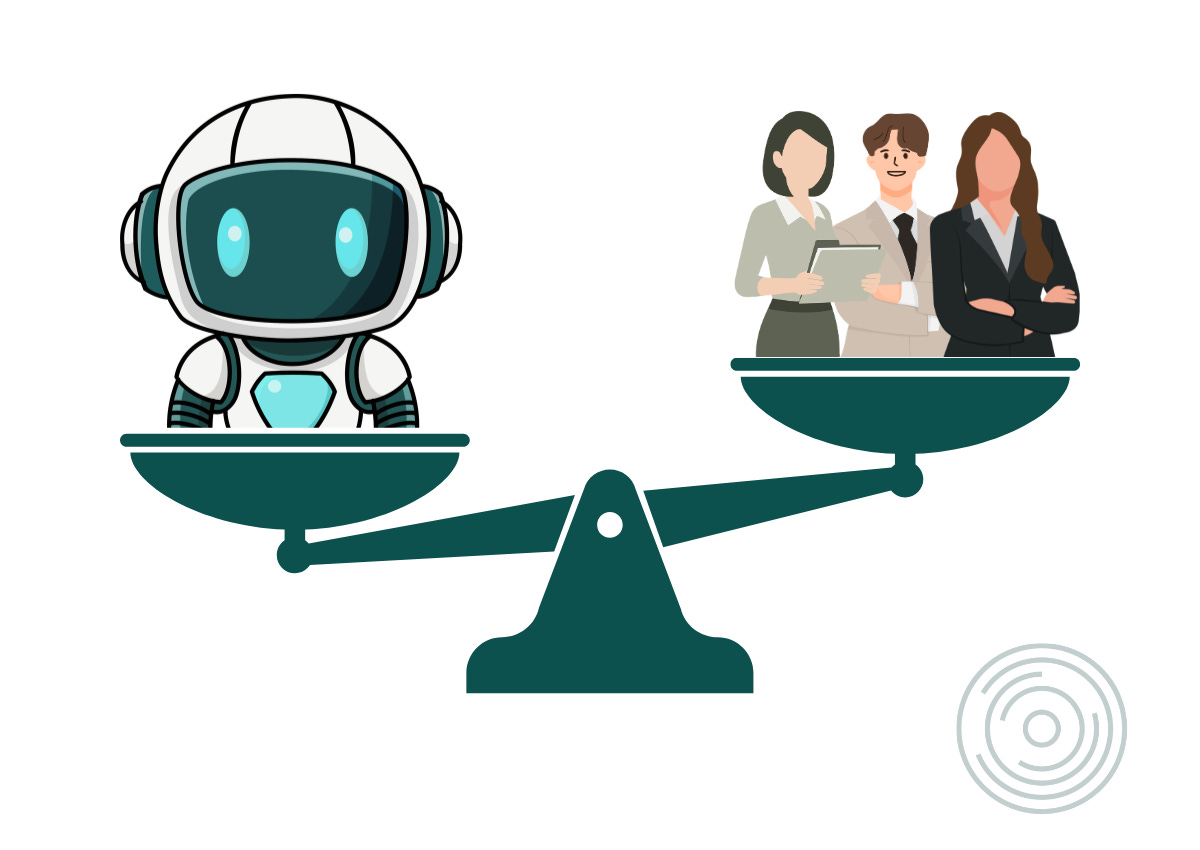
The current expert consensus suggests that AI is unlikely to eliminate entire professions in one fell swoop. Instead, its impact is far more granular, targeting specific subtasks within a role rather than the role itself. We are witnessing a recalibration of the professional scales, a literal balance where the bot and the human serve as counterweights in a functional workflow.
The primary objective of AI integration is the systematic removal of “mechanistic drudgery”, those repetitive, administrative, or rote tasks that often stifle intellectual growth. By automating these subtasks, we are left with the most valuable and demanding remains: judgment.
As a technology ethicist, I argue that preserving judgment is not just a strategic move, but a moral imperative. Judgment is the synthesis of context, empathy, and ethical accountability, qualities an algorithm, regardless of its sophistication, fundamentally lacks. While a machine can process data with frightening speed, it cannot “own” a decision or understand the human stakes of its output.
The Rule of Thumb for Delegation
Navigating this integration requires a rigorous strategy for delegation. To maintain professional fulfilment and ensure that human value remains distinct, we must draw a clear line between the tasks of utility and the tasks of the soul.
The core directive for effective delegation follows a clear ethical boundary:
Delegate the Mundane: Utilise AI for the tasks you dislike such as the data entry, the scheduling, and the rote synthesis that offer little heuristic value or personal satisfaction.
Protect the Creative: Maintain absolute personal ownership over creative work. This is the “soul” of your profession; to outsource your imagination is to outsource your identity.
By following this rule, AI becomes a tool for professional liberation, allowing us to offload the weight of the mundane to focus on the work that truly defines us.
The GPS Trap and the Erosion of Competency
Despite the efficiencies promised by automation, we must confront a significant risk: the “GPS Trap.” Just as total dependency on satellite navigation can lead to the atrophy of our natural spatial reasoning, an over-reliance on AI for professional tasks can lead to a dangerous “cognitive atrophy.”
The risk lies in the outsourcing of foundational tasks that build core competency. We often view “boring” entry-level work as a hurdle to be cleared, yet these are the very “reps” required to develop professional intuition. The struggle is, quite literally, the teacher. When we bypass the difficult foundational labour through automation, we fail to build the neural pathways necessary for the high-level judgment we claim to prize.
This dependency is the central warning of the AI era. If we allow the machine to perform the basic building blocks of our craft, we may eventually find ourselves as masters of nothing, unable to troubleshoot, innovate, or even understand the higher-level functions of our roles. We must ensure that the tools we use to save time do not simultaneously hollow out our expertise.
Navigating the New Landscape
The transition we are witnessing is not a march toward human replacement, but a shift toward AI as a sophisticated partner in task management. By offloading drudgery and fiercely protecting the creative judgment that requires human accountability, we can refine our roles to focus on higher-level problem-solving.
However, as we embrace these efficiencies, we must remain vigilant about the price of convenience. The foundation of mastery is built in the trenches of the “boring” tasks we are so eager to outsource. As you integrate these tools into your own workflow, you must ask yourself a piercing question: Are you becoming a master of your craft, or just a master of the tools that are slowly replacing it?
No posts
Comments
Nothing yet. Say the first thing.
Sign in to join the conversation.