
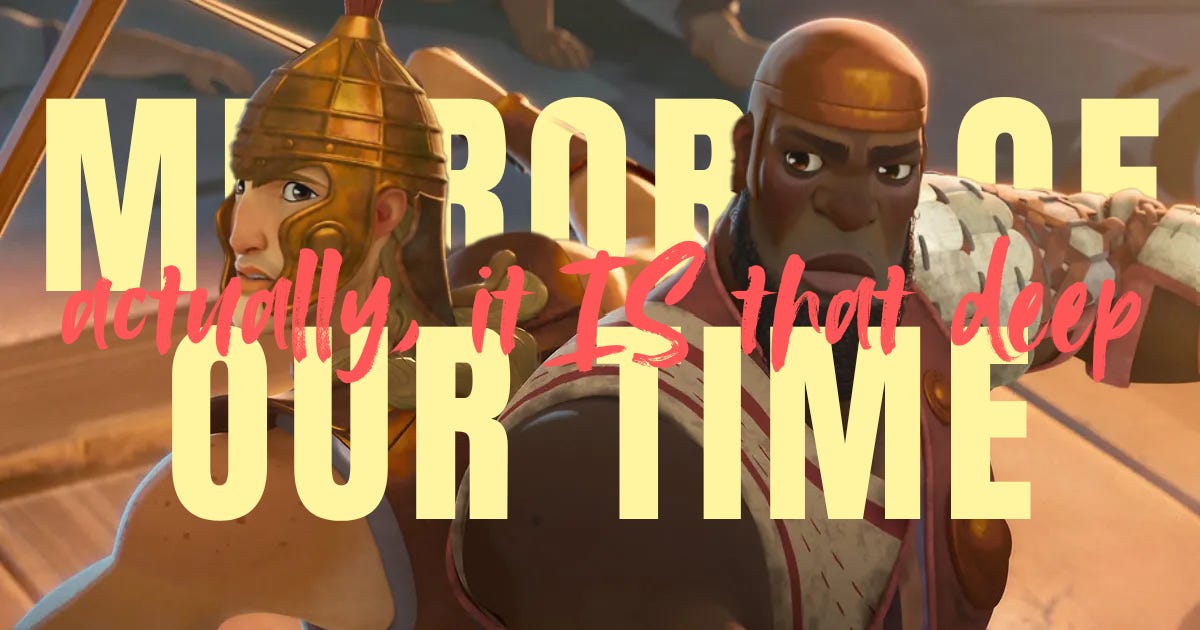
This show is kind of gnarly. I love it.
Watching Eyes of Wakanda, particularly the second episode, "Legends and Lies", I couldn't help but think about another story that has dominated pop culture conversations this year: Christopher Nolan's adaptation of The Odyssey.
The 2026 Odyssey has been met by polarised reviews, but what is more revealing is the polarised anticipation. A BBC article labelled it "the most anticipated film of 2026 – but also the most contested." Despite coming off the critical and financial success of Oppenheimer (on the surface, a far more contentious premise than a public-domain and frequently adapted Homeric epic) Nolan has been hit by a wave of criticism over the casting, costuming and dialogue before audiences had even seen the finished film.
It has become something of a lightning rod for broader political and cultural grievances. Some criticism has been well-founded, such as discussions around the lack of Greek actors or Nolan's apparent inability to resist casting every major Hollywood star available. Other criticisms, however, seemed to have little to do with filmmaking at all. The casting of actors such as Elliot Page, Lupita Nyong'o and Zendaya became flashpoints, despite all three delivering some of the strongest performances in the finished film.
Lupita Nyong'o's casting as Helen attracted particular outrage. One article by Accessible Art History from February documented the response, highlighting a series of viral posts questioning whether Helen could or should be portrayed by a Black actress. The discussion inevitably returned to Homer's description of Helen as "white-armed", presented as definitive proof that the casting was historically inaccurate.
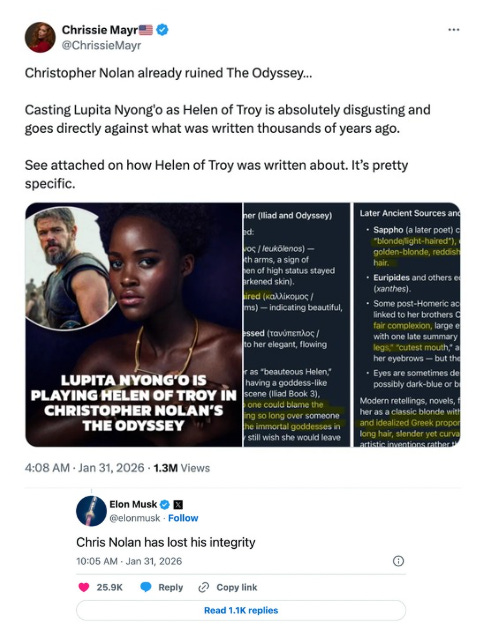
But let’s be honest here. Homer never described Helen as “white-armed”. He didn’t even speak English.
Those words belong to a translator. They are themselves an interpretation, filtered through language, culture and centuries of scholarship. Even beyond translation, many classicists argue that Homer was not inventing these stories from scratch. The Odyssey is generally understood to have emerged from an oral tradition stretching back generations before it was ever written down. It was never a single, fixed text. It was the product of countless performances, countless storytellers and countless adaptations.
In other words, The Odyssey is itself an adaptation. Every version we consider "classic" was, at one point, somebody's reinterpretation.
So why are people being so weird and weaponising the sacrosanctity of adaptation?
You probably know the answer without me spelling it out.
It sells.
Outrage sells. Culture wars sell. Political identities sell. And people are buying it.
That is why figures such as Elon Musk felt compelled to join the conversation. The debate was never really about Homer. Homer simply became the latest battleground for modern political anxieties.
Helen herself has never existed as a singular character. Depending on which version of the myth you read, she is born from an egg after Zeus, disguised as a swan (or perhaps a goose) assaults either Leda or Nemesis. In some traditions, she willingly leaves with Paris. In others, she is abducted. In one, the "real" Helen never even goes to Troy at all, with only a phantom taking her place while she spends the war in Egypt.
Contradictions have always been part of the story.
Adaptation has always been part of the story.
Perhaps the most famous continuation of Homer's world, Virgil's Aeneid, wasn't interested in faithfully preserving Greek mythology. It repurposed it to create a Roman national epic, reframing the Trojan War through Roman ideals and presenting Rome as the destined heir to Troy. Christopher Marlowe borrowed Helen centuries later to write Doctor Faustus, giving us the immortal line, "the face that launched a thousand ships." Shakespeare borrowed Homer. James Joyce borrowed Homer. Homer borrowed from Homer (in The Simpsons). Every generation has inherited these myths and reshaped them to reflect its own fears, politics and ambitions.
That is what adaptations do. They are mirrors. They tell us far less about the ancient world than they do about the society choosing to retell it.
Sometimes Helen becomes a warning against female temptation. Sometimes she is recast as a tragic victim. Sometimes she represents irresistible beauty. Sometimes she becomes a symbol of political legitimacy. The details change because every adaptation is trying to persuade us of something about the present, not simply reconstruct the past.
In that viral tweet, the Google GenAI response itself unintentionally demonstrates this point. It links to the interpretations of later poets and playwrights, such as Sappho and Euripides, as though they reveal a single, definitive Helen. Instead, they reveal the opposite: that Helen has always been a character in conversation. Each writer inherited the myth and reshaped it to explore their own concerns, whether those were love, war, gender, race, morality or power.
So perhaps the more interesting question isn’t whether Lupita Nyong’o is the “correct” Helen. It is why some people are so invested in convincing us she cannot be.
Perhaps that’s what makes Eyes of Wakanda feel so refreshing.
The second episode follows B'Kai, operating under the alias Memnon, as he finds himself caught up in the aftermath of the Trojan War. Rather than adapting either the Iliad or The Odyssey, it deliberately inhabits the space between them: after Hector's death but before Odysseus begins the long journey home. It explores a period that scholars believe was once covered by the now-lost poems of the Epic Cycle, filling those gaps with its own mythology and its own perspective.
It is, in many ways, doing exactly what Virgil did two thousand years ago. Exactly what Marlowe did. Exactly what Nolan is doing now. It doesn't treat Homer as untouchable. It treats Homer as living.
That is the real lesson of oral tradition.
Stories survive not because they remain unchanged but because they remain meaningful. Every storyteller inherits the same foundations, yet each generation rebuilds the house according to its own values. The myths endure precisely because they are never finished.
Adaptations aren’t mirrors of the past. They’re mirrors of the societies that create them.
If anything, refusing to reinterpret these myths would be the least faithful thing we could do.
This is Essay #4 of 102.
Between now and the release of Avengers: Doomsday, I’ll be working through every corner of the Marvel multiverse, using each story as a starting point to explore a bigger question about politics, philosophy and what it means to be human.
If that sounds like your kind of thing, I’d love for you to join me.
Subscribe below to follow the countdown, receive every new essay in your inbox, and let me know your own thoughts in the comments. Whether you agree, disagree, or have a theory of your own, I’d love to hear it.
If you want to learn more about the theories mentioned here, why not check them out? They should be available at your local library or through second-hand book sellers. They are both great reads that say far more than I can fit in this quick 600-word reflection.
BBC Culture. (2026). The most anticipated film of 2026 – but also the most contested: Christopher Nolan’s The Odyssey.
Homer. (c. 8th century BCE). The Iliad.
Homer. (c. 8th century BCE). The Odyssey.
Joyce, J. (1922). Ulysses.
Marlowe, C. (c. 1592). Doctor Faustus.
Virgil. (c. 19 BCE). The Aeneid.
Accessible Art History. (2026). Was Helen of Troy White?
No posts
Comments
Nothing yet. Say the first thing.
Sign in to join the conversation.