
Before we start, how good is that ‘Time in a Bottle’ scene with Quicksilver?!
I will reflect more on this in the margins, but this is an essay I have been nervous to publish. Not because I doubt anything I say in it, or because the ideas are particularly unfamiliar to me (quite the opposite), but because this conversation has become hostile. I’m writing anyway because I think refusing to have difficult conversations gives the hostility more power.
As Anthony Bourdain said in his episode on Palestinian food for Parts Unknown, “there’s no hope, none, of ever talking about it without pissing somebody, if not everybody off.”
So, let’s begin.
I remember one of the first lectures I gave. It was a public lecture to the Women’s Institute on how to read buildings politically. We looked at the reuse and collaging of Greek and Roman architectural practices throughout history to convey different political ideas. One thing I remember from it is that we keep going back and forth between the messaging of our architecture. One period mimics the empire and power of Rome; another returns to the intricacy of Greek architecture; another rejects both in favour of the apparent mundanity of modernism, only for Rome to return again.
This isn’t because of the building, or even necessarily the architect. It is because of the context in which the building is designed and for whom.
Architecture is political, and politics are recursive.
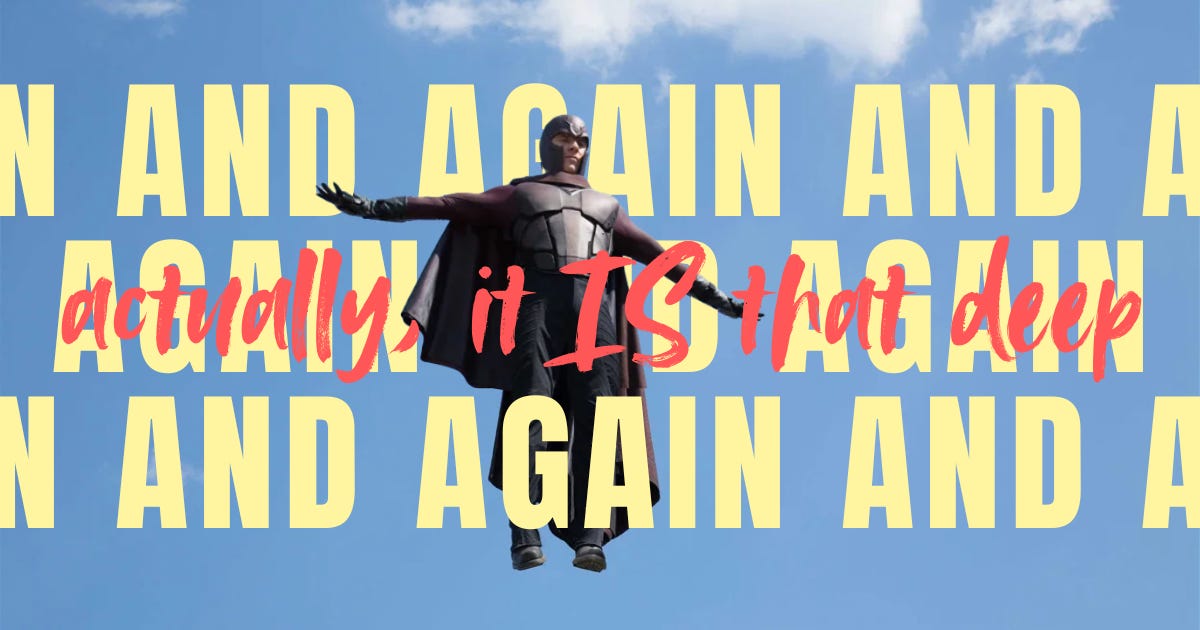
I have been thinking about this while rewatching X-Men: Days of Future Past. It is hard not to, with the impeccable character building of Magneto, the time-travel premise and the film’s themes of genocide, segregation, political violence and diaspora. What interests me most about the film is that its violence is never simply presented as something that happens. It is produced. The Sentinels do not appear out of nowhere; they emerge from fear, political rhetoric, scientific experimentation, state power and a particular understanding of who constitutes a threat. By the time we meet the future, this violence has become almost ordinary. Mutants are hunted, detained and killed because the political system has already decided that their existence represents a danger.
The film then does something rather clever with this. Instead of asking its characters to defeat the violence where they find it, it asks them to travel backwards and interrupt the chain of events that produced it. Days of Future Past is therefore not simply a film about political violence. It is a film about historical memory: how did we get here, and can knowing that change what happens next?
That question takes us directly to two words that have carried an extraordinary amount of political weight since the end of the Second World War: Never Again.
It is not subtle. Erik Lehnsherr is a Holocaust survivor, and the dehumanisation of the mutant population is laid on thick throughout the film. The Sentinels initially target mutants, but their logic expands to those who protect mutants and eventually to humans whose genetic inheritance might produce mutant offspring. The category of the threat keeps growing. It recalls Martin Niemöller’s famous postwar reflection on Nazi persecution, often reduced to the phrase “First they came”: persecution begins with a group that can be dismissed as somebody else’s problem, before the boundaries of who is threatened gradually expand.
But the phrase Never Again is older, stranger and more complicated than its casual use today suggests.
Murder had a name. Why was it a named crime for one person to kill another, but not for a government to kill millions of people? Shouldn’t states be held accountable for trying to destroy entire peoples – their lives, cultures and histories?”
— Raphael Lemkin
The modern political life of Never Again is inseparable from the Holocaust, but it is worth pausing over what the phrase meant when survivors first began using it. At Buchenwald, prisoners liberated the camp on 11 April 1945, before American forces entered later that day. Eight days later, on 19 April, survivors gathered for a memorial ceremony for those who had died. The ceremony ended with what became known as the Oath of Buchenwald, a collective pledge to continue fighting until Nazism was destroyed and to build “a new world of peace and freedom.” (United States Holocaust Memorial Museum, 2021)
That is rather different from the way Never Again can function as a commemorative slogan today. The survivors were not simply asking the world to remember that terrible things had happened to them. Their memory was explicitly political. They were looking backwards at an atrocity and forwards towards a different political order. Memory became a demand. It was angry, and it was action.
The postwar creation of the Genocide Convention makes this even clearer. Raphael Lemkin, the Polish-Jewish lawyer who coined the term “genocide”, spent the final years of the Second World War trying to give the destruction of peoples a legal name and, crucially, a legal response. His work helped shape the United Nations Genocide Convention of 1948, which established genocide as an international crime and created obligations for states to prevent and punish it. The United Nations itself describes the Convention as part of the international community’s commitment to “never again” after the atrocities of the Second World War. (UN, 2025)
This is our never. Never is absolute. It closes the door and draws a line: this must not happen again.
It is again that makes the phrase so much more complicated. To say “again” is to acknowledge the possibility of recurrence. Something happened once, we recognise it as intolerable, and then we make a promise that it will not happen twice. Never Again therefore sits awkwardly between history and prophecy: it is a statement about what happened and an instruction about what must happen next.
There is a long philosophical tradition of thinking about history in terms of recurrence. Friedrich Nietzsche’s idea of eternal recurrence is perhaps the most famous, although it is often reduced to the claim that everything literally happens again forever. Nietzsche’s formulation is more complicated (and interesting) than that. Recurrence becomes a thought experiment: if your life and every decision within it were to repeat endlessly, could you affirm what you have done?
I am not suggesting that the Holocaust, Cambodia or Rwanda were cosmically destined to repeat themselves. The more relevant idea is that conditions can recur.
Political history does not need to reproduce the past exactly in order to repeat it. The actors change, the technologies change, the language changes and the populations being targeted change, but familiar structures can reappear: a population is classified, its difference becomes threatening, exclusion becomes defensible, violence becomes necessary, and eventually that violence becomes ordinary. The repetition is not a copy. It is an iteration.
That is what I mean by political recursion. And it changes how I understand Never Again. The phrase cannot simply mean we will remember what happened. It has to mean something closer to we will learn to recognise the conditions that made it possible.
And suddenly the title of this essay makes a little more sense.
Again and again and again…
The question is whether we are watching history repeat itself, or whether we are simply failing to recognise the pattern until it is too late.
It happened, therefore, it can happen again: this is the core of what we have to say. It can happen, and it can happen everywhere.”
— Primo Levi, Holocaust survivor
If Never Again is a promise, Cambodia is one of the places where we have to ask what that promise was actually capable of achieving.
Between 1975 and 1979, the Khmer Rouge transformed Cambodia according to an extraordinarily violent revolutionary vision. Under Pol Pot, cities were emptied, families separated, religion and education suppressed, minorities persecuted, and millions subjected to forced labour, starvation, imprisonment and execution. Historian Ben Kiernan, whose The Pol Pot Regime remains one of the major studies of the period, places the violence within a complex combination of revolutionary ideology, racial hierarchy, political power and genocide. Estimates vary, but approximately 1.5 to 2 million people died.
The striking thing about Cambodia is not simply that mass killing happened again. It is that it happened in a world that already possessed the vocabulary with which to understand it. The Holocaust had happened. The Nuremberg trials had happened. Lemkin had coined genocide. The United Nations had adopted the Genocide Convention.
The promise existed. The language existed. The warning existed.
And yet people died still.
This challenges the comforting assumption that remembering atrocities naturally produces moral progress. Hannah Arendt spent much of her work resisting explanations of political violence that rely upon the existence of uniquely monstrous individuals. In The Origins of Totalitarianism, she examined the political conditions through which populations could be isolated, organised and subjected to domination. Later, in Eichmann in Jerusalem, her controversial concept of the “banality of evil” shifted attention towards the ordinary bureaucratic processes through which extraordinary crimes can be carried out.
This is where the Sentinels become such an effective image. They do not need to hate mutants. They only need to identify them. They scan, classify, calculate and eliminate. There is no rage in the machine. There is procedure, mundanity, bureaucracy.
The horror lies partly in how little emotion the violence requires.
Political violence can return precisely because its beginnings rarely announce themselves as historical repetition. It arrives through administration, security, classification, necessity and efficiency. The people participating in it may not think of themselves as recreating history. They may believe they are protecting their community, following orders, enforcing policy or responding to a threat.
That is what makes the word again so frightening. Recurrence does not necessarily look like recurrence while it is happening.
Cambodia therefore asks whether Never Again can mean more than remembering the final atrocity. If the promise is to have political force, perhaps it requires something more demanding: learning to recognise the processes through which people are gradually made into acceptable targets before the violence reaches its most recognisable form.
“The genocide in Rwanda was a failure of political will.”
— Roméo Dallaire
If Cambodia asks whether Never Again can prevent political violence from recurring, Rwanda asks a different question: what happens when we recognise the warning signs and still fail to act?
Between April and July 1994, an estimated 800,000 Tutsi and moderate Hutu were murdered in Rwanda. The genocide was not hidden from the international community. Radio broadcasts incited violence; identity cards marked people as Hutu or Tutsi; lists of targets were compiled; roadblocks were established; killings were carried out in homes, churches and streets. The world was receiving information about what was happening. United Nations peacekeepers were already there.
What was missing was not simply knowledge. It was political will.
The history of the United Nations Assistance Mission for Rwanda (UNAMIR) is particularly painful. Its commander, Canadian General Roméo Dallaire, repeatedly warned of preparations for mass killing and attempted to communicate the scale of the threat to the international community. After ten Belgian peacekeepers were murdered at the beginning of the genocide, Belgium withdrew its troops. The UN Security Council subsequently reduced UNAMIR from approximately 2,500 personnel to around 270. The people who remained were left to watch a catastrophe they did not have the resources or mandate to stop.
Rwanda therefore exposes another weakness in Never Again. Recognition is not the same as intervention.
We can know. We can document. We can investigate. We can issue statements, establish committees and construct legal frameworks for prevention. None of these things necessarily becomes the action demanded by the survivors of Buchenwald.
This is where Stanley Cohen’s work on states of denial becomes relevant. Cohen examined the ways individuals, institutions and societies can acknowledge facts while simultaneously avoiding their implications. The information can be available without becoming politically actionable. We can know something is happening while finding reasons why it is not yet our responsibility to respond.
Rwanda is therefore not simply a story about people who failed to see genocide coming. It is a story about the distance between seeing and doing.
The lesson of Never Again cannot simply be that we should recognise genocide when it has already begun. By then, as Rwanda demonstrates, recognition may arrive alongside hesitation, bureaucratic constraints, political calculation and the fear of intervention.
Perhaps Never Again therefore requires a more uncomfortable commitment: when the warning signs are there, believe the people raising the alarm, even when acting on that warning is inconvenient.
Bosnia makes Never Again particularly difficult because the recurrence happened not in some distant place that Europe could imagine as fundamentally different from itself, but within Europe, only fifty years after the Holocaust.
During the Bosnian War, Srebrenica was declared a United Nations “safe area” in 1993. In July 1995, Bosnian Serb forces overran it. More than 8,000 Bosnian Muslim men and boys were murdered, while approximately 25,000 women, children and elderly people were forcibly expelled. The International Criminal Tribunal for the former Yugoslavia subsequently determined that the killings constituted genocide.
The symbolism is almost unbearable. A population had been designated as needing protection. The international community had created a mechanism for that protection. The Genocide Convention had already existed for nearly half a century. And yet the people inside the supposed safe area were not safe.
The United Nations later acknowledged its failure. Its 1999 report on Srebrenica examined the establishment of the safe area, the role of UN forces and member states, the failure to understand Bosnian Serb war aims and the institutional failures that contributed to the massacre.
There is something particularly haunting about this failure because it undermines the comforting idea that international law represents a straightforward progression away from the violence of the past. By the 1990s, Europe possessed precisely the institutions that were supposed to make another genocide less likely. There were treaties, peacekeepers, designated safe areas and an international legal framework explicitly built in response to the destruction of the Second World War.
But there is another important layer here. In 2007, the International Court of Justice found Serbia responsible for failing to prevent the genocide at Srebrenica, even though it did not find Serbia legally responsible for committing the genocide itself. The judgment established something significant: prevention is not merely a moral aspiration. Under the Genocide Convention, states have a legal obligation to take measures to prevent genocide when they know, or should normally have known, of a serious risk that genocide will be committed.
The problem, just as with Rwanda, is the distance between having an obligation and exercising it.
The lesson is not that international law is meaningless. Quite the opposite. The law gave the world a framework through which Srebrenica could be recognised, prosecuted and remembered as genocide. But a legal framework cannot act by itself. Never Again requires people, institutions and governments willing to act before the historical record has already been written.
And this brings us, inevitably, to Palestine. Not because Gaza is the only place where the question of Never Again matters, and not because the Holocaust provides a template through which Palestinian history should be understood, but because here the phrase itself has become part of the political struggle. The argument is no longer simply over whether political violence can recur. It is over what the recurrence of historical violence is supposed to teach us.
For many people, particularly after the attacks of 7 October 2023, Never Again carries an intensely particular meaning: Jews must never again be left defenceless in the face of mass violence. The fear behind that interpretation is real. It is rooted in centuries of antisemitism and persecution, culminating in the Holocaust, and it has been violently renewed by the murder and abduction of Israeli civilians on 7 October. To dismiss that fear is not a serious engagement with Jewish historical memory.
But Never Again has never belonged exclusively to that interpretation.
Yechiel Klar, Noa Schori-Eyal and Yonat Klar identify four competing moral “voices” within Israeli Holocaust consciousness: never be a passive victim; never forsake your brothers; never be a passive bystander; and never be a perpetrator. What matters here is that these are not simply four ways of saying the same thing. They can produce very different political responses to the same historical memory.
The first two pull towards protection: never again will we be powerless; never again will we abandon our own. The latter two turn the lesson outward: never again will we stand by while another population is persecuted; never again will we become the people inflicting the violence.
There are Jewish people and organisations who understand Never Again precisely as a universal commitment. Holocaust survivors and descendants have publicly argued that the memory of Nazi persecution creates an obligation to oppose the suffering of Palestinians, including through the explicit formulation Never Again for anyone (Jewish Voice for Peace, 2026). Others reject comparisons between the Holocaust and Gaza, arguing that such comparisons distort Jewish history and can become a vehicle for antisemitism or for denying Jewish security. Those disagreements should not be flattened into a simple Jewish-versus-Palestinian binary. The dispute exists within Jewish communities, just as it exists across Palestinian, Israeli and international political movements.
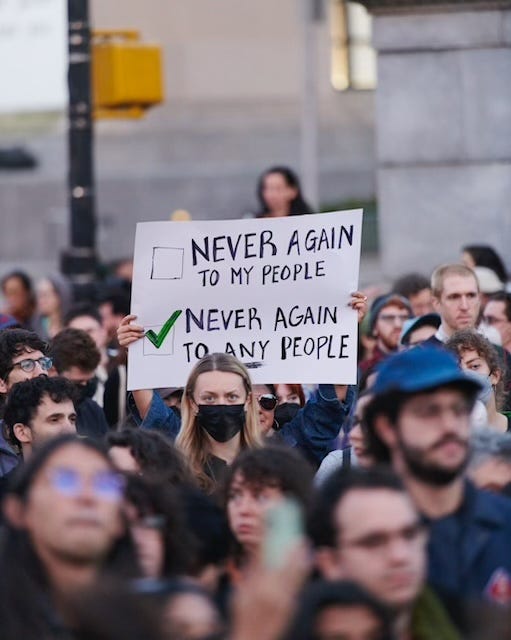
And this is precisely why I think Never Again for anyone is the only position I can truly defend. It does not require me to argue that the Holocaust and Gaza are the same. They are not. It does not require me to deny the reality of 7 October, Israeli civilian deaths, antisemitism or the particular history of Jewish persecution. Nor does it require me to believe that Palestinian suffering somehow becomes more important because it can be compared with Jewish suffering. Instead, it asks a much simpler question: if the lesson of history is that human beings should not be dehumanised, displaced, imprisoned, starved, persecuted or killed because of the group into which they were born, then why should that lesson stop applying when the victims are someone else?
This is where political recursion returns. The danger is not that Gaza is “another Holocaust”. The danger is that we learn nothing from historical violence if we only recognise its political mechanisms when we identify ourselves with the victim.
Again should teach us to recognise patterns beyond our own immediate experience.
And this is why the legal language matters too. In September 2025, the UN Independent International Commission of Inquiry concluded that Israeli authorities and security forces had committed genocide against Palestinians in Gaza, finding four of the five genocidal acts defined by the Genocide Convention and concluding that the required genocidal intent had been established.
The argument, then, is not that history is repeating itself perfectly. It is that political history is recursive. Categories, exclusions, fears and justifications can return in new forms.
And perhaps that is what Days of Future Past understands better than we initially give it credit for. The X-Men do not save the future by defeating the Sentinels in the future. They save it by going backwards and changing the conditions that produced them. The film understands that political violence has a history, and that if we only fight the final form of violence, we have already arrived too late.
Hate speech is an alarm bell - the louder it rings, the greater the threat of genocide. It precedes and promotes violence.”
United Nations Secretary-General, António Guterres
…and that is perhaps the simplest version of the argument I have been trying to make. We do not have to wait until the Sentinels exist.
This essay only scratches the surface of what Never Again can mean. I could have taken this much further through Sierra Leone, Sudan, Myanmar, or any number of other histories in which the question of recurrence looks different. That is partly the point. The more I looked at again, the less comfortable I became with treating it as a simple repetition of the past.
Political violence does not return neatly. It mutates, adapts and finds new language. Sometimes it is spectacular; sometimes it becomes administrative; sometimes it happens slowly enough that we barely notice it happening at all.
And perhaps that is why Days of Future Past is such an interesting film to think about alongside all of this. Its answer to political recurrence is not simply to remember. It is to intervene. Wolverine is sent backwards because by the time the Sentinels exist, it is already too late. The future cannot be defeated from within the future. The chain has to be interrupted somewhere earlier.
We, as far as I know, do not have a powerful telepath who can throw us back through time, so we have to do something much less exciting: learn from history, listen to the people warning us when they recognise its patterns, and act before the ending is already written.
This movie ends with the mutants very publicly saving the day, a striking change from First Class, where their existence and actions are still largely hidden from the world. That shift raises another set of questions about what happens after dehumanisation: about exceptionalism, belonging, visibility, and the expectation that marginalised people must demonstrate their usefulness before they are considered worthy of dignity. I explored some of this in THE MYTH OF THE 'PERFECT REFUGEE' - PART I. and I suspect it will keep returning throughout this series.
Because there are still eight or nine X-Men films left, and plenty more iterations of this story to come, there is a lot more to ask about segregation, diaspora, displacement, detention, resistance and the politics of who gets to belong.
The margins are where I wander a little further. Here you’ll find personal reflections, behind-the-scenes thinking, and connections to the wider ideas and essays that make up the Pop Culture as Parable archive.
For now, the margins are open to all free subscribers. If you’ve made it this far, why not subscribe and keep following the conversation?
This is Essay #7 of 102.
Between now and the release of Avengers: Doomsday, I’ll be working through every corner of the Marvel multiverse, using each story as a starting point to explore a bigger question about politics, philosophy and what it means to be human.
If that sounds like your kind of thing, I’d love for you to join me.
Subscribe below to follow the countdown, receive every new essay in your inbox, and let me know your own thoughts in the comments. Whether you agree, disagree, or have a theory of your own, I’d love to hear it.
If you want to learn more about the theories mentioned here, why not check them out? They should be available at your local library or through second-hand book sellers. They are both great reads that say far more than I can fit in this quick 600-word reflection.
Arendt, H. (1963). Eichmann in Jerusalem: A Report on the Banality of Evil.
Dallaire, R. (2003). Shake Hands with the Devil: The Failure of Humanity in Rwanda.
Kiernan, B. (1996). The Pol Pot Regime: Race, Power, and Genocide in Cambodia under the Khmer Rouge, 1975–79.
Klar, Y., Schori-Eyal, N., & Klar, Y. (2013). “The ‘Never Again’ State of Mind: Jewish-Israeli Holocaust Memory and Its Consequences.” Political Psychology, 34(6), 847–865.
Lemkin, R. (1944). Axis Rule in Occupied Europe: Laws of Occupation, Analysis of Government, Proposals for Redress. Carnegie Endowment for International Peace.
Nietzsche, F. (1882). The Gay Science.
United Nations (1948). Convention on the Prevention and Punishment of the Crime of Genocide.
United Nations (1999). Report of the Secretary-General Pursuant to General Assembly Resolution 53/35: The Fall of Srebrenica.
United Nations (2025). From Words to Violence: Lives Behind the Fields of Death.
Independent International Commission of Inquiry on the Occupied Palestinian Territory, including East Jerusalem, and Israel (2025). Legal Analysis of the Conduct of Israel in Gaza Pursuant to the Convention on the Prevention and Punishment of the Crime of Genocide. UN Human Rights Council, A/HRC/60/CRP.3.
United States Holocaust Memorial Museum (2021). Buchenwald. Holocaust Encyclopedia.
International Court of Justice (2007). Application of the Convention on the Prevention and Punishment of the Crime of Genocide (Bosnia and Herzegovina v. Serbia and Montenegro): Judgment.
International Criminal Tribunal for the former Yugoslavia (2004). Prosecutor v. Radislav Krstić: Judgment. Case No. IT-98-33-A.
Jewish Voice for Peace (2026). Never Again for Anyone.
Niemöller, M. “First They Came.” United States Holocaust Memorial Museum, Holocaust Encyclopedia.
No posts
Comments
Nothing yet. Say the first thing.
Sign in to join the conversation.