
Time for a slightly lighter essay…
I know this is completely out of the chronological order I have been attempting to follow, but I wanted to address Spider-Man: Brand New Day while the ideas are still fresh in my brain and I can make some sense of my increasingly crazed notes.
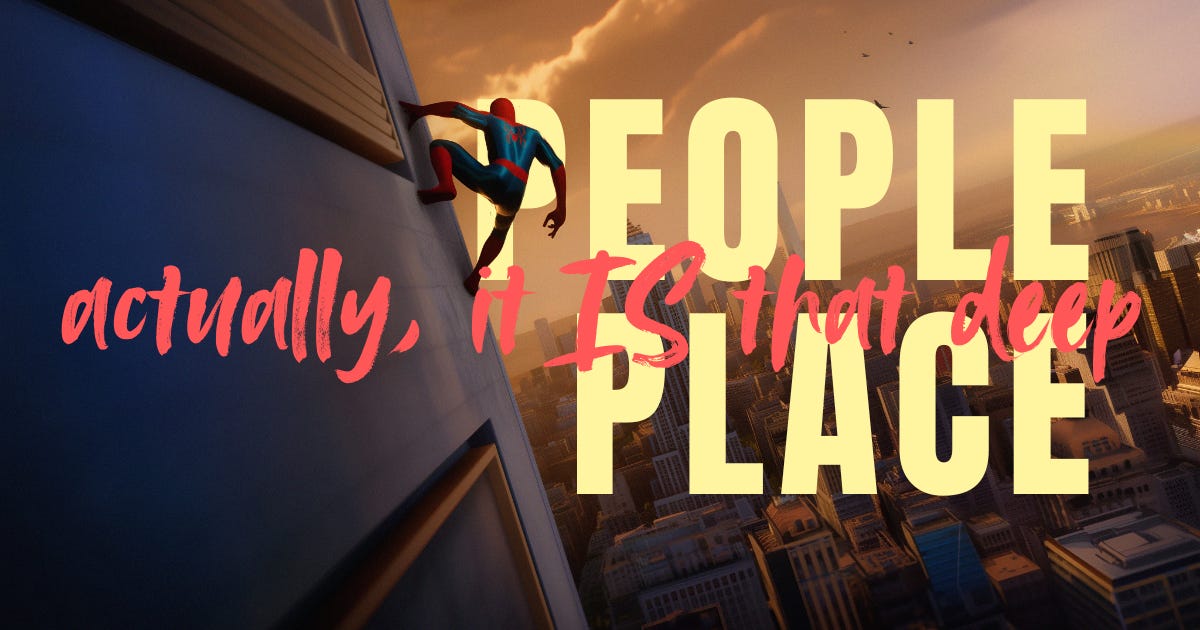
There is something about Spider-Man that makes New York feel less like a setting and more like a character. This has always been true, of course. The city is practically built into the mechanics of the character: Spider-Man needs buildings to climb, streets to cross, bridges to swing from and rooftops to leap between. Remove New York and you remove something fundamental about Spider-Man himself. He could exist somewhere else, but he wouldn't quite be Spider-Man in the same way.
What I particularly liked about Brand New Day, though, is that it seems to remember that the city isn't just architecture.
It is people.
This sounds almost embarrassingly obvious when written down, but I think it is something superhero films can forget surprisingly easily. Once the stakes become sufficiently enormous, ordinary people tend to disappear from the story. Cities become anonymous landscapes for enormous CGI battles. Brand New Day feels much more interested in the neighbourhood part of friendly neighbourhood Spider-Man.
This is a big theme in the movie: the idea of little potatoes and big potatoes. I have a lot of thoughts about how I resonated as a humanitarian researcher, which I will reflect on in the margins, but I think this really sets the focus of this ground-level hero.
We get a sense of the people who actually keep a city functioning. First responders, emergency workers, ordinary residents and all the other people whose jobs don't involve stopping an intergalactic invasion but who nevertheless have to respond when something goes wrong. I particularly enjoyed that the emergency workers don't simply exist to demonstrate how spectacularly incompetent normal people are compared with superheroes. They know what they're doing. They have their own forms of expertise. They are part of the response.
Because at the end of the day, what is place?
It is tempting to answer that question geographically. New York is a particular patch of land, with particular boundaries, buildings, streets and infrastructure. We can put it on a map, give it a name and draw a line around it. But that tells us remarkably little about what makes somewhere a place rather than simply a location.
For Yi-Fu Tuan, that distinction begins with experience. In Space and Place, Tuan describes space as something open and undifferentiated, while place emerges as that space becomes known and meaningful through experience. A location becomes somewhere when we develop familiarity with it: when a street becomes the route we take home, when a building becomes somewhere we remember, when a particular corner becomes associated with a person or an event. Place, in this sense, is not simply where we are. It is somewhere that has acquired meaning through the ways we experience it.
Spider-Man's New York is almost entirely built upon this kind of familiarity. He doesn't encounter the city as a map. He knows it through movement. He knows which buildings he can swing from, which streets he can cross, which rooftops connect to which others. More importantly, he knows the people within it. His relationship with New York is therefore experiential: the city becomes his place through the accumulated encounters that make its spaces familiar.
But there is something potentially limiting about stopping at this distinction between space and place.
It can, if taken too literally, make meaning seem like something that humans simply add to otherwise empty spaces. There is a faintly uncomfortable implication in imagining an unvisited forest, an uninhabited island or a landscape beyond human experience as somehow less of a place because nobody has yet developed a relationship with it. It also raises the question of whose experience counts. Who gets to decide what makes somewhere meaningful? And what happens when one person's meaning is imposed upon a place at the expense of another's?
I wouldn't go so far as to call Tuan's formulation inherently colonialist, but it is certainly possible to see how a purely human-centred understanding of place could be co-opted into a colonial logic: the idea that land acquires significance, value or legitimacy through the presence, knowledge or intervention of particular humans. That becomes especially uncomfortable when we remember that colonialism has so often involved declaring places empty, unused or meaningless in order to justify taking possession of them.
There is another problem too. Tuan's emphasis on experience can become quite individualistic. My New York might be different from your New York, which might be different from Spider-Man's New York, and so on. There is truth in that, but it doesn't quite explain the city itself. Our experiences do not happen independently of the structures around us.
There are buildings that have been designed and constructed. Streets have been laid out. Property has been bought and sold. Transport systems have been built. Laws determine what can happen in particular spaces. Some people can afford to live in particular neighbourhoods while others cannot. Some people are welcomed into particular spaces while others are excluded from them. We do not simply arrive in a place and give it meaning. We arrive in places that have already been shaped by other people, other systems and other histories.
This is where Henri Lefebvre's The Production of Space takes the argument somewhere considerably more complicated. For Lefebvre, space is not an empty container waiting for social life to happen inside it. It is produced through social relations and practices. The spaces we inhabit are shaped by the ways we organise society, by institutions and representations, by economic systems and by everyday activities. Space is therefore not merely the setting for social life. It is one of the things social life continually produces.
The city that Spider-Man moves through has been produced by millions of actions that have nothing to do with him. Its streets, buildings and infrastructure are the accumulated result of political decisions, economic interests, architectural practices and generations of everyday use. The fact that Spider-Man can swing between two buildings is dependent upon an entire urban system that existed before he arrived.
But production does not stop once a building has been constructed or a street has been paved. Space is continually reproduced through its use. Every person moving through a city participates, however unequally, in making that city what it is.
This is where the people of Brand New Day become more than scenery.
There is something about the way this film populates its world that I particularly enjoyed. It often feels as though there are no simple extras. Every person is a potential interaction. Every character seems capable of becoming part of the story. You find yourself watching a scene and wondering whether the person in the background is simply there to make New York feel populated, or whether they might become important two minutes later with all the mind-jumping shenanigans.(how awesome was that scene btw?).
That gives the film a strange sense of collective possibility. The story does not feel as though it is happening around a group of passive people while Spider-Man gets on with the actual plot. The story itself emerges from interactions between people.
And that takes us neatly from Lefebvre to Doreen Massey.
Where Lefebvre asks us to understand space as something produced through social relations, Massey challenges the idea of places as bounded, coherent entities with a single identity. In Space, Place and Gender and her other writings on space and place, she instead understands places through the relationships that constitute them. Places are formed through connections extending beyond themselves: through histories, movements, encounters and different trajectories that happen to meet in the same geographical location.
New York therefore isn’t simply produced by New Yorkers.
It is produced through migration, tourism, trade, media, finance, politics, infrastructure and countless movements between New York and elsewhere. Its identity is not something contained neatly within its geographical boundaries. It is continually negotiated through the relationships that pass through it.
And, whether intentionally or not, Brand New Day is itself part of that identity.
Every representation of New York contributes another version of the city to the enormous collection of meanings through which we understand it. Spider-Man's New York is fictional, obviously, but fictional places can still become part of how real places are imagined. The city that exists in these films becomes part of our cultural understanding of New York: the skyline, the streets, the bridges, the neighbourhoods and the particular mythology of a person swinging between them.
That distinction matters because there is a tendency, particularly in superhero narratives, to make the hero the central agent of the city. The city is threatened; the hero saves it. The city is damaged; the hero restores it. The city becomes the object of heroic action.
Brand New Day is more interesting when it makes Spider-Man part of the place rather than placing him above it.
He participates in New York.
He is one trajectory among millions.
And this brings us back to the little potatoes.
The distinction between big and little problems is funny because superhero stories are almost entirely organised around scale (especilly in that awkward post infinity war era). The bigger the threat, the more important the hero appears. Saving the world is obviously more spectacular than helping one person. Stopping an alien invasion produces a more satisfying third act than making sure someone gets home safely.
But if we take Tuan, Lefebvre and Massey seriously, the apparently little things are not peripheral to place. They are part of how place comes into being.
It is produced through repetition: the same routes taken every morning, the same shops opening, the same people meeting in the same places. It is produced through relationships: neighbours recognising one another, workers responding to emergencies, strangers helping strangers. It is produced through movement: people arriving, leaving, commuting, migrating and passing through. And it is produced through power: decisions about who can access which spaces, who can shape them and whose presence is welcomed or resisted.
A city isn't made once. It is made over and over again, by people with wildly different amounts of power, moving through the same physical spaces and giving them different meanings. Some of those people wear superhero costumes. Most very much do not.
THE MARGINS
The margins are where I wander a little further. Here you’ll find personal reflections, behind-the-scenes thinking, and connections to the wider ideas and essays that make up the Actually it is that Deep archive.
For now, the margins are open to all free subscribers. If you’ve made it this far, why not subscribe and keep following the conversation?
This is Essay #8 of 102.
Between now and the release of Avengers: Doomsday, I’ll be working through every corner of the Marvel multiverse, using each story as a starting point to explore a bigger question about politics, philosophy and what it means to be human.
If that sounds like your kind of thing, I’d love for you to join me.
Subscribe below to follow the countdown, receive every new essay in your inbox, and let me know your own thoughts in the comments. Whether you agree, disagree, or have a theory of your own, I’d love to hear it.
If you want to learn more about the theories mentioned here, why not check them out? They should be available at your local library or through second-hand book sellers. They are both great reads that say far more than I can fit in this quick 600-word reflection.
Tuan, Y.-F. (1977). Space and Place: The Perspective of Experience. Minneapolis: University of Minnesota Press.
Lefebvre, H. (1991). The Production of Space. Translated by Donald Nicholson-Smith. Oxford: Blackwell.
Massey, D. (1994). Space, Place and Gender. Cambridge: Polity Press.
Comments
Nothing yet. Say the first thing.
Sign in to join the conversation.