
Attempts to calculate Russian losses in the Ukrainian War—often taken as gospel by the mainstream—are limited by highly uncertain extrapolations. Even the most reliable estimates depend on a more or less arbitrary death-to-injury ratio, applied to a plausible but partial sample of known deaths.1 Furthermore, they struggle to distinguish between recoverable and irrecoverable casualties, and can hardly calculate the deserter component. A method not based on known deaths allows us to estimate Russian irrecoverable losses from 2022 onwards in a different way—exploiting curious convergences between Russian and “Western” sources, and testing the coherence of the analyses disseminated in our media, political, and propaganda ecosystem.
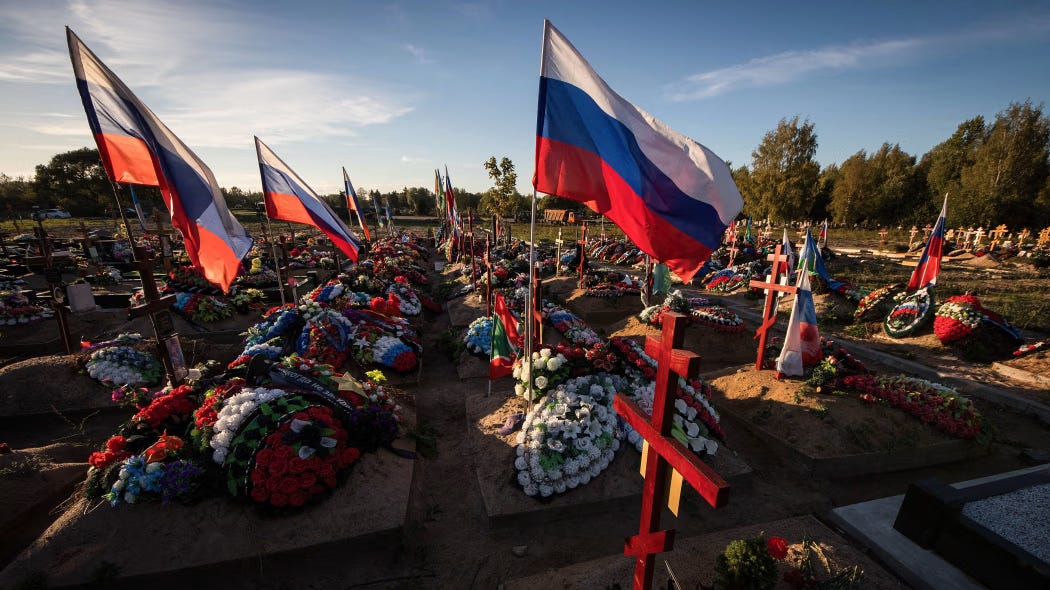
Since 2022, obituaries counted by Mediazona have typically been the only verifiable data used in more serious attempts to estimate Moscow’s military losses, but they remain an insufficient tool.2 On the one hand, such counts based on the identification of obituaries lag significantly behind the reality on the front. Furthermore, not all deaths leave a mark. The estimate of Russian military deaths, based on inheritance data and parallel to the count of verified deaths, also offered by Mediazona, only partially addresses these critical issues.
Above all, these counts completely ignore the wounded, and the sick: in particular, it is essential to calculate the proportion of irrecoverable wounded and sanitary losses, understood as those who must be permanently replaced with new recruits. Often, more or less reasonable death-to-injury ratios are assumed, based on past conflicts. But no previous conflict on this scale has seen the massive use of infantry quadcopter drones—which allows the killing of wounded and hors-de-combat soldiers with unprecedented ease, significantly altering the death-to-injury ratio. Other times, as in the widely reported estimate by The Economist, Western intelligence data is assumed to be accurate, obviously without any possibility of verification.3
What if, in attempting to estimate Russian losses, we counted the living?
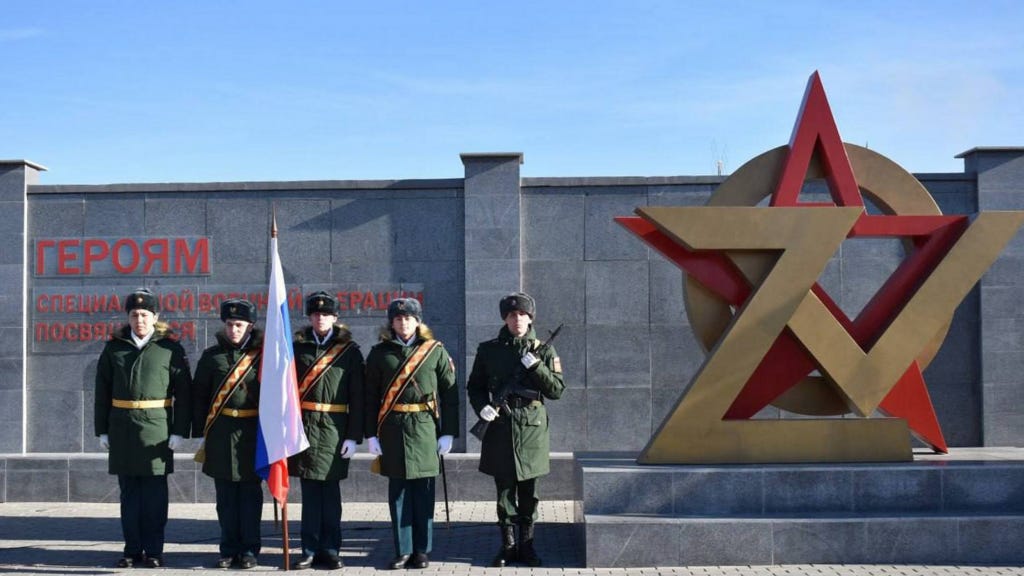
Focusing on the pre-war size of the Russian armed forces, war-time recruitment figures, and estimates of Russian troops in Ukraine at the end of 2025—around 700,000 according to both Moscow4 and Kiev5 —it is possible to deduce a ceiling of non-recoverable losses (dead, seriously wounded, sanitary losses, missing, prisoners).
Comments
Nothing yet. Say the first thing.
Sign in to join the conversation.