
Between Trump’s accusations of betrayal, and Rutte’s boasting of the extensive use of Italian bases for Operation Epic Fury, the Italian Government appears in a difficult position - alternatively choosing to highlight its support for the US ally, or deny any participation in the Iran War.
The use of Italian bases by the US military is regulated by the 1954 Bilateral Infrastructure Agreement, which is still kept secret by both parties. However, the crucial Article 2 of the Agreement has been leaked in 2008. It states that:
“The United States Government obligates itself to use the facilities agreed upon in the spirit and within the framework of NATO collaboration. The Government of the United States obligates itself to utilize the installations agreed upon exclusively in order to carry out its NATO responsibilities and, in any case, not to use them for warlike purposes unless pursuant to NATO dispositions or by agreement with the Italian Government.”1
Article 2 does not make any distinction between “kinetic” and “non-kinetic” missions, but refers to “warlike purposes”: evidently including non-kinetic missions such as logistic, transfers, reconnaissance, electronic warfare, if part of a war operation. Thus, those missions, if supporting the non-NATO war against Iran, and using Italian airbases, had to be authorized by the Meloni Government.
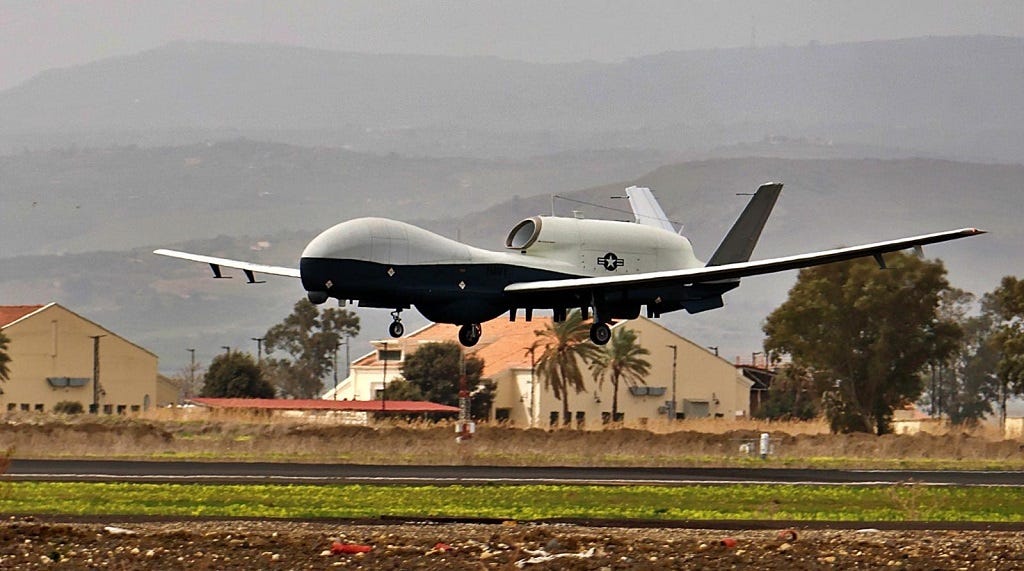
Despite this, the Meloni Government, through Ministry of Defence Guido Crosetto, repeatedly referred to pre-existing binding agreements, alternatively implying that the US do not need permission for non-kinetic air missions from Italian bases;2 that foreign non-NATO offensive air missions cannot be launched from Italy at all; that allowing those flights was not a political choice, but a treaty-bound obligation;3 and that the Italian Government did authorize only non-kinetic flights (so, they did need authorization!).4
Crosetto then declared that 518 US flights had been authorized, from 29 February until 23 June - but, unconvincingly, tried to pass them as routine air activity, evidencing the similar number of flights of previous years, while omitting that, this time, the US air forces were fighting a war. Note that Rutte had earlier said that “500 US planes took off from US bases in Italy, to support Epic Fury”: going by NATO’s chief words, almost all of the flights admitted by Crosetto had been in support of the Iran War.5
Many of the incoherent statements from the Meloni Government are hard to believe, especially given the refusal to reveal the text of those supposed agreements, or explain the glaring contradiction with the leaked Article 2 of the 1954 Agreement, which requires authorization for all “warlike purpose” missions. In fact, the Italian Government seems to have followed exactly what the 1954 BIA stipulated: provide authorization for numerous US logistic, transfer and reconnaissance flights, for “warlike purposes”. Or, alternatively, to have let the US be tacitly and automatically authorized for those non-kinetic missions, despite what has been stipulated in the 1954 BIA, perhaps following a long-established practice.
Both of those scenarios do, of course, imply a deliberate political choice by the Meloni Government - but the latter would also imply a grave distortion of what the 1954 Agreement stipulated, at least in the Article 2 that we know of.
So, as far as can be documented, how have the US exploited Italian airbases for Operation Epic Fury?
Since the beginning of 2026, tension was soaring. On 13 January, President Trump openly called Iranians to “take over their government” and publicly alluded towards an impending military operation, stating that “help is on the way”, and that those responsible for the repression of the protests “would pay a very big price”. That same day, national security officials met at the White House to review potential military options, including airstrikes and targeted raids. On 23 January, Trump announced that a US “armada” was heading to the Middle East.
Thus, certainly by the end of January, the scope of any US military buildup in the region could not be any clearer for the Italian Government.
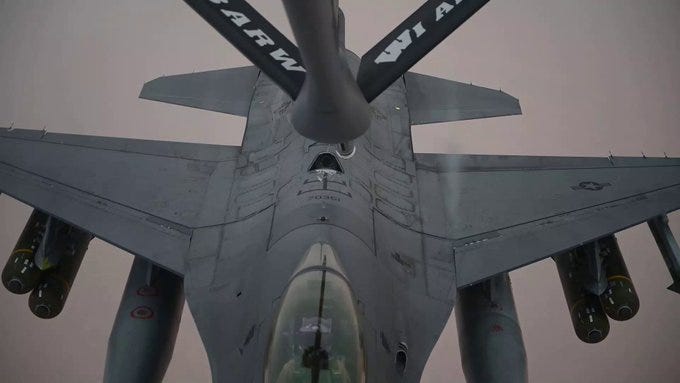
At least since 17 February, the US Air Force started moving F-16 fighters from their normal deployment at Aviano Air Base,6 in Italy’s Friuli region, towards Prince Sultan Air Base in Saudi Arabia - or, possibly, also to Jordan:7 they were part of a force buildup in preparation for the attack on Iran, and Aviano’s F-16s were to be used, particularly, as strike aircraft. Some of those fighters would eventually be photographed during missions against Iran, armed both for ground strikes, and air-to-air tasks.
The forward deployment of Aviano’s F-16s did not merely mean transferring the fighter jets, but also moving all the equipment and logistical support needed for the wartime needs of a fighter squadron. From at least 18 February, huge C-5 strategic airlift aircraft flew from Aviano towards the aforementioned Middle East bases, moving the necessary equipment for setting up and supporting the upcoming F-16 sorties as part of Epic Fury.8 Such movements were frequently tracked for several of the following days,9 and very likely continued during the war.
Comments
Nothing yet. Say the first thing.
Sign in to join the conversation.