

Creative problem-solving often feels most exciting when a promising idea is finally selected. The room relaxes. The team has moved through uncertainty, compared options and chosen a direction. Someone may even say, “Great, now we have the solution.”
Not quite.
A selected idea is not yet a solution. It is a starting point, a direction of travel, and a promising possibility that has earned further attention. But until it has been shaped, tested, resourced, owned and translated into real-world action, it remains unfinished.
This is where many creative efforts lose momentum. Organisations, entrepreneurs and professional teams often generate excellent ideas and even choose the best ones, but then struggle to convert them into workable outcomes. The idea sounds good in the meeting, looks attractive on the whiteboard and creates enthusiasm in the moment. Then it drifts into the great idea graveyard, where promising concepts go to enjoy a peaceful retirement without ever troubling the real world.
The gap between the idea and the solution is not a minor administrative detail. It is the critical bridge between creativity and execution. It is where imagination begins to meet constraints, customers, systems, budgets, timelines, relationships, skills, habits and all the other inconvenient realities that make implementation interesting.
For entrepreneurs and professionals, this phase matters enormously. A good idea may open the door, but only a practical solution creates value. The work is not finished when the idea is selected. In many ways, that is when the real creative discipline begins.
WHY: Why Good Ideas Are Not Yet Solutions
Good ideas matter. They bring energy, possibility and direction. They help teams escape old patterns and imagine better ways forward. But even a strong idea is still incomplete.
An idea usually describes what could be possible. A solution describes what will be done, for whom, how it will work, what it will require, how it will be tested, how it will be delivered and how success will be recognised.
That difference matters because reality is more demanding than imagination. In the ideation phase, an idea can remain broad and attractive. It can sound elegant because it has not yet been required to answer difficult questions. Who exactly is this for? What problem does it solve first? What behaviour must change? What resources are needed? What could go wrong? What must be simplified? What has to be true for this to work?
These questions do not diminish creativity. They mature it.
Many organisations are idea-rich but action-poor. They have innovation workshops, brainstorming sessions, strategy days and digital boards filled with suggestions. The problem is not always generation. The problem is conversion. Possibilities are captured but not owned. Concepts are admired but not tested. Decisions are made but not translated into action.
Entrepreneurs face the same challenge under sharper pressure. A founder may choose a promising business idea, product feature, service offering, or customer segment, only to discover that the selection was the easy part. The idea now needs a value proposition, pricing, delivery model, customer testing, marketing message, operational capacity and a route to revenue. It must move from “This could work” to “This is how we will make it work.”
Professionals designing programmes, processes, strategies or client solutions face a similar conversion challenge. A good concept may excite stakeholders, but it still needs structure. Without careful development, it can remain vague, overcomplicated or disconnected from the realities of adoption.
This is why the transition from selected ideas to practical solutions is so important. It protects the value of creative thinking by giving it a route into action.
Without this bridge, ideas become souvenirs of a creative session. With it, ideas become instruments of change.
WHAT: What Changes When an Idea Becomes a Solution
The move from idea to solution is a shift from possibility to practicality. It does not mean making the idea dull. It means making the idea usable.
A selected idea is often still broad. It may contain a strong insight, an attractive concept or a promising direction, but it usually lacks the detail required for action. A practical solution has been refined to the point where it can be understood, tested, delivered, and improved.
This shift involves several important changes.
From Inspiration to Value
An idea may be inspiring because it feels fresh, bold or different. A solution must create value. It must help someone achieve, solve, avoid, understand, or experience something better.
This requires a sharper focus on the user, customer, client, stakeholder or team affected by the solution. Who is it for? What are they trying to do? What problem are they experiencing? What would make this useful enough for them to adopt, pay for or support?
A common mistake is to assume that because a team likes an idea, others will value it. Internal enthusiasm is useful, but it is not evidence of external value. A practical solution must be shaped around the people it is meant to serve.
From Concept to Design
An idea may be expressed in a sentence. A solution needs design. It needs form, sequence, experience and delivery logic.
For a service, this may include the customer journey, touchpoints, roles, timing, communication and support. For a product, it may include features, usability, materials, channels and maintenance. A process improvement may include workflow, decision rights, handovers, training, and measures of success. A leadership programme may include learning outcomes, session flow, participant experience, practice activities, and follow-up.
Design turns the idea from a statement into something people can interact with.
From Possibility to Constraint
Ideas often enjoy a brief romantic period before constraints arrive. Then budgets, systems, regulations, skills, time, capacity, politics and stakeholder expectations enter the conversation. This can feel like creativity being attacked by reality.
A more useful view is that constraints help shape the solution. They reveal what must be simplified, prioritised, sequenced or adapted. A constraint is not always a stop sign. Sometimes it is a design brief with a stern expression.
The question is not, “How do we protect the idea from constraints?” The better question is, “How do we use constraints to make the idea workable without destroying its essence?”
From Ownership by Originator to Ownership by Implementers
Ideas often begin with one person or a small group. Solutions require wider ownership. The people who will deliver, use, fund, approve, maintain or be affected by the solution need to be involved early enough to shape it.
This does not mean everyone must decide everything. It means the solution must be developed with the reality of implementation in mind. If the people responsible for execution are excluded until late in the process, the solution may look attractive but fail in practice.
Implementation is not where creativity ends. It is where creativity meets other people’s realities.
From Decision to Iteration
Selecting an idea can feel final, but developing a practical solution is iterative. The first version is rarely the best version. It needs testing, feedback, refinement and sometimes a significant redesign.
This is not failure. It is development.
The selected idea should be treated as a working hypothesis: “We believe this direction can create value if shaped in the right way.” The task is then to learn what the right way might be.
A Mini-Example: From Broad Idea to Clearer Solution
Consider a broad, selected idea: “We should help managers communicate better.” It sounds useful, but it is not yet a solution. It is too wide, too vague and too difficult to implement as it stands.
Through development, the team sharpens its value proposition: newly promoted managers need help with difficult conversations in their first 90 days. It designs a first usable version: a short, practice-based learning sprint with real scenarios, peer rehearsal and follow-up reflection. It considers constraints: managers have limited time, HR needs something easy to sponsor, and the business wants practical behaviour change rather than more theory. It involves implementers early on: facilitators, HR partners, and a small group of managers help shape the experience. It then tests the first version, gathers feedback and refines the structure.
The original idea has not been abandoned. It has been translated. “Help managers communicate better” becomes “a practical, three-part learning sprint that helps newly promoted managers handle difficult conversations with more confidence in their first 90 days.” That is the difference between an appealing idea and a solution people can understand, test and use.
HOW: How to Turn Selected Ideas into Practical Solutions
Moving from selected ideas to practical solutions requires disciplined development. The goal is to protect the idea's creative promise while making it robust enough for the real world.
This calls for a shift in mindset. The selected idea should no longer be treated as a finished answer. It should be treated as a promising raw material that needs to be shaped, tested, and translated into something people can understand, use, and support.
Disciplined development means holding two responsibilities simultaneously. The first is to protect the essence of the idea: the insight, value or opportunity that made it worth selecting in the first place. The second is to expose the idea to reality: users, constraints, resources, delivery requirements, risks and feedback.
This is where many ideas either become useful or quietly fade. If the team protects the idea too much, it remains attractive but impractical. If the team forces it into implementation too quickly, it may lose the creative insight that made it valuable. The work is to keep the promise alive while making the form more practical.
The playbook below turns that discipline into a clear process: clarify the essence, define the value, shape the first usable version, test assumptions, refine through feedback and create a route to action.
The work is not to force the original idea into the world exactly as imagined. The work is to help the idea become something that can live usefully in the world.
The No-More-Idea-Graveyard Playbook: Practical Strategies for Making Ideas Work
The gap between idea selection and implementation can be managed. The following four practices help entrepreneurs and professional teams convert promising ideas into practical, testable and actionable solutions.
1. Clarify the Value
Before refining the idea's form, clarify why it matters and who it is meant to serve. This prevents the team from rushing into activity before it has understood the value the solution must create.
Start by protecting the essence. Ask:
What is the original insight behind this idea?
What problem or opportunity is it really addressing?
What makes it worth preserving?
If we simplify or adapt it, what must not be lost?
This prevents the team from accidentally removing the very thing that made the idea valuable. For example, an idea for a highly personalised client experience may need to become more scalable, but the sense of personal relevance should not disappear. The form can change. The essence should be protected.
Then turn the idea into a practical solution statement:
“We will help [specific audience] achieve [specific outcome] by providing [solution approach], so that [value created].”
For example:
“We will help newly promoted managers handle difficult conversations more confidently by providing a short, practice-based learning sprint, so that they can lead earlier with greater clarity and less avoidance.”
This moves the team from vague excitement to usable clarity. It also exposes gaps. If the team cannot clearly complete the statement, the idea is not yet solution-ready.
2. Shape the Experience
Once the value is clear, give the solution a practical shape. Do not try to build the perfect version immediately. Define the first usable version.
This version should be small enough to develop quickly, but complete enough to create real learning. It should answer the question: What is the simplest version that still delivers the core value?
For a service, this might be a pilot workshop. For a product, it might be a prototype with only the most essential features. For a process improvement, it might be a trial in one team before wider rollout. For a coaching offer, it might be a three-session version before a full programme.
The first usable version gives the idea a practical shape without overcommitting resources too early.
Then map the user journey. A solution is not only what the team builds. It is what the user experiences. How do people first hear about it? What do they understand? What do they need to do? Where might they hesitate? What support do they need? What happens afterwards?
This helps the team discover hidden friction. Many ideas fail not because the core concept is weak, but because the surrounding experience is confusing, inconvenient, or unsupported.
3. Test and Refine
A practical solution should be developed through contact with reality. Start by surfacing the assumptions behind it. Ask what must be true for the solution to work.
Common assumptions include:
The target audience cares about the problem.
The proposed solution creates enough value.
People understand the offer or process.
The team can deliver it consistently.
The cost and effort are justified.
Stakeholders will support adoption.
The solution fits the broader strategy.
Once these assumptions are visible, decide which ones need testing first. Do not spend weeks polishing something built on an untested belief.
Use prototypes and pilots to move from internal confidence to real feedback. A prototype helps people react to the solution before it is fully built. A pilot tests a small version in a realistic setting. Both help reduce risk and improve the solution.
The purpose is not to prove that the original idea was right. The purpose is to learn what the practical solution needs to become.
Useful questions include:
What did people understand immediately?
Where did they hesitate?
What created value?
What felt unnecessary?
What needs simplifying?
What must be added, removed or changed?
Then translate feedback into design decisions. Feedback is only useful if it changes something. Use a simple structure:
Keep: What is working and should remain?
Change: What needs to be adapted?
Remove: What is unnecessary or confusing?
Add: What is missing?
Test next: What remains uncertain?
This prevents feedback from becoming a pile of interesting comments that nobody uses.
4. Build the Route to Action
A practical solution needs ownership and momentum. It also needs the right conditions to succeed.
Clarify:
Who is responsible for moving this forward?
Who needs to be involved?
What resources are required?
What decisions are needed?
What timeline is realistic?
What risks must be managed?
What support will users or stakeholders need?
Many ideas fail not because they are bad, but because no one is responsible for turning them into reality. Ownership turns intent into movement.
To avoid the great idea graveyard, define what will happen in the next 30 days. This might include customer conversations, prototype development, stakeholder interviews, a small pilot, a costing exercise, a feasibility check or a decision meeting.
The 30-day action path keeps momentum alive. It shifts the team from admiration to action.
Ask: “What must happen in the next month for this idea to remain alive and useful?”
A Worked Example: From Promising Idea to Practical Solution
Imagine a consulting firm selects an idea for a new leadership development offer: “help managers become more confident in difficult conversations.” The idea is promising, but it is not yet a solution.
First, the team identifies the essence. The core insight is that many managers avoid difficult conversations because they lack confidence, structure and practice. The value is not simply more knowledge. The value is practical confidence in real workplace moments.
Next, the team writes a solution statement: “We will help newly promoted managers handle difficult conversations more confidently by providing a short, practice-based learning sprint, so that they can lead earlier with greater clarity and less avoidance.”
Then the team designs the first usable version. Instead of building a six-month programme, it creates a three-part pilot: a diagnostic conversation, a two-hour live practice session and a follow-up reflection clinic.
The user journey is mapped. Participants receive a short pre-session prompt asking them to identify one real conversation they are avoiding. During the session, they learn a simple conversation structure, practise in pairs and receive feedback. After the session, they apply the conversation at work and return for reflection.
The team surfaces assumptions. It assumes that managers will be willing to bring real examples, that organisations see this as urgent, that a short format can create meaningful confidence, and that practice is more valuable than content alone.
The pilot is tested with one client group. Feedback reveals that participants value the practice, but want clearer examples before role-play. HR likes the format, but asks for a manager briefing guide to support follow-through.
The team translates feedback into design decisions. It keeps the practice-based structure, adds example scenarios, removes a long theory section, adds a manager briefing guide and decides to test pricing with two more clients.
Now the idea has become a practical solution. It has a defined audience, value proposition, structure, journey, evidence, owner and next action path. It is no longer a nice thought. It is becoming real.
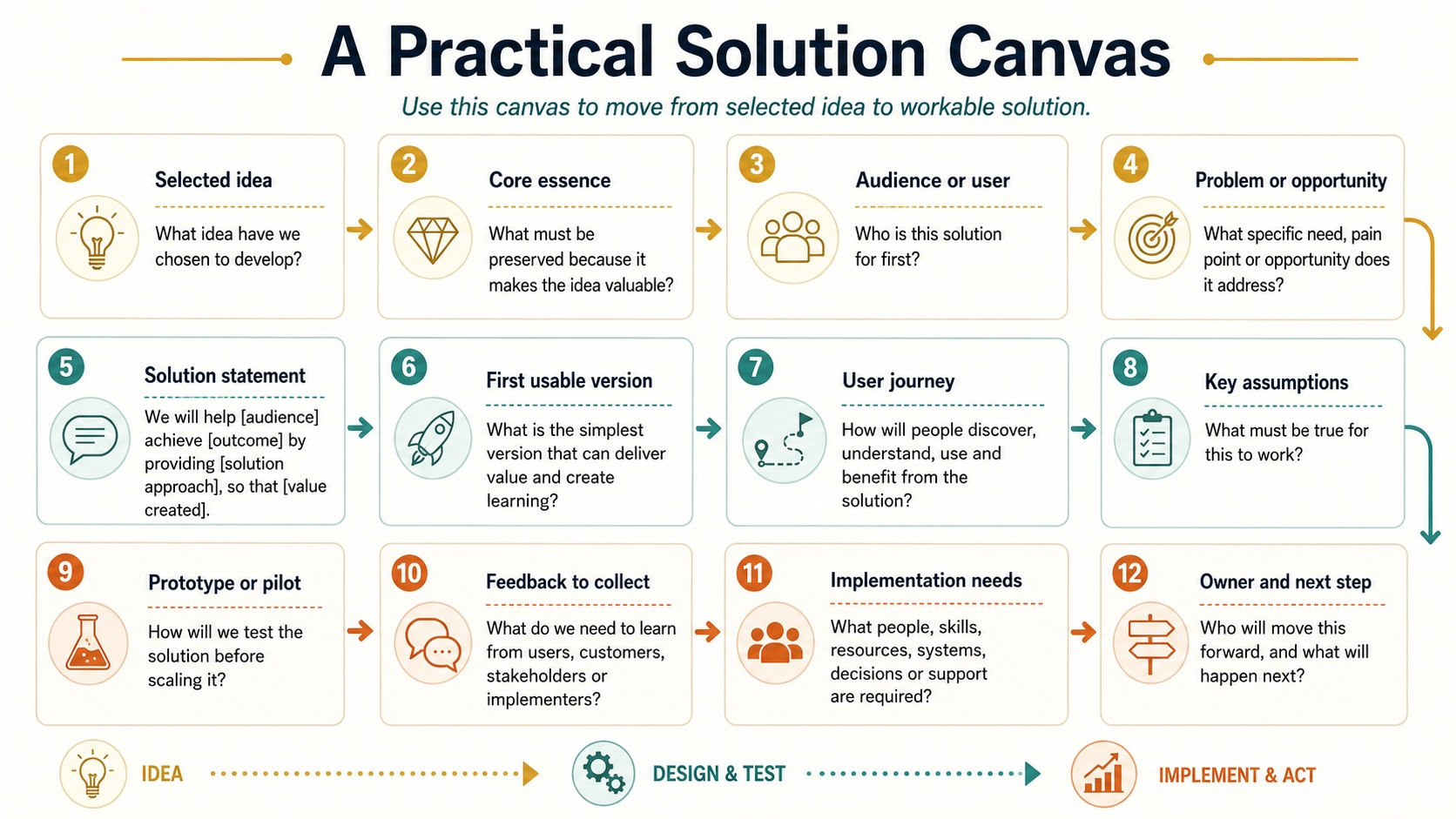
A Practical Solution Canvas
Use this canvas to move from a selected idea to a workable solution.
Selected idea: What idea have we chosen to develop?
Core essence: What must be preserved because it makes the idea valuable?
Audience or user: Who is this solution for first?
Problem or opportunity: What specific need, pain point or opportunity does it address?
Solution statement: We will help [audience] achieve [outcome] by providing [solution approach], so that [value created].
First usable version: What is the simplest version that can deliver value and create learning?
User journey: How will people discover, understand, use and benefit from the solution?
Key assumptions: What must be true for this to work?
Prototype or pilot: How will we test the solution before scaling it?
Feedback to collect: What do we need to learn from users, customers, stakeholders or implementers?
Implementation needs: What people, skills, resources, systems, decisions, or support are required?
Owner and next step: Who will move this forward, and what will happen next?
WHAT BECOMES POSSIBLE: From Idea Selection to Real-World Value
When teams learn to turn selected ideas into practical solutions, creative problem-solving becomes more consequential. Ideas no longer disappear after the workshop. They move into development, testing and action.
Entrepreneurs benefit because they become better at converting inspiration into offers, products, services and business models that customers can understand and value. They waste less time overbuilding vague concepts and become more skilled at shaping the first usable version.
Professional teams benefit because creative work becomes more credible. People begin to trust that idea generation is not a performance, but the beginning of meaningful change. This increases engagement because contributors can see a path from imagination to implementation.
Decision-making improves because selected ideas are developed rather than merely approved. The team learns to ask better questions: What must be true? Who is this for? How will it work? What must be tested? What must be simplified? Who owns the next step?
Implementation becomes stronger because practical realities are considered earlier. Users, customers, delivery teams and stakeholders can shape the solution before it is too late. This reduces resistance and increases adoption.
Innovation becomes more repeatable. The team develops a disciplined way of moving from possibility to practicality. It no longer depends only on inspiration, heroic effort, or a single enthusiastic champion. It has a process for converting selected ideas into workable outcomes.
Most importantly, the creative culture becomes more hopeful and more accountable. People stop saying, “We always have good ideas, but nothing happens.” Instead, they begin to see that ideas can travel. They can be shaped, tested, improved and brought to life.
That is when creativity earns its place in the real world.
The Idea Is Only the Beginning
The transition from selected ideas to practical solutions is the crucial bridge between creativity and execution. It is where possibility becomes design, where excitement becomes evidence, and where intention becomes action.
A good idea is not yet a solution. It may contain the seed of a solution, but it still needs development. It must be clarified, shaped, tested, refined, resourced and owned. It must be translated into something people can understand, use, support and benefit from.
For entrepreneurs and professionals, this is one of the most important creative disciplines. It prevents the great idea graveyard. It protects scarce resources. It improves implementation. It strengthens trust in the creative process.
The work is not to preserve the selected idea exactly as it first appeared. The work is to help it become useful. That may require simplifying it, adapting it, combining it with another idea, testing it with real users or changing the delivery model. None of this is a betrayal of creativity. It is creativity growing up.
The best creative thinkers do not stop when they have chosen an idea. They ask what the idea must become in order to create value.
That question changes everything.
Ideas open possibilities. Practical solutions change reality.
Join us at ACRE30, Africa’s Premier Creativity and Creative Thinking Conference in 2026 at Klein Kariba, South Africa! https://acreconference.com
Comments
Nothing yet. Say the first thing.
Sign in to join the conversation.