

Looking back at the other two film festivals I covered this year, I started to think of them in terms of how they function within the overall festival circuit. At only two years old, the Montreal Critics’ Week acts as a counter to the dominant, consumption-heavy mode most festivals operate in, its format of post-screening discussions encouraging a more active exchange of ideas between audiences, filmmakers, and programmers. Slamdance, now over three decades old, trucks along with the times as an alt Sundance, with a focus on unveiling new works from independent filmmakers.
The New Directors/New Films Festival, founded in 1972, relies on the strength of its curation. A joint effort between Film at Lincoln Center and the Museum of Modern Art, ND/NF compiles films from emerging directors around the world that make up a snapshot of the next generation of (possibly) major filmmakers. Take a look at the festival’s history on their website and you’re immediately greeted with a stacked list of alumni that proves why ND/NF is still going strong after five decades. If you watch something here, there’s a good chance you’ll be hearing more about its director(s) in the years to come.
The quality of the selection, along with the lack of adhering to limiting factors other festivals self-impose (even the definition around a “new” director is loose, as Erupcja director Pete Ohs has helmed at least six films in the last 15 years), is why I consider ND/NF to be one of my favourite film festivals, and one I always pay attention to. I’ve lost count of the amount of directors I’ve discovered over the years, names that often slipped through the cracks of sidebars and festival lineups from the other side of the world. With the festival starting today, here are my thoughts on four films from this year’s selection.

An example of the KISS principle in action, Pete Ohs’ Erupcja admirably keeps things simple to tell its story of two women swept up in one big metaphor. British couple Bethany (Charli XCX) and Rob (Pete Ohs) arrive in Warsaw, Poland for a vacation. Rob intends to propose to Bethany before they head back, a surprise she already picked up on and wants to avoid at all costs. That’s partly why Bethany wanted to visit Warsaw, because she knows the perfect person to keep her busy: Nel (Lena Góra), a friend she met years ago when she found herself stranded in the city due to the eruption of Icelandic volcano Eyjafjallajökull back in 2010. Not long after Bethany and Rob arrive, news of a volcano eruption far away coincides with Bethany and Nel’s reunion, kicking off a days long bender that threatens to upend their lives.
And that’s basically Erupcja in a nutshell. The significance of volcanic eruptions, both as a coincidence that occurs every time Bethany crosses paths with Nel and as a representation of the destructive force their bond creates with each meetup, is the film’s foundation and its target. This isn’t the kind of symbol a viewer is supposed to infer from the story since the characters are well aware of it, and Bethany happily uses the eruptions as a justification for her selfish impulses. But as quickly as they dive back into old habits of bar hopping and partying, the film gives Bethany and Nel’s glamorized bout with destiny a reality check. Eruptions aren’t exactly a rare event and, as their new friend Claude (Jeremy O. Harris) points out, volcanoes kill people.
It’s a direct dismantling of the allure of romanticization, where one can find themselves deriving meaning from their own projections, which makes for an ideal pairing with the backdrop of a European vacation (maybe Erupcja could act as a bucket of cold water on Richard Linklater’s Before trilogy). Ohs takes on a collaborative approach with his solid ensemble, as the four aforementioned cast members developed the story during filming and all share co-writing credits. It gives the film a looseness from scene to scene that goes well with Ohs’ handheld, run-and-gun camerawork. And since the film is so low stakes with its drama, and so self-contained by design, it’s hard to take much issue with something so fleeting.
Maybe if I saw Erupcja on a different day I might have found it too slight for my liking, or found its cheeky nods to its European arthouse inspirations tacky. But I can’t really find much fault in what it’s doing, and it’s so light on its feet it would probably require more effort than it’s worth to try and take it down. I may not feel especially strong about it, but I gotta hand it to them: on its own, modest terms, Erupcja succeeds.
Erupcja comes out in cinemas on April 17th in the US via 1-2 Special and April 24 in Canada via Vortex Media.
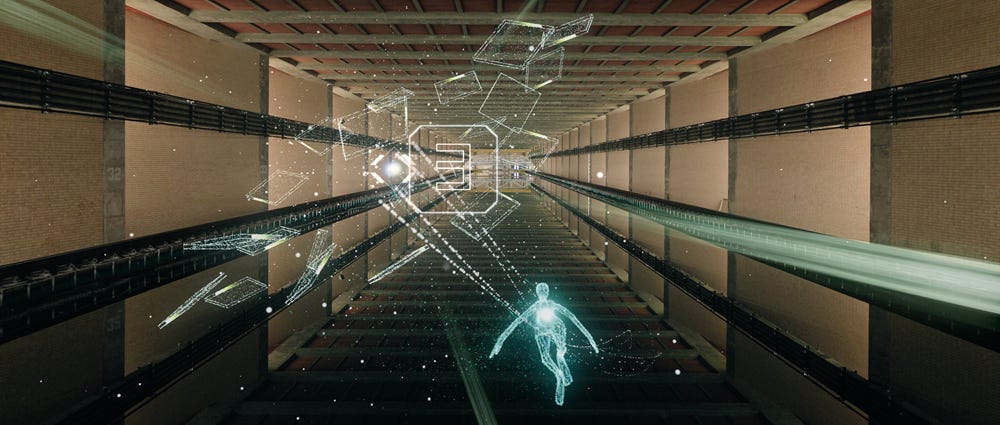
I would consider Agon to be, on a surface level, an ideal example of what ND/NF likes to showcase: a film that’s formally audacious, a feature that makes the “New” in the name associate with being at the forefront of cinema rather than taking on the literal meaning of merely a “New” work. For his directorial debut, Giulio Bertelli comes out swinging hard. Title cards introducing us to the film’s three protagonists, all of them women athletes competing at a fictitious Olympic Games, abruptly cut to the sound of gunshots before a smooth tracking shot at a firing range shows rifle shooter Alex (Sofija Zobina) working on her form. A hard cut takes us to fencer Giovanna (Yile Vianello) training in a gym, with the camera sliding around on the floor as it observes different fencers practicing. Then, a cut to judo fighter Alice (Alice Bellandi, a real-life gold medalist playing a fictitious version of herself) as she trains, until her complaints about knee pain bring us to extreme close-ups of Alice’s knee surgery during the opening credits.
It’s a disorienting introduction from Bertelli, who switches between rigorously composed shots and crude, “imperfect” bits of handheld so rapidly it’s difficult to figure out what, exactly, Agon wants to pull off. As Bertelli’s stylistic tics eventually develop their own rhythm, the conceptual glue tying the three storylines together sets in. Each woman specializes in a combative and/or violent sport, with all their work and dedication boiled down to a brief competition in the grand scheme of things. Bertelli’s interests lie in the intensity of that process, the toll it takes on them, and how technology plays a role in amplifying the extreme highs and lows they go through.
Like I said, big swings, although most of them don’t land. Bertelli’s attempts to weave these stories together thematically end up thwarted by his formal restlessness, bouncing around so much that Agon takes on a modular shape that never quite fits together. The back and forth between observational, documentary-like scenes and deliberately staged ones become more jarring as the film arrives at its fake Olympic event, with Bertelli throwing wrenches into each plotline that could potentially ruin Alex, Giovanna, and Alice’s careers. These contrived moments point to Bertelli as a filmmaker eager to show off his ideas but lacking the skills to transfer that energy into something that satisfyingly coheres (if you want to see something similar that does a better job, I recommend Yuri Ancarani’s films The Challenge and Atlantide, with the former being an ND/NF selection back in 2017).
Agon will stream exclusively on MUBI in North America on April 24th.
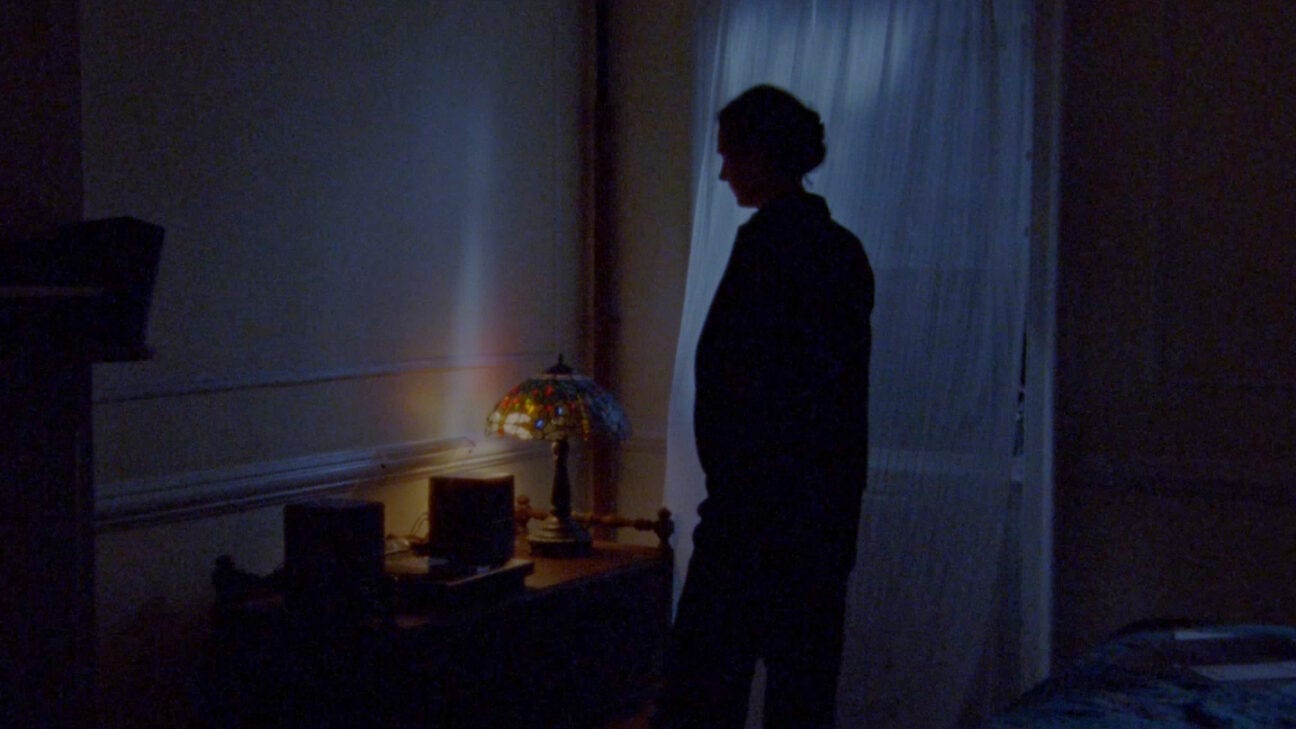
I may not share the same level of fervor as others who hyped up Jack Auen and Kevin Walker’s Chronovisor after its premiere at Rotterdam earlier this year, but the response is understandable. A kind of first person conspiracy thriller, the film is partly the result of a rabbit hole the filmmakers fell into from what they describe as a “passing reference” in a book. Chronovisor tells the story of someone falling down the same rabbit hole by tagging alongside them in the research process, which in turn lures us into the same obsession. It’s a fun experience, a bit of analog horror more invested in the analog part of the term that’ll surely be one of the most assured directorial debuts from this year.
To get the basics of the plot out of the way: philosophy professor Béatrice Courte (Anne-Laure Sellier) spends most of her days in solitude, holed up in libraries poring through literary materials for her research. One night, she comes upon an article about a device called the chronovisor. Built in the 1950s by a Benedictine priest, he claims it can broadcast transmissions of the past and that, using the device, he was able to witness Christ’s crucifixion. That’s all it takes to get Béatrice’s attention, and in no time she starts going through every book, magazine, and article she can find to learn more.
Auen and Walker, working with a low budget, let the majority of their film play out as nothing but Béatrice’s process. Take the familiar montage of a character going through bookshelves and microfiche you’d see in plenty of other films, focus almost entirely on the text of those research materials, stretch it out to about an hour and you’ll get some sense of what Chronovisor is like. And while I’m well aware that my description doesn’t sound like the most appealing way to spend one’s time, Auen, Walker, and cinematographer Leo Zhang ensure the presentation never gets too dry. Shooting on grainy 16mm stock and highlighting relevant passages from texts Béatrice reads (with English translations when needed), the scenes where we read along have a dynamism to them as we watch the wild, conspiratorial backstory of the chronovisor assemble in real time, line by line.
It’s exciting to see Auen and Walker’s confidence in their process, how they trust viewers will be taken by their meticulously researched collection of all things chronovisor (a fact that will echo across all coverage of this film is that the story of the chronovisor and the archival materials are all real). And while the film stays rooted in analog technologies, Chronovisor isn’t too far removed from creepypastas, liminal horror, cosmic horror, and other subgenres that online communities have formed around. Béatrice’s “old school” methods of digging around libraries has its similarities to playing ARGs or reading blocks of text in video games to fill in narrative blanks. While the film has multiple references to experimental filmmakers and literary influences, seeing them remixed and repurposed into this moody, microbudget genre piece is the type of ingenuity we should see more of from new artists (or, if you want a glib summary of the film: intellectual Skinamarink).
Chronovisor was recently acquired for North American distribution by Grasshopper Film with plans for a theatrical release this fall.

I reviewed Sho Miyake’s latest feature back at the Locarno Film Festival last summer, where it took home the Golden Leopard. You can read my thoughts here.
No posts
Comments
Nothing yet. Say the first thing.
Sign in to join the conversation.