
You can still see the environmental impact of World War I today.
In northern France, entire regions remain contaminated by unexploded ordnance and heavy metals—land that, more than a century later, still carries the scars of conflict. These aren’t temporary damages. They are generational.
And yet, when we talk about war, we rarely talk about the environment.
We focus—understandably—on human suffering, political outcomes, and military strategy. But as Doug Weir, Director of the Conflict and Environment Observatory (CEOBS), explains, the environment is often the “silent victim” of war.

The war in Ukraine has changed that—at least partially.
For the first time, a major conflict is being widely documented not just in terms of casualties and territory, but in terms of environmental damage.
A front line stretching hundreds of kilometers has carved through ecosystems and industrial zones
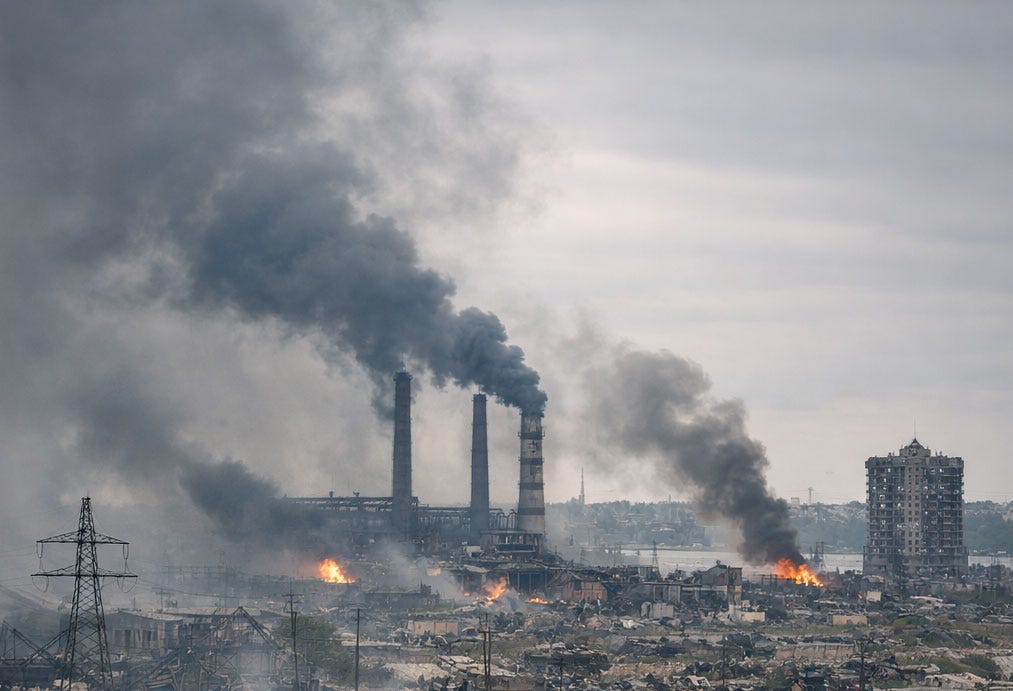
Energy infrastructure has been repeatedly targeted
The destruction of the Kakhovka dam disrupted agriculture, water systems, and communities
The Zaporizhzhia nuclear plant remains under military occupation
What’s different this time is visibility.
Ukraine has a strong environmental civil society, a government willing to highlight environmental damage, and international support documenting it. That combination has brought the environmental cost of war into the spotlight in a way we’ve rarely seen before.
It’s even shaping conversations about the future—what a “sustainable recovery” could look like after war.
In Iran, the environmental impacts of conflict have taken a different but equally alarming form.
When oil storage facilities around Tehran were bombed, the result wasn’t just destruction—it was massive air pollution affecting millions.
Tehran’s geography traps pollutants. When fires from oil depots burned overnight, pollution settled over the city, exposing residents to dangerous air quality levels.
These kinds of impacts are often:
Short-term but intense (toxic air, smoke, fires)
Long-term and hidden (soil contamination, groundwater pollution)
And they’re difficult to measure in real time.
As Weir points out, environmental damage in war is rarely a single event—it’s a cascade of effects that unfold over months, years, or decades.
There’s a deeper, less visible layer to environmental damage in conflict: the collapse of environmental governance.
In places like Iraq and Libya, the damage didn’t stop when the fighting did.
War disrupts:
Environmental monitoring systems
Regulatory enforcement
Funding for conservation and cleanup
Access to affected regions
The result is long-term degradation that compounds over time.
“We haven’t seen a huge amount of success in regime change wars,” Weir notes—“certainly not for the environments of those countries.”
The Persian Gulf is one of the most environmentally vulnerable regions in the world—and conflict makes it worse.
It’s already under pressure from:
Heavy oil traffic
Industrial pollution
Fragile marine ecosystems
Add military conflict, and the risks multiply:
Tanker attacks could trigger massive oil spills
Damaged vessels leak fuel into the sea
Desalination plants become unusable if water is contaminated
And yet, ecosystems persist—coral reefs, seagrass beds, even populations of humpback whales.
For now.
One of the most overlooked aspects of modern warfare is its carbon footprint.
Military emissions are largely exempt from international climate reporting. That means:
Massive fuel consumption goes uncounted
Increased defense spending translates into higher emissions
Climate goals and military policy operate in separate silos
At the same time, governments are redirecting funds from climate and conservation efforts into defense budgets.
The result? We are spending more to prepare for war—and less to prevent environmental collapse.
What if we’ve been thinking about security all wrong?
Instead of focusing primarily on military strength, Weir suggests a broader view:
Energy independence through renewables
Food security through healthy ecosystems
Climate stability as a foundation for peace
Some countries are starting to move in this direction.
Spain, for example, has invested heavily in renewables, helping shield it from energy shocks. Latvia is exploring restoring peatlands as both carbon sinks and natural defenses.
These approaches recognize something fundamental:
Environmental stability is national security.

Efforts are growing to hold countries accountable for environmental damage in war.
Concepts like “ecocide”—treating large-scale environmental destruction as an international crime—are gaining traction. Some countries have already adopted laws.
But in reality, enforcement is complicated:
Powerful nations rarely hold themselves accountable
International systems rely on political will
Post-war settlements often prioritize peace over justice
Still, documenting the damage matters.
Because what gets measured, gets acknowledged.
At the heart of all this is a difficult question:
What are we really protecting when we go to war?
If the cost includes poisoned land, polluted water, destabilized ecosystems, and delayed climate action—then the definition of “security” starts to look very different.
As Weir puts it, we need to rethink where security comes from—because right now, we may be undermining the very systems that sustain us.
If you found this valuable, consider sharing it or subscribing for more deep dives on climate, conflict, and global systems.
Listen or watch this full episode on ACC with Doug Weir: Apple, Spotify, iHeart, & YouTube.

No posts
Comments
Nothing yet. Say the first thing.
Sign in to join the conversation.