
Hey friends,
The last month has been packed with unique builders and monumental achievements. There seems to be a common throughline to all of it, which is that the center of gravity for science-and-engineering-based technology (energy, manufacturing, aerospace, compute, robotics, etc) is moving back to America, and the founders building that future are doing it faster than most people realize.
In this issue we will cover our latest podcast episode, updates across the portfolio, the Reindustrialize conference, thoughts on the SpaceX IPO (as a former SpaceX-er myself), and a new deep tech job board for the engineers in this audience.
As always — if you’re building in deep tech, or you just want to argue with me about any of this, reach out. We’re here to help.
~Brannon
On a personal front: I was honored to be selected for Kauffman Fellows Class 31. It’s a program I’ve admired for a long time, and I’m grateful to be joining such a remarkable community of investors. Thank you to everyone who supported me through the process. A quick note here.

If you’ve been following along, you know Abe and I started The Long Frontier podcast to nerd out with the people and ideas we’re fascinated by while exploring the technologies that will define the next fifty years. This month we released our second episode, and I’ve got to say, it’s a good one.
Episode 2 — Biological Computers, with Dr. Hon Weng Chong: Hon is the founder and CEO of Cortical Labs, and he’s building something that is hard to even wrap your brain around (pun intended): computers that run on living, lab-grown human neurons wired to silicon. The premise that Hon set out to test is you can compute with neurons instead of simulating them. His argument is that biology already solved some of the scaling problems that silicon is still fighting – your brain runs extraordinary computation on roughly 20 watts ,whereas data centers run on megawatts to do similar computations. In this episode we get into why biological systems may be dramatically more sample-efficient than today’s models (they adapt continuously rather than training on massive datasets), how reinforcement learning works in living tissue, why this could matter for robotics and embodied AI, and the hard problems that still remain ahead — memory, reproducibility, scaling, and ethics.
Missed the first one? We opened the series with The Orbital Economy and In-Space Propulsion, featuring Jeff Thornburg — CEO of Portal Space Systems and the former architect of SpaceX’s Raptor engine.
What’s next: Episode 3 goes deep on nuclear fusion. Subscribe on YouTube so you don’t miss the drop.
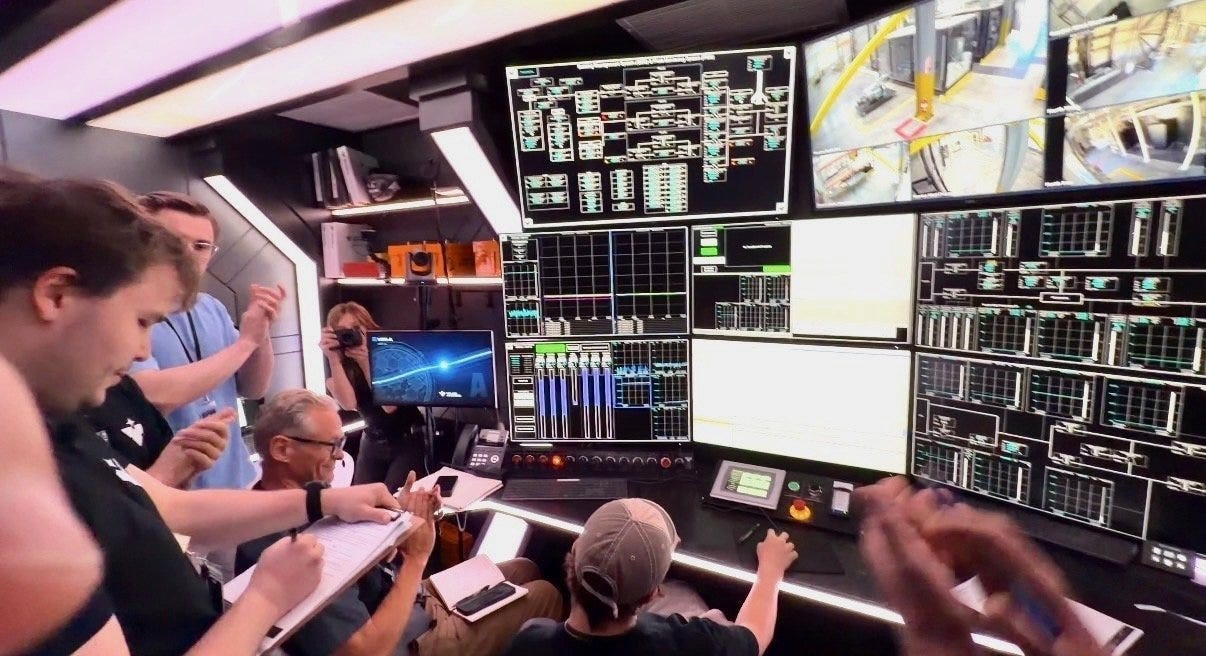
We’ll keep this relatively brief for now (I promise you, there will be much more to announce later) but it was a genuinely historic month, and we’re proud to be investors. Three distinct milestones, days apart:
June 18 — Criticality. Valar brought its Ward 250 reactor to a self-sustaining nuclear chain reaction (zero-power criticality) at Utah’s San Rafael Energy Lab — the second advanced reactor to go critical under Executive Order 14301’s DOE Reactor Pilot Program, and, per the DOE, the first ever to do so that was built outside of a national laboratory.
June 21 — First power. Three days later, the team began power ascension, bringing Ward 250 to 10 kW of thermal output and holding it steady overnight — what founder and CEO Isaiah Taylor called the first nuclear power ever generated by a startup.
June 25 — Full power. As of today, the team has held full power on Ward 250 for over 24 hours! More Isaiah here and from Chief Nuclear Officer Mark Mitchell here digging into the reactor’s safety features, fuel, shielding and more.
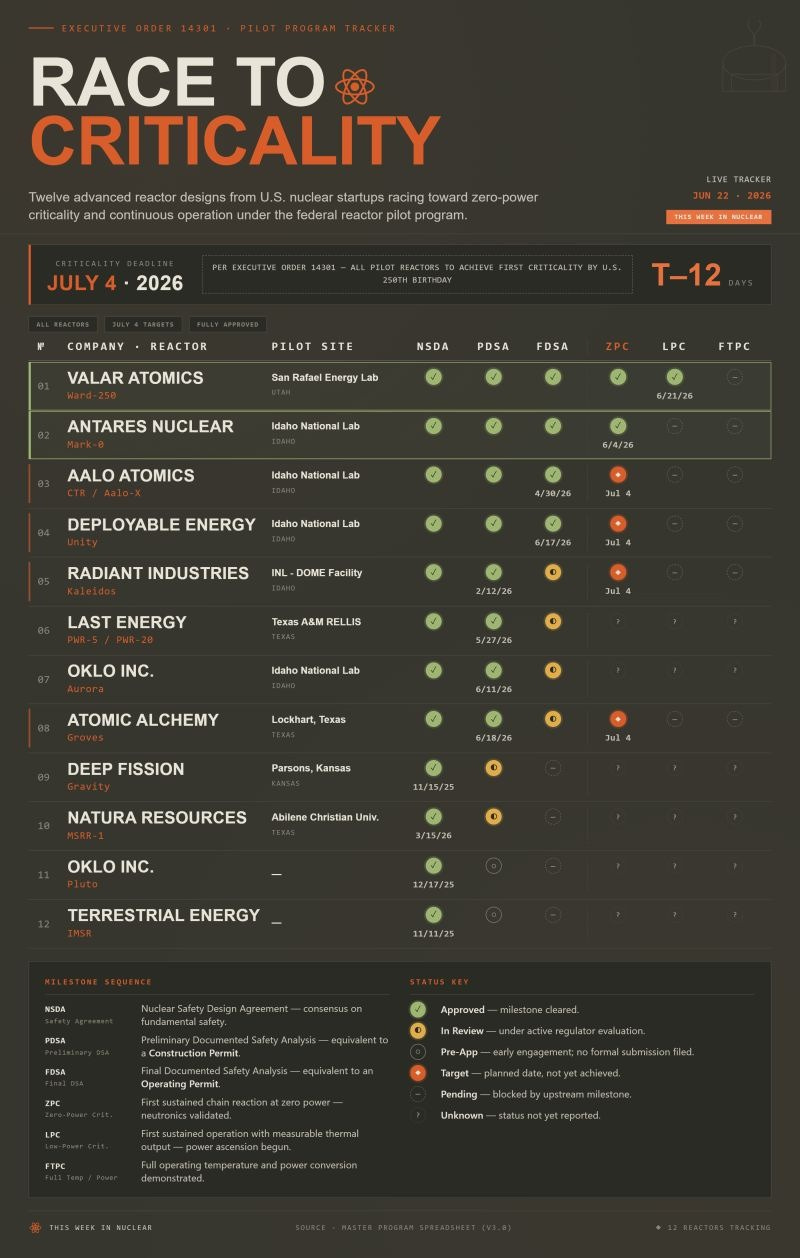
If we zoom out, Valar sits at the front of a competitive field — a dozen U.S. reactor startups racing toward criticality and continuous operation under the same federal pilot, all against a July 4 deadline (chart credits to Dylan Robideaux).
Going from an empty site to a critical, power-producing reactor in roughly nine months is a remarkable thing to watch up close. Read what Isaiah shared publicly on LinkedIn and X.

One of our portfolio companies had a big week. Halo Braid came out of stealth with the world’s first braid-assist device for professional stylists — and a $7M seed round led by Alexis Ohanian’s Seven Seven Six, with AlleyCorp participating. The idea is elegant: a stylist starts each braid by hand, then hands off to the device, which finishes it about 5x faster, matching their style, gently and without pulling. It’s built to assist stylists, not replace them — taking the repetitive strain (carpal tunnel, early arthritis) out of a craft that today consumes an estimated 8 billion hours a year and can mean six-plus hours in the chair per appointment.

Founder and CEO Yinka Ogunbiyi, a Harvard trained mechanical engineer and repeat hardware founder, got here after 600 prototypes — exactly the kind of hard, overlooked, deeply human problem we love to back. It’s also a good reminder that “deep tech” and “advanced manufacturing” show up in a lot more places than rockets and reactors. The device launches in salons later this year. Read more in Allure.
We put money to work in three companies over the last month — one in robotics, one in energy / data centers, and one at the intersection of advanced manufacturing and defense.
All three are hard things with real demand pulling them forward. If you’re a founder, an operator, or an investor who wants to compare notes on any of those three areas, please reach out — happy to talk shop (and make introductions where it’s useful).
More on each soon!
Viam is the fastest way to build a robot. Curious to dive in? Check out their upcoming online course Viam 101 — free, self-paced, and no hardware required. Launching July 2026, you’ll build a real robotics application yourself, entirely in simulation, and leave ready to build your own robot in Viam.
Plus: Save your spot by July 31, and you’ll be entered to win a UFACTORY Lite 6 robotic arm, valued at $3500!
Sign up at: www.viam.com/viam-101/early-access
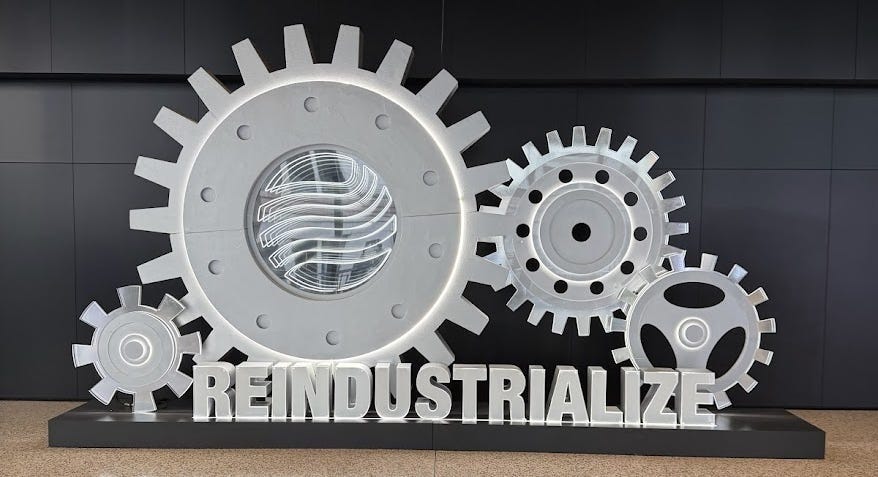
We were proud to sponsor and partner with Reindustrialize this year, and it was the highlight of the month. The summit brought together more than 1,500 founders, operators, investors, and government leaders, and it was bigger and higher-energy than any year prior. I met more startups in two days than I have at almost any event I can remember. A few takeaways:
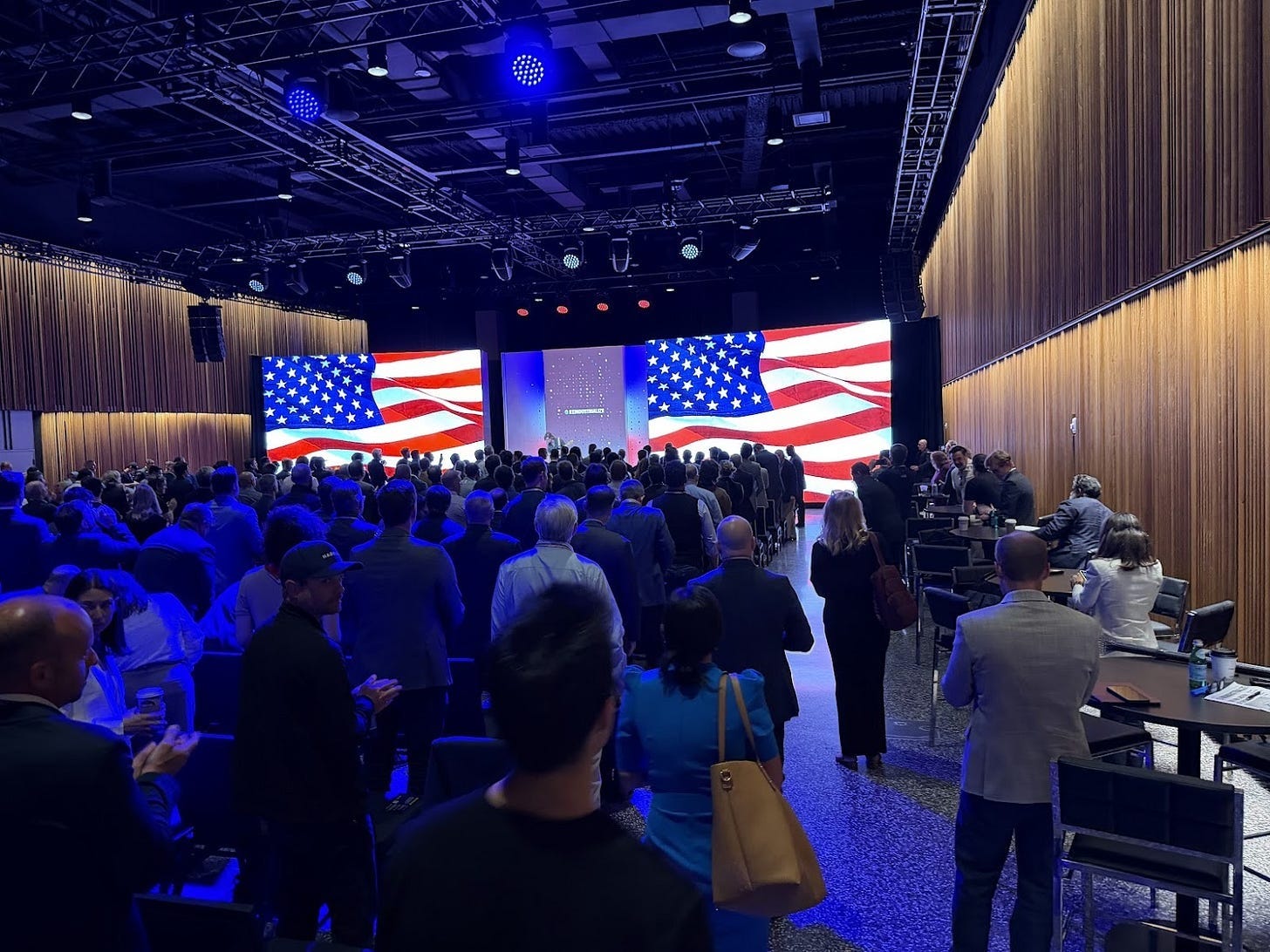
The defense landscape has shifted, fast. Between recent legislation and a national security strategy now explicitly organized around industrial capacity, “building in America” and “securing America” have become the same sentence. That’s a structural tailwind, not a news cycle.
The capital is showing up to match the rhetoric. Organizers noted the largest bank in the country has committed on the order of $1.5 trillion to the reindustrialization effort, OEMs are actively pulling supply chains out of China, and a new generation of American manufacturers is being capitalized to execute. A survey of last year’s attendees found 52% had already deployed robotics and automation and 39% were deploying AI — but 69% said skilled technical roles are their hardest to fill. (Hold that thought — see the job board below.)
The builders are real. The thing you can’t get from a headline is the density of serious, technical founders in one room. That’s what made us more bullish, not less.
Reindustrialize is also a reunion. That’s my AlleyCorp partner Abe Murray in the middle below — yes, in the Hawaiian shirt — wearing the sponsor badge with pride. (And standing next to our good friends Matthew Chang, an OG at factory build outs, and Joshua Shacter, an OG at building and backing incredible companies)
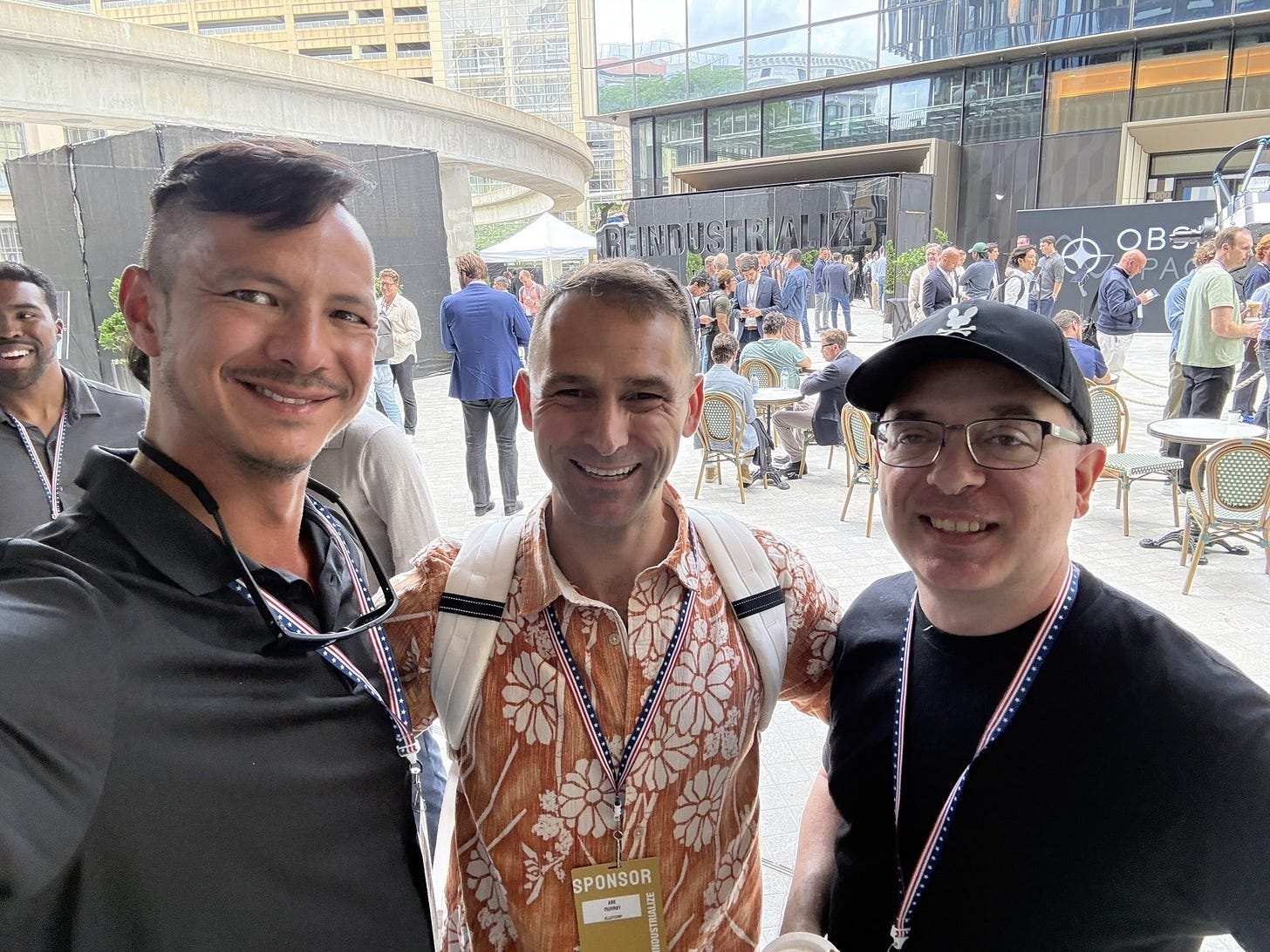
The bottom line for us: we are very long verticalized advanced manufacturing in the U.S. We like companies that own their stack rather than renting it, and at events like this you can feel the ecosystem starting to win.
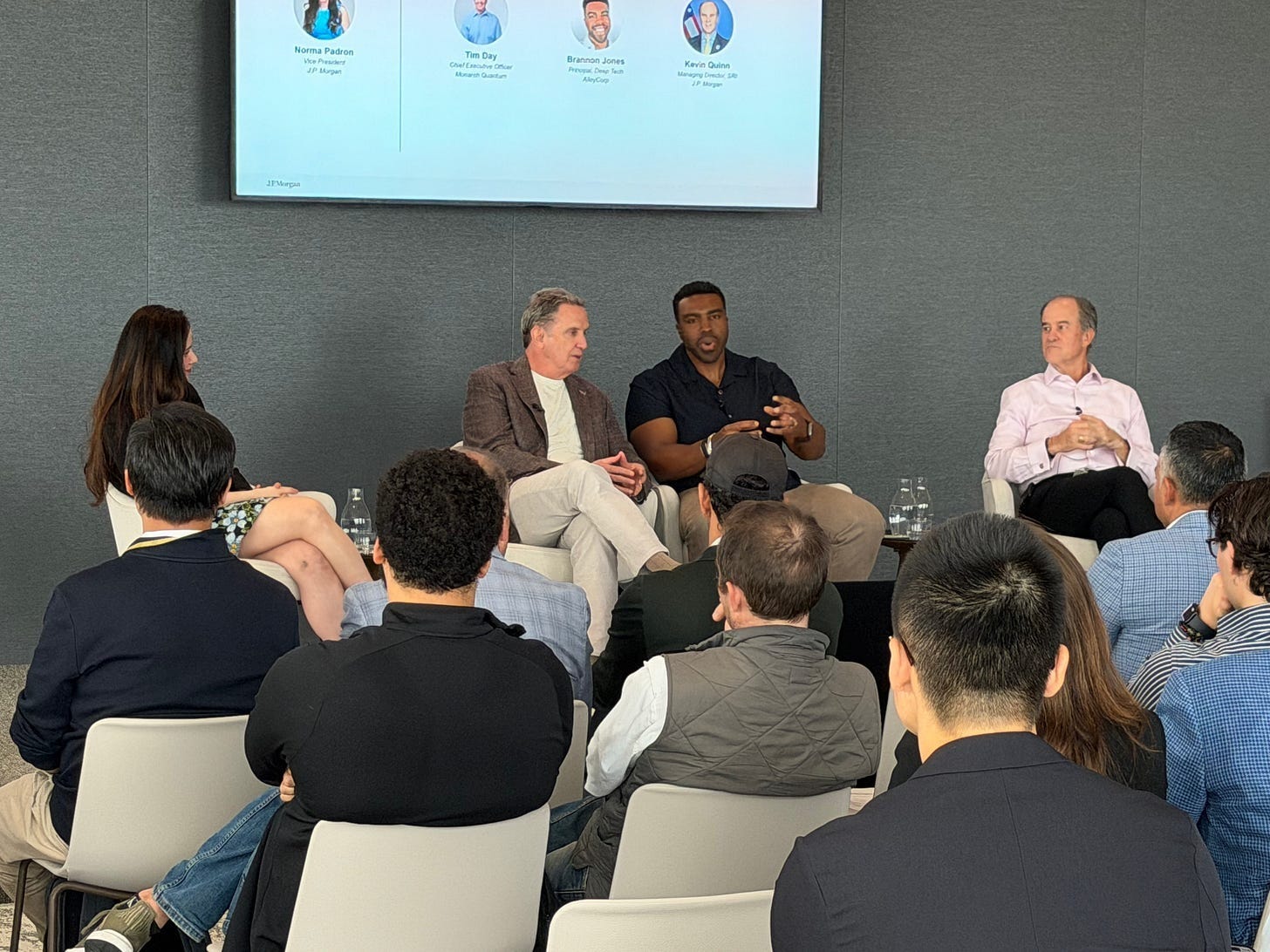
Earlier this month I joined a fireside at J.P. Morgan on the state of quantum computing, alongside Monarch Quantum CEO, Tim Day, and JP Morgan’s head of Frontier & Strategic Technologies, Kevin Quinn.
We discussed where the different qubit modalities actually stand, and how to think about a “picks and shovels” approach to investing in the space rather than betting on a single architecture. Quantum is one of three legs of the future-of-compute stool we are keeping our finger on the pulse of.
A personal reflection on a company that shaped how I think about everything
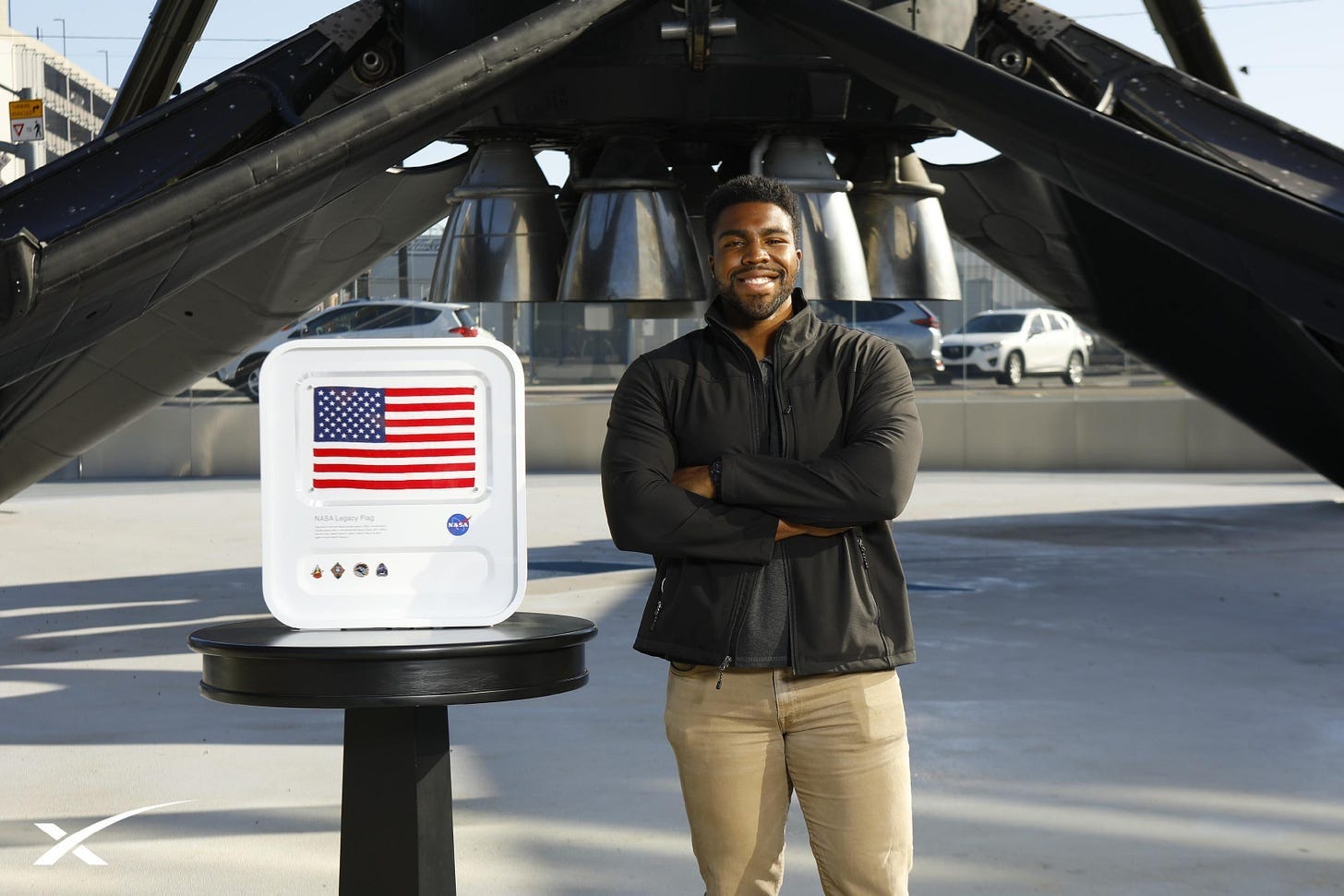
On June 12, SpaceX went public on the Nasdaq under the ticker SPCX. Shares priced at $135, raised roughly $75 billion, popped about 19% on day one to close near $161, and put the company’s market cap above $2 trillion — the largest IPO in history by a wide margin. I’ll be honest: I got a little emotional watching it.
I spent four years at SpaceX as a manufacturing and propulsion engineer, working on Falcon 9 and the Starship Raptor engine and commissioning a robotic factory line. So for me, it’s the culmination of the work of thousands of absurdly talented, absurdly committed engineers, technicians, and operators who decided that “impossible” was just a scheduling problem. I know what the late nights on the test stand felt like. Seeing that work recognized at this scale is a moment worth celebrating, and I’m proud of every person who poured themselves into it.
A few things I believe about what it means:
We’re still long. The valuation debate is real and healthy… the company isn’t profitable, and reasonable analysts disagree about the multiple. But if you zoom out to the timeframe SpaceX actually operates on, the thesis is: reusable launch, Starlink as the cash engine, and now an AI compute ambition that increasingly reaches into orbit, that necessitates developing or acquiring even more AI and advanced engineering capabilities.
It’s the clearest precedent we have for how deep tech manufacturing scales in America. SpaceX didn’t just build rockets; it built the infrastructure and the tolerance for vertical integration, for hardware-rich iteration, for failing fast on the test stand and learning in public. It proved a capital-intensive, physics-bound, manufacturing-heavy company can become one of the most valuable on earth. Every deep tech founder we back is operating in a world where that’s now possible, and where investors have seen it work.
And it’s a factory for founders. One of the most valuable things SpaceX has produced is people. We fully expect a wave of founders to spin out of the “SpaceX mafia” and start the next generation of great hard-tech companies and we’d very much like to meet them. (If that’s you - reach out!)
This is a beginning, not an ending. The most exciting chapters of the off-Earth economy haven’t been written yet. Congratulations to everyone at SpaceX, and to the market that built the conditions for it.
New this month, and partly inspired by that Reindustrialize stat (69% of manufacturers say technical roles are their hardest to fill), we’ve decided to compile a running list of open roles at deep tech companies in and around our portfolio. If a role catches your eye, reach out and we’ll make the introduction. Where a listing is linked, you can apply directly.
Stealth | Los Angeles, CA — Advanced composite materials, robotics, and full-stack manufacturing:
Composites Engineer — 5+ years; composites are your obsession.
Mechanical Engineer — lead automated manufacturing robotic cells: end-effector design, fixturing, and cell layout.
Head of Operations / Manufacturing — own the factory floor and stay calm coordinating a thousand things at once.
Software Engineer — hardware-meets-software; apply simulation models to the physical world (and you’re done with B2B SaaS).
Avatar Robotics | San Francisco, CA — Autonomous robotic labor:
Operations Leader — turn a messy operation into a well-run machine; physical-equipment experience preferred.
ML Robotics Engineer — machine learning + robotics, tackling full autonomy.
Portal Space | Seattle, WA — Space Propulsion:
Business Systems Engineer — own the systems infrastructure behind business operations: SSO/identity, cross-system integrations, and BI/data.
Halo Braid | Cambridge, MA & Bristol, U.K. — Robotics for textured hair:
Senior Robotics Engineer - Cambridge, MA
Senior Robotics Engineer -Bristol, England
Senior Mechanical Engineer - Cambridge, MA
Social Media Associate - Remote
Hiring for a deep tech role and want it featured (named or anonymized) in next month’s issue? Reply and let us know.
The most interesting things we read this month across our theses — fundraises, breakthroughs, and the commercial and policy moves shaping the landscape. Links at the bottom, as always.
Mach Industries — $300M Series C: The defense manufacturer raised at a $1.8B valuation, a ~4x jump in a year, led by Infinite Capital and Ribbit — capital moving fast toward American defense production. TechCrunch
Impulse Space — $500M Series D: The Redondo Beach in-space propulsion and orbital-transfer company crossed $1B in total funding, underscoring how central mobility is becoming to the orbital economy (a theme we hit in Episode 1). Crunchbase
Generalist AI — $400M: The robot-foundation-model company raised at a reported ~$2B valuation to push toward more general real-world robot intelligence — embodied AI continues to attract outsized checks. Crunchbase
Allen Control Systems — $200M Series B: The maker of “Bullfrog,” an autonomous counter-drone robotic gun system, raised to scale manufacturing as counter-UAS demand surges. New Market Pitch
Robots are starting to build — and finish — real parts: Reindustrialize co-founder Aaron Slodov shared video of Unitree humanoids assembling units from their own models (no teleoperation), while Almond Robotics’ “Axol” autonomously deburred a metal part on its production line the way a human operator would. Embodied AI is crossing from demo reel to factory floor — and the case for building it domestically only gets stronger. @aphysicist
Neros ships its first 1,000-drone week: The Torrance, CA manufacturer crossed 1,000+ FPV drones produced in a single week for the first time — up from roughly 800/week just a month earlier. It’s a concrete, week-over-week picture of what reshoring drone production at scale actually looks like. @neros_tech
Antares Nuclear goes critical first: Antares’ Mark-0 microreactor reached criticality at Idaho National Laboratory on June 4 — the first private company to do so under the DOE pilot, and the first novel reactor design to go critical at INL in over 50 years. (Valar, above, followed as the second.) DOE
The U.S. nuclear pilot is delivering: Two advanced reactors critical within two weeks, both racing the July 4 deadline EO 14301 set, is the clearest sign yet that the “metal beats paper” approach to nuclear is producing hardware, not just decks. POWER
Elementl Power picks GE Vernova Hitachi’s BWRX-300: Elementl signed an Early Works Agreement to deploy BWRX-300 SMRs at a planned ~1.5 GW station in southeast Ohio — one of the largest announced SMR developments in the U.S., and a sign the BWRX-300 is becoming a default for utility-scale SMR projects. PR Newswire
Standard Nuclear files to go public (NYSE: STDN): The TRISO-fuel maker filed its S-1 on June 18, disclosing up to $245M in backlog plus a ~$416M pipeline. A fuel fabricator going public before any advanced reactor hits commercial scale says a lot about where the real bottleneck is — fuel, not reactor design. Reuters
SpaceX’s compute deal with Reflection: Reporting pegged a SpaceX computing-power agreement with the open-source AI startup at up to $6.3B — more evidence that launch, satellites, and AI compute are converging onto one balance sheet. CNBC
The grid is the bottleneck: DOE issued a string of emergency 202(c) orders in June to keep generation online amid rising demand — a blunt reminder that the AI buildout is now a power-and-grid story as much as a chips story. DOE
On the SpaceX IPO: Peter Diamandis wrote a thoughtful (and bullish) take on what the listing means for the off-Earth economy. And a reflection from a fellow SpaceXer on IPO day that captured the human side of it.
If you’re not reading it already: Packy McCormick’s Not Boring remains the best wide-aperture writing on technology and markets we know of. Not Boring
Thanks for reading — and as always, if you’re building in deep tech (or “software for hardware”), we want to meet you.
Keep building! 🚀
— Brannon | AlleyCorp Deep Tech
Comments
Nothing yet. Say the first thing.
Sign in to join the conversation.