
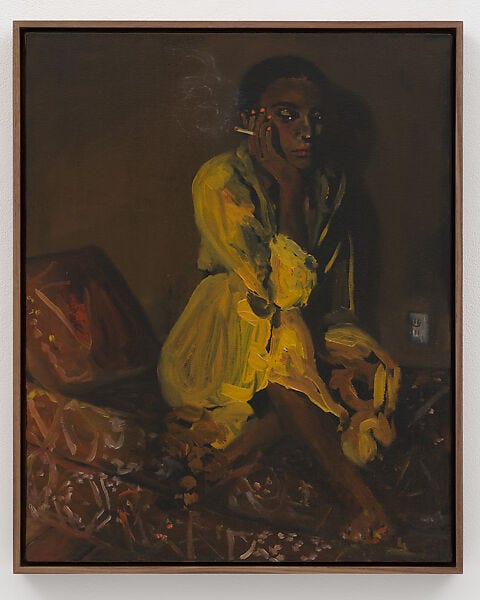
Womanhood is not a thing I can easily define, perhaps because, like most other things in society, it was first constructed by everyone but women in the hopes of defining it for us. A woman is all the things the system of patriarchy expects her to be. She is a daughter, a sister, a wife, a mother, a grandmother, a fossil. She has the map towards the end of her life readily available if need be. Then, somewhere along the way, women decided that if womanhood was simply a constructed identity, we might as well define it in our own ways.
There are many ways to be a woman, some of which still rely on a permeance of patriarchal values. It’s a hard leech to peel off, unfortunately, but some don’t see it as a leech. As with anything oppressive, there will always be a group who, intentionally or unintentionally, mould their oppressive state of living into a falsehood that somewhat resembles freedom. Enter: the world of divine femininity.
There is a long and studied history of the divine feminine. It gets its roots from several parts of the world as a celebration of ancient goddesses1, but the Western understanding of the divine feminine sophisticates2 the message with its own desire to somehow live in equlibrium the patriarchy by directly engaging in it. Much of the messaging of divine femininity content has been debunked to its very unmarrowed bones, so I won’t bore you with my thoughts on it, but know that I do not believe that there is some inherent feminine or masculine energy. Feminine and masculine are social constructs we perform as part of our desire to exist in society. You can be masculine or feminine presenting, but this is not because you are biologically those things. However, the point of this content is to convince you that this is, in fact, an innate part of your womanly nature, the ability to ‘tap into’ your feminine and ‘discard’ your masculine.
As a fat, dark-skinned Black woman who has often considered my womanhood as othered to the experiences I’m told I should have—in dating, in friendships, in self-agency, etc.—, a concept like the divine feminine would appeal to me. It has actually, and I don’t want to take away the reclamation of historically denigrated traits from women who have been masculinised their whole lives. But when building an identity based on the divine feminine, what does that look like for women who do not fit the mould of being traditionally feminine? If the Western proponent skews eerily close to that of Christian nationalist conservative propaganda in a liberal wig, then how could you, Black woman, be divinely feminine?
“The idealised woman becomes property, symbol, and ornament; she is stripped of her essential human qualities. The devalued woman becomes a different kind of object; she is the spittoon in which men release their negative anti-woman feelings.”
― bell hooks, Ain't I a Woman: Black Women and Feminism
A creator [@Bunmisupreme] defined the ways patriarchy has wounded black women and white women. Where white women have existed in the cage of social transaction, often being paraded and conformed into the non-rebellious roles of wife and mother, Black women are treated as bodies to devalue, devoid of personhood and predisposed to a life of “strangling commitment from resistant partners.” The natural consequence of this is that the burdens accompanying each wound are misconstrued by the other side. White women misunderstand Black women’s lack of personhood as freedom or autonomy, a sexual rebellion, because they have no legal or social currency to withhold them. Black women see the social currency of wifedom as stability, a legal promise of care.
These are just the racial implications that come with the label of womanhood, sans class, sexuality, etc., but we’ll focus on race—and a little on sexuality later on—, as that defines the argument that Bunmi states clearly in her video: “historically, black women have been denied the bourgeois wife script.” And the issue here is that you cannot easily curate a “soft life” without somewhat trying to entertain that script.
Given my history of desiring and wanting to be desired, I cannot immediately bash these women. I myself craved reciprocal intimacy, where I’m seen as a whole and not a scrap. But it is difficult to watch Black women feed into the puritanical tradwife grift. Black women who, if these were different times, would have never seen the inside of a house.
I’m gonna tell on myself a little here; I am deeply monogamous. I read a lot of fanfiction, consume a lot of self-insert media, and the ones that I find myself subconsciously scrolling past are the ones where there is no established relationship. I avoid cheating fics, I avoid one-night stand fics ( this is circumstantial), and I gravitate towards stories where the characters are married or happily in love. This doesn’t apply to books that I read, only fanfiction. Note: I compartmentalise these two by what I’m reading as a self-insert and what is a separate, constructed story.
Whenever I set up my little scenarios before going to bed, it is almost always an established relationship between me and my “scene partner”; any deviation ruins the fantasy. I find no thrill in being a one-night stand or situating myself in the angst of cheating. This is my fantasy, after all, and I get to imagine what I desire: a stable, happy relationship.
That being said, being a wife is not aspirational to me. Despite what my fantasies suggest, I don’t desire wifedom. I desire partnership. I desire love, slow-moving, everyday love. I find it irksome when people say, “I want to be somebody’s wife” because the opposite sentiment is never shared. I have never heard a man say he wants to be somebody’s husband, because systemically, there is no profit tied to the latter like there is to the former. Wives act as a function of society; there’s a necessity in becoming a wife, whether as an unpaid labourer or a symbol of the brand-managed heterosexual relationship (i.e. family channels), whereas husbanddom (see? doesn’t even roll off the tongue) is not a pursued role but rather a thing that a man becomes if he wants a wife. Even when it is, much like the “I wanna be a dad”, it is said with much flippancy, as though a child is a new toy you can return.
The weight of heterosexual marriage obviously burdens women more than it does men, but as Bunmi says, “this burden is abstract to Black women.” A bad partner is manageable as long as he’s around. A cheater is manageable as long as he knows where home is, and a ring is always enough to convince a woman that being kept by a horrible man is more bearable than being considered not worth keeping.
These Black women are not trying to be vain; they simply want to be picked. Understandably so, because we have never really existed with the option of being picked. In my experience, I’ve had to abandon the idea of being chosen based on my appearance and focus centrally on my personality, which now makes it difficult to decipher whether a man is flirting with me as a joke or not. For years, it’s made me incapable of envisioning myself as a romantic prospect, despite being a perverted glutton for romance. Said romance lives outside of me, and I am only now coming to realise that I am a being capable of the things I read and watch and fantasise about. Fortunately for me, I’ve been able to cultivate a self outside of romance—mostly for the sake of survival, but the point still stands—and so I don’t allow the desire for it to change me as it once would have. For many Black women, this is not the case. Our positions are devalued from young, reducing us to stereotypes that many of these divine femininity grifters baulk at. To become “wifeable”, you must shun any semblance of the sexual association to rebellious, almost to the point where you begin to mimic the puritanical supremacy of your white counterparts, and thus the reformation begins.
“In an imperialist, racist, patriarchal society that supports and condones oppression, it is not surprising that men and women judge their worth, their personal power, by their ability to oppress others.”
― bell hooks, Ain't I a Woman: Black Women and Feminism
To shed these stereotypes, you must, in some ways, lean into the whiteness of it all, because ‘softness’ as prescribed by the divine femininity gurus is inherently white. She exudes purity, adorns herself modestly, and has a mignon-esque way about her. Much of that delicacy invites whiteness and rejects blackness, which is immediately assigned to aggression, intensity, passion and sex. Even when the goal isn’t this idea of ‘softness’, there is still a subconscious desire for acquiring that other currency. Marriage culture for Black women is still rife even without the rejection of stereotypes. The conversation about cheating comes up every five business days. Relationship debates have smoothed over the collective brain grooves we once had, and there is no shortage of dating advice on how to attract, keep, or get over a man. At every point in which we try to attain agency or power in an increasingly patriarchal society, switching currencies and increasing our value, we are still being spent and traded by men.
The aim then shifts from taking back the role of agent to slotting oneself into whatever position yields the highest rewards. It’s why trends exist and change with such rapid succession. Clean girls become Mob wives, become coquettish girls. Whilst I don’t think these trends exist directly for men, the quickness with which they alternate makes you wonder why women must have so many variations to themselves to be desirable. And need I remind you, it isn’t always men you’re trying to please. The patriarchy is a system, which means it can and is perpetuated by anyone socialised within it. You’ll notice that many of these trends don’t include Black women because, as I said, we already have a market, and it is most obvious with how people like to masculinise Black women as a way to keep them within that constant state of suppression.
The topic of masculinisation gets more and more complex the longer you realise that people subconsciously assign labels where they don’t need to be. I mentioned this in my last essay:
“Even when the goal is to bring awareness to a trope or stereotype, it seems people can’t help but see women as those stereotypes first and foremost. Guilty until proven innocent, I guess. Caught in the crossfire of discourse wars over One Battle After Another was Sinners, Ryan Coogler’s feature about the SmokeStack Twins running a juke joint during the Jim Crow era. Smoke’s ex-wife, Annie, has been used as collateral damage over and over again as an example of a “mammy” caricature, which tells me that some of you don’t know what a caricature is.” - The Overfed Artist.
Micheala Stirling, a character from Bridgerton, is the newest target for this strange phenomenon. With the release of Bridgerton S4, we were introduced to a gender-bent and race-bent version of Michael Stirling, the cousin of John Stirling, who would soon become the love interest for Francesca Bridgerton. It’s important to note two things here:
Francesca is, aesthetically at least, very much the type of woman that fits into the image of a feminine woman in the Victorian era. She’s waifish and demure and the perfect love interest to fulfil the hetero dream of being dominated by the uber-masculine and incredibly abusive cousin of her dead husband.
In the show, Micheala is portrayed to be just as feminine, though more lively and chaotic. At no point does Micheala come across as dominant or arrogant. Instead, she is much like Eloise, who has a strong sense of self and cares very little for the propriety of the ton.
The initial audience response was an unsurprising mix of racism and homophobia from fans of the book and show alike, enraged by the fact that their dainty princess, Francesca, would be corrupted by a Black lesbian. The horror!
However, what’s been more interesting is the recent disdain Black women have been voicing, which has less to do with her Blackness and more to do with her being “masculinised” by the show.
In my opinion, Micheala is never masculinised by the show. If anything, she is constantly hinted at as being the submissive one between her and Francesca. No, the issue these women have expressed is that Micheala should have been with a white man; that her being a Black lesbian, no matter how femme presenting, is an automatic form of masculinisation. Guilty until proven innocent.
This highlights the almost extreme grasp femininity has on Black women because of our history of being discarded for a lack of it. To be loved and cared for by a white man is often considered more desirable than being loved and cared for by a white woman because, by the rules of the divine feminine, there must be balance, and so begs the question: who wears the pants?
I’ve been using heterosexuality as the basis for my arguments because the divine feminine does not consider women who exist outside of heteronormativity. Lesbians, trans women, fat women, Black women, disabled women, women who can’t have kids, women who don’t want kids, promiscuous women, angry women. You cannot separate much of the beliefs they hold from the idea that a woman’s spiritual peak rests in her biological existence as a woman, and thus, anyone outside of the traditional woman is not allowed to consider themselves feminine. I, of course, beg to differ.
The existence of a black lesbian does not immediately masculinise her. If a woman decides to be childless or physically can’t get pregnant, that does not erase her femininity. Fat women do not need to lose weight before they can be loved. Femininity is not a biological assignment women must adhere to, and it sure as hell has no real basis for the way women should live their lives. Without sounding like a choice feminism apologist, the desire to be desired lives in us all. It isn’t dictated by how your biological makeup preordains you. You cannot bend into the shape of a desirable woman. You must be unbendable and willing to be loved in the shape that makes you happiest. Black women will never exist as those in the realm of divine femininity do because they don’t view you as deserving of the wonders they preach. That innate divinity does not extend to you because, by nature, you are not a woman. To conclude, I’m going to quote my own novel, a work in progress, that I think is quite apt for where all of this leaves us:
“You’ll never be like the girls in this town. You’re different. We’re different. We’re not girls or boys. We’re other, mystical things. Formless beings. You and I have no tethers here, and aren’t we so lucky that the world is wide and wild enough to carry us both?”
https://www.researchgate.net/publication/391425664_The_Divine_Feminine_Rediscovering_Women’s_Spiritual_Legacy_in_World_Religions
The verb form related to the noun sophism (a fallacious, deceptive argument) is sophisticate, which means to alter, pervert, or make something less natural, simple, or innocent. It also refers to using clever but dishonest reasoning.
Comments
Nothing yet. Say the first thing.
Sign in to join the conversation.