
Spring has finally arrived in Stockholm (I’m sending this newsletter from my balcony), and the city is coming to life again. This might be the underlying reason for the positive sentiment in this week’s newsletter, including topics such as the positive vibe shift, how to funmaxx your ads, and the new opposition challenging populists.
On the same note: Someone has made the app that everyone has always wanted: one that shares the sunniest outdoor seating spots for grabbing a beer. The best thing? They are not alone because multiple apps compete.
PSA: Maxim is in desperate need of money to survive due to some expensive renovations. Help them if you can and be a part of saving Stockholm’s cultural life.
The most interesting things I've read, seen, thought about, or debated the last two weeks. High and low.
THE POSITIVE VIBE SHIFT. We have been living under the dark vibe shift, but it might be changing soon. Gen Z is slowly starting to use hope as a coping mechanism – and of course, it’s called hopemaxxing. Japanese designer Yuki Torii recently launched a collection called “Towards Future”. I wrote a while ago about how fun is back in fashion, and we have all followed the rise of millennial optimism. Funmaxxing is inspired by Alysa Liu and all about bringing whimsines and joy in, and optimization out. But also about starting to play games and engage in childlike hobbies. In the fashion world, people are sillymaxxing – going for oversized and playful aesthetics. Luxury brands like Hermès and Loewe follow. People are also combating the CBK hype by dressing in a funmaxxing way. Drinking is supposed to be fun – maximalist cocktails are bringing the playfulness back in your martini glass. H&M is collaborating with Bubs in a series of candy-inspired beauty products. WGSN has named 2026 an “unserious year”.

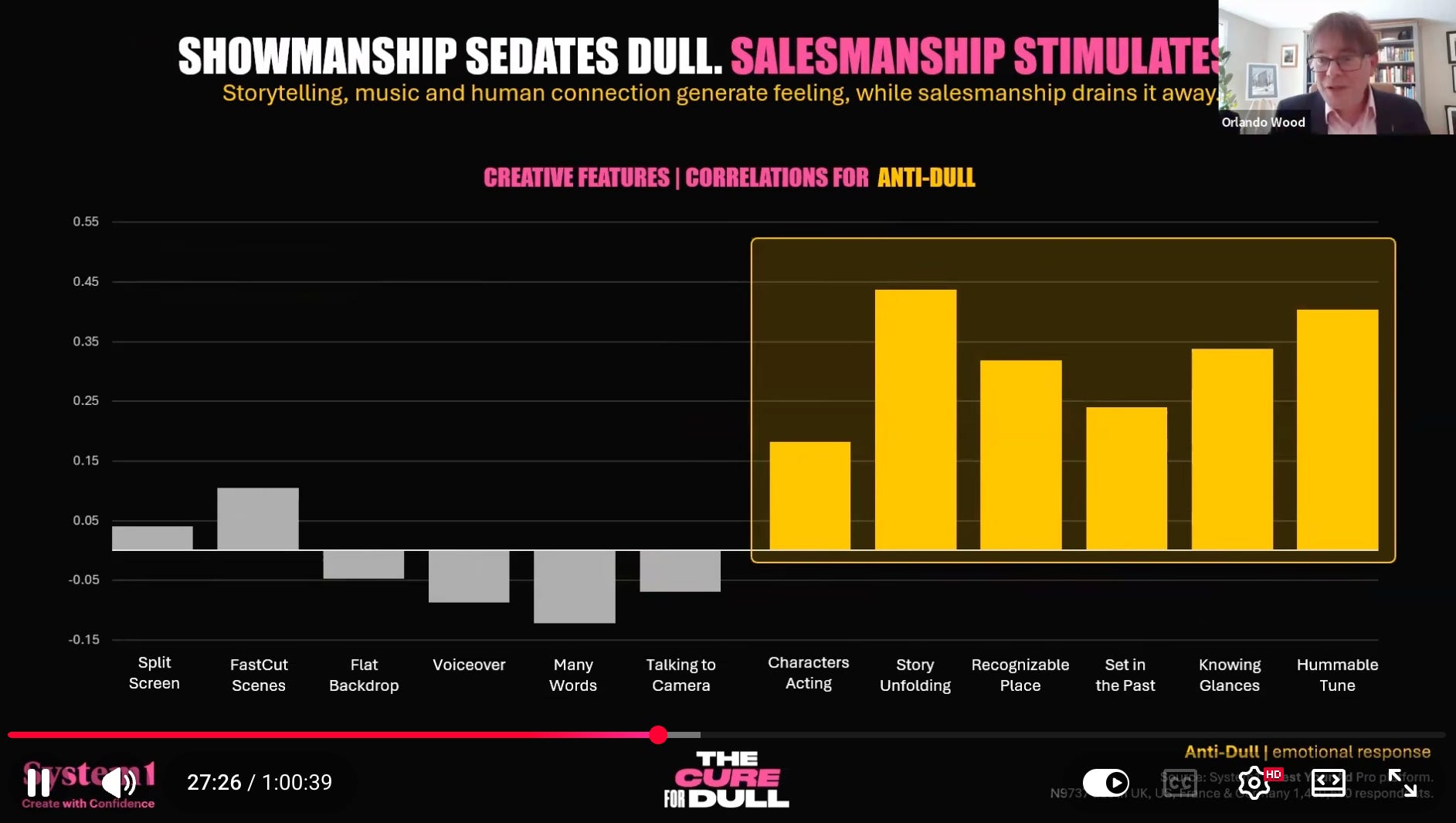
FUNMAXX YOUR ADS. Wanna bring fun to your ads? It might be a good idea, at least according to the old Extraordinary Cost of Dull report by System1 and IPA, among others. Now they are also providing a solution through The Cure For Dull. The report hasn’t been released yet, but a webinar recording has. The conclusion? Non-dull needs more time to resonate with consumers but delivers better business effects. How do you do non-dull ads? You use story, drama, melody, humor, and fluent devices. I.e., do good ads that people like and brand them well. No negative vibes.
QUANT WITH DEPTH. A new HBR article claims that AI finally makes it possible to get qualitative insights at a quantitative scale since AI moderators make it possible to do more interviews and do them faster. It’s about combining qualitative depth with quantitative breadth to get “the why behind” in your quant (earlier limited to qual), and capture emotional responses that ticking a box in a survey typically can't. According to the article, it’s not about replacing human researchers, but complementing them. I see this the other way around: it is better to think of this not as elevated quals but as a quant method that can capture dimensions and responses traditional surveys can’t. Maybe we should call it quant with depth? Does this sound boring to you? Someone used an AI voice agent to collect the Guinness prices on 1000+ pubs in the UK.
THE NEW OPPOSITION. Right-wing populists have dominated the political discourse and landscape for the last fifteen years. And still do in many countries, such as the UK, where Nigel Farage is leading the polls. However, there might be a new opposition. Gavin Newsom is leveraging MAGA tactics to go against Donald Trump. Now the opposition is appropriating something even closer to Trump – wrestling (Trump is a WWE Hall of Famer). Brody King is an American wrestler going against the ICE, and wrestling crowds are now chanting “f**k ICE”. In Hungary, the liberal-conservative opposition leader Péter Magyar is the first to really challenge the sitting prime minister, Viktor Orbán, in ≈15 years. This Sunday, he won a supermajority, capturing over two-thirds of the parliamentary seats. In Italy, Genoa Mayor (plus former Olympic Hammer Thrower and EDM-festival goer) Silvia Salis is a progressive candidate who unseated a Giorgia Meloni-affiliated candidate in Genoa and is now trying to unseat Mrs. Meloni nationally. But this is still just an embryo. Even though a new opposition has formed, and the term woke 2.0 has surfaced, woke is not yet back.
CHIEF EXECUTIVE A**HOLES. The work zeitgeist right now is all tough work and no fun play. Emma Grede recently went viral for bragging about only spending 3 hours per week with her four children. But beyond putting heavy pressure on their employees, some execs also seem to be slightly out of touch with normal people’s lives. Perplexity CEO Aravind Srinivas claims, “AI layoffs are not bad, because people hate their jobs” and Suno CEO Mikey Shulman claims “It’s not really enjoyable to make music now,” because, “It takes a lot of time, a lot of practice, you need to get really good at an instrument or really good at a piece of production software.” Vulnerability advocate Brene Brown might have found the explanation. Most leaders are this way, and now the zeitgeist has given them permission to also behave this way in public. “From the C-suite down to a manager at a local retail shop [are leaders who feel] a sense of relief and permission from the current political climate to be the a**holes that they are and have always been.” Since I am engaged to a CEO and founder, I know from firsthand experience that this is not true for all business leaders.
BRANDED ENTERTAINMENT ELEVATED. Branding as entertainment is a thing right now, and consumers clearly want it (57% of social media users want brands to post original content series). Liquid Death has taken it the furthest by being “An entertainment company that monetizes via beverage”. Other brands also deliver entertainment. A24 is crushing the comms game right now, especially with the campaign for The Drama. Part of it is a YouTube show where the cast gives advice to anonymous callers. Pinterest is launching a six-episode series, Bring My Pinterest To Life, in which they turn Pinterest users’ boards into real-life transformations, which they then showcase on Pinterest. Does this inspire you to step up your entertainment game? Tracksuit and Small World’s new report, Entertain or Die 3.0, is fresh off the press. I’m yet to dig deep into it, but beyond loads of tips on how to make your brand more entertaining and how to measure it, it leaves two clear conclusions. Being an entertaining brand is crucial from a commercial standpoint. And most profoundly, Entertainment is not something you just sprinkle on top of your serious work. It is the work.
ATTENTION PLEASE. Dentsu has released a new report that go beyond impressions and cheap clicks on online video. Instead, they study the long-term effects and reclaim brand building by linking attention to both brand equity and sales. Their conclusions? Digital video (including short-form content) drives brand-building effects. Connected TV is on par with linear TV in brand-building effects. Non-skippable is more effective than skippable if the viewer stays for more than two seconds. More than 20 seconds of attention really doesn’t give anything back. Karen Nelson-Field has appeared on the Behavioral Science for Brands podcast, discussing how attention works and how it differs from reach and impressions. An ad can be on screen for four seconds, but consumers only view it for half a second. Hence, the focus should be on stepping away from CPM and investing in fewer high-attention placements, front-loading the branding. The main conclusion, once again, is: make good ads that people like and brand them well.
SILICON VALLEY’S ANTI-INTELLECTUALISM. Since Marc Andreessen claimed that he “doesn’t do introspection” because “great men of history didn’t sit around doing this stuff,” there has been a lot of writing about the anti-intellectualism of Silicon Valley. Examples beyond Andreessen include Peter Thiel inspiring people to skip college, and Palantir CEO Alex Karp believing AI will hurt educated women the most. However, some people stress that some of their inspirations (Sun Tzu, Marcus Aurelius) were kinda into introspection. Recently, Roblox’s Peter Yang encouraged people to skip college and start a company instead.
ARTIFICIAL ICKS. I reported on anti-AI signaling in the last newsletter, looking into how “AI produced” is perceived as non-premium. This is kind of the follow-up, because it’s not just about brand relationships. In the dating world, using AI is considered the world’s biggest ick. Ezra Klein is hiring a new assistant. The brief: “AI cover letters are strongly discouraged.” It might be because of an academic study from last year that found AI use in the workplace led others to judge your competence and motivations negatively. There might be a reason why people think AI is an ick: it’s trained on cringe millennial online discourse. Do you want to stop eliciting the ick among others? Check out Vogue’s Anti AI Slop Handbook. Some execs might have read it. According to Gartner, over half of the companies that shifted their customer service workers to AI will go back to humans. Brands are now adding “no AI” disclaimers to stand out against AI slop.
PHONE FREE VIBES. A London restaurateur went viral earlier this year for threatening to ban “camera-wielding influencers” after his establishment, The Park, was overrun by them. In the U.S., phone-free bars and restaurants are on the rise. Even Chick-fil-A is offering free ice cream for phone-free customers. Phone-free bars were also an emerging trend in Bacardi’s 2026 cocktail trend report. In Ibiza, the new, phone-free club, Nocturne, is opening with a focus on ”sound, connection and being fully present”. At the legendary golf tournament, U.S. Masters, which ran last weekend, recording devices such as smartphones are prohibited, and they are taking it seriously: former major champ Mark Calcavecchia got kicked out for using one.
Things I've been reading, watching, and listening to. Some connect to bigger ideas. Some are just nice reading on their own.
AI is doing to photography what photography did to art.
Anna Wintour and Meryl Streep are on the latest Vogue cover together.
Interview with Elon Musk’s model daughter Vivian Wilson.
Thomas Bangalter’s DJ set at Fred Again’s residency is now on Apple Music.
Nick Wooster interviewed on Throwing Fits, covering topics such as CDG (the airport and the brand), the CBK/JFK Jr. hype, and working at CK in the 90s.
The new generation of packaging design is awesome.
If you’re soon heading to Berlin, the Boros Bunker is opening again with a new presentation.
Gstaad Guy interviewed Björn Franzén on his podcast.
30u30.fyi tracks all fraud committed by those who made the Forbes 30 Under 30 list.
Intel for Stockholm-based marketers. Jobs, new spots, and occasional gossip.
IW Agency is launching a book about designs strategic role in AI-driven products.
New spots: Myllimäki and Pi Le at Mälarterassen (Nya Slussen). The Tjoget gang at Söderhallarna. Francis Francis is back on Götgatan selling soft serves, and now also Japanese sandos.
Stockholm Art Week starts next week. Here is your map.
Jobs: Head of Marketing at Hemglass. Production Manager at Wendelfalck. Head of Innovation at SBAB. Marketing Coordinator at HOPE. Senior Strategic Advisor at JMWGolin. Production Manager Global Marketing at H&M.
xoxo don’t forget to share with your colleagues, clients, agencies, external stakeholders, and offices nemeses.
Comments
Nothing yet. Say the first thing.
Sign in to join the conversation.