
I started this week by giving a short morning speech on my favorite topic, “the dark side of consumer insights,” to the wonderful people at Narva Communications. It was really exciting to speak to people who work with communications, but predominantly not in marketing.
This issue is practically a media planner’s dream. Local news, YouTube vs. TV, a new Les Binet study on big budgets, microdramas, the rethinking of print, and whether AI influencers actually work. Consider this your fall strategy update.
The most interesting things I’ve read, seen, thought about, or debated the last two weeks. High and low.THE NEW LOCAL NEWS. Feed Me – a newsletter famous for reporting on incredibly local matters – reports (ironically in its Hamptons Edition) on the rise of local news (specifically in said Hamptons), including The Hamptons Chronicle – a newsletter recently launched by a former WSJ journalist. Earlier this year, the same newsletter covered the newly funded Los Angeles-centric media company L.A. Material. The New Yorker reports on the rise of neighborhood newsletters covering Brooklyn’s Boerum Bulletin, and L.A.’s Eastside Rag. Apparently, reach is low, but engagement is high – according to Beehiiv, the click-through rate is 2.5 times higher than regular newsletters. The local news renaissance is not limited to newsletters. Local newspapers are struggling but are being replaced by non-profits. This made me think that it would be very smart to launch a high-quality, English-language Stockholm newsletter right now.
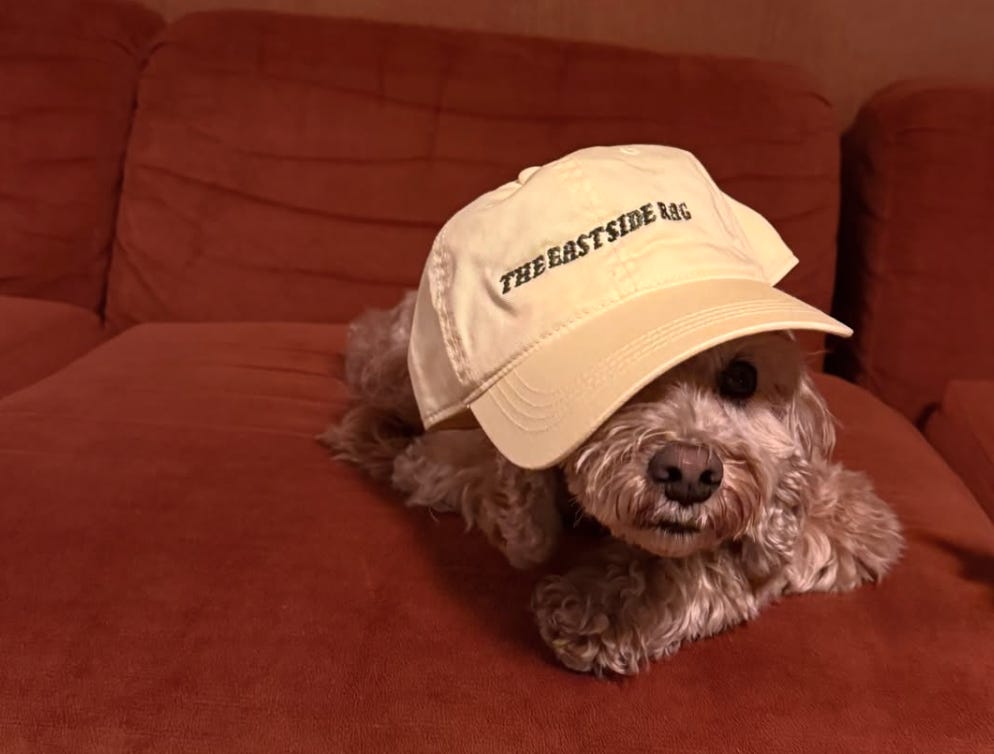
(A picture of a very cute dog, wearing a hat from L.A. newsletter The Eastside Rag, stolen from @eastside_rag.)
ANGRY INSIGHTS. Last week, Øutlier and Uncommon Creative Studio Stockholm launched their Anger Issues research project at the Uncommon housewarming party. I was late to the party and missed the research, but I have read up on it, and it’s incredibly exciting. According to them, people are fed up with the optimism. 1 in 4 Europeans is angry, and 7 in 10 claim people seem angrier than they used to. Brands could solve this, but are doing the opposite, ≈ 1 in 3 respondents has experienced a bad brand or product recently, and ≈60% feel brands and businesses are exploiting normal people more than before. Excited about the subject? They’ve started a Substack that will continue to cover the topic. I got excited about the research and texted Maximillian Weigl, CSO and co-founder at Uncommon Creative Studio Stockholm, a few questions.
1. Why is it important to get a better understanding of anger today?
In a performatively optimistic marketing world people often don’t see their reality represented, where anger and frustration are very real. Knowing what drives people mad isn’t a downer but a huge opportunity for brands to develop valuable ideas.2. What was the most exciting or unexpected finding?
I didn’t expect Swedish respondents to feel more angry than the French, Germans, or Brits. And I was surprised that older people are more frustrated about the future than young people.3. As a brand, how shall you think or act differently to benefit from tapping into anger issues?
Anger marks a white space. Don’t shy away from people’s frustrations, listen to them and figure out how you can offer people a credible way to act on their anger: a new feature, a new product, a new initiative. Or just a shift in how you communicate with them.4. You started a Substack for the project. What are the next steps, and what are we going to find there in the future?
The plan is to turn this into an ongoing exploration of the things that drive Europeans mad. First up will be more deep dives into the data we collected in the first wave of online interviews, compare the markets, age groups, and so on. And we’re planning a few more interesting conversations with experts that we’ll be sharing there, too.
BIG REACH ENERGY. Les Binet is back with a new report called Go Big or Go Home. The 411? Go big or go home. Even though we love the story of creative ideas that outsmart small media budgets, it’s risky since small thinking can lead to small returns. Budget is as important as creative quality, and hence, big ideas must also be supported by big media.
SMUT PEDDLERS. Spotted: the entertainment industry doubling down on smut following the romance book hype. Hulu recently inked the first deal with romance publisher 831 to create a series based on Alexandra Romanoff’s books. Off-Campus is a new and widely popular TV series at the intersection of ice hockey and horniness (just like Heated Rivalry). The Heated Rivalry actors are (together with Andrew Scott of Fleabag and Jamie Campbell Bower of Stranger Things) lending out their voices to audio erotica app Quinn. Rivals – a TV series based on a novel by “bonkbuster” romance writer Jilly Cooper – is Disney+’s most-watched series outside the US, and has gotten major buzz in advance of its upcoming second season. Allie Rowbottom, famous for covering lowbrow feminine culture such as porn, plastic surgery, and influencers, has centered her latest novel, Lovers XXX, around the San Fernando 1980s porn boom. Across the globe, smutty book clubs are opening up. Even the cool kids are down with smut. A24 is launching the book In The Mood? covering 100 erotic movies.
MICRODRAMA MANIA. Microdramas have been surging for a few years, and brand marketers have therefore turned it from an experiment into an integral part of the marketing mix. This is a bigger shift than one might think. Since production costs for microdramas are dramatically lower than regular entertainment, brands are funding their own shows rather than advertising around existing shows. Some examples are Marc Jacobs’ The Scene, InStyle’s The Intern and follow-up The Boss (featuring Julia Fox!), and soap opera originators P&G’s Golden Pear Affair, which includes their Native personal care line. But the microdrama ecosystem might be challenged. In China, the microdramas’ native home country, actors are being replaced with AI.
RETHINKING PRINT. Print has made a slow comeback over the years, but it has also changed. Print now has a slower pace, fewer issues, and tighter editing. This makes it still lucrative for luxury brands to advertise in the new generation of print magazines. Le Figaro Editor in Chief Alexis Brezet (yes, he is biased) presents print as something of a stronger influence and compares it to haute couture, arguing that when Emmanuel Macron or Bernard Arnault want to say something, they do so on the cover of a print magazine or newspaper. This might be the reason for a comeback wave of legacy print magazines, including Vibe, The Onion, and The Face (again!). For brands, this shifts print from a broad-reach media to one with what media planners call “higher affinity,” i.e., people actually engage with it deeply.
NICHE LLMS. The logic of markets is usually that when a group of undifferentiated first movers solidifies their positions, differentiated challengers appear. This now happens to LLMs. Earlier this year, Knut och Alice Wallenbergs Stiftelse announced it was developing a large-scale Swedish language model. India has unveiled three sovereign AI models. YouTuber PewDiePie is launching his own Open-Source LLM called Odyssey. But there are even more niche ones – Ephrem is a Catholic LLM set to launch in 2027.
OLD WORLD LIVING. Yes, we heard that Gen Z is all about nostalgia. But are they actually trying to cosplay the old world? Monocle reports on a part of Spain filled with old-world hotels and free from modern design hotels. Phone calls are apparently back – due to their ability to both be great for mental health (getting off the screen) and privacy (no texts to screengrab). Melbourne brand Milkbar is marketing like it’s the 1950s — launching its first suit not with an Instagram campaign, but with a full broadsheet newspaper delivered across the city’s cafés. Pizza Hut is also going old school. A franchisee in Kansas has turned 38 of its 93 locations into the chain’s old 80s and 90s dine-in format. Wanna go all in during your Italy vacation this summer? A bar in Torino is furnished like a 60s office.
MAJOR TUBE. YouTube has for a long time been the biggest streaming player, but during this year’s annual upfront week, their CEO Neal Mohan proudly declared “welcome to the YouTube era” claiming they are now TV. His narrative focused on how the regular entertainment industry played it safe through focus groups and formulas turned into calculated bets, while YouTube just built a stage where anyone with a story could find an audience. This has made YouTube the main stage for many leading creators. One of them is Trevor Noah, who joined Neal on stage. Kareem Rahma of Subway Takes decided to launch his new show, Run The Meter, on YouTube instead of CNN, where it got stuck in a seven-month development without a final destination. YouTube creator Julian Shapiro-Barnum was in discussions with the major networks about adapting his Recess Therapy show into TV. It hit a dead end, and he turned back to YouTube. His latest show, Celebrity Substitute, now has 500 million views on the streaming platform. Celebs like Ziwe, Mark Wahlberg, and Phil Rosenthal are also releasing shows on the streaming platform.YouTube is attacking regular TV from other angles as well. From 2029, it will stream the Academy Awards.
GATEKEEPING’S RETURN. Gatekeeping has been an ugly word for a long time (this newsletter has, for instance, claimed to be free of gatekeeping), but it might be back. The very outspoken media personality Chris Black went on a podcast last year, talking about how gatekeeping is cool and we need to respect people with more knowledge than us. Research consultants (?) Matter claims gatekeeping is the natural antidote to algorithmic overexposure. Emily Oberg is asking for the return of exclusivity, since it creates desire, and desire motivates us to push harder and become better. This might be why members’ clubs are on the rise, and everything is now a members’ club. Stockholm band Civil Polis refused to share their last year’s album En Man Utan Referenser on Spotify. The Finsta (a closed secondary Instagram account) is making a comeback for everyone, from celebs to brands – everyone from Balenciaga to Addison Rae is in. Charli XCX took it to the furthest extent and made some songs from her new album only available on vinyl and her finsta @b.sides, which is limited to “only” 360k followers.
THE NEW LOW PRICE. Luxurification, premiumization, and inflation have joined forces to raise prices across everything from slop bowl lunches to cars for many years now. This might be changing because consumers want something else. The luxury industry has lost 50 million customers, mostly due to price hikes. One category that has seen an insane price hike is cocktails, but a new wave of bars are instead lowering the prices. In France, bouillons – a type of 19th-century workers’ canteen – are surging by being an antidote to expensive eateries. It’s working well, and 253 bouillons have opened in the last four years. Gen Z is swapping their Birkins for much “cheaper” bags from Coach. Zero Art Fair is an art fair where the price of every artwork is a stunning zero dollars, euros, yen, or whatever currency you pay with. It might be a good idea to revisit those low-price line extension plans before you go on vacation.
DISTINCTIVE BRAND STRATEGIES. A new article by Byron Sharp et al. adds new depth to the conversation about Distinctive Brand Assets©®™. According to the study, shapes such as logos (not wordmarks), product shapes, and similar are the most effective DBAs. The second most effective are stories. What makes the study interesting is that shapes work best in categories with tangible products (such as CPGs), but stories become incredibly more effective for companies with slightly more abstract products, like service companies. Too long to read? Marketing Architects has a nine-minute podcast episode covering the study.
ARTIFICIAL IN OR UNFLUENCE. A new article in Journal of Advertising Research explores the effects of AI influencers vs human influencers. Human influencers outperform their AI peers overall, especially in terms of emotional connection and storytelling. However, AI influencers perform relatively better at conveying rational messages, since they are perceived as less human and more objective. But AI influencers can also deliver emotional effects: the more “real human” they appear, the better, primarily because they feel more real and authentic.
LUXURY SPORTS. The luxury-drooling folks at Condé Nast have discovered sports: Vanity Fair just launched its inaugural Global Sports Issue. Some of the articles cover the luxuryfication of sports. The issue explores the topic of luxury sports travel, including everything from visiting the pitch during the FIFA World Cup, mingling with NFL leaders, and adding a breakfast at Tiffany’s on top. Another article claims that owning a sports team is the ultimate status symbol. The Mark Hotel offers a $1M package for the final. It includes private helicopter transfers, “coveted” premium seating, and a private cocktail lounge with caviar from Caviar Kaspa. Luxury brands are also hitting the sports world. Gucci just became the title sponsor for F1 team Alpine and started their Gucci Racing division. Watch brands are swarming around sports leagues and athletes with sponsorship contracts. Are visiting sports events not for you, and instead you wanna hit the gym? Dior just launched a wellness collection, including a $980 pilates mat.
Things I’ve been reading, watching, and listening to. Some connect to bigger ideas. Some are just nice reading on their own.
Why so many brands are releasing music videos.
Dua Lipa is not down with gatekeeping. She has launched 12 maps in collaboration with Google Maps to help you figure out where to go this summer.
Mark Ritson on why the fundamentals still win.
Uncensored CMO: Rory Sutherland and Tom Goodwin fix marketing part one and part two.
Intel for Stockholm-based marketers. Jobs, new spots, and occasional gossip.
Monocle Radio is broadcasting live from Almedalen this year.
Spots: Adam and Albin’s new restaurant looks stunning (and they retained their Michelin star). Someone (AMF fastigheter) is trying to make Marievik a cultural hotspot, and Way Gallery is joining in. Kustom (fka Klarna checkout) now has a physical concept store.
Jobs: COO at Klingit. Digital Project Lead at Barkas. PR Specialist at A World Beneath.
Arkdes has launched an architectural map of Sweden. First class intel for your summer itinerary.
Xoxo, see you in two weeks.
Did you like this newsletter? Share it with your friend, your boss, or your nemesis.
Comments
Nothing yet. Say the first thing.
Sign in to join the conversation.