
We are finally heading for the holidays.
Accidental Insights is going with the flow and will be on a three-week hiatus. The newsletter will be back in your inbox on January 8.
This December is the darkest month in Stockholm since 1934, and we’ve received only 0.5 hours of sunlight all month. However, the economy might be shining brighter. The purchasing index for the service sector in Sweden is up and at its highest level since June 2022. Toast to all consultants.
INSIGHT DOWNLOAD
The most interesting things I’ve read, seen, thought about, or debated the last two weeks. High and low.
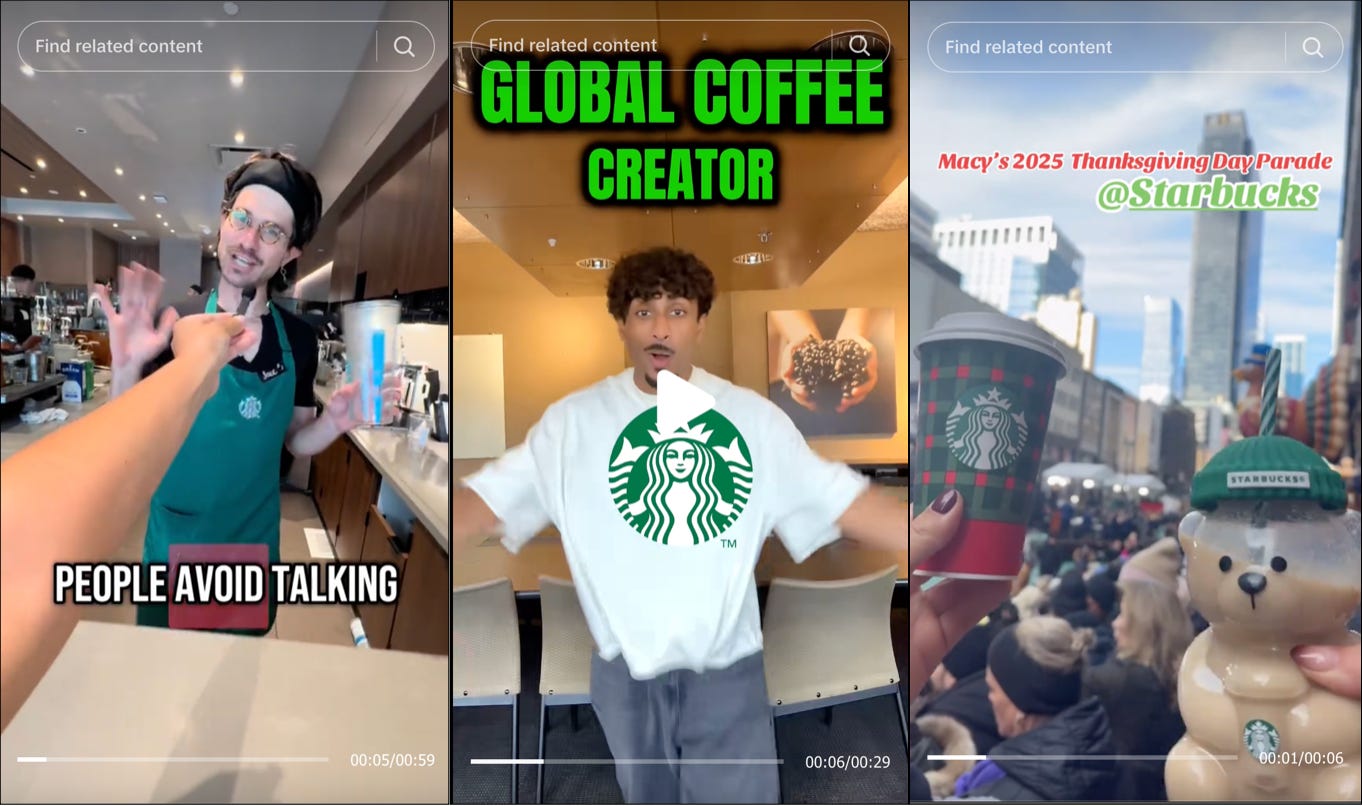
IN-HOUSE INFLUENCE. The demand for company storytellers is surging since brands have become their own publishers. But some brands are taking it to the next level, turning employees into media channels. Both WSJ and NYT report that companies like Starbucks, Delta, and DHL, instead of paying external influencers and content creators, use their employees to create online content. Employees as influencers hit the intersection of trustworthiness and financial efficiency like no other, but can be hard to control. This is probably why employers handpick specific employees and put them into programs like Starbucks’ 54-barista-strong Green Apron Creators Initiative. All employees becoming content creators on behalf of your job: don’t forget to negotiate a salary increase.
TASTE WARS. Spotted: cultural critics beefing over taste. Taste is back as the ultimate flex. Everyone from Ezra Klein to Marc Andreessen is cherishing taste right now. I wrote about “taste to die for” in an earlier newsletter. This has led to a taste beef among Swedish journalists whether Rosalia is a genius or just a radio pop star (TLDR: the girls believe she’s a genius, the boys think she’s not, and instead promote indie rock from Philly). The godfathers of Swedish pop critique have their beef, too. Andres Lokko’s column on “This Ain’t Rock’n’Roll” (a book exploring nazi’s influence on rock music) triggered Fredrik Strage to write a Facebook post claiming that this was the worst thing written about synth pop since the 70s and posted a picture of himself at the stroke unit at Karolina Hospital (as a consequence of his reaction). Lokko is yet to respond. Now you can also argue with your weird uncle all Christmas day about who’s the best pop star: Charli, Rosalia, or some obscure alternative rock band from Philly.
DISTINCTIVE BRAND PARADOX. I have been rambling about this for a long time, so I’m delighted that Mark Ritson has finally put words to it. Distinctive brand assets are the biggest hype in marketing right now. However, most people tend to look at it only at a surface level, only utilising the least effective DBAs (logo and color), overlooking the broad plethora of options. This has been covered before in this IPSOS report, the Creative Dividend outlined that DBAs are “not just a logo,” and System1 has proven it is true for TikTok as well. The conclusion: we use DBAs, but not the ones that make a difference. I also wrote about a study demonstrating that most marketers overestimate their DBAs earlier.
LUXE, MODE ET SKI. It’s winter season, and the fashion world wants you to look good on the slopes. Saint Laurent launches the “Snow Edition,” including furry snow boots. Pharell has made a ski collection for LV rooted in the LVERS ideology. Jacquemus and Nike have joined forces for an “Apres Ski” collection, which includes triple-layer Gore-Tex jackets, among other things. Non-French brands make ski gear too. Loro Piana introduces a ski capsule collection. Skims and The North Face do so as well. Earlier this fall, Moncler and A$AP Rocky launched a collection where “retro ski meets future sound”. Ralph Lauren just unveiled the Team USA Olympics and Paralympics uniforms.
ADS OF THE TIMES. “This consumer is impossible to reach with bought media”. Hold your horses because ads are coming to new platforms. Substack is taking the first steps towards introducing ads by launching a native sponsorship pilot. Google Gemini is introducing ads next year. ChatGPT stealth-launched ads early this December as part of a longer-term plan to develop an advertising offer, but put it on hold in order to focus on its core product. However, a leak suggests it might be up and running soon.
INDIAN IN-CROWD. India is in fashion right now. Kartik Research is an incredibly hyped brand positioned as “Indian Future Vintage” and has an NYC store, as well as shown during Paris Fashion Week. One of the big fashion headlines lately is that Prada has launched $930 ‘Made in India’ Kolhapuri sandals after facing criticism for appropriating the traditional indian footwear. Louis Vuitton and Gucci are also finding inspiration in India. The aftermath of Chanel’s Metiers d’Arts show has been a lot of talk about Bhavitha Mandava, the first-ever Indian model to walk a Chanel show. Earlier this year, Zoran Mandami was the first NYC mayor of indian descent. Indian-American Neal Mohan, CEO of YouTube, was named Time’s CEO of the year 2025, and 11 Fortune 500 companies (with a total market cap of $6.5 trillion) are now led by CEOs with Indian heritage. India’s economy? It’s surpassing Japan to become the world’s 4th biggest.
RETAIL AGENTS. U.S. retailers are drawing up new strategies to win in a time when AI is replacing search engines. Strategies include creating content, optimizing webpages for AI indexing, and even developing “silent” webpages, websites only designed for AI scrapers. Shopify is launching “agentic storefronts” – a new set of tools that make products from Shopify merchants discoverable and purchasable directly inside AI-driven conversations. Instacart is bringing its checkout into ChatGPT, so chatbots can now do your whole grocery run. Does this make you nostalgic for a day and age where salespeople partied like no other? No need to worry, there are now drugs for your chatbots.
NPO OR NP-NO-GO. Guldägget (the leading Swedish advertising awards) has created a specific subcategory for non-profits, excluding them from all other categories. Why? Because their tear-jerking effects are perceived as unfair compared to jobs from for-profit organisations and used by agencies to win awards (at Cannes Lions, NPOs are not eligible for Grand Prix). This has sparked an opinionated debate whether it is true or not. My friend Elias took the opposite route and actually dug into the data. His conclusions? ≈22% of all wins are attributed to NPO campaigns, and top-performing agencies are utilising them to a greater extent. However, he has hinted that he will later reveal numbers that conclude something completely different.
HORNY SZN. According to The Cut, it’s “horny lit girl winter” due to the surge of book-to-movie translations with dialed-up sexuality. According to Slate, the HBO show Heated Rivalry is becoming a hit due to its “off-the-chart levels of horniness”. Bon reports on the Magliano and Cormio colab, which is promoted with an NSFW promo film.
DRINK DIFFERENT. French wine critic Michel Bettane now believes that Chinese wines beat their French counterparts in technical precision. I wrote about Swedish wine earlier, but other unexpected countries are making moves. In the Decanter World Wine Awards, Japan and India submitted their highest number of wines yet, resulting in new records for both. Japan gained seven golds and one platinum while India received six silvers. Uzbekistan was a newcomer this year and won one silver and five bronze. According to Will Lyons in The Times, we should look east for wine this year and recommend wines from Poland, Moldova, Armenia, Romania, and Bulgaria. The wine world might be conservative, but it also never stands still, which makes it incredibly interesting.
STOCK CAPITAL. According to The Economist, Stockholm is the new capital of capital. Stockholm is also leading Europe in IPO’s, the city’s stock market was the largest venue for IPO’s in Europe (5th globally) during 2025. EQT is the only European PE firm capable of taking on the American giants. When AstraZeneca moved from the London Stock Exchange to its NYC counterpart, it still kept a quotation in Stockholm. Other EU countries look to Sweden for inspiration – as an example, 46% of Swedes hold an investment product, compared with an EU average of 24%. Stockholm’s Chamber of Commerce is acting on this and has published the report “The Greatest Capital in the World”.
SPORTY SNACKS. Novak Djokovic is the co-founder and lead investor of the clean-eating snack brand Cob. He is joining a club of other athletes. F1 driver Charles Leclerc’s LEC. Tom Brady’s Goat Gummies. WNBA Player Paige Bueckers Ragerz. Ed McGaffery’s protein snacks. Athletes are credible spokespeople for healthy snacks, but the real shift is that they just don’t do endorsements anymore. They start their own brands. “I snack from the brand I own” might not sound as powerful as “I play for the team I own,” but it still delivers sufficient extra income for the athletes.
MILLENIAL NOSTALGIA. Gen Z has bashed millennials for a long time, but the pendulum is, as always, swinging. The latest Gen Z craze is “millennial optimism”: dreaming themselves back to a nostalgic version of the early 2010s. A millennial woman posted a throwback to her 2007 high school years. Gen Z is going crazy, dreaming themselves away into a simpler time. They might be wrong, at least according to Liz Plank, who sees through the rosy shimmer and claims Millennial Work Culture was a cult and that hustle culture swallowed our identities. Millennials en masse have also rallied to call out that these times weren’t as easy as they look. The millennials themselves? They suffer from “millennial age dysmorphia” because they don’t feel their age. Apparently, sh*t really hits the fan at 44.
INFLUENCER IMPLOSION. Last newsletter, I wrote that content creators are the new media establishment and that they should act accordingly. The follow-up is that in Sweden, they don’t. Journalists, government agencies, and the long arm of the law are hunting them down. In April, the Swedish Consumer Agency opened around 50 supervisory cases against famous influencers for insufficient ad labeling. Joakim Lundell, arguably Sweden’s most famous content creator, is being scrutinized for fabricating details of his upbringing in his 2018 autobiography. His brother Crippa is in court for promoting unlicensed casinos in his livestream as well as financial crimes. Vanja Wickström is under scrutiny for luring people into losing money through her NFT project “World of Alidia”. The Consumer Agency is also issuing a prohibition order against the influencer Bianca Ingrosso’s company, Bianca Ingrosso AB, and Beauty Icons AB (which owns Caia) because of social media posts that promoted cosmetics without being clearly labeled as advertising. Samuel Wennberg, an influencer peddling online courses on how to succeed in e-commerce, is under scrutiny for complaints from dissatisfied customers and, now also, for making major losses in his own e-commerce business. No one is safe. The Speaker of the Swedish Parliament, Andreas Norlén, has promoted his book about tomatoes on Instagram and received criticism, and is now also reported for undisclosed advertising.
OUTBOUND INSIGHTS
Stuff I read, listen to, and watch. Some ladder up to bigger insights, and some are just great reading in their pure form. I’ll share them here.
Podcast is now a genre in the Golden Globes.
Selahatin has made a colab with Rick Owens for all you dental care goths.
Kids want in-game currency for Christmas.
The Pinterest Predicts Trend Report is here.
The Fader’s top 50 albums of 2025 have every album you missed out on this year.
Chris Black on his “Hanover” brand.
BEYOND INSIGHTS
Stuff that’s relevant for Stockholm-based marketers. Hence, exciting job openings, new third places to freelance work, or random gossip.
NORD is hiring a Resource Lead.
xoxo, don’t forget to share.
Comments
Nothing yet. Say the first thing.
Sign in to join the conversation.