
Text within this block will maintain its original spacing when published
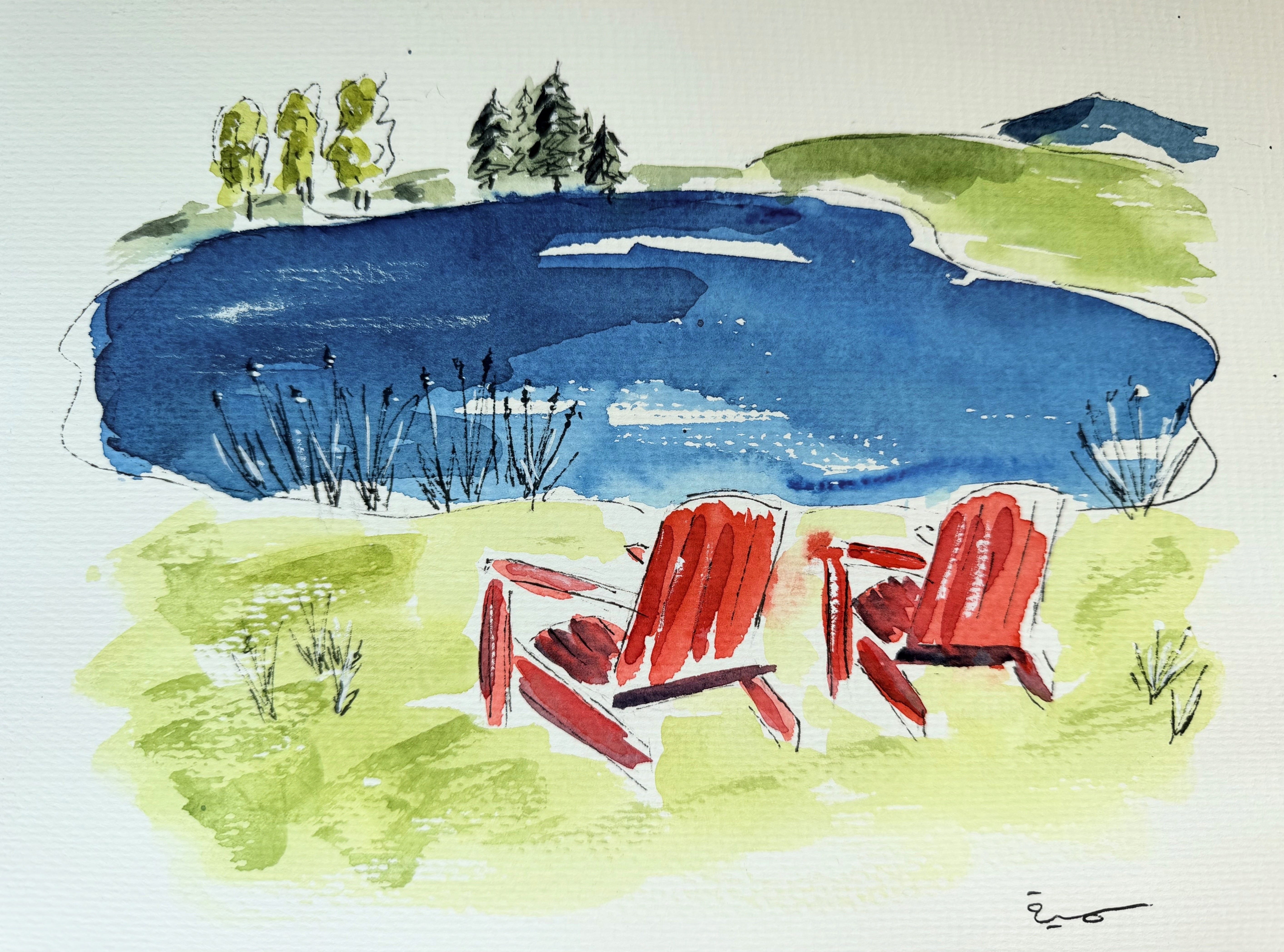
What can these peaceful waters
and peaceful souls
know of
war and bombs and fear?
Can they know?
Can they know
how one little person's
peace
can be shattered
in one
terrifying
second?

It happened in June of 1982.
There were rumors that Israel was going to invade Lebanon. Making the best guess he could, a bit like playing a strange wartime Russian roulette, my dad decided that we would be safest at our family home in the mountains.
He was wrong. There was no safe place.
My parents, four siblings, and I spent fourteen days in the basement hallway of our house, huddled together on mattresses on the floor, as Israeli fighter jets incessantly bombed our world.
All day and all night, we listened for, and braced for, the intense whistling sound they made as they dove down towards us and then dropped a bomb. The time between the whistling and the deafening sound of a bomb exploding felt like a time warp. Infinitely long, unbearable.
This went on day after day, night after night. For two interminable weeks.
We had to run across a window to get to the bathroom, likely the most dangerous moments of our day. My sister and I would hold hands, waiting as long as we could behind the safety of the concrete wall, until we couldn’t hold it any longer, and then we would dash together, terrified, to the bathroom on the other side of that seemingly enormous window. The worst part is that once we relieved our aching bladders, we had to do it all over again to get back to the safety of the hallway.
How did we pass the time? Before phones, before Netflix, before all the possible distractions that are now a given for children needing to pass the time? I don’t remember. But I hope we had books. Maybe my mom grabbed a few books from my room on the way to the basement that first day. Maybe Nancy Drew mysteries--the books I loved at that time. I hope so. I hope spunky, smart Nancy kept me company. But I don’t remember if she did.
What I do remember with a vividness I wish I could dim was the night a bomb fell so close to our house that every single window broke simultaneously, and the entire house shook like it might collapse. It happened in the dead of night, and I was in the deepest sleep.
I woke up to the physical experience of pure terror.
I was screaming uncontrollably. My mom jumped on top of me, trying to cover my ears. I couldn’t stop screaming. I had no idea what was happening. I was swept away in an experience of fear beyond all reason, a fear too great for a sensitive little body and a sensitive little brain.
Our family was lucky and fled Lebanon during a ceasefire. We made our way to the peaceful little town of Waterford, Maine—a most unlikely place for a family of seven fleeing a war zone. But it was the place that made sense because my mom had family with “camps” on the lake, and they spent their summers there.
We rented a cabin on a lake and settled in for a surreal summer in a quiet, idyllic place that knew nothing of war.
We did regular “summer in Maine” things. I guess. How would I know what regular “summer in Maine” things really were?
My parents chased bats out of the house with ancient wooden tennis rackets. We took hikes and jumped off the dock into the cool water. We toasted our first marshmallows and ate our first s’mores. We sat around our first campfires and learned a song about a hole in a bucket and someone named “Deerliza.” Or so I thought.
My sister and I joined group swimming lessons at a nearby lake. And we participated in a children’s play—a musical—that involved scenes about George Washington chopping down a cherry tree.
“Cherry tree chop. Chop chop. Cherry tree chop. Chop. Chop….”
Those lines from a song in that play stuck deep in my brain and are still as vivid as if it all happened yesterday. It was so weird. I didn’t know who George Washington was and couldn’t fathom what chopping down a cherry tree had to do with anything. Anything at all.
I didn’t ask. I sang the words and pretended I fit in.
Our costumes for the play were white baseball shirts with red sleeves. They had our names emblazoned in red capital letters on the back.
JOHN. JENNIFER. MICHAEL. JAMES. BILL. SUZIE.
LAMIA. SUMAYA.
Ouch. We did not fit in. And our not-belonging was there for all to see in red letters on our backs. Our very own scarlet letters.
I moved through that whole summer feeling like there was a window pane between me and that foreign, peaceful world of lakes and plays and swimming lessons. And like I had my hands and nose pressed onto the glass, looking in on a world I knew I could never belong to.
I might look like a tow-headed American kid, but I would never, ever be one.
I felt invisible. My confusion and fear felt invisible.
As did my grief—the wrenching grief of leaving behind everything and everyone familiar and beloved: family, friends, home, landscape, culture, language, and even beloved dogs and horses. All gone with no chance for hugs, goodbyes or “I love you”s.
That pain felt even deeper than bombs shattering my peace in the dead of night.
But none of it was actually invisible. Because within days of arriving in Maine, I had started having seizures. Not mild seizures, but full-blown Grand Mal seizures. They happened at night. Of course. Sleep had become unsafe. Especially deep sleep.
My body was screaming for. But no one understood its cries. Least of all me.
So I continued to have those seizures for the next four years.
After that bizarre summer, we moved into a furnished rental apartment in Manhattan. I remember absolutely nothing about the months we spent there. Except that the apartment had an ugly red leather couch in the living room. My memory of that couch, however, is surrounded by nothing but black. I can’t see any of the room around it. I can’t remember the bedroom or bed I slept in. I can’t remember the kitchen or what the building looked like from the outside.
What I do remember is that I continued having grand mal seizures that landed me in doctors’ offices more times than I care to remember—with only the vaguest of diagnoses—and that I somehow managed to go to school every day. Oh, and that I cried myself to sleep every night, alone in my room.
The fear and grief I felt were like a black hole that threatened to pull me in and never let me go. It was a black hole that I would carry with me, unresolved, for exactly forty years.
I carried it until the fall of 2022. Which is when I started working with Meagan—my unicorn-on-the-moon, kick ass witch of a therapist (see chapter 19). That’s when I started to understand and feel what my body had so valiantly carried all these years.
And to understand how that black hole of fear and grief that had lurked in my shadows was triggered in 2020, when I spent months alone, scared and isolated, as I desperately tried to recover from my concussion. And how that triggering got worse and worse as Covid hit, and I continued to face fear and grief in isolation for months, and even years.
It was the perfect storm to make the invisible visible.
In some ways, as unlucky as it all seems, I was actually lucky. Not everyone gets served the perfect shitstorm to bring unresolved traumas into the light. That’s certainly true of most Lebanese of my generation.
I have a dear childhood friend who went through some of the same traumatic war experiences I did. And like me, his family left Lebanon in 1982. He built a beautiful life for himself here in the United States, with a lovely wife and son, and a successful career as an investment banker.
I recently asked him about his experience with the war and how he thinks it impacted his life. He shrugged and said with his charming, sheepish smile:
“I’m just not a trauma guy.”
Until 2020, I would have said the same thing. I too had built a beautiful life for myself. I too felt like I just wasn’t a “trauma gal.”
Of course, there were some glaring red flags. Like the fact that I needed Jason’s over-the-ear, industrial-strength noise protection ear muffs to join my family for the Fourth of July fireworks. Or like that time when we were visiting friends during the Seattle Sea Fair, and low-flying fighter jets directly above us sent me cowering into a nearby bush (literally), my whole body shaking, struggling to breathe.
And, of course, there was the flight.
Text within this block will maintain its original spacing when published
Oh! I have slipped the surly bonds of Earth
And danced the skies on laughter-silvered wings;
Sunward I've climbed, and joined the tumbling mirth
Of sun-split clouds, — and done a hundred things
You have not dreamed of — wheeled and soared and swung
High in the sunlit silence. Hov'ring there,
I've chased the shouting wind along, and flung
My eager craft through footless halls of air . . .
Up, up the long, delirious burning blue
I've topped the wind-swept heights with easy grace
Where never lark, or ever eagle flew —
And, while with silent, lifting mind I've trod
The high untrespassed sanctity of space,
Put out my hand, and touched the face of God.

~ “High Flight” by John Gillespie Magee Jr
As a hang glider pilot in my “roaring 20’s,” I loved this poem. I loved it so much that I bought a copy mounted on decorative wood, ready to hang wherever I lived. I still have it and still love it.
But I see it differently now. I see so much foreshadowing of what was to come, so many hints of what I was longing for deep in my bones.
Text within this block will maintain its original spacing when published
slipping the surly bonds of Earth..
the delirious burning blue…
silent, lifting mind…
touched the face of God.
It was like a cosmic whisper of both the challenges and the joys to come, nestled into the words I carried with me.
I thought my love of flying was driven by pure joy. I thought it was the simple, healthy impulse of an adventurer and a “flying dreamer.” And it was. But that’s not all it was.
It was also a creative way to channel my inner response to the world, my inner state of “flight.” As in the “flight” part of “fight or flight.” Except I was quite literal about it. Not to mention quite clueless about what it meant.
Until 2020. Until the underlying trauma wiring of my brain was cracked open like a raw egg and slowly oozed out onto my life.
And I had no choice but to clean up the mess.

If you’re new here, welcome!
However you made your way here, I’m grateful you found me and happy to have you pop into my little world, whether it’s for a brief visit or a longer hangout around my campfire.
Accidental Alchemy is a serial memoir, so if you’re curious and have the time, I recommend starting with the Prologue and reading chapters in order for the full experience. You can access all chapters on my Substack homepage.
For the best reading experience, I recommend reading in a browser and on a larger screen. It makes it easier to enjoy the art and navigate through the chapters with the buttons at the bottom of each post.
If you’re enjoying this memoir, please share with someone you love!
Share Accidental Alchemy by Sumaya Abuhaidar
PS.. All art and poetry included in this memoir are my own unless I specifically credit another author or artist.
Comments
Nothing yet. Say the first thing.
Sign in to join the conversation.