
Friday, May 22nd, was Jerome Powell’s last day as Chair of the Federal Reserve. It also marks the end of a two-decade experiment in transparent and interventionist monetary policy that began in 2006 under Ben Bernanke. It was a period defined by new communication devices, policy tools, and regulations. And perhaps most importantly, it was a period of expansive transparency and a near-zealous belief in consensus. That last piece will remain — the power of a culture of consensus is unlikely to be undone anytime soon. But the era of increased transparency and inventive policy tools, with a smooth-sailing FOMC, is behind us.
What comes next for the Fed will likely be a fractious period of (polite) public disagreements, policy dissents, and questions on the institution’s ability to remain independent while staying on top of an increasing number of inflationary shocks. That’s not a statement meant to be critical of the FOMC. It’s an assessment of the structure of our economy, the nature of the current political environment, the condition of economic data and models in the post-pandemic world, and the personality mix and objectives of individual FOMC members.
To be fair, this isn’t all about Kevin Warsh; these seeds were sown long before Trump floated him as a potential Chair. But Warsh enters the Fed at a time when consensus is breaking down — see the recent spate of dissents — with questions about the institution’s ability to maintain its independence, and his willingness to defend it. That backdrop will make it even harder for him to deliver on his policy goals, many of which run counter to the current stance and recent decisions of the rest of the FOMC. His ability to navigate this new, only partially understood, economy while guarding Fed independence will define the early years of his Chairmanship. And unfortunately for Mr. Warsh, he may not have much control over his own fate, or ours.
Long-time readers will not be surprised by our belief that the economy is in a new, more volatile era. In fact, Access/Macro was started in part because of a speech by central bank legend Mark Carney — he has the distinction of being the only person to have served as the Governor (head) of two separate central banks, Canada and the Bank of England; he’s now the Prime Minister of Canada. In that 2022 speech, Carney laid out a prediction:
The economic environment is now very different from that which reigned since the global financial crisis. The long era of low inflation, suppressed volatility, and easy financial conditions is ending. It is being replaced by more challenging macro dynamics in which supply shocks are as important as demand shocks, increasing inflation, volatility, interest rates and risk premia. The reaction functions of central banks must adjust accordingly. Climate policy is becoming the third pillar of macro-economic policy.
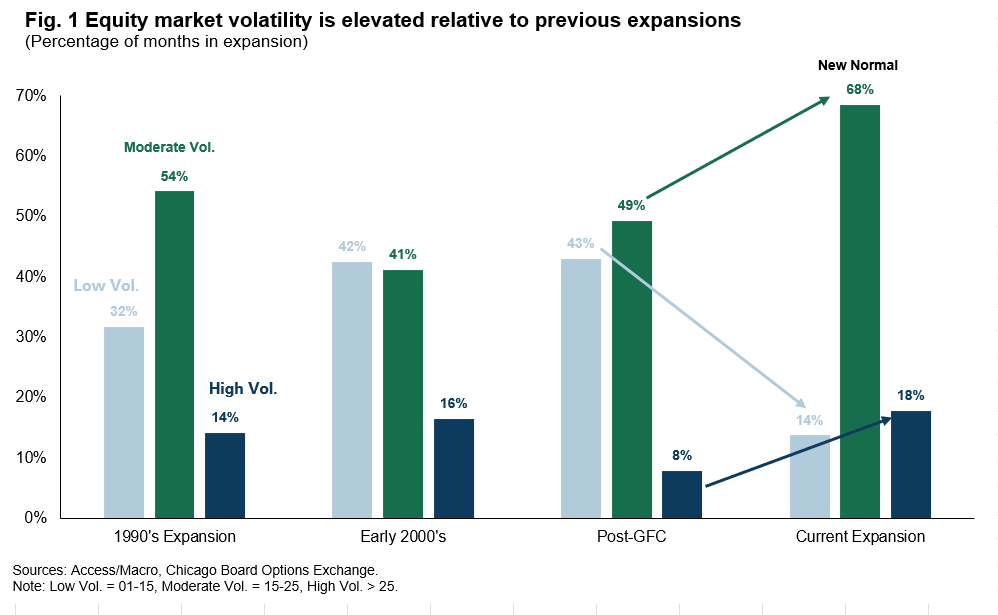
Carney was talking specifically about climate risks and shocks, but his view that we’re in a more volatile period extends to all parts of the economy. You can see it in financial markets. Figure 1 shows just how much volatility has entered equity markets in the current expansion. The chart tracks the monthly average of the VIX index, which measures the daily volatility in the S&P 500. Each bar represents the percentage of months in that expansion that qualify as low-, medium-, or high-volatility, based on a classification from S&P. For example, 32% of the months during the 1990’s expansion were classified as low volatility.
Take a look at the current expansion. The number of high volatility months has risen from 8% during the long 2010s expansion to 18% today. But the real movement has been in the number of medium-volatility months. During the 2000s and 2010s expansions, the shares were 41% and 49%, respectively. That percentage has skyrocketed lately, reaching 68% in the current expansion. We’re in a new era, and markets are pricing for it
So, what’s driving the volatility? A confluence of structural forces that have been accruing for decades. Figure 2 highlights a few of the most pressing, but it is by no means a complete list. These forces are rewiring the economic connections that have defined our economy for the last forty years. And, it is clear they will be with us for at least another decade, if not more.
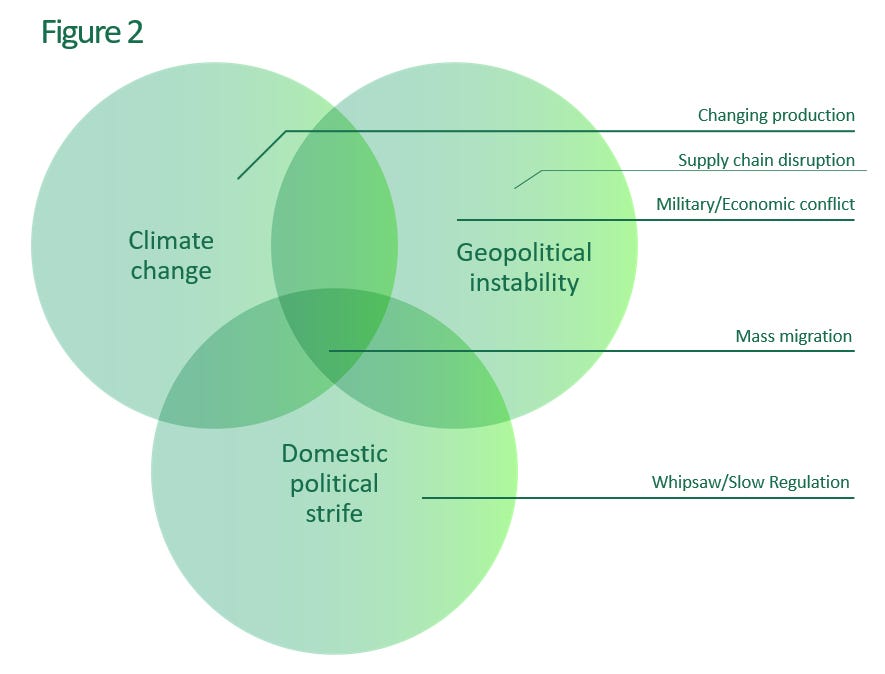
What is also clear is that these factors are well outside both the purview and the control of central banks. They are broad global forces with complicated intersections. However, they share a few commonalities. First, nearly every one of them — AI is potentially the exception — is likely to disrupt markets and supply chains, thereby fanning the flames of inflation. Second, these tectonic shifts will lead to greater swings in economic cycles — faster expansions, deeper and/or longer recessions, and potentially slower recoveries. That shifting landscape poses a significant risk to central bank credibility if the public loses faith in those institutions that fail to manage the economy with the steady hand we’ve come to expect. And this is happening at a time when traditional models and data are showing wear and tear, complicating policymakers’ ability to see the runway.
Central bankers are generally a cautious group by nature. They understand that monetary policy has always been as much art as science, and that changes to interest rates usually take years to filter through the economy; Milton Friedman famously described it as “long and variable lags.” But incomplete models and degraded data argue for even more caution and patience than usual. Why act swiftly if you’re more unsure of the surroundings — better to wait and let conditions reveal themselves. But that is in direct opposition to what the new world requires. We’re dealing with more shocks and less predictability. More opportunities to misread the tea leaves and less forgiving terrain. Under those conditions, central banks must be humble in their assessments, short in their memory, and nimble in their actions. They must stand ready to act quickly and decisively to quell shocks before they become malignant. And they must be ready to reverse course if the conditions require it or if they overcalculate. That tension between needing to remain patient and humble to first do no harm runs right into the need to be agile and, in some ways, reactionary to quell persistent and unpredictable shocks. That paradoxical tug-of-war is going to define the next decade of monetary policy.
A 2026 Fed led by someone other than Kevin Warsh would be facing the same reality. That FOMC would be exposed to the same political pressure, the same supply shortages, and the same volatile geopolitical and environmental landscape. But that alternative Committee might also have an incoming Chair who isn’t at odds with existing monetary policy and regulations. Someone who hasn’t been championing policies that would force a 180-degree reversal of recent FOMC decisions, even if they may be needed. Whether one agrees with Warsh’s assessment or not, his objectives are plainly stated and clear. The question is, can he pull it off? Early signs suggest probably not. He’s going to run into a wall of resistance inside the Committee if he comes out swinging, especially with inflation heading in the wrong direction. And if he doesn’t, he may run into the speeding train that is the President’s Truth Social account. Either way, it’s going to be an interesting second half of the year. And it’s going to remake the way the Fed communicates with the public.
Comments
Nothing yet. Say the first thing.
Sign in to join the conversation.