
We have an inflation problem, and it started before the Iran War. You’re going to hear that phrase a lot in the words below. Why, because we have an inflation problem, and it started before the Iran War. We all, especially markets, need to wake up to that fact because it has some sobering implications for monetary policy over the next six months.
It happened again today. You probably missed it between the headlines that we may or may not have a ceasefire in the Middle East. Consider this your update. This morning’s Personal Income and Outlays release was not great. In fact, it was bad. We’ll get to the consumer side in a separate post. This one is about the inflation problem no one wants to talk about. But first, here are some facts.
The data we just received was for February 2026. We’ll get the March data drop on 4/30. Stay tuned.
The yearly change in inflation, also called the 12-month change, dropped from 3.05% to 2.97%. HOORAY! That’s exactly where it was last February at 2.97%. HOORAY AGAIN! And it’s lower than the 3.06% rate in February of 2024. HIP, HIP HOORAY! Mission. Accomplished.
The Fed’s target is 2.0%. Ummmmmmm…
February was always destined to decline because of a statistical quirk called base effects, in which last year’s reference point influences the percent change this year. And those positive base effects are in the rearview for 2026. Is it me, or is it getting hot in here?
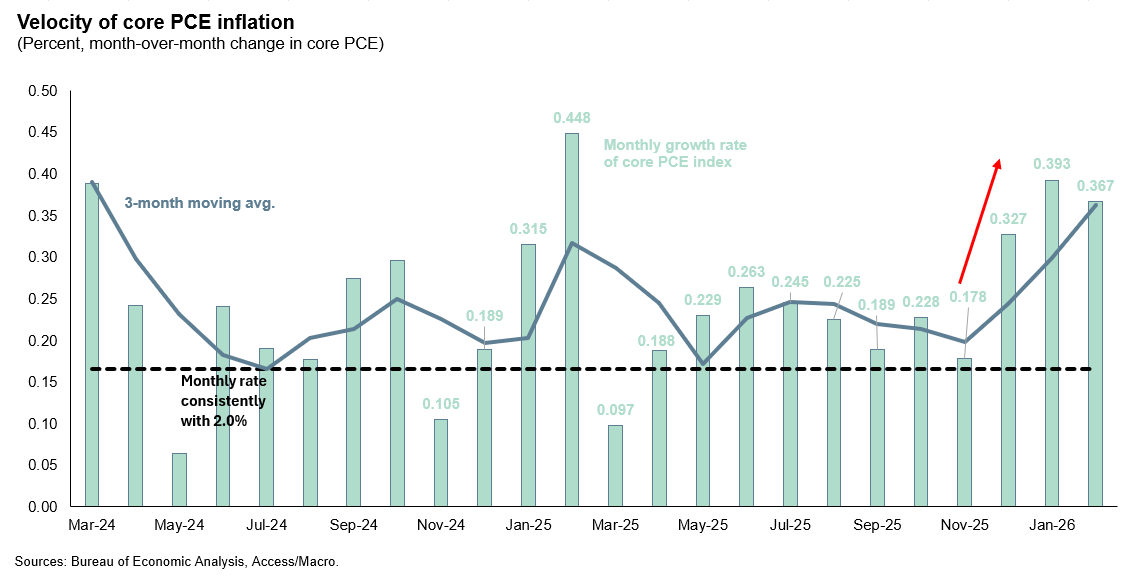
As the figure below shows, the monthly pace of core inflation (green bars) is still very far above the monthly pace that will sustainably bring that yearly pace down to the Fed’s target of 2.0% (black line, aka the speed limit). Look at that jump. We’re cooked.
That was the rollercoaster of emotions I went on this morning as I sifted through the data and read the release. It’s 2026. I should be used to that kind of whiplash, but somehow it still stings.
At this moment, you might feel the urge to find comfort and shelter in that decline to 2.97%. Let me provide some perspective for you. Back in Access/Macro’s December forecast, we expected a 0.35 percentage point (ppt) drop in the yearly change in February. The actual change was 0.08ppt. That’s a massive difference between the forecast and the outcome. Is that because the forecast was bad? Perhaps. But I refer you to the chart above, which shows the recent surge in the green bars.
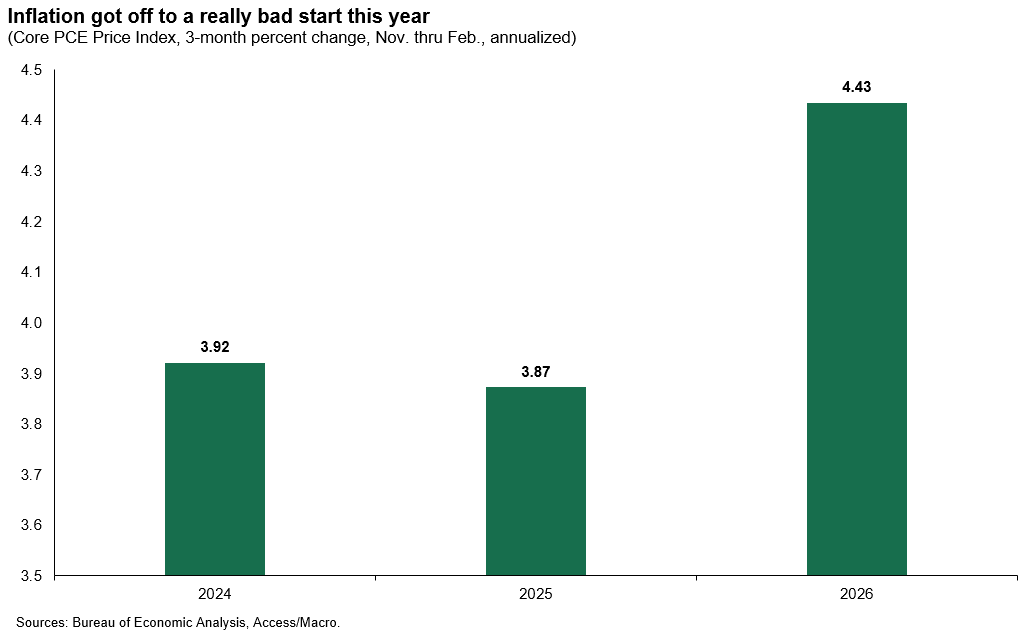
Here’s some more level setting. The chart below has three green bars. Each one is the annualized change in the core PCE index from November to February for the given year. Annualized means that we took the change from November to February and did some algebra to show the pace of inflation over 12 months if it had grown by that Nov-Feb change for the whole year. That last bar, the one that says 2026 below it. That’s a scary number. It tells us that if things don’t change, inflation will hit 4.5% by this time next year. It would be 2021 all over again.
The cold, hard truth is that the 12-month change in core PCE inflation was last below 2.0% in February of 2021. That’s sixty months of inflation above the Fed’s target. Six. Zero. The last time that happened was in early to mid-1990’s, which was the tail end of the late 1980’s inflation shock. The FOMC didn’t have an explicit inflation target back then, but that episode was one of the reasons central banks around the world started discussing inflation targeting — the practice of targeting a specific inflation rate rather than just throwing darts at a board to hit “stable prices”.
That’s the point. Context matters. And the context here is that inflation has been above target for forever. That fact is making policymakers uncomfortable; the chorus of hawks has grown louder since last October’s FOMC meeting, when labor market concerns waned. Powell mentioned the importance of context at the March press conference:
“And I think now it’s also dependent now on what you mentioned, which is that broader context of five years now of inflation above target. We have to keep all of those things in mind, and the question of “looking through,” when it does arise, will be one to approach not lightly but, you know, in the context that you mentioned.”
The beauty of Fed decisions has been in the eye of the analyst over the last few years. Some would argue that the Fed was slow to react to inflationary pressures and remains behind the curve. Others would argue that they’ve shown remarkable restraint in the face of simmering, not boiling, inflationary pressures — they were close to landing the plane gently on the runway.
None of that matters now. The ground is shifting beneath our feet. We’re inching towards a significant market repricing, because of context. Because five years in is different than a surprising post-pandemic surge. Because it’s increasingly obvious that we live in a world of regular supply shocks now. Policymakers have to take all of that as given, as context.
Expect them to start talking a lot more about it as they weigh raising rates later this year. The only thing that would stop them is better inflation data. But, with the full effects of the Iran War still in the pipeline, we very well may look back on this February Personal Income and Outlays release as the calm before the storm.
Markets need to wake up. It’s about to get worse, for a while, before it gets better.
Tim Mahedy is CEO and Chief Economist at Access/Macro, an independent macroeconomic research firm.
Comments
Nothing yet. Say the first thing.
Sign in to join the conversation.