
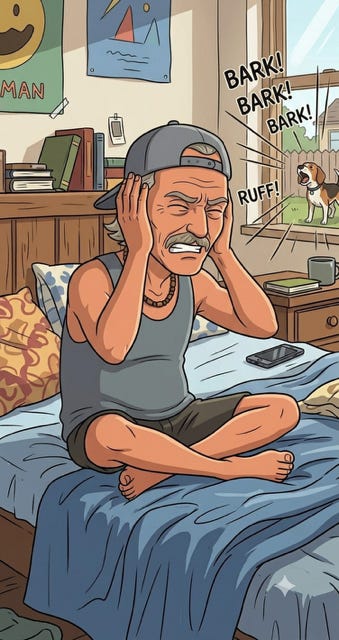
The sound was sharp, relentless, and persistent. Next door’s dog was barking again, a rhythmic piercer of quietude that made John’s jaw tighten and his neck muscles lock into iron bands.
For months, every yap had felt like a small hammer against his nervous system. He had tried everything to block it out—closing windows, putting in earplugs, and gritting his teeth in simmering resentment. But the more he wished for the barking to stop, the LOUDER and more intrusive it became.
The resistance was exhausting.
He could not understand why, when he was on holiday a few weeks before there was a dog that barked every night of the whole fortnight he was there, but it never bothered him that much then?
John realised that his frustration with noise isn’t actually about the sound itself, but about psychological ownership and territorial control.
At home, unwanted noises feel like an aggressive intrusion into his personal sanctuary and a long-term problem he is forced to endure, which triggers a stress response to protect his space.
On holiday, however, he holds no territorial claim over the environment, meaning the noise doesn’t register as an invasion of his personal boundary or a problem he needs to solve. Because he views the location as someone else’s domain and knows his stay is strictly temporary, this psychological detachment allows him to frame the disturbance as a transient background detail rather than an intolerable personal offense.
John then thought the mindset behind trickery and psychological detachment and letting go of what isn't yours to fix is a brilliant observation. Then, one sunny morning, sitting with a lukewarm cup of coffee, John had a moment of quiet insight. He decided to try an experiment on himself. He knew that pretending to be on holiday would not work because the mind is not that gullible, the mind is still going to be possessive of his private privacy and space. So he tried another approach.
What if I stop wanting quiet? he thought. What if I trick my mind entirely?
Instead of fighting the noise, John closed his eyes and leaned into it. He deliberately said to himself, “I want to hear that dog bark.” I’m waiting for the next one. “Let me hear it.” He also thought that he was lucky to be able to hear the dog barking. “I’m lucky to have my hearing, some people who are deaf would love to hear a dog barking” he thought. This mind shift altered how he was reacting to this situation.
Instead of resisting the barking he went towards it. This was tricking is brain into wanting something instead of NOT wanting something.
The result was immediate and almost magical. The moment he switched from wanting silence to welcoming the sound, the tension vanished from his shoulders. The dog barked again, but it no longer carried a threat or an annoyance; (in-fact instead of being angry, he felt empathy for the dog) it was simply a sound in the background, no more offensive than rustling leaves or falling rain. By surrendering the struggle, the irritation died on the spot.
Not long after this incident of the barking dog, his next door neighbour decided to hang a dartboard up on the adjacent wall to John’s bedroom. Every night while John was trying to sleep his neighbour decided to have a darts match with his sons. John’s first reaction was to get annoyed and resist the constant 3 thumping intervals of the darts embedding themselves into the dartboard. He knew if he started resisting it would drive himself insane. But instead John tricked his mind that he wanted to hear the darts enter the board and treated the rhythm has a friendly beat to send him to sleep.
It was John’s first true glimpse into a profound truth: what you resist, not only persists but GROWS in size.
The Art of the Peripheral View
Encouraged by his breakthrough with the barking dog and next door neighbours dartboard, John embarked on a personal journey to see just how far this psychological strategy and trickery could go. He began to view the human mind like a camera lens—too often zoomed in tight on the very things that cause distress, magnifying small troubles until they fill the entire frame.
He realised that what you pay ATTENTION to, becomes your life.
John began testing his new coping strategies and trickery across different areas of his daily routine:
The Trap of Panic:
During a particularly crowded train ride into Birmingham, John felt the familiar, suffocating wave of a Panic Attack taking hold. His chest tightened, and his instincts screamed at him to escape. Instead of fighting the claustrophobia, John tricked his mind yet again. He took a slow breath and thought, “Alright, heart, beat as fast as you want. Tighten up. Let’s see how strong this Panic sensation can get. ”By demanding the panic to do its worst, he took away its power. Within seconds, the anxiety, deprived of his chemical fear-fuelled resistance, dissolved into nothing.
The Weight of Worry:
When sleepless nights arrived with endless lists of “what-ifs,” John stopped trying to force sleep. He shifted his mental stance from resisting the dark thoughts to observing them from a distance—a peripheral view. He treated worry like passing clouds in the sky rather than a storm inside his head.
The Climax: When Acceptance Saved His Life
John’s ultimate test came a few years later while on holiday during a solitary trek through a rugged, foggy coastal headland. The weather shifted unexpectedly, and thick, disorienting sea fog rolled in, blotting out the path. In the mist, John took a wrong step and tumbled down a steep, loose shale embankment, wedging his foot tightly between two heavy boulders.
Alone, injured, and far from the main track, cold panic set in. The temperature was dropping fast, and the darkness was falling.
His first instinct was to thrash frantically against the rocks, screaming until his voice went raw. But all the struggling did was wedging his foot tighter and sending spikes of excruciating pain up his leg. His heart raced dangerously, and hyperventilation threatened to knock him unconscious. The sheer resistance to his situation was rapidly draining the vital energy he needed to survive.
John caught himself. He closed his eyes, forced his body to go still, and remembered the lesson of the barking dog.
“Stop fighting where you are,” he whispered to himself. “Accept the cold. Accept the trap. Welcome the challenge.”
He tricked his mind into absolute calm by fully surrendering to the reality of the moment. Instead of focusing on the terror of being trapped—which was growing LARGER by the second—he shifted his focus outward, using his peripheral awareness.
In that state of deep Acceptance, the fog in his mind cleared alongside the Panic. With a cool, calculating head, John stopped pulling against the rock. Instead, he systematically unlaced his sturdy boot, wiggled his foot free from the footwear that was pinned, and used his belt to bind his sprained ankle.
Using a sturdy fallen branch he noticed nearby—a detail he would have completely missed had he stayed consumed by panic—he hoisted himself up the slope, step by deliberate step, and dragged himself to a nearby warden’s hut just as the freezing night set in.
Medical help arrived hours later, but the paramedic was clear: had John continued to panic and struggle in the freezing cold, shock and hypothermia would have claimed his life long before rescue reached him.
A Mind at Peace
John survived not because he conquered the mountain, but because he stopped battling his own thoughts.
He learned that life will always feature barking dogs and peoples dartboards and other unwanted noises, sudden storms, packed out train rides and unexpected traps.
But by choosing not to resist the reality of the present moment, by stepping back to view life from a wider, gentler angle, and by tricking the mind into Acceptance, peace is always within reach. Practicing Acceptance and changing the way he was thinking saved John’s life.
THE END
“Acceptance” ‘Change the way you are thinking’ (Full 359 pages)
Click link below:
Comments
Nothing yet. Say the first thing.
Sign in to join the conversation.