
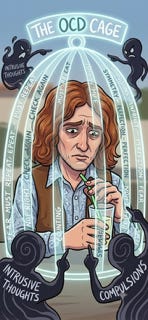
The above scene is John drinking Sanatogen Tonic Wine that his mother gave him to help his nerves so he could escape from the invisible cage of OCD. (God Bless Her) It was a 15% ABV fortified ruby wine blended with a vitamin and iron tonic. Originally marketed in the early 20th century as a "nerve revitaliser".
For a child growing up in the 1950s, the world was supposed to feel wide open, bright, and full of post-war optimism. But for eight-year-old John, the world was a labyrinth of invisible terrifying rules that was constantly developing from his mind.
If John stepped on a crack in the pavement, his mind screamed that his mother would fall gravely ill. To quiet his internal scream, he had to walk backwards, touch the nearest lamppost three times, and repeat a silent prayer in his head. If he missed a syllable, he had to start the entire sequence over again, and again, and again in his head.
His parents watched with a mixture of confusion and growing irritation. To his father, John was “Too Sensitive” and needed to “Buckle Down, and Man-up a bit”
To his mother, he was simply a sensitive boy with peculiar habits that needed extra looking after.
No one had a name for what was happening in John’s mind.
By 1965, John was a teenager, and his “habits” had mutated into a exhausting, full-time occupation. His hands were extremely raw and bleeding from excessive washing, a desperate attempt to scrub away the terrifying, intrusive thoughts of contamination that haunted him. Desperate for answers, his parents took him to a prominent psychoanalyst in the city of Birmingham just 10 miles from his place of birth: Dudley in the West Midlands UK.
The office was heavy with the smell of pipe tobacco and lined with towering bookcases. John was instructed to lie on a leather sofa and speak freely about his earliest memories of this wretched illness that was tormenting his mind.
Below is an image of a typical mid-century psychoanalytic consulting environment.

The prevailing medical theory of the 1950s and 1960s dictated that John’s behavior was a symbolic manifestation of repressed childhood trauma or subconscious guilt.
The analyst spent hours dissecting John’s intrusive thoughts. John couldn’t win because when John eventually confessed to a terrifying unwanted mental image of hurting his older sister, the analyst did not recognise it as a standard OCD harm obsession. Instead, he treated it as a literal, repressed desire that John may in-fact perform this dreadful act.
John became terrified in confessing anything that would be taken literally.
John was forced to endlessly analyse, discuss, and probe these painful thoughts. But for someone with OCD, treating an intrusive thought as highly significant that there was a chance that these thoughts could actually happen, is like pouring fuel on a fire. The more John analysed the thoughts, the more real they felt, and the more intensely he felt compelled to perform mental rituals to “undo” them.
Rather than curing him, the talk therapy drove John deeper into despair. He felt like a monster, convinced that his own subconscious was a dark, dangerous place to live.
By the time John reached his early twenties in the early 1970s, he was barely surviving. He had dropped out of college, unable to leave his home because checking the door lock took up to four hours every morning.
In that era, when psychoanalysis failed and a patient could no longer function in society, the medical establishment offered unspeakable grim alternatives.
During the mid-20th century, severe“treatment-resistant” cases of mental distress were frequently treated with prefrontal lobotomies or other invasive psycho surgeries. The goal was to physically sever and cut through the connections in the frontal lobe part of the brain located just behind your forehead to quiet the chronic, agonising worry—often leaving patients permanently emotionally blunted, passive, or severely brain-damaged. Also bloodletting was used to treat symptoms of what we now call Obsessive Compulsive Disorder.
This sent John further into himself, frightened that the more he showed or discussed his illness, the more people recognise that he needed this surgery or blood letting.
This procedure that was mentioned, terrified John to the extent that perhaps irreversible self-harm was his only way out.
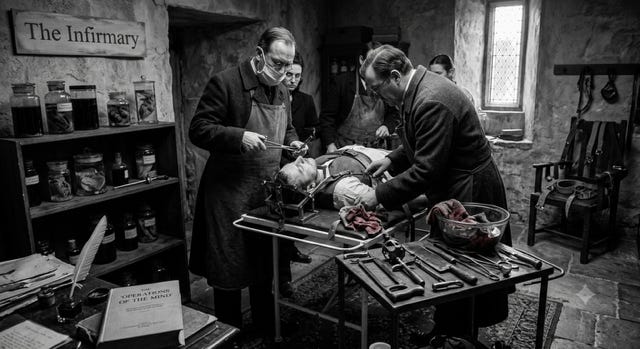
John’s doctors began hinting at permanent institutionalisation. They viewed his condition as a progressive, neurological deterioration. For three years, John lived in a state of quiet terror, hiding the true extent of his rituals from his family, knowing that showing too much panic could land him behind the locked doors of an asylum. He was trapped in a cycle of exhausting compulsions just to keep the terror at bay, with no hope of a cure.
John suffered like this till he reached 30 years of age when John started to research into reading psychology books from his nearest library.
The breakthrough did not come from analysing John’s past, but from changing how he responded to his present thoughts. In the late 1960s and early 1970s, a quiet revolution was beginning in psychiatry. Pioneers like Victor Meyer in the UK were developing a radically different approach called Exposure and Response Prevention (ERP).
Instead of asking why the thought was there, this new school of thought accepted that the brain simply fires off random anxious thoughts and no one as control over them, its all the verbal dialogue we add to them ourselves that create the problem. The trick wasn’t to stop the thoughts, but to stop the compulsions and rituals that our mind thinks we need to do to rectify the situation. It’s the stories we add ourselves that’s keeping us ill.
It would take years for these modern behavioural therapies and serotonin-targeting medications to reach mainstream clinics, but the paradigm shift saved John’s life. In his early thirties, John finally bought a few books on the subject by Dr Claire Weekes who told him: “Your thoughts are just brain static. You don’t have to analyse them. You just have to sit with the anxiety without washing your hands.”
This to John was excruciatingly difficult, but for the first time in his life John was feeling hopeful. Claire told John to start to Accept his condition for now with as much Acceptance as he can muster and in the meantime let his intrusive thoughts just come and go without any interference from himself and just let them be there without resistance or judgment but with utter Acceptance.
Claire went on to tell him not do do any rituals or Compulsions whatsoever it doesn’t matter how hard it is for him. Then ride through all the fear that comes from not doing these repetitive acts.
Then a remarkable thing started to happen to John, the fear of something dreadful happening started to fade away from John’s mind. For the first time in John’s life he felt in control of his own thoughts. This was something he had never had any control over ever before in his life. The invisible bars of the cage began to break one-by-one. John was eventually set free from The Invisible Cage of OCD.
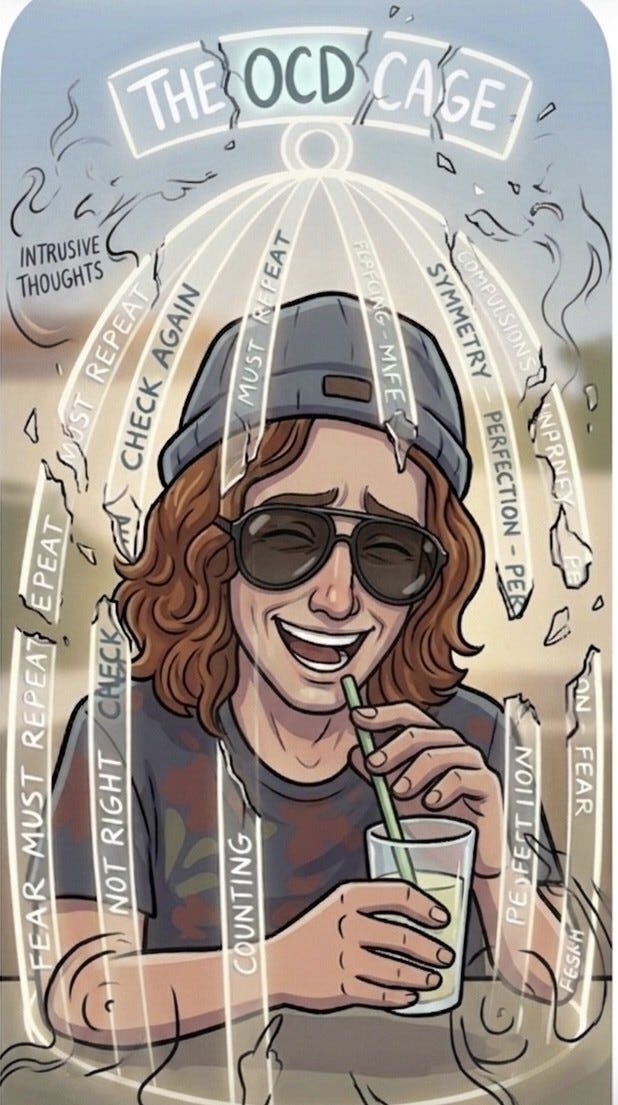
John’s story is a testament to how far our understanding of mental health has come—shifting from a dark age of invasive surgery and self-blame to one of genuine evidence-based hope that all you have to do is simply face your fears to make them go away.
To this present day John has tried to educate people by telling his story on how he overcome THE ANXIETY STATE.
The Anxiety State can affect anyone at anytime of their life, you don’t have to suffer from OCD like John did. We are all subject to small doses of anxiety in everything we do, even if you are in sound mind. John is an expert from his experience from living in this dark place, enough to be able to advise people how to escape from it.
To learn more on how how John recovered from THE ANXIETY STATE in particular OCD, Please click HERE.
No posts
Comments
Nothing yet. Say the first thing.
Sign in to join the conversation.