
If I had to identify the single greatest problem facing young Christians right now, it would not be doubt.
It would not be science.
It would not even be moral compromise.
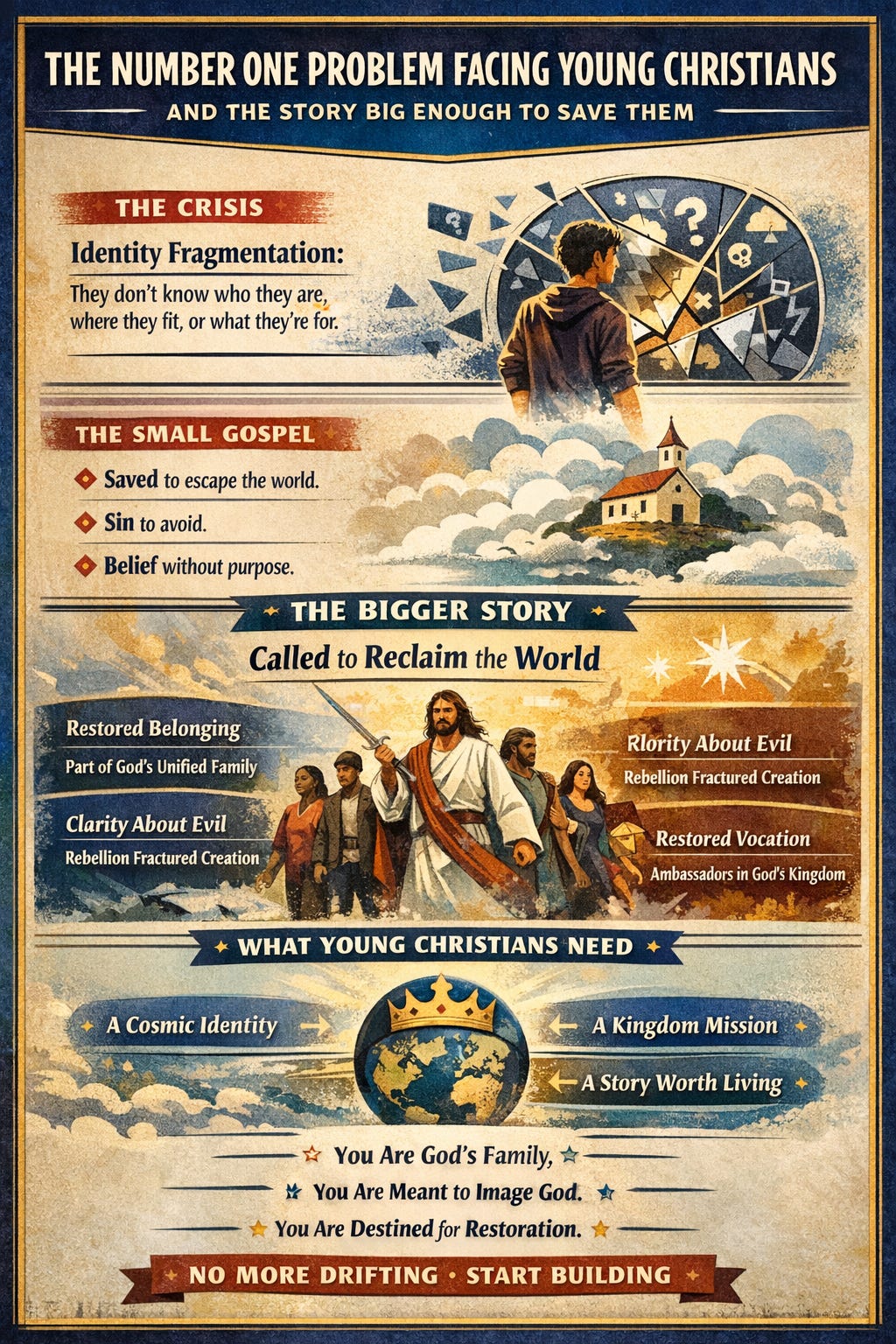
It is identity fragmentation.
Young believers do not know who they are, where they fit in the biblical story, or what their lives are actually for.
They’ve been told they are saved — but not what they are saved into. They’ve been warned about sin — but not commissioned for purpose. They’ve been taught to believe — but not invited to participate.
And when faith is reduced to private forgiveness plus future heaven, something collapses inside the soul.
Drift sets in.
Some slide into moralism — trying to prove they are serious Christians. Some slide into deconstruction — assuming the faith must be shallow because it feels shallow. Some merge faith with political tribes to find weight and identity. Others simply disengage quietly.
But underneath all of it is the same issue:
They have lost the story.
Modern Christianity has often reduced the gospel to personal afterlife insurance. Pray the prayer. Go to heaven. Try to behave.
But Scripture presents something far larger.
The biblical story is not about escaping the world. It is about reclaiming it.
It is about a fractured family — both heavenly and earthly — being reunited under the Lordship of Jesus Christ.
It is about restoring God’s rule over creation, the nations, and humanity itself.
When young Christians see that bigger picture, everything changes.
They are not merely forgiven sinners trying to survive culture.
They are reclaimed imagers of God.
They are members of a kingdom that has invaded hostile territory.
They are participants in a mission to restore what rebellion fractured — death, depravity, and domination.
That changes identity.
First, it restores belonging.
Young believers are not isolated spiritual consumers choosing worship styles and podcasts. They are part of a unified family. The church is not a religious club — it is the earthly expression of God’s reclaimed kingdom community. It is an embassy of the age to come.
Belonging becomes covenantal, not casual.
Second, it restores clarity about evil.
The chaos they feel — anxiety, confusion, cultural instability — is not proof that faith failed. Scripture explains why the world feels disordered. Death entered. Corruption spread. The nations fractured. Humanity lives in contested space.
Evil is real. But so is Christ’s victory.
Young Christians are not crazy for sensing that something is wrong with the world. They are living inside a story that acknowledges exactly that.
Third, it restores vocation.
Salvation is not escape. It is enlistment.
Christ has been raised. The powers have been disarmed. The Spirit has been given. The nations are being reclaimed through the gospel.
Young believers are not spectators in a Sunday service. They are ambassadors. They are witnesses. They are called to image God faithfully in work, relationships, creativity, leadership, and endurance.
They are not waiting for heaven. They are participating in restoration now.
Fourth, it restores endurance.
If faith is merely about comfort, suffering feels like betrayal. But if we live in contested territory awaiting final restoration, suffering is not abandonment — it is evidence that the story is still unfolding.
Young Christians need categories large enough to hold pressure.
They do not need a thinner gospel that feels easier to defend. They need a bigger gospel that feels worth giving their lives to.
The church often responds to young people’s struggles with therapeutic language, political alignment, or entertainment-driven relevance.
But what they are actually hungry for is weight.
They want a faith that explains reality. They want a story that dignifies sacrifice. They want belonging that demands loyalty. They want a King worth following.
When you teach them:
You are part of God’s unified family. You have been transferred from hostile dominion into Christ’s kingdom. You are meant to image God in a fractured world. You are destined to reign with Christ in a restored creation.
Identity solidifies.
Purpose sharpens.
Faith deepens.
The crisis facing young Christians is not primarily intellectual doubt.
It is narrative dislocation.
And the solution is not trendier worship or softer doctrine.
It is recovering the full biblical story — a story cosmic in scope, covenantal in structure, and deeply personal in allegiance.
When young believers see that they are not random individuals trying to survive modernity but heirs of a kingdom reclaiming the nations, something awakens.
They stop drifting.
They start building.
And they begin to live like people who know who they are — and whose they are.
The gospel is not small.
We’ve just told it too small.
And this generation is ready for something bigger.
Thank You Dale for this Great Article!
No posts
Comments
Nothing yet. Say the first thing.
Sign in to join the conversation.