
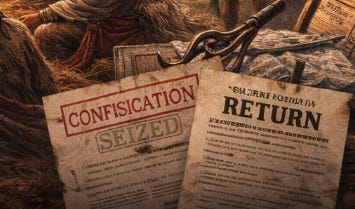
Before Canada pushed its jurisdiction west, the land that became Alberta and Saskatchewan wasn’t some political blank space. It was governed. Not like London. Not like Ottawa. But governed.
Cree, Blackfoot, Assiniboine, Saulteaux, Nakoda, Dene, these weren’t scattered bands drifting through undefined territory. They had structure. Authority. Law. Diplomacy. Territory that was recognized, defended, and negotiated. Leadership wasn’t about decrees; it was about reputation, consensus, and the ability to hold people together when survival depended on cooperation.
At the band level, councils of elders, hunters, spiritual leaders, and warriors debated migration, conflict, and alliance. It is important to recognize these are not represented by modern day Indigenous governing structures. Confederacies like the Blackfoot coordinated across multiple bands. Not centralized states, but organized political alliances capable of collective decision-making.
Law existed. It just wasn’t written in statute books. Marriage rules, hunting territories, compensation for injury, obligations in trade, these were enforced through restitution, public sanction, even expulsion. On the plains, exclusion wasn’t symbolic. It could be fatal. Order was embedded in reciprocity.
Territory wasn’t surveyed into neat rectangles, but it wasn’t undefined. Hunting grounds were understood. Overlaps were negotiated through diplomacy. Treaties between Indigenous nations long predated European arrival. Sovereignty wasn’t theoretical, it was practiced.
Even the buffalo hunt shows it. Large-scale hunts required discipline and coordination. Among the Métis, written codes governed conduct. Captains were elected. Scouts were appointed. Fines were imposed on those who broke formation and jeopardized the herd. That’s governance, adapted to mobility and ecology, but governance nonetheless.
Then came the Hudson’s Bay Company.
In 1670, Britain granted a corporation sweeping authority over Rupert’s Land. On paper, that looked like sovereignty. In practice, it was commercial rule layered over Indigenous political reality. The Company controlled trade posts and employees. Beyond the palisade walls, Indigenous law still prevailed.
This wasn’t a settler colony with assemblies and civic institutions. It was corporate governance, distant, profit-driven, hierarchical. Authority flowed from London through Company factors to trading posts. There was no elected legislature preparing for provincehood. The territory was treated as an asset, not a future partner.
When Britain authorized transfer to Canada in 1868–70, sovereignty was handled like property. The Hudson’s Bay Company was compensated. The Dominion expanded west. Indigenous nations and the Métis weren’t part of that negotiation.
At Red River, resistance followed. The provisional government demanded recognition before entry into Confederation. The Manitoba Act of 1870 was the compromise, but even then, the new province was small, and Ottawa kept control over public lands and resources. The larger northwest became territory under federal administration.
That distinction mattered.
Provinces under the 1867 constitutional framework had entrenched powers. Territories did not. Ottawa could structure, limit, or override territorial governance. Alberta and Saskatchewan, when created in 1905, entered Confederation without control over their natural resources, or choice. That control didn’t come until 1930.
Unlike the American “equal footing” doctrine, where new states entered the Union as constitutional equals, the Prairie provinces were staged into equality. Territorial first. Provincial second. Resource control later. Equal representation, never.
From Ottawa’s perspective, central control made sense. Railways had to be built. Settlement had to be organized. American expansion was a real concern. Coordination required authority.
But structure leaves imprint.
The Prairie West didn’t join Confederation as a founding partner. It was transferred, administered, then gradually empowered. Corporate sovereignty gave way to federal sovereignty, not to regional constitutional equality at the outset.
Before Confederation, the plains were not a vacuum. They were a mosaic of self-governing societies operating under their own norms and diplomatic systems. After transfer, the region was not immediately a province among equals. It was territory to be managed.
That layered origin, Indigenous sovereignty, corporate governance, federal administration, still echoes in debates about autonomy, resource control, and decentralization.
You can’t understand Alberta and Saskatchewan’s political instincts without understanding how they entered the country in the first place.
Darren Grimes
No posts
Comments
Nothing yet. Say the first thing.
Sign in to join the conversation.