
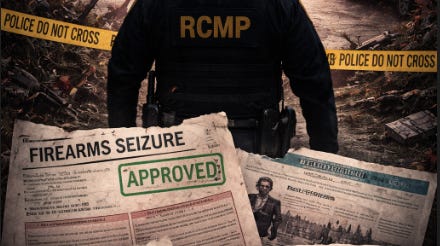
Police had been to that house multiple times.
There were mental-health concerns. At least once, firearms were seized under existing Criminal Code authority. That means officers determined there was enough risk to remove guns from that environment.
The system identified danger.
Then the guns were returned.
A lawful owner petitioned. The legal process ran. The firearms went back into the residence.
Now ten people are dead.
The suspect’s minor firearms licence had expired. He had no guns registered in his own name. Two firearms, a long gun and a modified handgun, were recovered at the school. Authorities have not yet confirmed whether they were the same guns previously seized and returned.
But here’s the question that should be unavoidable:
If the risk threshold was high enough once, what lowered it?
What changed between “seize” and “return”?
Because this country has not been shy about aggressive enforcement when it wants to be.
We’ve seen sweeping emergency powers invoked. We’ve seen financial accounts frozen during the truck convoy. We’ve seen heavy-handed policing justified under the banner of public safety and extremism. We’ve seen legislation threatening prison for speech. When institutions perceive ideological risk, they move fast and they move hard.
So ask the uncomfortable question:
If the individual in that home had been publicly tied to the convoy, flagged for political extremism, or sitting in a different ideological category , would those firearms have been returned?
Would caution have won out over restoration?
That’s not an attack on anyone’s identity. It’s a question about consistency.
Because enforcement in Canada today is not just about law. It’s about optics. Narrative pressure. Internal risk assessments shaped by cultural climate. No police service wants to be accused of bias. No administrator wants to be the headline.
But public safety cannot be subordinate to public relations.
Canada already has licensing. Continuous eligibility screening. Revocation powers. Seizure authority. Daily cross-referencing of licence holders against police databases. Thousands of interventions every year.
This wasn’t a case where there were no tools.
You can pass ten more bans tomorrow. It won’t fix inconsistent thresholds. It won’t fix hesitation shaped by politics. It won’t fix a system that sometimes applies maximum force in one context and maximum leniency in another.
Ten people are dead.
If enforcement standards shift depending on who’s involved or how the situation might be perceived, that’s not neutrality. That’s institutional drift.
And until we’re willing to examine that honestly, without defaulting to symbolic legislation, we’re not serious about prevention.
We’re serious about appearances.
And appearances don’t save lives.
Darren Grimes
Comments
Nothing yet. Say the first thing.
Sign in to join the conversation.