
When I was an evangelical, I often read 2 Corinthians 5:8, where St. Paul states, “We are confident, yes, well pleased rather to be absent from the body and to be present with the Lord.” I had heard many sermons about this concept. We would breathe our last breath here and take our next one in the presence of Christ. And in my thinking, as a devout follower of Christ, what could be more appealing than being with Christ? So I always thought that I would rather go today than tomorrow since my ultimate dream was to be with Christ.
I will admit that as a now Syriac Orthodox believer, I have changed my mind. Why is that? It’s certainly not that I do not believe that what St. Paul says isn’t true. I do believe that we will be in the presence of Christ. My bigger question with my Orthodox understanding of salvation is how prepared I will be to meet the Lord.
Will I have done all I can to become more and more like Him? Will I have truly tried to turn away from my sin? Will I have repented time and again when I have offended Him? And then, when I have received His forgiveness, will I have gotten up again to walk in faith toward Him? Will Christ find me truly attempting to follow Him with my all?
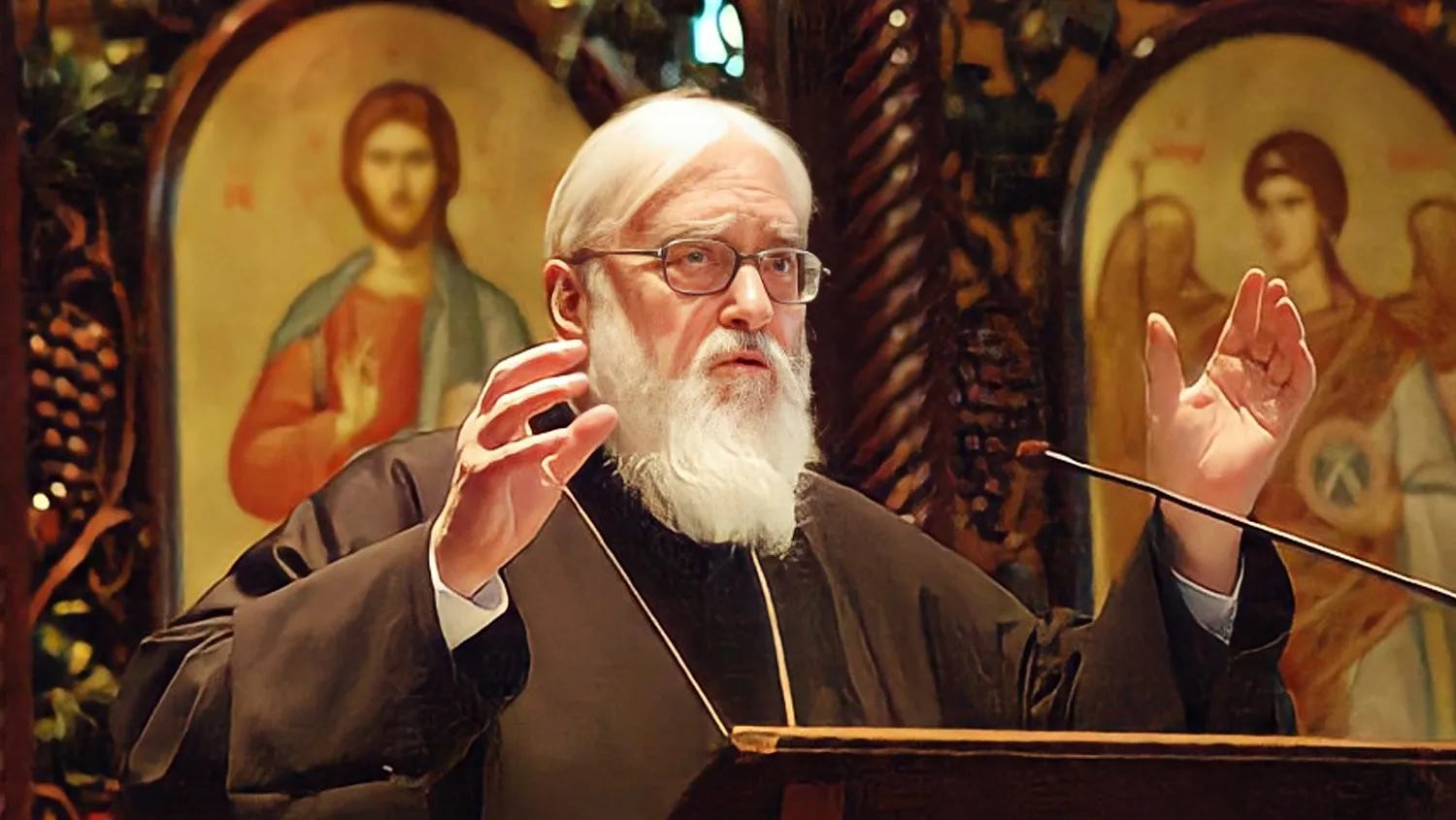
Remember His Eminence Metropolitan Kallistos Ware of blessed memory and his famous story?
Twice in my life, once in a bus and once in a railway carriage, I have been asked by a stranger: "Are you saved?
How should we reply to this question?
For my own part, I hesitate to respond categorically, “Yes, I am saved.”
Such an answer suggests that my salvation is already here and now an accomplished fact, a fully realized and completed actuality.
But how can I know for certain what my behavior will be during the remaining course of my life?
Despite God’s guiding hand upon me, I still retain the power to say No to Him as well as Yes.
Long after his conversion on the road to Damascus Saint Paul feared that after preaching to others he might himself end up “rejected” or disqualified” by God (I Corinthians 9:27).
Must we not show a similar caution?
The warning issued by the pagan Solon applies equally in a Christian context: “Call no one blessed until he has died.”
It is the one who endures to the end who will be saved (St. Matthew 10:22; 24:13).
Instead, then, of answering ‘I am saved’, I prefer to make use of the continuous present: “I trust that by God’s mercy and grace I am being saved.”1
You can hear his talk on the subject in this video.
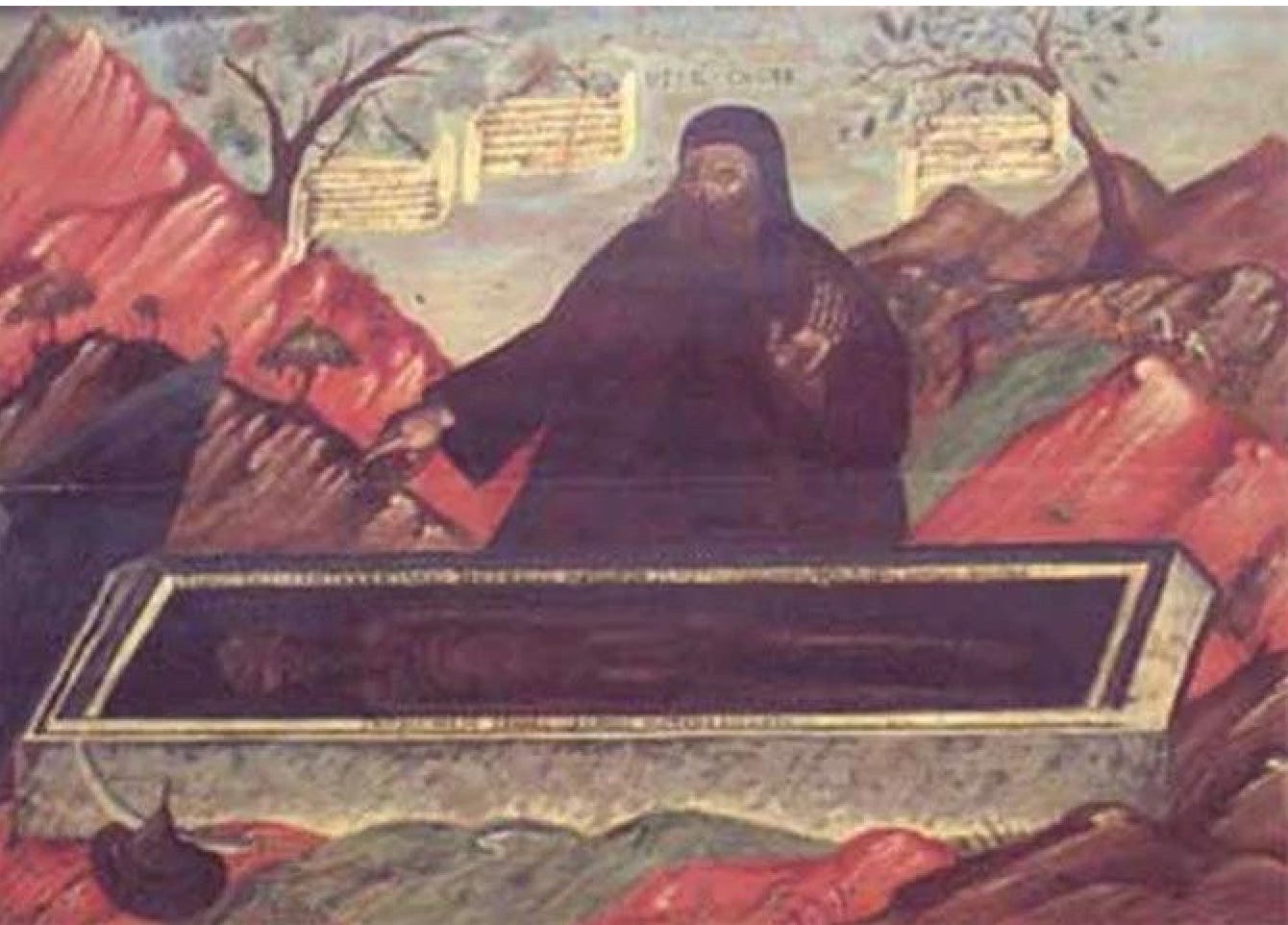
Saint Sisoes the Great (also Sisoi, Shishoy) was an Egyptian desert father and ascetic who died in AD 429. He lived in the Desert of Scetis (modern-day Wadi El Natrun in Egypt), the cradle of early Christian monasticism, before moving to the Mountain of St. Anthony at the Red Sea after the death of St. Anthony the Great. He is considered one of the great Desert Fathers, and he shared his wisdom through a life of radical humility, asceticism, and compassion toward others.
Yet, as he lay dying, he asked for more time before departing to stand before Christ:
When Saint Sisoes lay upon his deathbed, the disciples surrounding the Elder saw that his face shone like the sun. They asked the dying man what he saw. Abba Sisoes replied that he saw Saint Anthony, the prophets, and the apostles. His face increased in brightness, and he spoke with someone. The monks asked, “With whom are you speaking, Father?” He said that angels had come for his soul, and he was entreating them to give him a little more time for repentance. The monks said, “You have no need for repentance, Father.” Saint Sisoes said with great humility, “I do not think that I have even begun to repent.”2
While St. Sisoes is recognized and venerated in the Coptic Orthodox Church and also in the Eastern Orthodox world, he is less familiar in the Syriac Orthodox Church. However, a Syriac Orthodox Christian would generally recognize him as a holy ascetic of the undivided early Church and part of the shared Desert Father heritage.
The reason I am sharing these stories is to give you the background of my change of mind. I no longer want to depart immediately to be with the Lord. I, like Metropolitan Kallistos Ware and St. Sisoes, would like to work out my “own salvation with fear and trembling,” as St. Paul reminds us in Philippians 2:12. I believe there is much to reflect upon in my soul (and FIX! with God’s help) to be ready to meet the Lord. Orthodox Christians do not believe in purgatory, but in the Syriac Orthodox funeral prayers, there are repeated prayers for protection from hostile powers after death.
The priest offers these prayer for the departed3:
O Lord, make this soul, that has been set free from this temporal life and has departed from this world, be worthy to be guided by Your holy angels to the heavenly mansions that abound in delight and rest until the day of resurrection, on which she will meet You with confidence, Father, Son, and Holy Spirit forever and ever. Amen. (p. 6)
. . .
Receive his soul with the abundance of Your pleasure, and deliver him from the regions of the wicked spirits by the support and guidance of Your angels. (p. 26)
. . .
In You, O Lord, we take refuge, and unto You we make supplication on behalf of this soul that has departed by the decree of Your Lordship. Deliver him, O merciful God, from the snares of the evil spirits and from the invisible powers of darkness. Guide him to the abodes of life. Grant him rest among the righteous and make him to dwell among Your saints, Father, Son, and Holy Spirit forever and ever. Amen. (p. 34)
. . .
May Your cross be my guide in the realms of death, and through it may I conquer the evil one and the power of death on the day of resurrection. (p. 54)
. . .
Glory be to the Father, and to the Son, and to the Holy Spirit. Verily, my brethren, death is bitter and the hour of departure is severe and fearful. When the dreadful angels surround the soul, all thoughts and movements come to an end, while the eyes overflow with sorrowful tears. It is not the body that weeps for the soul, it is rather the soul that weeps for the body. Merciful Lord, have compassion upon both of them on the day of resurrection. (p. 58-59)
. . .
Open, O our Saviour, the treasure of Your beatitudes for Your handmaid that she may go and rejoice in the realms of bliss. May Your cross be a bridge unto her, thereon to pass over the dreadful places of destruction that she may rejoice with the just and the righteous. (p. 90)
. . .
Deliver her, O Lord, from the captivity of the evil spirits. (p. 96)
But the news for those who have entrusted their lives to Christ at the end is one of great hope and joy - and for this we give glory to God:
Resurrection day is drawing near, therefore, sorrow not, O departed, for the corruption of your bodies. He, Who created and adorned your substance, will quicken and raise your bodies, and, in justice, He will reward everyone according to his deeds. (p. 18)
O Lord, Who descended into Sheol, and became the guest of those who arc in the graves, we humbly beseech You, when You come on the last day to quicken the human race that, by Your grace, You may raise this Your servant who has passed away trusting in You. (p. 18)
Sorrow not, all you who die in Christ, for the general resurrection and the day of reward is drawing near. You will be raised from your graves in incorruption, you will come out in haste to meet the King’s Son, you will put on the robe of glory, and you will sing praise before Him. O Lord, Who raises the children of Adam, have mercy and compassion upon us. (p. 56)
And so, knowing all I know now in the fullness of faith that comes from the teachings of the early Christian Church, having been carried forward through the millennia, I, too, would like more time to repent. I want to spend the remainder of my life in repentance for my many sins, ask the Lord to shape me more and more into His likeness each day, and help me overcome my many daily offenses against my precious Lord. And then I would love the holy angels to carry me to Him, safe from the accusatory attacks by the evil powers.
Kallistos. 1996. How Are We Saved? : The Understanding of Salvation in the Orthodox Tradition. Minneapolis, Minn.: Light & Life Pub.
No posts
Comments
Nothing yet. Say the first thing.
Sign in to join the conversation.